
The Tool Desk
Outbyte Driver Updater FREEFix the driver behind crashes, sound loss and screen glitchesFind Drivers →Outbyte PC Repair FREEClear out junk files and repair common Windows errorsFree Scan →iTechGuides is reader-supported. When you buy through links on our site, we may earn an affiliate commission. As an Amazon Associate I earn from qualifying purchases. Learn more
Playing with friends? Godlike.Host runs hosted Minecraft Java servers from 10 data-center locations, with free DDoS protection.
In Minecraft, bones primarily come from skeletons and strays. Skeleton horses and wither skeletons are also listed as bone sources, and bones can appear in chests in dungeons, ancient cities, desert pyramids, jungle pyramids, and woodland mansions. Once you have them, craft bone meal to accelerate plant growth or use bones on untamed wolves to attempt taming. Peaceful difficulty changes the plan because hostile skeletons do not spawn; on that setting, structure chests, fishing, and Bedrock fish drops become the practical alternatives.
What bones do in Minecraft
Bones are a compact resource with two important jobs. First, you can convert them into bone meal and use that bone meal to feed crops and other plant life so growth happens faster. Second, bones are the item used to tame untamed wolves. A bone is therefore useful both for developing a base and for building a traveling companion.
What’s actually slowing this PC down?
Pick the symptom - the matching free tool is one click away.
The best acquisition route depends on your edition, difficulty, and whether you need a handful of bones or a steady supply. Manual skeleton hunting is usually the simplest early-game approach. A skeleton spawner trap or a dark-room hostile-mob farm is better when you need volume. On Peaceful, you must replace hostile-mob drops with chest loot, fishing, or the Bedrock fish-drop mechanic.
Where do I get bones in Minecraft?
Kill skeletons and strays
Skeletons and strays are the dependable Survival sources. They are the normal route when hostile mobs are allowed to spawn, and they require no special structure or crafting setup: find them, defeat them, and collect the drops. Strays are a skeleton variant, so the same general approach applies.
#1 Best Overall

- Capture the excitement and adventurous play of Minecraft!
- Each 3.25-inch scale Minecraft action figure comes with an accessory to recreate favorite in-game moments!
- Each also includes 1 Redstone Building Piece -- fans can collect the figures and combine all 6 building pieces to build a working TNT Cannon (each sold separately, subject to availability).
- For even more ways to play and display, the pixelated character figures are posable with movable joints!
- The collectible figures make a great gift for video-game players and fans ages 6 years old and up, who will want them all! (Each sold separately, subject to availability.)
Bring a shield, keep room to move, and collect drops after the area is safe. If you are searching specifically for bones rather than experience or other loot, a short, controlled hunt near a secure base is safer than wandering far from shelter. Lighting the area around your base after the hunt reduces additional hostile spawns while you sort your drops.
Other listed bone-dropping mobs
The Bone item reference also lists skeleton horses and wither skeletons among bone sources. These are alternatives rather than the usual first choice: your access to them depends on where you are playing and which encounters you have reached. Treat them as supplementary sources when you are already dealing with those mobs, not as a reason to delay a basic skeleton hunt.
Search generated-structure chests
Bones can appear in chests in several generated structures:
- Monster rooms, commonly called dungeons
- Ancient cities
- Desert pyramids
- Jungle pyramids
- Woodland mansions
The quantity and chance vary by structure and edition. A chest route is valuable when you are exploring anyway, but it is not as predictable as repeatedly defeating skeletons. Check every chest, take the bones, and leave the rest of the structure secured before returning to exploration.
Build a farm for a repeatable supply
For high-volume production, use either a skeleton-spawner trap or a dark-room hostile-mob farm. Both approaches move mobs through water to a controlled kill point. Hoppers below the collection area can gather bones and other drops automatically. A spawner setup is tied to a discovered skeleton spawner; a dark-room design depends on a suitable dark spawning area and a safe collection chamber.
Which bone source should you choose?
| Route | Edition and difficulty | Speed and volume | Risk | Required setup |
|---|---|---|---|---|
| Manual skeleton or stray hunting | Java or Bedrock when hostile mobs can spawn | Immediate, but limited by how many mobs you find | Ranged attacks and other hostile mobs | Weapons, armor, and a safe area |
| Skeleton horse or wither skeleton drops | Java or Bedrock; encounter-dependent | Occasional supplementary source | Depends on the encounter and location | Access to the relevant encounter |
| Structure chests | Java or Bedrock; loot differs by edition and structure | One-time exploration supply per chest | Structure hazards and hostile mobs | Finding and safely exploring a structure |
| Skeleton spawner trap | Java or Bedrock when the spawner can operate | Repeatable production; scales with collection time | Construction mistakes or exposed mobs during building | Located spawner, water transport, kill point, and optional hoppers |
| Dark-room hostile-mob farm | Java or Bedrock; design details differ | Repeatable production when the farm is operating | Build and spawn-control hazards | Dark spawning chamber, transport path, kill point, and optional hoppers |
| Fishing on Peaceful | Java and Bedrock rules differ | Slow and chance-based | Low combat risk; time is the main cost | Fishing rod and a valid fishing location |
| Fish drops on Peaceful | Bedrock Edition only in the cited mechanic | Chance-based; each fish can provide 1–2 bones | Low combat risk | Fishing and Bedrock Edition |
Use the first row for an urgent early-game need, a spawner or dark-room farm for ongoing bone meal production, and the Peaceful methods only when hostile spawning is unavailable.
Quick wins for a faster PC:
Scan for outdated or missing drivers - takes under a minuteDriver Scan →Clear out junk files and repair common Windows errorsFree Scan →How to get bones by hunting skeletons
- Prepare a safe return route. Place torches or other markers between your base and the hunting area so you can retreat without getting lost.
- Carry protection. A shield helps you survive incoming arrows, while a melee or ranged weapon lets you finish a skeleton without standing in the open.
- Choose a controlled location. A small cave section, a lit perimeter, or an open area near shelter is easier to manage than an unmarked night-time expedition.
- Separate targets. Pull one skeleton away from groups when possible. Deal with strays and other hostile mobs before collecting drops.
- Collect and secure the bones. Return them to a chest or crafting area rather than carrying a growing supply through unnecessary fights.
- Convert only what you need. Keep some bones in storage for future wolf-taming attempts and turn the remainder into bone meal when you are ready to use it.
This method has no infrastructure cost, so it is often the right answer for a first wolf or a small batch of bone meal. Its limitation is throughput: you must continue finding and defeating mobs.
Rank #2

- Each authentically designed, 3.25-inch scale Minecraft character comes with 2 papercraft blocks and an accessory.
- Figures have moveable joints, so Minecraft fans can pose them for action and storytelling play!
- Design and personality details stay true to the unique, pixelated world of Minecraft.
- Adventurous fun for kids who love exploration, creativity and survival the Minecraft way.
- A great gift for video-gamers who love adventure, ages 6 years old and up!
Can I make a bone farm?
Yes. The two practical patterns in the cited guidance are a skeleton spawner trap and a dark-room farm. Both route mobs through water to a kill point, with hoppers underneath the collection area if you want automatic pickup.
Skeleton spawner trap
- Locate a skeleton spawner. Do not dismantle it; mark its position and secure the surrounding room.
- Make the room safe while building. Light the spawner area temporarily so new skeletons do not interrupt construction.
- Shape the collection area. Leave a path for water to push spawned skeletons toward one side of the room and into a controlled channel.
- Build the kill point. End the water stream where you can defeat the skeletons safely and reach their drops.
- Add storage. Place hoppers below the collection point and connect them to chests if you want bones and other drops gathered without manual pickup.
- Test before sealing the room. Remove temporary lighting, observe the flow, and confirm that skeletons arrive at the kill point rather than stopping on ledges.
A spawner farm is attractive because its location is fixed and its output is repeatable. It does require finding the spawner and spending materials on the room, transport, and storage.
Dark-room hostile-mob farm
- Choose a suitable location. Build the dark spawning chamber where you can control nearby spawnable spaces and reach the collection area safely.
- Create the spawning floor. Keep it dark and arrange the floor so mobs are directed toward the transport route.
- Use water to move drops toward a kill point. The cited farming guidance specifically describes routing mobs through water before they reach the collection area.
- Protect the player position. Use a safe viewing and attack point so you can kill mobs without exposing yourself to the entire chamber.
- Install hoppers and chests if desired. Put hoppers under the kill or collection area to gather bones and other drops automatically.
- Check the output and nearby caves. If production is poor, spawnable spaces elsewhere may be competing with the farm. Light or otherwise secure nearby areas before redesigning the collection system.
A dark-room farm can produce more than bones because it handles several hostile-mob drops. That flexibility is useful, but its output depends on the design, edition, and how effectively nearby spawning is controlled.
How do I get bones on Peaceful?
Peaceful difficulty prevents hostile skeletons from spawning, so the normal hunting and skeleton-farm routes are unavailable. Use generated-structure chests, fishing, and—on Bedrock Edition—the cited fish-drop mechanic instead.
Search Peaceful chest locations
The Peaceful-resource guidance lists desert pyramids, jungle temples, dungeons, ancient cities, and woodland mansions as chest routes. These structures can still be difficult to locate, and some have environmental or non-hostile hazards, but they do not require skeleton spawning. Keep a map or coordinate notes so you can revisit structures after finding additional supplies.
Fish for a chance at bones
The cited Peaceful-resource tutorial reports a 1.1% chance of catching a bone while fishing without Luck of the Sea. This is a chance-based figure from that tutorial, not a guarantee per cast, so fishing is a patience route rather than a fast way to fill several chests.
Understand the Bedrock fish-drop rule
The same tutorial reports that, in Bedrock Edition, fish have a 25% chance to drop 1–2 bones. That rule is edition-specific and should not be carried over to Java Edition. If you are playing Bedrock on Peaceful, fishing can therefore supply bones through both the fishing result and the fish-drop behavior described by the tutorial.
Rank #3

- Small LEGO figure - 1.6" Tall
- From LEGO Set Minecraft Sets.
- SMALL PARTS - Figure Measures 2 Inches tall. - Not Suitable for Kids under 5 years of Age.
- LOOSE - Comes in Loose Pieces ready to build. No retail Packaging
- Authentic LEGO Parts
| Peaceful option | Edition context | Documented figure or result | Best use |
|---|---|---|---|
| Structure chests | Java and Bedrock; loot tables differ | Bone quantities and chances vary by structure and edition | Exploration when you need a finite supply |
| Fishing without Luck of the Sea | Peaceful-resource tutorial figure | 1.1% chance for a bone | Slow, repeatable attempts when combat is unavailable |
| Fish dropping bones | Bedrock Edition | 25% chance for 1–2 bones per fish, as reported by the tutorial | Additional fishing-based supply on Bedrock |
Because these figures are tied to edition and the stated Peaceful context, check which edition you are using before planning a large build around them.
What are bones used for?
Craft bone meal to accelerate plant growth
Convert bones into bone meal in your crafting interface, then apply the bone meal to eligible crops and plants. Minecraft’s official guidance describes bone meal as a way to feed crops so they grow faster. This is useful when you need food, flowers, decorative plants, or other renewable vegetation sooner than normal growth would allow.
Bone meal is best treated as a speed resource rather than a substitute for planting. Keep your farmland planted, apply bone meal where immediate growth matters, and store extra bones so a successful skeleton hunt can support several future harvests. If an application appears to do nothing, the plant may not be eligible at that stage or the surrounding conditions may not permit the growth you want; try another valid crop or plant instead of wasting the remainder of the stack.
Recommended Free Tools
Tame an untamed wolf
Hold a bone and use it on an untamed, non-hostile wolf. The official Minecraft Wolf article explains: “But if you feed one bones, you’ll be able to tame it and bring it home.” Each use is an attempt, so a wolf may require more than one bone.
The advancement guidance says a wolf takes about two bones on average. That is an average rather than a fixed recipe: some wolves can tame with fewer, while another may need more. Carry several bones when searching for multiple wolves, especially if you are trying to tame more than one variant during the same trip.
Understand what a tamed wolf does
After taming, a wolf can follow you and attack creatures you attack. You can also command it to sit, which keeps it in place when you do not want it to follow. Feed meat to heal a tamed wolf. Bones are for the taming attempt; they are not the healing item.
How many bones does it take to tame a wolf?
There is no guaranteed fixed number. The cited advancement guidance gives about two bones per wolf on average, so two is a planning estimate, not a promise. Bring extra bones if you are traveling to find several wolves, because each animal makes its own taming attempts and an unsuccessful use consumes time and a bone without changing the wolf into a companion.
Rank #4
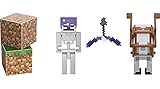
- Both authentically designed, 3.25" scale Minecraft characters come with 4 papercraft blocks and an accessory each.
- Exclusive deluxe figures have moveable joints, so Minecraft fans can pose them for action and storytelling play!
- Design and personality details stay true to the unique, pixelated world of Minecraft.
- Adventurous fun for kids who love to build a better world as they create, explore and survive the Minecraft way.
- A great gift for Minecraft fans age 6 years old and up who love adventure!
Once the wolf is tamed, stop using bones. Switch to meat when it needs healing, and use the sit command whenever you need it to remain at home, near a transport point, or outside a dangerous expedition.
Independent reader supportYour contribution helps us test, update, and keep practical guides available for everyone.Edition and difficulty differences that change your plan
| Question | Java Edition | Bedrock Edition |
|---|---|---|
| Do skeletons provide the normal route? | Yes, when the difficulty allows hostile spawning. | Yes, when the difficulty allows hostile spawning. |
| Can Peaceful use skeleton hunting? | No; hostile skeletons do not spawn on Peaceful. | No; hostile skeletons do not spawn on Peaceful. |
| Are structure-chest quantities identical? | Not established as identical; loot varies by structure and edition. | Not established as identical; loot varies by structure and edition. |
| Is the cited fish-drop mechanic available? | Do not assume the Bedrock rule applies. | The cited tutorial reports a 25% chance for fish to drop 1–2 bones. |
| What should a Peaceful player prioritize? | Structure chests and the cited 1.1% fishing chance. | Structure chests, the cited 1.1% fishing chance, and the reported fish-drop behavior. |
Use the table as a planning guide, not as a promise that every loot table or farm design behaves identically across versions. When a particular quantity matters, identify the edition and the current game version before building a large automated system.
Troubleshooting common bone problems
No skeletons are appearing
- Confirm that the difficulty is not Peaceful. Hostile skeletons cannot spawn there.
- Move away from heavily lit areas if you are relying on natural hostile spawning.
- For a spawner, remove temporary lights only after the room and collection path are complete.
- For a dark-room farm, check whether nearby caves or dark spaces are taking the available hostile spawns.
The farm produces mobs but few bones reach storage
- Watch the water path and look for ledges where skeletons stop.
- Make sure the kill point is reachable and that the collection area is directly below the drops.
- Check hopper orientation and the chest connection if you installed automatic collection.
- Confirm that mobs are actually being killed rather than accumulating outside the collection zone.
The wolf will not tame
- Verify that you are using a bone on an untamed, non-hostile wolf.
- Try again with another bone; about two is only an average.
- Keep additional bones with you if you are attempting several wolves.
Bone meal appears ineffective
- Apply it to a crop or plant that can respond to growth acceleration.
- Check that the plant is at a stage where growth can occur and that its surrounding conditions are suitable.
- Use smaller batches while testing so you can see which plants respond before spending the rest of your supply.
A practical bone plan for different goals
You need one wolf early in a world
Hunt skeletons near a safe base, collect several bones rather than stopping at the first drop, and carry them to the nearest untamed wolf. Plan for about two bones on average, with extras because the number is not fixed.
You need bone meal for a farm or garden
Start with manual skeleton hunting while establishing your base. Once repeated harvests consume more bone meal than hunting supplies, convert a skeleton spawner or build a dark-room farm with water transport and hopper collection.
You play Peaceful
Mark every structure you find and search the listed chest locations. Add fishing to your routine, using the 1.1% bone chance reported for fishing without Luck of the Sea. If you are on Bedrock, account for the reported 25% chance that fish drop 1–2 bones.
You want a long-term automated supply
Choose a skeleton spawner if you have located one and want a fixed production site. Choose a dark-room farm if you want a general hostile-mob system and are prepared to control nearby spawning spaces. In either case, route mobs through water, provide a safe kill point, and place hoppers below the collection area when automatic storage is worthwhile.
Quick Recap
Quick checklist
- Use skeletons and strays as the standard Survival source.
- Remember that skeleton horses and wither skeletons are also listed bone sources.
- Check dungeons, ancient cities, desert pyramids, jungle pyramids, and woodland mansions for chest loot.
- Build a skeleton-spawner trap or dark-room farm when manual hunting no longer supplies enough bones.
- Craft bone meal to accelerate eligible plant growth.
- Use bones on an untamed, non-hostile wolf; about two bones is the cited average.
- Heal tamed wolves with meat, not bones, and use the sit command when you need them to stay.
- On Peaceful, rely on structure chests and fishing; the cited 25% fish-drop rule is Bedrock-specific.
Product prices and availability are accurate as of the date/time indicated and are subject to change. Any price and availability information displayed on Amazon at the time of purchase will apply.

