
The Tool Desk
Outbyte Driver Updater FREEScan for outdated or missing drivers - takes under a minuteDriver Scan →Outbyte PC Repair FREEClear out junk files and repair common Windows errorsFree Scan →iTechGuides is reader-supported. When you buy through links on our site, we may earn an affiliate commission. As an Amazon Associate I earn from qualifying purchases. Learn more
Microplastics are not chemically inert in water. A Nature study published on 14 October 2026 reports that common plastic particles spontaneously generate reactive oxygen species (ROS) at their water-facing surfaces. The effect grows as particles become more hydrophobic and is tied to both reorganized interfacial water and a negative electrical double layer. The experiments were performed under controlled laboratory conditions, so they do not yet establish how strongly the same chemistry operates on weathered particles in rivers, oceans or drinking-water systems.
What the 2026 Nature study found
Qian, Zhao, Chan and colleagues tested commodity microplastics made from six widely used polymers: polypropylene (PP), polyethylene (PE), polyvinyl chloride (PVC), polystyrene (PS), polyethylene terephthalate (PET) and polymethyl methacrylate (PMMA). All six produced a spontaneous radical signal in water. Activity varied with the chemistry of each polymer–water interface rather than with bulk plastic alone.
That distinction matters because fragmentation increases surface area relative to particle volume. A small fragment therefore exposes much more interface where water molecules, ions, dissolved contaminants and biomolecules can interact. The paper describes the resulting ROS chemistry as an emergent interfacial property: a behavior that is easy to miss when plastics are treated as inert solids in bulk.
Free tools Windows power users keep installed
One-click scans. No signup required.
The study’s central claim is that commodity microplastics exhibit “intrinsic physicochemical activity in water,” with ROS generation increasing with interfacial hydrophobicity and strongly correlating with interfacial electrostatics.
#1 Best Overall

- The BPA-free Everyday water pitcher with filter holds 10 cups of water, enough to fill 3 24-ounce reusable water bottles; Product reservoir and lid may vary
- Get great-tasting water without the waste; by switching to Brita, you can save money and replace 1,800 single-use plastic water bottles* a year; *16.9 oz water;**Based on IRI data;***vs. tap
- This space efficient Brita pitcher fits perfectly on refrigerator shelves, features an easy-fill locking lid and is easy to pour; Height 10.47"; Width 5.59"; Length/Depth 10.94"; Weight 2.29 pounds
- Brita is the #1 water filter** reducing chlorine (taste & odor), Mercury, Copper, Zinc and Cadmium; always get cleaner***
- Compatible with Longlast and Standard water filters; for the freshest tasting water, replace your Longlast filter after 120 gallons or approximately every 6 months or Standard filter after 40 gallons or approximately every 2 months
How a plastic–water interface generates ROS
1. Interfacial water is structurally different
Hydrophobic polymer surfaces disrupt the normal tetrahedral organization of nearby water. More undercoordinated or “dangling” OH groups remain in the first water layers, and those waters are only partly solvated. Molecular calculations indicate that this arrangement makes oxidation of hydroxide more favorable, providing a route to hydroxyl and other reactive oxygen species without an added photocatalyst or deliberate oxidant.
2. The interface develops a negative electric field
Pristine PS particles had strongly negative zeta potentials in both pure water and 1 mM sodium chloride. A positively charged fluorescent dye, Rhodamine 800, accumulated at the particle surface, consistent with an electrical double layer. Ab initio calculations linked the two observations: partial solvation and the negative interfacial field reduce the energetic cost of hydroxide oxidation and radical formation.
Rank #2
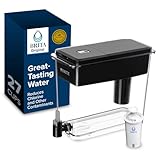
- WATER DISPENSER: One BPA-free, large 27-cup Brita UltraMax Filtered Water Dispenser includes one Standard filter to help remove impurities from your tap water
- CUTS OUT IMPURITIES: Brita water purifier dispenser cuts the taste and odor of chlorine and also reduces copper, mercury and other impurities
- SUSTAINABLE: By switching to a Brita water filter system, you can save money and replace up to 1,800 single-use plastic water bottles a year
- FRIDGE-FRIENDLY: Space-efficient Brita water dispenser is fridge-friendly, and it features an easy-locking lid and precision-pour spigot
- REPLACEMENT INDICATOR: Sticker filter indicator lets you know when it is time to change your Brita filter
The authors estimate a modeled surface charge density of approximately one negative OH− charge per 3 nm2. This is a model-derived scale, not a universal charge value for every environmental microplastic.
3. Surfactant tests connect charge to chemistry
Adding 0.1% Triton X-100 drove the PS zeta potential close to neutral (less than −5 mV), suppressed Rhodamine 800 partitioning and markedly reduced ROS generation. Across four surfactant conditions, physical activity and chemical activity showed a Pearson correlation of r = −0.99. In this experiment, weakening the interfacial charge and reorganizing the surface also weakened radical production; it does not mean every surfactant will have the same effect in natural water.
Rank #3

- [Replacement Filters] Need filters for PT-05? Search for PF-01A or ASIN B086ZPR3WM on Amazon. Choose genuine Waterdrop filters for a precise fit and reliable performance. Please confirm your model before ordering
- [NSF/ANSI 372 & 42 Certified] This countertop water pitcher filter is certified by NSF International against NSF/ANSI 372 and 42, using high-quality activated carbon fiber to help reduce chlorine, taste, and odor. Tested by a third-party lab, it also helps reduce substances such as PFOA, PFOS, iron, calcium, copper, mercury, magnesium, and more for great-tasting water. Note: This system DOES NOT lower TDS value. If you prefer a low TDS value, please choose the Waterdrop TDS Reduction Glass Pitcher by searching PT-13W on Amazon
- [3-Month Extended Lifespan] This filtered water pitcher features a long filter life of up to 3 months or 200 gallons, depending on local water conditions and usage. The extended lifespan helps reduce frequent replacements and plastic bottle waste, allowing you to enjoy great-tasting water for longer with minimal investment
- [Budget-Friendly Performance] This countertop water filter pitcher offers reliable filtration performance at a lower cost, making it an affordable choice for everyday drinking water. Crafted from food-grade BPA-free plastic with an ergonomic handle, it is easy to hold and designed for daily use
- [Mechanical Life Recorder & Colors] This water pitcher with filter includes a mechanical life recorder to help track filter usage and remind you when it is time to replace the filter. Available in a range of vibrant colors and beautifully boxed, it brings both style and convenience to daily water filtration
Which plastic is most reactive?
The experiments found radicals from all six tested polymers, but hydrophobic polyolefins (PP and PE) were more reactive than the less hydrophobic materials. Simulations connected the fraction of dangling OH groups with APF fluorescence, a ROS-related signal, across the six polymer–water systems (Pearson r = 0.94).
| Polymer | Interfacial result reported in the study | Dangling-OH ratio | What can be concluded |
|---|---|---|---|
| PP | Spontaneous radical generation; comparatively hydrophobic | Not stated | More hydrophobic and more reactive than the less hydrophobic polymers tested |
| PE | Spontaneous radical generation; comparatively hydrophobic | Not stated | More hydrophobic and more reactive than the less hydrophobic polymers tested |
| PS | Spontaneous ROS; strongly negative zeta potential in pure water and 1 mM NaCl | 21.0% | Shows the largest stated dangling-OH fraction and a clear electrostatic response |
| PVC | Spontaneous radical generation | 15.8% | Intermediate dangling-OH fraction among the values reported |
| PET | Spontaneous radical generation | 10.7% | Lower stated dangling-OH fraction than PS or PVC |
| PMMA | Spontaneous radical generation; more hydrophilic than PP in the comparison | 9.7% | Lower stated dangling-OH fraction and weaker biomolecule enrichment than PP |
The ratios above are the study’s reported modeled or simulated values for those polymer–water systems. They should not be read as a ranking of every commercial product: additives, particle size, oxidation, weathering and surface coatings can change the interface.
Rank #4

- [Replacement filters] Need filters for PT-07? Search for PF-01A or ASIN B086ZPR3WM on Amazon. Choose genuine Waterdrop filters for a precise fit and reliable performance. Please confirm your model before ordering
- [NSF certified filtration performance] The Waterdrop Lucid filtered water pitcher with lid has passed NSF/ANSI 42 and 372 certifications. Tested by a third-party lab, it helps reduce PFOA/PFOS, odor, iron, mercury, copper, and other metal ions. Note: This system DOES NOT lower TDS value. If you prefer a low TDS value, please choose the Waterdrop TDS Reduction Pitcher by searching PT-13W on Amazon
- [Quality daily water choice] The Waterdrop Lucid water filter pitcher with lid is designed for efficient daily filtration, making it a practical choice for apartments, kitchens, living rooms, dorms, and offices. It helps provide better-tasting drinking water for everyday use
- [Exceptional quality] This pitcher features a hands-free lid for automatic water dispensing without opening the lid, helping prevent dust accumulation for convenient and hygienic use. Its compact body is designed to fit most refrigerators. Product dimensions: 10" x 5" x 10.1"; please verify your fridge dimensions before ordering
- [5x longer lifespan & indicator] The filtered water pitcher has a filter lifespan of up to 200 gallons or 3 months, helping support longer daily use with efficient water flow. The LED indicator lets you check the filter usage status and reminds you when it is time to replace the filter
What surface charge means for proteins and DNA
Charged biomolecules—including wheat-germ agglutinin (WGA), R-phycoerythrin (R-PE) and DNA oligomers—partitioned to the microplastic surfaces. Positively charged WGA enriched more strongly than negatively charged R-PE, matching the expectation that a negative interface attracts cationic species. More hydrophobic PP also enriched biomolecules more strongly than PMMA, while Triton X-100 reduced enrichment.
The researchers additionally observed protein aggregation at PS surfaces and discuss possible cellular damage. Those observations establish plausible mechanisms for biological interaction, not population-level evidence that environmental microplastics cause a particular disease or toxicity outcome in humans. ROS can damage biomolecules, but dose, exposure duration, particle weathering, antioxidant defenses and biological barriers determine whether that chemistry produces harm in an organism.
Best Value
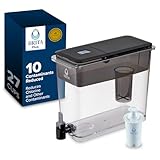
- REDUCES 2X CONTAMINANTS VS. STANDARD*: BritaPlus high-density filter traps twice as many contaminants as our Standard filter — including chlorine, mercury, cadmium, copper and zinc — for superior filtered water from your 27-cup UltraMax dispenser
- HELPS RETAIN MINERALS & ELECTROLYTES: BritaPlus filter helps retain beneficial minerals and electrolytes naturally present in your water for great-tasting, balanced filtered water for the whole family — all day, every day
- LARGE 27-CUP BPA-FREE DISPENSER: Made without BPA, the UltraMax holds 27 cups of filtered water and features a convenient spigot for easy dispensing; fits on most countertops or in the fridge for flexible placement
- REPLACE UP TO 300 PLASTIC BOTTLES: One BritaPlus filter replaces up to 300 single-use 16.9 oz plastic bottles — reduce plastic waste and save money by switching to Brita
- WQA NSF/ANSI CERTIFIED — LASTS 2 MONTHS: BritaPlus filter is certified by WQA to NSF/ANSI standards; replace every 40 gallons or approximately 2 months. *vs. Standard filter. Minerals retained may not be in all users' water. Substances reduced may not be in all users' water
Intrinsic ROS chemistry is not the same as contaminant adsorption
Microplastics can also act as sorbents. Reviews of surface interactions report that antibiotics, metals and other contaminants adsorb through mechanisms controlled by polymer functional groups, contaminant ionization and solution chemistry. That adsorption process is related to the same high-area interface but is chemically distinct from ROS generation by water at the surface.
Both processes are sensitive to environmental conditions. pH, salinity, temperature, dissolved organic matter, particle size and surface aging can alter zeta potential, aggregation, transport and the availability of adsorption sites. A contaminant bound to a particle should therefore not automatically be described as being produced by the particle, and a ROS signal should not automatically be interpreted as proof that the particle has concentrated a pollutant.
What remains uncertain outside the laboratory
The evidence currently consists mainly of controlled experiments using fluorescence and electrophoresis measurements, together with molecular and ab initio calculations. The supplied sources do not establish independent replication using field-aged particles in natural waters. Real particles acquire biofilms, oxidized groups and mineral coatings; seawater contains much more salt and dissolved organic matter than the simple solutions used for mechanistic tests.
- The reported zeta potential is specific to the tested PS particles and water conditions, not a universal value for all PS or all microplastics.
- The 0.1% Triton X-100 experiment demonstrates a mechanism under a defined surfactant treatment; it is not a recommendation to add surfactant to environmental waters.
- “More reactive” refers to the measured interfacial ROS signal in the study, not a complete environmental-toxicity ranking.
- Field measurements are needed to determine ROS lifetimes, concentrations and biological relevance in rivers, estuaries, oceans and treatment plants.
Why the result changes the way microplastics are evaluated
Risk assessments have often treated polymer particles as passive carriers whose importance comes mainly from size, persistence and the contaminants they adsorb. The new work adds a third consideration: the particle can alter the chemistry of the water immediately around it. Fragmentation, hydrophobicity and charge can therefore influence both what a particle attracts and what reactive species it generates.
For researchers, useful measurements now include contact angle or another hydrophobicity metric, zeta potential in the relevant water matrix, ROS signal, dangling-OH fraction and biomolecule enrichment. Reporting pH, salinity, temperature, dissolved organic matter, particle history and surfactant or coating treatments is essential because each can shift the interface. For readers, the practical conclusion is narrower but important: “plastic” is not a single chemical category, and an apparently inert bulk material can be chemically active at its boundary with water.
Quick Recap
Product prices and availability are accurate as of the date/time indicated and are subject to change. Any price and availability information displayed on Amazon at the time of purchase will apply.

