
iTechGuides is reader-supported. When you buy through links on our site, we may earn an affiliate commission. As an Amazon Associate I earn from qualifying purchases. Learn more
Short answer: Choose the Lenovo Yoga Pro 9i Gen 11 when your work depends on Windows, NVIDIA CUDA or RTX acceleration, a touch/pen interface, or a larger 16-inch canvas. Choose the 14-inch MacBook Pro with M5 when your applications run well on macOS and you value a compact body, quiet mobile editing and long unplugged sessions. Neither is universally better: the Yoga is a 16-inch Windows workstation-style laptop with a discrete GPU option, while the MacBook is a 14.2-inch macOS machine built around Apple silicon.
This is also a size-class comparison. Lenovo’s current Gen 11 Aura Edition documentation identifies a 16-inch Yoga Pro 9i; Apple’s model has a 14.2-inch display. Screen area, weight and portability therefore matter as much as processor benchmarks.
At a glance: the important differences
| Category | Lenovo Yoga Pro 9i Gen 11 | 14-inch MacBook Pro M5 |
|---|---|---|
| Operating system | Windows; exact edition depends on the retail configuration | macOS; exact version depends on Apple’s current release and your update policy |
| Processor platform | Intel Core Ultra processors; Lenovo’s Australian example uses Core Ultra 9 386H | Apple M5 with a 10-core CPU in Apple’s listed configuration |
| Graphics | NVIDIA laptop GPU options including RTX 5060, RTX 5070 and RTX 5050; the Australian example has RTX 5060 with 8GB GDDR7 | Integrated Apple GPU architecture; no NVIDIA discrete GPU option |
| Display | 16-inch OLED choices, including a 2.8K 120Hz touch panel and an optional 3.2K tandem OLED | 14.2-inch, 3024×1964 Liquid Retina XDR, 254 pixels per inch, up to 120Hz ProMotion |
| Memory and storage | Documented examples include 32GB memory and a 1TB PCIe Gen 4 SSD; family maximums are up to 64GB memory and 2TB storage | Apple’s cited test configuration has 24GB unified memory and a 1TB SSD; retail combinations vary |
| Battery evidence | 92.5Wh battery in Lenovo’s Australian example; no directly comparable runtime was established | Tom’s Guide measured 18 hours in its battery laboratory test of a 14-inch M5 configuration |
| Best fit | Windows-only applications, CUDA/RTX workflows, 3D, AI experimentation, touch input and a large timeline | macOS-compatible creative suites, travel, quiet editing and long sessions away from a charger |
The table combines named manufacturer specifications with independent tests. It does not imply that every Yoga or MacBook sold has the listed configuration.
PC Slower Than It Used to Be?
A free scan shows the junk files, broken settings and background clutter dragging Windows down - then fixes them in one click.Free scan · Windows 10 & 11Crashes, No Sound, or Screen Glitches?
Random freezes, missing sound and display glitches usually trace back to one bad driver. Find and replace yours safely.Free scan · under a minuteWhat the Yoga Pro 9i Gen 11 is designed to do
Lenovo positions the Gen 11 Aura Edition as a creative-focused 16-inch laptop. Its defining hardware choice is the combination of Intel Core Ultra processors and an NVIDIA GeForce RTX laptop GPU. Lenovo’s United States specification page lists optional Core Ultra 9 processors and RTX 5070, RTX 5060 or RTX 5050 graphics. Lenovo’s Australian product page describes one configuration with a Core Ultra 9 386H, RTX 5060 with 8GB of GDDR7, 32GB of LPDDR5X-7467 memory, a 1TB PCIe Gen 4 SSD, a 92.5Wh battery, a 5MP camera and a 16-inch 2.8K 120Hz OLED touchscreen.
#1 Best Overall

- Processor - Intel Ultra 9 285H Processor (E-cores up to 4.50 GHz P-cores up to 5.40 GHz)
- Operating System - Windows 11 Pro 64
- Graphic Card - NVIDIA GeForce RTX 5060 Laptop GPU 8GB GDDR7
- Memory - 32 GB LPDDR5X-8400MT/s (Soldered)
- Storage - 1 TB SSD M.2 2242 PCIe Gen4 TLC
Those are not interchangeable specifications. An RTX 5070 model should not be assumed to perform like an RTX 5050 model, and a 3.2K tandem-OLED option changes the display characteristics and likely the price. Confirm the complete SKU before ordering. Lenovo lists up to 64GB of soldered LPDDR5X memory and up to 2TB of storage for the family, so memory and storage cannot necessarily be upgraded later.
TechRadar’s review dated October 16, 2026 describes the machine as a creative-oriented 16-inch laptop with an RTX 5060 and touch OLED. That review helps establish the product’s positioning, but it does not provide a battery result directly comparable with the MacBook laboratory figure discussed below.
What the 14-inch MacBook Pro M5 is designed to do
The MacBook Pro 14 uses Apple’s M5 system-on-a-chip architecture. Apple’s technical specification lists a 10-core CPU, an integrated GPU and a 16-core Neural Engine in the M5 model. Apple’s newsroom announcement claims up to 1.6 times faster graphics performance than M4 in professional applications. That is Apple’s own comparison claim, not an independent benchmark, and the result depends on the application and configuration.
The built-in display is a 14.2-inch Liquid Retina XDR panel with 3024×1964 resolution, 254 pixels per inch and ProMotion refresh rates up to 120Hz. Apple’s cited test configuration uses 24GB of unified memory and a 1TB SSD, while retail models can be ordered with different memory and storage combinations. Unified memory is shared by the CPU and GPU, so choosing enough at purchase is important for large photo catalogs, high-resolution timelines and virtual machines.
GPU acceleration: RTX and CUDA versus Apple’s integrated GPU
When the Yoga has the technical advantage
An RTX 5060 or RTX 5070 gives the Yoga a discrete GPU with NVIDIA’s CUDA and RTX software ecosystem. That matters in applications and plug-ins that use CUDA kernels, NVIDIA OptiX ray tracing, GPU-based encoding or AI models optimized for NVIDIA hardware. 3D artists, motion designers and creators testing local generative-AI tools can often choose from more Windows software and model packages when an NVIDIA GPU is present.
VRAM is also separate from system memory. Lenovo’s Australian RTX 5060 example specifies 8GB of GDDR7. This can prevent a large texture, effects or 3D scene from competing directly with Windows applications for ordinary RAM, although 8GB still imposes limits on very large scenes and high-resolution effects. The RTX 5070 option may be faster, but Lenovo’s cited specifications do not establish a universal performance figure for it.
Where the MacBook remains competitive
Apple’s M5 GPU is integrated rather than a replaceable NVIDIA card, but it shares fast unified memory with the rest of the chip and can be highly efficient. Apple’s media frameworks are deeply integrated with macOS, and many editing applications are optimized for Apple silicon. For timeline editing, color work and export tasks that are well optimized for those frameworks, the MacBook can feel fast without the fan noise or power draw associated with a discrete GPU.
The limitation is categorical: the MacBook has no NVIDIA CUDA or RTX hardware. If a plug-in, renderer or AI package requires CUDA, the MacBook cannot substitute for the Yoga merely by having a faster CPU. You would need a different rendering path, a cloud machine or another computer.
Video editing: which one fits your timeline?
Choose the Yoga for Windows and GPU-dependent workflows
- Use the Yoga when your editor, effects package or codec workflow is Windows-only.
- Prefer an RTX 5060 or RTX 5070 configuration when GPU effects, 3D compositing, AI denoising or CUDA-accelerated rendering are central to your work.
- The 16-inch panel gives a longer horizontal timeline and more room for bins, scopes and preview windows without an external monitor.
- A touch OLED screen can be useful for scrubbing, quick adjustments or pen-based annotation, provided the application supports those interactions.
Choose the MacBook for mobile, macOS-native editing
- The 14-inch MacBook is the better travel tool when your editor and plug-ins are macOS-compatible and you routinely work away from power.
- Apple’s media engines and application optimization can make playback and export efficient, although no supplied test establishes a head-to-head Gen 11-versus-M5 render time.
- The smaller display is easier to fit on an airplane tray or a crowded desk, but serious editors may want an external monitor for bins and scopes.
For either computer, storage speed and capacity affect the practical experience. A 1TB internal drive can fill quickly with camera originals, cache files and proxies. Plan an external SSD or shared storage rather than assuming the internal drive is a complete media archive.
Photoshop, Lightroom and photography work
Both platforms can handle mainstream Adobe photo workflows, so the deciding factors are usually plug-in compatibility, display requirements, memory and mobility rather than a simple brand preference. The Yoga’s larger 16-inch canvas and optional touch input help when you want a large workspace or direct adjustment with a pen. Its optional 3.2K tandem OLED is specified for 100% sRGB and P3 coverage, 99% Adobe RGB and Delta E below 1, with up to 1,600 nits HDR and 1,000 nits SDR. Those figures are Lenovo’s configuration ratings; confirm that the exact SKU includes this panel.
Rank #2

- Flagship Processor >>> Intel Core Ultra 9 285H, 16C (6P + 8E + 2LPE) / 16T, Max Turbo up to 5.4GHz, 24MB Intel Smart Cache. Work, game, create and get the best AI PC experiences. It’s all possible on the Intel Core Ultra processors. The ultimate balance of performance, battery life and security let you do more with ease without sacrificing mobility and peace of mind.
- Built for Creators. Designed to Inspire >>> NVIDIA GeForce RTX 5060 8GB GDDR7, Powered by NVIDIA Blackwell, GeForce RTX 50 Series Laptop GPUs bring game-changing AI capabilities to gamers and creators. Multiply performance with NVIDIA DLSS 4, generate images at unprecedented speed, and unleash your creativity with NVIDIA Studio.
- Your Canvas, Brighter and Truer Than Ever >>> Witness your creations on the 16" 3.2K Tandem OLED screen, offering true-to-life color accuracy, HDR visuals with 1000 nits peak brightness, and energy efficiency. The 120Hz refresh rate ensures smooth motion, bringing your ideas to life effortlessly.
- Unleash the Power of X >>> Lenovo X Power optimizes performance for 3D projects, edits, and multitasking. With ultra-fast RAM and biomimetic cooling achieving 130W TDP, it ensures faster, smoother workflows. Whatever you’re working on, it ensures effortless execution.
- Memory & Storage >>> 32GB Soldered LPDDR5X-8400, Upgraded to 2TB SSD M.2 2242 PCIe NVMe. Get up to 15x faster performance than a traditional hard drive. Give you a long-lasting and smooth experience, both system boot up and application start are very fast.
The MacBook’s Liquid Retina XDR screen offers high pixel density, wide color and up to 120Hz ProMotion in a smaller enclosure. It is a strong choice for photographers who prioritize consistent macOS color-management behavior and a compact workstation. Apple’s 14.2-inch size leaves less room for a full image, layers panel and reference window simultaneously, so an external display may be useful for long retouching sessions.
Quick wins for a faster PC:
Fix the driver behind crashes, sound loss and screen glitchesFind Drivers →Clear out junk files and repair common Windows errorsFree Scan →Scan for outdated or missing drivers - takes under a minuteDriver Scan →Large Lightroom catalogs and Photoshop documents consume memory. The Yoga family’s documented ceiling is up to 64GB soldered LPDDR5X, while Apple’s cited M5 test unit has 24GB unified memory. Because neither figure applies to every retail configuration, select the memory tier according to your catalog size and expected ownership period instead of assuming a later upgrade.
3D, motion graphics and local AI
For Blender, Unreal-style scenes, GPU ray tracing and applications that explicitly require CUDA, the Yoga is the practical choice. An RTX 5060 or RTX 5070 supplies a discrete NVIDIA path that the MacBook does not offer. Check the software’s Windows and GPU requirements before buying; an RTX label alone does not guarantee that every renderer supports the specific driver or feature you need.
The MacBook can still suit motion graphics and 3D work that supports Apple’s GPU APIs and runs efficiently on M5. Its integrated design reduces the number of hardware components, but it cannot provide CUDA compatibility. If your workflow alternates between Apple-optimized editing and CUDA-only rendering, the Yoga or a two-machine setup avoids repeated project conversion.
Display: size, color, brightness and touch
| Display characteristic | Yoga Pro 9i Gen 11 | MacBook Pro 14 M5 |
|---|---|---|
| Physical size | 16 inches | 14.2 inches |
| Known resolutions | 2.8K OLED in Lenovo’s Australian example; optional 3.2K tandem OLED in the US specification | 3024×1964 |
| Refresh rate | 120Hz | Up to 120Hz ProMotion |
| Touch | Touchscreen options are documented | Not a touchscreen |
| Color claims | Optional 3.2K panel: 100% sRGB/P3, 99% Adobe RGB and Delta E below 1 | Apple identifies the panel as Liquid Retina XDR; the cited specification does not provide a matching Adobe RGB percentage |
| Brightness claims | Optional 3.2K panel: up to 1,600 nits HDR and 1,000 nits SDR | Not stated in the supplied M5 specification summary |
The Yoga wins on physical workspace and interaction options, especially when the selected SKU has the higher-end tandem OLED. The MacBook prioritizes a dense, high-quality panel in a smaller chassis. Do not assume every Yoga has the 3.2K, 1,600-nit display: Lenovo documents it as optional.
Free tools Windows power users keep installed
One-click scans. No signup required.
Sustained performance and battery life
What the available tests actually show
Tom’s Hardware recorded 4,288 Geekbench 6 single-core points for its M5 review unit, approximately 10% above its M4 result in that publication’s comparison. The test also placed the laptop ahead of the comparison systems in that benchmark set. This is a single-core synthetic result from one configuration, not a prediction of export time in your editor.
Tom’s Guide measured 18 hours for the 14-inch M5 in its battery laboratory test. Brightness, background processes, browser tabs, codec choice and workload can move real runtime far below or above a laboratory number. The Yoga’s Australian configuration lists a 92.5Wh battery, but no directly comparable Gen 11 battery test was established. Battery capacity alone cannot be converted into hours without a controlled workload.
How to choose for unplugged work
Choose the MacBook when long mobile sessions are a primary requirement and your software is macOS-compatible. Choose the Yoga when you need the performance of a discrete GPU and normally edit near an outlet. Running an RTX GPU at full load will generally consume more power than light office work, so the Yoga’s large battery should not be interpreted as an 18-hour guarantee.
Portability, ergonomics and desk setup
The 14.2-inch MacBook has the smaller screen footprint and is easier to carry or use in a confined workspace. The Yoga’s 16-inch body gives a more desktop-like editing area but occupies more desk and bag space. The supplied specifications do not establish comparable weight or thickness, so a size-based conclusion is safer than inventing a portability score.
Touch and pen interaction are available on documented Yoga configurations; the MacBook’s display is not a touchscreen. That difference is meaningful for illustrators, retouchers who like direct navigation and presenters who annotate on-screen. It is irrelevant if you always use a mouse, keyboard and external tablet.
Rank #3
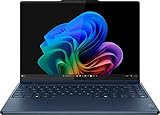
- UNOPENED RETAIL PACKAGING, sold as configured by Lenovo. Includes one year of Courier or Carry-in Lenovo Warranty. Add up to 4 years Lenovo Premium Care Onsite Plus when you register your computer with Lenovo.
- Powered by the high performing Intel Core Ultra 7 258V processor, the Yoga 9i 2-in-1 laptop is ready to take on any challenge, big or small. It unlocks maximum performance and creative efficiency, it has plenty of memory with 32 GB and even more storage with 1 TB.
- The 14″ 4K OLED touchscreen display brings sharp clarity and bold colors, with 100% DCI-P3 for spot-on color accuracy. With the Anti-fingerprint WQUXGA high resolution OLED touchscreen and up to 600 nits of brightness.
- Ports: 1x USB-A (USB 10Gbps / USB 3.2 Gen 2), Always On; 1x USB-C (USB 20Gbps / USB4 Gen 2x2), with USB PD 3.0 and DisplayPort 1.4; 2x USB-C (Thunderbolt 4 / USB4 40Gbps), with USB PD 3.0 and DisplayPort 2.1; and 1x Headphone / microphone combo jack (3.5mm).
- The Yoga Pen, with tilt and pressure detection, low latency, and magnetic attachment to the lid, extends your flexibility, offering precise control and smooth drawing.
Operating-system and application compatibility
Reasons to select Windows
- Your employer or school requires a Windows-only application.
- A plug-in, renderer or AI package requires NVIDIA CUDA or RTX features.
- You need touch or pen input built into the laptop.
- You want to configure the system around a discrete GPU and up to 64GB of soldered memory.
Reasons to select macOS
- Your editing, photography and audio applications are macOS-native or already tested on Apple silicon.
- You value a compact machine with proven long battery testing in the 14-inch class.
- You rely on Apple’s media frameworks and do not need CUDA.
- You prefer a high-density 14.2-inch HDR display and a quiet mobile setup.
Before purchase, verify every essential plug-in, font manager, control surface and hardware driver. A project that opens in the main application can still fail because one effect or utility is unavailable on the chosen operating system.
Memory and storage: buy for the workflow you will have later
Lenovo documents up to 64GB of soldered LPDDR5X-7467 memory and up to 2TB of storage for the Gen 11 family. The Australian example has 32GB and 1TB. Soldered memory means the configuration decision is effectively permanent. For 4K multicam, large Photoshop composites, 3D scenes or local AI, 32GB is a sensible floor; heavier work benefits from the 64GB option if the price and GPU configuration fit your budget.
Apple’s cited M5 configuration has 24GB unified memory and a 1TB SSD, with other retail combinations available. Unified memory is shared by CPU and GPU, so opening a large catalog while exporting video can reduce available headroom sooner than a simple application-by-application estimate suggests. Whichever model you choose, reserve internal storage for active projects and keep originals, completed projects and backups on fast external or network storage.
The Tool Desk
Outbyte PC Repair FREEClear out junk files and repair common Windows errorsFree Scan →Outbyte Driver Updater FREEFix the driver behind crashes, sound loss and screen glitchesFind Drivers →Ports, camera and audio
Apple’s 14-inch design family includes MagSafe 3, three Thunderbolt-class ports depending on model, HDMI, SDXC and a headphone jack; verify the exact M5 tier because port availability can vary. That selection is useful for cameras, external displays and fast storage without relying entirely on a hub.
Lenovo’s Australian configuration lists a 5MP camera, but the supplied specifications do not provide a complete port list for every Gen 11 SKU. Check the exact product page for USB, display-output, card-reader and audio connections before purchasing accessories. A 16-inch creative laptop may suit a desk workflow, but the wrong port mix can still force a dock.
Price and configuration: compare like with like
Current prices, stock and regional availability are volatile, and the supplied specifications do not establish a universal price for either machine. Compare the exact country-specific retail SKUs rather than a headline starting price. A fair comparison should match memory, SSD capacity, GPU class and display tier.
- Write down the Yoga’s exact processor, RTX model, memory, SSD and display resolution.
- Record the MacBook’s M5 tier, unified-memory amount, SSD capacity and included power adapter.
- Price the external SSD, dock, monitor or memory tier you would need to make either system usable for your workflow.
- Check warranty, return terms, keyboard layout and local availability before treating a listed price as the final cost.
An RTX 5070 Yoga with the 3.2K tandem OLED is not a meaningful value comparison against a base MacBook with less memory, just as a lower-end Yoga RTX option should not be judged against a much more expensive MacBook configuration.
Which creator should buy which laptop?
Buy the Lenovo Yoga Pro 9i Gen 11 when
- Windows compatibility is non-negotiable.
- Your renderer, plug-in or AI tool requires CUDA, RTX or NVIDIA drivers.
- You want a 16-inch timeline and canvas without carrying an external monitor.
- Touch or pen input changes how you work.
- You can stay near power during sustained GPU-heavy sessions.
Buy the 14-inch MacBook Pro M5 when
- Your applications and plug-ins run reliably on macOS and Apple silicon.
- Portability and long unplugged sessions matter more than a discrete GPU.
- You want a dense 14.2-inch HDR display in a smaller travel footprint.
- You value Apple’s media software ecosystem and do not need CUDA.
- Your work is mostly editing, photography, audio or motion design that is optimized for Apple’s hardware.
Use a two-computer or remote-render setup when
Your everyday editing is best on macOS but a specific renderer requires CUDA, separating those jobs may be more practical than compromising every project. Conversely, a Windows-only studio can keep the Yoga as the main workstation and use a smaller mobile computer for travel. The right answer depends on the one application you cannot replace, not on a single benchmark score.
How to avoid a bad purchase
- Do not assume every Gen 11 Yoga has RTX 5070 or the 3.2K tandem OLED; both are optional family-level specifications.
- Do not treat Apple’s up-to-1.6-times graphics statement as an independent test result.
- Do not compare the MacBook’s 18-hour laboratory result with the Yoga’s 92.5Wh battery as if they were the same measurement.
- Do not buy minimum memory for a machine whose memory is soldered.
- Do not overlook operating-system requirements for plug-ins, fonts, drivers and renderers.
- Do not use a synthetic CPU score as a substitute for an application-specific export or playback test.
The practical verdict is profile-based: the Yoga Pro 9i Gen 11 is the more capable platform for Windows, NVIDIA-accelerated and large-screen creative work, while the 14-inch MacBook Pro M5 is the more convincing mobile choice for macOS-compatible creators who prioritize efficiency and battery endurance. Verify the precise retail configuration in your country before deciding.
Quick Recap
Product prices and availability are accurate as of the date/time indicated and are subject to change. Any price and availability information displayed on Amazon at the time of purchase will apply.

