
iTechGuides is reader-supported. When you buy through links on our site, we may earn an affiliate commission. As an Amazon Associate I earn from qualifying purchases. Learn more
Choose the Romanian deadlift (RDL) for a controlled hip hinge and deliberate hamstring loading. Choose the kettlebell swing for ballistic hip extension, power work, or conditioning. Neither is universally better. They train overlapping posterior-chain muscles, but the speed, loading pattern, equipment and technical demands are different.
The practical choice is the movement you can perform with control for your immediate goal. If you cannot yet hinge reliably, learn the unloaded and loaded hinge before attempting swings or heavy RDLs.
The difference in one view
Both exercises use a hip hinge: the hips travel backward, the hamstrings and glutes contribute, and the torso stays organized while the hips return forward. The decisive difference is how the load moves.
Quick wins for a faster PC:
Fix the driver behind crashes, sound loss and screen glitchesFind Drivers →Clear out junk files and repair common Windows errorsFree Scan →Scan for outdated or missing drivers - takes under a minuteDriver Scan →| Factor | Kettlebell swing | Romanian deadlift |
|---|---|---|
| Main action | Ballistic hip hinge; rapid hip extension propels the bell forward. | Controlled hip hinge; the hips move back and forward while the load stays close. |
| Primary training emphasis | Power or conditioning, depending on how the work is programmed. | Controlled loading and hamstring tension through the hinge. |
| Knees and range | Slight knee bend with relatively vertical shins in ACE’s hip-hinge description. | Slightly bent knees; descend only while a useful hamstring stretch and body position are maintained. Mid-shin is a typical NASM reference, not a mandatory depth. |
| Equipment | Kettlebell. | Barbell; NASM also lists a dumbbell RDL variation. |
| Speed | Fast and ballistic. The hips create the movement; the arms guide the bell. | Deliberate and controlled on the way down and up. |
| Skill demand | Requires a sound hinge plus the ability to control a moving load. | Requires control of the hinge, spinal position and range of motion under a relatively stable load. |
This is a synthesis of separate ACE and NASM exercise descriptions, not the result of a direct, controlled swing-versus-RDL trial.
#1 Best Overall

- VERSATILE STRENGTH TRAINING: Supports a wide range of resistance exercises for full-body workouts.
- SHIPMENT CONTAINS: Single 40-pound cast iron kettlebell designed for building strength and endurance
- DURABLE CONSTRUCTION: Made of solid cast iron for reliable, built-to-last strength through intense training sessions
- COMFORTABLE GRIP: Textured wide handle ensures a secure, comfortable grip whether holding with one hand or two hands
- COMPACT DIMENSIONS: Measures 8.5 x 5.5 x 9.8 inches (LxWxH) for easy storage in home gyms or workout spaces
What the kettlebell swing does
The two-handed kettlebell swing is a hip-hinge exercise in which the bell is projected forward by forceful hip extension. It is not primarily an arm raise. ACE identifies the hamstrings, gluteus maximus and adductor magnus as prime movers; the forearm grip muscles and other stabilizers also work to control the implement.
How to perform the hinge and swing
- Set the hinge. Stand with the kettlebell in front of you. Keep a long, straight spine, send the hips backward and allow a small amount of knee flexion. The shins remain relatively vertical in ACE’s description.
- Load the hips. Let the bell travel back between the legs as the hips move behind you. The movement should feel like a hinge, not a squat: excessive knee travel changes the pattern and reduces the hip-driven action.
- Drive with the hips. Extend the hips rapidly to send the bell forward. The posterior chain supplies the force; the arms control the path and do not provide the main lift.
- Let the bell return. As the bell comes back, receive it by folding at the hips again. Keep the spine long rather than rounding to reach farther behind you.
- Stop when the hinge changes. If you have to pull with the shoulders, squat deeply, lose your spinal position or slow into an uncontrolled motion, end the set and reduce the challenge.
Why the swing feels different
Every repetition has a rapid acceleration and a moving implement. That makes timing and control important: the bell’s momentum must be redirected on each pass. The exercise can be programmed toward power with heavier loads and eight or fewer repetitions, or toward aerobic conditioning with timed work intervals, provided form remains sound. Those are ACE’s example approaches, not a universal prescription for every trainee.
What the Romanian deadlift does
The RDL keeps the load close while you deliberately push the hips back and then return to standing. NASM describes the barbell version with a neutral spine, braced core, slightly bent knees and a controlled descent. The hamstrings and glutes are primary muscles; the erector spinae, adductors and trapezius also contribute.
How to perform an RDL
- Start tall. Hold the barbell close to the thighs. Set a neutral spine and brace the trunk without exaggerating an arch.
- Unlock the knees. Keep a small, consistent bend rather than turning the movement into a squat.
- Push the hips back. Hinge while keeping the load near the legs. The torso inclines because the hips travel backward, not because you deliberately reach the weight toward the floor.
- Use the hamstring stretch as the depth check. Descend only as far as you can maintain your position and feel an adequate stretch. NASM gives mid-shin as a typical reference point, but body proportions and mobility mean that depth is not a requirement.
- Return by driving the hips forward. Keep the load close and retain hamstring tension as you stand. Do not jerk the weight from the bottom.
Why more depth is not automatically better
Going lower is useful only while the hinge and spinal position remain controlled. If the lower back rounds, the knees bend much more, or the load drifts away from the body, the extra range is no longer the controlled RDL described by NASM. A shorter range with stable alignment is preferable to forcing the bar to the floor.
Rank #2

- VERSATILE STRENGTH TRAINING: Supports a wide range of resistance exercises for full-body workouts.
- SHIPMENT CONTAINS: Single 20-pound cast iron kettlebell designed for building strength and endurance
- DURABLE CONSTRUCTION: Made of solid cast iron for reliable, built-to-last strength through intense training sessions
- COMFORTABLE GRIP: Textured wide handle ensures a secure, comfortable grip whether holding with one hand or two hands
- COMPACT DIMENSIONS: Measures 7.4 x 4.4 x 8 inches (LxWxH) for easy storage in home gyms or workout spaces
Which exercise fits your goal?
Choose the RDL for deliberate hamstring loading
Use the RDL when your priority is a controlled hinge in which you can feel and manage hamstring tension. The stable, close-to-the-body load makes it easier to slow the descent, check your position and adjust range. A barbell is not essential if you already have a suitable dumbbell; NASM lists the dumbbell RDL as a variation.
Choose the swing for power practice
Use the swing when you want the hips to extend quickly and repeatedly. The movement’s value comes from acceleration and timing, so it belongs after you can demonstrate the underlying hinge with control. It is not a substitute for learning the hinge by simply swinging a light bell with poor mechanics.
Choose the swing for conditioning intervals
Timed swing intervals can target conditioning, according to ACE’s programming discussion. Because fatigue can change a ballistic movement quickly, end the interval when you can no longer keep the long spine, hip-driven action and controlled bell path.
Choose based on the equipment you have
- A swing requires a kettlebell.
- An RDL can be performed with a barbell, and NASM describes a dumbbell variation.
- If you already own an appropriate implement, there is no need to purchase another one simply to perform the movement.
Choose based on the skill you can currently control
A technically sound RDL is generally the more straightforward place to practice slow hinge mechanics. A swing adds speed and momentum, so it demands that you control a moving load rather than only a stationary one. If your hinge is inconsistent, regress before adding either substantial load or ballistic speed.
Rank #3

- VERSATILE STRENGTH TRAINING: Supports a wide range of resistance exercises for full-body workouts.
- SHIPMENT CONTAINS: Single 15-pound cast iron kettlebell designed for building strength and endurance
- DURABLE CONSTRUCTION: Made of solid cast iron for reliable, built-to-last strength through intense training sessions
- COMFORTABLE GRIP: Textured wide handle ensures a secure, comfortable grip whether holding with one hand or two hands
- COMPACT DIMENSIONS: Measures 7 x 4 x 7.5 inches (LxWxH) for easy storage in home gyms or workout spaces
Learn the swing in the right order
ACE’s teaching progression is explicit: establish the hip hinge, add a loaded hinge, then progress to ballistic swings.
- Unloaded hinge: Practice sending the hips backward while keeping a long spine and only a slight knee bend.
- Loaded hinge: Hold a kettlebell and repeat the same pattern without trying to make it move quickly.
- Readiness check: ACE suggests that someone who can perform a loaded kettlebell hinge with good form for approximately 12–15 repetitions may be ready to progress. Treat this as a general guideline, not a clinical standard or guarantee of swing readiness.
- Ballistic swing: Add the rapid hip extension only after the first two stages are repeatable and controlled.
The progression matters because the swing magnifies errors in the hinge. Speed should be the final addition, not the way you discover whether you can hinge.
How to select and manage the load
For a kettlebell swing
Select a bell that lets your hips, rather than your arms, create the movement. The correct choice depends on the person’s current hinge skill and ability to control the moving bell; a single weight cannot be prescribed responsibly for an unknown reader. During practice, the bell should travel on a repeatable path, the spine should remain long, and the return into the hinge should stay coordinated.
The Tool Desk
Outbyte PC Repair FREEClear out junk files and repair common Windows errorsFree Scan →Outbyte Driver Updater FREEFix the driver behind crashes, sound loss and screen glitchesFind Drivers →For power-oriented work, ACE discusses heavier loads and eight or fewer repetitions. For conditioning, it discusses timed work intervals. In both cases, the limiting factor is form: stop the set when the ballistic pattern deteriorates.
Rank #4

- TURN OF A DIAL: With the turn of a dial, you can easily adjust from 8 to 40 lbs., rapidly switch from one exercise to the next, and perform a wide variety of full-body exercises.
- SPACE EFFICIENT: Replaces up to 6 kettlebell with weights at 8, 12, 20, 25, 35, and 40 lbs.
- 2-MONTH FREE TRIAL: Try our JRNY All-Access Membership for 2 months, free.
- JRNY MOBILE-ONLY MEMBERSHIP: Workout at home or on the go with inspiring trainers, and just-for-you adaptive workouts, from your phone or tablet.
- WIDE WEIGHT RANGE: Offers a variety of workouts, including swings, rows, squats, twists and more.
For an RDL
Use a barbell or dumbbells that allow a controlled descent, a close load path and a stable spine. Increase the challenge only when you can preserve the same range and position. A heavier weight that causes rounding, jerking or a shortened, improvised movement is not an improvement.
Common mistakes and practical fixes
| Problem | What it looks like | Adjustment |
|---|---|---|
| Turning the swing into an arm lift | The shoulders and arms raise the bell while the hips contribute little. | Return to the unloaded or loaded hinge and focus on sending the hips forward to create the bell’s motion. Let the arms guide rather than initiate. |
| Squatting the swing | The knees travel forward and the hips drop instead of moving back. | Practice pushing the hips behind you with relatively vertical shins and only a slight knee bend. |
| Rounding the lower back in the RDL | The spine loses its neutral position near the bottom. | Reduce the load or shorten the range. Stop at the deepest point where you can keep the intended position. |
| Excessive knee bend in the RDL | The movement becomes a squat and hamstring tension decreases. | Keep the knees slightly bent but make the hips travel backward first. |
| Jerking the RDL | The bar accelerates abruptly from the bottom or the torso snaps upright. | Slow the descent, keep the load close and return by driving the hips forward smoothly. |
| Chasing depth | The bar is forced toward the floor even after the hamstring stretch or position has reached its limit. | Use your controlled range rather than a fixed destination. Mid-shin is a reference, not a requirement. |
| Using too much load | Any of the preceding errors appear as fatigue or weight increases. | Lower the challenge until every repetition follows the same hinge pattern. |
Can you use both?
Yes. The exercises serve different purposes and do not have to be treated as mutually exclusive. An RDL can provide controlled hinge practice and hamstring loading, while swings can provide ballistic hip-extension or conditioning work. The sources do not establish that one must replace the other.
If you combine them, organize the session around the priority that matters most to you and keep enough quality in reserve to preserve technique. A movement that requires speed and timing should not be continued after fatigue has changed the hinge. Likewise, do not use swings to compensate for an RDL load or range that you cannot control.
What’s actually slowing this PC down?
Pick the symptom - the matching free tool is one click away.
A simple decision process
- Define the immediate goal. If it is controlled hamstring tension, start with the RDL. If it is rapid hip extension or conditioning, consider the swing.
- Check the hinge. Can you move the hips backward with a long spine and slight knee bend? If not, practice the unloaded hinge first.
- Match the equipment. Use a kettlebell for swings; use a barbell or dumbbells for an RDL.
- Match the speed. Choose the RDL when you need a deliberate tempo. Choose the swing only when you can control acceleration and the bell’s return.
- Use the range you own. Stop an RDL at the deepest position you can maintain. Do not add swing speed when the hinge is already breaking down.
- Reassess by performance, not by novelty. The better exercise is the one that consistently delivers your intended stimulus with sound technique.
What the available evidence can—and cannot—say
ACE and NASM provide exercise-library guidance on technique, muscles and progressions, but those descriptions are not a direct head-to-head trial. No verified statistic establishes that the swing or RDL is universally superior.
Best Value
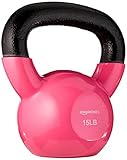
- 15 pound kettlebell weight for exercise and strength training
- Solid cast iron with Pink vinyl coating that protects floors, reduces noise, and prevents corrosion
- Flat base for stay-in-place storage; weight clearly printed on both sides
- Textured, wide, curved handle offers a comfortable, secure grip; hold with one hand or two
- Available in multiple color-coded weight sizes to mix and match for specific workout needs and to expand on over time (additional weights sold separately)
ACE also reports an ACE-commissioned study by researchers in the University of Wisconsin–La Crosse Department of Exercise and Sport Science. The report involved 16 resistance-trained volunteers aged 20–25 and examined hamstring exercises. ACE notes that skin electrodes could not accurately measure one of the three hamstring muscles. That limitation, the small sample and the study’s focus mean the report should not be converted into a universal swing-versus-RDL verdict.
Accordingly, claims about injury prevention, treatment, or a guaranteed “best” exercise go beyond what these sources establish. If you have pain, a relevant medical condition, or uncertainty about your technique, seek individualized advice from a qualified clinician or coach rather than using a general exercise description as a diagnosis or treatment plan.
Bottom-line choice
Do the Romanian deadlift when you want a controlled, loadable hinge with deliberate hamstring tension. Do the kettlebell swing when you want ballistic hip extension for power or conditioning and already control the hinge. They overlap in muscles and movement pattern, but they are not interchangeable in speed, loading or skill demand—and neither is the universal winner.
Quick Recap
Sources
- American Council on Exercise, “The ACE Do it Better Series: The Two-handed Kettlebell Swing,” January 2025.
- National Academy of Sports Medicine, “Romanian Deadlift Barbell,” accessed October 13, 2026.
- American Council on Exercise, “New Research Determines Which Hamstrings Exercises Yield the Best Results,” accessed October 13, 2026.
Product prices and availability are accurate as of the date/time indicated and are subject to change. Any price and availability information displayed on Amazon at the time of purchase will apply.

