
iTechGuides is reader-supported. When you buy through links on our site, we may earn an affiliate commission. As an Amazon Associate I earn from qualifying purchases. Learn more
Japan’s cleantech scene is best read as a set of visible companies and emerging projects, not a ranked list of market leaders. The J-Startup directory offers a broad discovery map, while a 2025 Ministry of the Environment program highlights seven research and feasibility-stage projects. Neither source establishes which companies have the strongest commercial performance or widest deployment.
How to read this map of Japan’s cleantech startups
“Prominent” has no consistent ranking in the official sources covered here. J-Startup membership and selection for a government-supported project are useful, verifiable signs of ecosystem visibility. They are not evidence by themselves of technical superiority, market leadership, commercial readiness, revenue, or scale.
The J-Startup directory, operated under Japan’s Ministry of Economy, Trade and Industry (METI), groups companies in a broad “Environment, Energy & Society” category. That category is a starting point for finding candidates, not a narrow cleantech classification or a league table. Open the J-Startup directory.
METI reported 31 companies newly selected in the fifth J-Startup selection on 13 March 2025. That figure covers the full selection round, not cleantech companies alone; selection connects companies with government support measures and private-sector supporters. Read METI’s announcement.
#1 Best Overall

- HANDS-ON WATER FILTRATION: Kids can build their own water filtration and distillation plant, providing a practical understanding of how clean water is produced and the science behind water purification.
- SOLAR POWER DISINFECTION: The kit teaches children how to disinfect water using solar power, promoting renewable energy concepts and demonstrating sustainable practices in water resource management.
- COMPREHENSIVE EXPERIMENTATION: Includes a detailed booklet with suggested experiments and activities, allowing for a variety of hands-on learning experiences that reinforce the principles of clean water science.
- ENVIRONMENTAL AWARENESS: Features alarming water facts that educate children about environmental issues and the importance of protecting clean water resources, fostering a sense of responsibility toward the planet.
- PERFECT FOR ALL SETTINGS: The kit includes clear instructions and all necessary materials, making it simple for children to conduct experiments safely and effectively. STEM powered learning.
Which cleantech startups in Japan are worth watching?
These names are examples listed in J-Startup’s Environment, Energy & Society category. The directory inclusion is the evidence for their visibility here; it does not establish a shared maturity level or comparable commercial results.
| Company | Documented signal | What that signal does—and does not—show |
|---|---|---|
| INTER HOLDINGS | J-Startup category listing | Directory visibility; the listing alone does not establish a specific cleantech product or commercial stage. |
| Innoqua | J-Startup category listing | Directory visibility; the listing alone does not establish a specific cleantech product or commercial stage. |
| JEPLAN | J-Startup category listing | Directory visibility; the listing alone does not establish a specific cleantech product or commercial stage. |
| Pirika | J-Startup category listing | Directory visibility; the listing alone does not establish a specific cleantech product or commercial stage. |
| Shizen Energy | J-Startup category listing | Directory visibility; the listing alone does not establish a specific cleantech product or commercial stage. |
| Kyoto Fusioneering | J-Startup category listing | Directory visibility; the listing alone does not establish a specific cleantech product or commercial stage. |
| Sagri | J-Startup category listing | Directory visibility; the listing alone does not establish a specific cleantech product or commercial stage. |
| GRA | J-Startup category listing | Directory visibility; the listing alone does not establish a specific cleantech product or commercial stage. |
| Challenergy | J-Startup category listing | Directory visibility; the listing alone does not establish a specific cleantech product or commercial stage. |
| WOTA | J-Startup category listing | Directory visibility; the listing alone does not establish a specific cleantech product or commercial stage. |
What are Japan’s leading climate-tech projects working on?
On 16 September 2025, Japan’s Ministry of the Environment announced seven selected startup-support projects. The program supports research and development contributing to reductions in energy-related CO2 emissions. The project descriptions below identify documented topics, not proof of commercial deployment. See the ministry announcement.
Rank #2

- COMPREHENSIVE, CURRICULUM-DRIVEN SCIENCE KIT: This state-of-the-art kit, designed for both classroom and home use, explores how renewable energy is generated and consumed through hands-on activities and projects.
- QUALITY COMPONENTS & MODULAR BUILDING SYSTEM: Durable plastic parts designed for long-term use and experimentation include a solar panel, wind turbine parts, and more, enabling kids to build several models such as a windmill, hand-crank generator, LED buzzer, electric car, and beyond. Easy-to-use system allows for pieces to be swapped, combined, and reconfigured in multiple ways.
- HANDS-ON, PROJECT-BASED LEARNING: Visualize and experience different types of energy generation through the models of real-life devices and machines and better understand the concepts related to alternative energy and sustainable living. Also compatible with micro:bit (sold separately) for ease of digital data collection.
- COMPATIBLE WITH NGSS: The 24 experiments align with several Next Generation Science Standards, cross-cutting concepts, and disciplinary core ideas for easy integration into at-home or classroom curricula.
- CLASSROOM RESOURCES AVAILABLE: In addition to the 32-page illustrated manual, printable worksheets to guide student learning are available online.
| Representative | Documented project topic | Evidence stage stated by the ministry |
|---|---|---|
| ElectroFluxion | Automated electrolysis experiment system aimed at electrifying chemical manufacturing | Feasibility study |
| 2DC | International-standard conformity and road installation for guided wireless power | Research |
| EXELIM | Quantum-dot thermoelectric conversion technology to use otherwise untapped energy | Development |
| Rinsaku Oda | System and cell design for SO2 electrolysis; the Japanese listing identifies an individual representative | Proof of concept |
| Quantum Flowers & Foods | Improving methane-generating microbial communities through neutron-induced breeding | Demonstration |
| QioN | Locally produced and supplied green ammonia | Feasibility study |
| AC Biode | Chemical recycling of mixed and multilayer waste plastics otherwise incinerated or landfilled | Feasibility study |
The distinction between a feasibility study, proof of concept, research or development, and a demonstration matters: these labels describe project work, not a uniform path to a launched product. The ministry’s announcement does not provide comparable deployment, revenue, or performance metrics for the seven projects.
Quick wins for a faster PC:
Fix the driver behind crashes, sound loss and screen glitchesFind Drivers →Clear out junk files and repair common Windows errorsFree Scan →What government support says about Japan’s cleantech ecosystem
Japan’s New Energy and Industrial Technology Development Organization (NEDO) lists support programs that include deep-tech startup programs and a Green Transformation (GX) field program. This provides context for an ecosystem that includes capital-intensive research and industrial technologies; it does not mean every company named above received NEDO funding. Explore NEDO’s startup-support programs.
Rank #3

- Horizon puts renewable energy technology into the hands of our future scientists
- Designed to demonstrate the workings of a complete clean energy system
- Build your own miniature renewable energy system for experimentation
- Learn the system step-by-step, configure and visualize from start to finish
- Includes miniature wind turbine kit, a solar photovoltaic panel, an electrolyzer, a PEM fuel cell, and hydrogen storage system
The Ministry of the Environment’s 2025 announcement cites Japan’s national targets: reducing greenhouse-gas emissions by 46% by fiscal 2030 compared with fiscal 2013, and achieving carbon neutrality by 2050. These are policy targets, not outcomes attributable to any startup in this article.
Independent reader supportYour contribution helps us test, update, and keep practical guides available for everyone.What the official sources can—and cannot—tell you
- Useful for discovery: J-Startup’s category listing identifies companies visible in an official startup directory.
- Useful for project detail: the Environment Ministry announcement names seven selected representatives and describes their project topics and stated stages.
- Useful for policy and program context: the ministry’s targets and NEDO’s program listing show the public-sector setting for climate and industrial technology work.
- Not established consistently: these sources do not provide comparable data on company performance, revenue, deployment, funding, or current scale.
- Not a complete census: the directory and selected-project announcement are useful snapshots, not a comprehensive account of Japan’s cleantech market.
For a decision about a particular company—such as a partnership, investment, procurement, or job move—check its current primary materials for operating status, technology claims, deployments, and commercial availability. The government listings establish visibility and project descriptions, not those company-level details.
Quick Recap
Best Value

- FIFTH-GENERATION WIND TURBINE KIT: Updated version of the best-selling STEM kit about wind power and energy, kids can make their own wind turbine to explore this renewable energy source.
- OPTIMIZED FOR INDOOR & OUTDOOR USE: Design includes a new blade hub and gear ratio to enhance performance in outdoor wind and with indoor fan setups.
- WHAT YOU LEARN: Dive into the technology behind one of the most promising sources of clean energy, how it has been used it the past, and how it is used today.
- INCLUDES ELECTRIC MODEL CAR: Use your turbine to generate and store electricity to power a model car in just two minutes—no batteries required!
- GUIDED JOURNEY THROUGH WIND POWER: The 32-page, full-color manual provides illustrated step-by-step assembly instructions and easy-to-understand explanations about the scientific concepts at work.
Rank #4
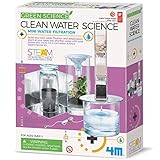
- This personal desalination kit demonstrates the scientific way to extract salt from sea water.
- The kit contains a plastic filter system, active carbon, sand, rock and filter paper.
- Perfect for young science enthusiasts, especially those with an interest in chemistry and the environment.
- Detailed instructions for use and care are included.
- Recommended for ages 8 years and up.
Product prices and availability are accurate as of the date/time indicated and are subject to change. Any price and availability information displayed on Amazon at the time of purchase will apply.
The Tool Desk
Outbyte Driver Updater FREEScan for outdated or missing drivers - takes under a minuteDriver Scan →Outbyte PC Repair FREEClear out junk files and repair common Windows errorsFree Scan →
