
iTechGuides is reader-supported. When you buy through links on our site, we may earn an affiliate commission. As an Amazon Associate I earn from qualifying purchases. Learn more
You can connect a supported iPhone to a monitor, use a mouse through AssistiveTouch, and add a keyboard for compatible apps. The result is a useful larger-screen workstation, but it is usually a mirrored iPhone display—not a Mac-style extended desktop with universal windows and desktop shortcuts.
For a reliable setup, match four things before buying anything: the exact iPhone model, its charging-port type, the monitor’s video input, and the connection and power features your accessories provide. Apple’s current guidance documents USB-C display output up to 4K at 60 Hz in suitable configurations, but the phone, cable, adapter, monitor and app all affect the result.
What “using an iPhone as a desktop” actually means
Apple’s default behavior is mirroring: “When you connect an external display, it mirrors the built-in display of your iPhone.” The external screen shows the iPhone’s interface at a larger size rather than becoming a separate, always-independent workspace. Some apps can provide a second-screen experience—for example, a video app may put playback on the monitor while controls remain on the phone—but that behavior belongs to the app.
Recommended Free Tools
Therefore, this setup is best for tasks such as viewing content on a larger screen, presenting an app, using a pointer for easier navigation, and typing in apps that recognize an external keyboard. It is not safe to expect every iPhone app to become a desktop application, support resizable windows, or provide the same keyboard shortcuts as macOS.
#1 Best Overall

- 【iPhone 15 HDMI ADAPTER TO TV】- The 2-in-1 iPhone to HDMI adapter for tv helps iPhone15/16/iPad/MacBook expand a HDMI 4K@60Hz port and a charging port, enjoy crystal-clear audio and high-definition video experience, just share happiness with your family or friends. This apple HDMI to USB C adapter allows for faster charging, stable connections and high-definition output, which means you can enjoy home-theater, live streaming ,working report and playing while charging for your apple USB C to HDMI adapter.
- 【PLUG AND PLAY】- The apple HDMI to USB C adapter no need install any driver or app, no need to connect WiFi, no need power supply, no need to adjust mirror of iPhone15/16/iPad, just insert each interface to corresponding device, click the “Trust” button when connecting and then wait a few seconds to connect automatically. Plug and play, easy and quick to install, the iPhone 15/16 HDMI adapter to TV is so easy to use, saving your much time.
- 【WIDELY COMPATIBILITY】- The apple USB C to HDMI adapter is compatible with devices equipped with USB-C ports supporting display port alternate mode. The iPhone to HDMI adapter for tv compatible with iPhone 16/16 Plus/16 Pro/16 Pro Max, iPhone 15/15 Plus/15 Pro/15 Pro Max, MacBook M3/M3 Pro/M3 Pro Max, MacBook Pro 2015-2024, MacBook air 2018-2024, iPad Pro 2018-2024, iMac 2017-2024, Samsung Galaxy S24/S24+/S24 Ultra/S23/S23+/S23 Ultra/S22/S22+/S22 Ultra/S21/S20/Note 10, and other USB C devices.
- 【APPLICATION SUPPORT】- The apple USB C to HDMI adapter supports a variety of video applications, the iPhone to HDMI adapter for tv connector supports mirror videos from Apps, such as YouTube, Quickflix, Hulu Plus, IDMB, Family on TV, ABC, NBC, FOX, Microsoft Office and more videos downloaded and saved on your iOS devices for stream. But please note this apple USB C to HDMI adapter won’t work with Apps with have “HDMI” video copyrights protection, such as Netflix, Prime video, Amazon video, HBO go, HULU.
- 【STURDY AND LASTING DESIGN】- The apple HDMI to USB C adapter for extra durability and a high-quality USB-C connector provides a snug connection with your devices for stable signal transfer. Premium aluminum alloy casing and nylon braided cable for better heat dissipation. The iPhone 15 HDMI adapter to tv is compact and light design let you carry the apple HDMI to USB C adapter in bag everywhere. This tiny device will fit even in the smallest pocket and will always be with your when you need the apple USB C to HDMI adapter.
Check iPhone model and port support first
Start with the model, not the adapter. Apple’s current USB-C connector guidance lists external-display support for iPhone 15 models, iPhone 16 models except iPhone 16e, iPhone 17 models except iPhone 17e, and iPhone 18 Pro models. Product availability and support can change, so verify your exact model on Apple’s current compatibility page before purchasing equipment.
| iPhone situation | What to check | Likely display path |
|---|---|---|
| Supported USB-C model | The model must be in Apple’s supported families and exceptions list. | USB-C DisplayPort connection to a USB-C display, or USB-C-to-HDMI connection to an HDMI display. |
| USB-C model with a model-specific limitation | Confirm whether the exact model, including an “e” variant, is listed as supported. | Use the connection Apple documents for that model; do not infer support from the presence of a USB-C socket alone. |
| Older Lightning iPhone | Identify the Lightning connector and follow Apple’s connector-appropriate adapter instructions. | A Lightning display adapter may be required. If the model does not support the wired display path you need, AirPlay can mirror content wirelessly. |
Apple’s USB-C guide is the authoritative place to confirm the current model list: Charge and connect with the USB-C connector on your iPhone. Its general wired-display instructions cover older connector types as well: Connect iPhone to a display with a cable.
Find the connector on your phone
- USB-C iPhones use USB-C display cables or a USB-C adapter that matches the monitor’s input.
- Lightning iPhones need a Lightning-compatible display adapter rather than a USB-C-only adapter.
- A USB-C-shaped port does not, by itself, guarantee the same display behavior across all iPhone models; check the exact model listing.
Choose the connection for your monitor
Look at the monitor’s physical inputs before selecting a cable. A USB-C monitor and an HDMI monitor require different connection paths. VGA is covered in Apple’s wired-display instructions for older display equipment, but it needs the appropriate connector-specific adapter.
Do these 3 things before closing this tab:
1Clear out junk files and repair common Windows errors2Fix the driver behind crashes, sound loss and screen glitches3Repair Windows errors before they cause bigger problems| Monitor input | Connection for a supported USB-C iPhone | Important qualification |
|---|---|---|
| USB-C with video input | Use a suitable USB-C cable that carries DisplayPort video. | Apple documents USB-C DisplayPort output up to 4K at 60 Hz with an appropriate cable. The display and cable must also support the desired mode. |
| HDMI | Use a compatible USB-C-to-HDMI cable or a USB-C-to-HDMI adapter plus an HDMI cable. | Apple documents up to 4K at 60 Hz with an HDMI 2.0-capable adapter or cable. The adapter, cable and monitor must support HDMI 2.0. |
| VGA | Use the connector-appropriate Apple-listed display adapter and VGA cable. | VGA is an older analog connection; the adapter must match the iPhone’s port and the monitor’s input. |
For a Lightning iPhone, use the Lightning adapter path described in Apple’s wired guide instead of assuming that a USB-C video adapter will work. A multiport display adapter can be useful at a desk because Apple describes its display adapters as having an additional port for charging while video is connected.
Rank #2
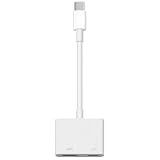
- 【Never Worry About Power】 Enjoy uninterrupted entertainment with 4K HDMI video output and USB-C 100W charging, ensuring you're always powered up and ready to go
- 【Widely Compatibility】Usb c to HDMI adapter for tv can work with devices equipped with USB-C ports that supporting DisplayPort Alternate Mode, compatible with iPhone 17/17 Air/17 Pro/17 Pro Max, iPhone 16/16 Plus/16 Pro/16 Pro Max, iPhone 15/15 Plus/15 Pro/15 Pro Max, MacBook Pro/Air, iPad Pro/Air 5, Galaxy S24/S23/S23+/S23 Ultra/S22/S22+/S22 Ultra/S21/S20/Note 20/Note 10, Switch, Surface Book 3/Laptop 5/Pro 7, XPS 17/15/13, etc
- 【Sturdy and Lasting Quality】Our usb c to HDMI pd dual adapter uses eco-friendly ABS case for better heat dissipation, soft but durable TPE cable is anti-pulling, nickel -plated connector for extra durability and long-term service life
- 【Plug and Play】 No power supply required, no WiFi, no hotspot or any driver/software required, our c to HDMI adapter is truly plug and play, support hot swappable, you can set the connection in 10 seconds, easy to achieve fast and stable connection. This iPhone 16 HDMI adapter is so easy to use, even the olders can use it, easily set up and enjoy large and clear screen displaying anywhere anytime
Set up the external display step by step
- Identify the exact iPhone and port. Confirm the model’s display capability and whether it uses USB-C or Lightning. Do this before ordering a cable.
- Inspect the monitor’s inputs. Note whether it accepts USB-C video, HDMI, or VGA. If the monitor has several inputs, decide which one you will use and locate the monitor’s input-selection control.
- Choose a compatible cable or adapter. For USB-C video, use a cable intended to carry DisplayPort. For HDMI, use a compatible USB-C-to-HDMI cable or adapter; for Lightning, use the matching Lightning display adapter.
- Connect the adapter to the iPhone. Insert the connector firmly into the phone. If you are using a multiport adapter, leave its charging port accessible for the next step.
- Connect the monitor cable. Attach the USB-C, HDMI or VGA cable to the adapter and the monitor’s matching input.
- Select the monitor’s video source. If the screen remains blank, use the monitor’s Source or Input control and choose the port you used. Apple’s wired instructions explicitly include changing the display source when necessary.
- Allow the phone and app to settle. The iPhone should mirror its screen once the connection is recognized. An app may instead offer its own second-screen behavior; that is app-specific and not a system-wide desktop mode.
Apple’s cable instructions are available at Connect iPhone to a display with a cable. Keep that page available when checking connector-specific adapter requirements.
Connect and configure a mouse
iPhone pointer support is enabled through AssistiveTouch. Apple documents both Bluetooth and USB pointer devices, including mice. The pointer does not become available merely because a monitor is connected.
Pair a Bluetooth mouse
- Open Settings.
- Go to Accessibility > Touch > AssistiveTouch.
- Turn on AssistiveTouch.
- Open Devices, then choose Bluetooth Devices.
- Put the mouse in pairing mode and select it when it appears.
If the mouse does not appear, confirm that it is powered on, not actively paired with another device, and within Bluetooth range. The relevant Apple instructions are in Use AssistiveTouch on iPhone.
Connect a wired mouse
Apple also documents USB pointer devices. Connect the mouse to the iPhone or to a compatible hub. A USB-A mouse may require an adapter if the phone or hub provides USB-C instead. The adapter must support the physical connector and provide enough power for the peripheral.
Rank #3

- The Anker Advantage: Join the 80 million+ powered by our leading technology.
- Vivid Video: The HDMI adapter lets you connect to any TV or display with an HDMI port to stream video in up to 4K resolution.
- Plug and Play: Instantly turn your laptop’s USB-C port into an HDMI port, with no installation necessary. This product does not support charging or Power Delivery (PD).
- Premium Construction: A lightweight aluminum casing allows for greater heat dissipation, while the reinforced braided-nylon cable is designed to withstand the twists and tugs of daily use.
- Compatibility: Supports USB-C DP Alt mode, USB4, and Thunderbolt connections.
Adjust pointer behavior
AssistiveTouch provides pointer-related controls, including pointer appearance and tracking options. Use those settings if the cursor is difficult to see or moves too slowly for the monitor’s size. Pointer availability and behavior can still vary by iOS version and by the app currently in use.
Add a keyboard without assuming desktop behavior
A keyboard can make text entry faster, but treat it as optional and app-dependent. The cited Apple AssistiveTouch documentation discusses pointer devices, Mouse Keys and the onscreen keyboard; it does not promise one universal external-keyboard setup procedure, complete shortcut coverage, or desktop-style behavior in every app.
Choose a connection type
- Bluetooth keyboard: Check that the keyboard can pair with iPhone and that the intended app accepts external text input.
- Wired keyboard: Confirm the keyboard’s connector and whether an adapter or powered hub is required. A USB-A keyboard generally needs a USB-A-to-USB-C or other connector-appropriate adapter when used with a USB-C phone.
- Keyboard through a hub: If the same hub carries display, mouse and keyboard connections, verify that the hub supports the iPhone model and has adequate power. A hub that works for charging alone is not automatically a video or data hub.
Test the apps you actually use
Open the exact writing, messaging, terminal, remote-access or productivity app you plan to use and test typing, navigation and shortcuts. One app may accept ordinary text input while another continues to rely mainly on touch controls. Do not buy a keyboard on the assumption that every iPhone app will expose a desktop command set.
Keep the iPhone powered during long sessions
Video output, Bluetooth, a mouse and keyboard can turn a short connection into a long session. Apple says its display adapters include an extra port so the iPhone can charge while a wired display is connected. Some USB-C displays can also charge the phone through the same cable.
Rank #4

- USB C to HDMI Converter: With Apple MFi certified chip, it supports mirroring/extending the iPhone 15/16/computer/MacBook/iMac/iPad Pro/smartphone screen (including apps, videos, pictures, presentations, websites, slides, etc.) to HDMI-enabled TVs, monitors, projectors and other devices. Suitable for home theater entertainment, office, exhibition, demonstration, teaching, etc.
- UHD 4K@60Hz HDMI Output: Plug and play, no app or driver installation required. The USB C to HDMI cable transmits up to 4K@60Hz UHD (3840x2160@60Hz) resolution for clear audio and HD video experience. Supports HDCP 2.2, you can stream 4K protected content from video apps, Compatible with Netflix, HBO Max, Disney+, Hulu, etc.
- Widely Compatible: This Type C HDMI Dongle is compatible with iPhone 15/15 Plus/15 Pro/15 Pro Max, 16/16 Plus/16 Pro/16 Pro Max, iPhone 17 / 17 Air/ 17 Pro / 17 Pro Max, M3/M3 Pro/M3 Pro Max, MacBook Pro 2015-2025, MacBook Air 2018-2025, iPad Pro 2018- 2025, iMac 2017-2025, Samsung Galaxy S25/S24/S23/S22 Ultra 5G, S21/S20/S20 fe/S20 Ultra/S10/S10 Plus/S8/S8 Plus/S9/S9 Plus/ Note 8/9/10/ Note 10 plus, Surface Book 2, Dell XPS 13/15, Acer Spin7, Acer Chromebook R13, Yoga 900/910, Google Chromebook Pixel, HP Spectre X2/X360, etc.
- 100W PD Charging Port: The USB-C port supports up to 100W fast charging to charge your USB-C port computer/smartphone/tablet. (Note: The actual charging speed may vary due to the charging cable, charging adapter and voltage level.)
- Worry-Free Guarantee: We always strictly in quality and provide a 24-month warranty. If you have any problem with this Digital AV HDMI Connector Cable, please feel free to contact us.
Check the actual power and video specifications of the display, adapter or hub you select. A USB-C port that charges a phone may not carry video, and a video adapter may not provide charging passthrough. For a desk installation, a multiport adapter with HDMI and charging passthrough can reduce cable changes, but compatibility must be checked for the exact phone and display.
Resolution and refresh-rate limits
Apple’s current USB-C guidance describes these technical maxima:
- USB-C DisplayPort: up to 4K resolution at 60 Hz with an appropriate cable.
- HDMI: up to 4K resolution at 60 Hz when using an HDMI 2.0-capable adapter or cable.
These are documented capability limits, not a guarantee that every combination will reach 4K/60. The iPhone model, adapter chipset, cable rating, monitor input and app can each limit the mode. If a connection negotiates a lower resolution or refresh rate, check every component before treating the phone as defective.
The Tool Desk
Outbyte PC Repair FREERepair Windows errors before they cause bigger problemsFix Now →Outbyte Driver Updater FREEScan for outdated or missing drivers - takes under a minuteDriver Scan →Troubleshoot a blank or unreliable display
The monitor says “No signal”
- Verify that the iPhone model supports the chosen wired-display path.
- Confirm that the adapter matches the phone’s connector: USB-C for supported USB-C models or the appropriate Lightning adapter for older phones.
- Reseat the adapter and video cable at both ends.
- Use the monitor’s Source or Input control to select the exact HDMI, USB-C or VGA port in use.
- Try a cable or adapter whose specifications explicitly support the required video mode.
The phone charges but does not show video
Charging does not prove that a USB-C cable or hub carries video. Replace a charge-only cable with a cable designed for DisplayPort video, or use a video adapter suited to the monitor input. For HDMI, verify HDMI 2.0 capability if you are targeting Apple’s documented 4K/60 maximum.
Best Value

- The USB-C digital AV multiport adapter lets you connect your USB-C enabled Mac or iPad to an HDMI display, while also connecting a standard USB device and a USB-C charging cable. This adapter allows you to mirror your Mac Display to your HDMI-enabled TV or display.
- Simply connect the adapter to a USB-C or Thunderbolt 3 (USB-C) port on your Mac or select iPad model and then to your TV or projector via an HDMI cable (sold separately).
- Use the standard USB port to connect devices such as your flash drive or camera or a USB cable for syncing and charging your iOS devices. You can also connect a charging cable to the USB-C port to charge your Mac, iPad, or iPhone.
- System Requirements: macOS Mojave 10.14.6 or later; iOS 12.4 or later
- Requires an HDMI cable (sold separately) for connection to your TV or projector. Supports both video and audio output.
The image works but the mouse does not
- Open Settings > Accessibility > Touch > AssistiveTouch and make sure AssistiveTouch is on.
- For Bluetooth, open AssistiveTouch > Devices > Bluetooth Devices and pair the mouse there.
- For USB, check the physical connector and use the required adapter for USB-A or another incompatible plug.
- Test the pointer in another app. Pointer behavior can be app-dependent.
The keyboard is connected but not useful
Check the keyboard’s connection type, then test it inside the specific app you need. The Apple guidance cited for this setup does not establish that every app supports full external-keyboard navigation or desktop shortcuts. If the workflow depends on a particular shortcut, confirm that shortcut in the app rather than assuming iPhone-wide support.
Choose equipment by the job, not by the connector alone
| Decision | What to verify | Why it matters |
|---|---|---|
| Phone model | Exact model and whether Apple lists it for USB-C external display. | USB-C shape alone does not establish display support. |
| Monitor input | USB-C video, HDMI, or VGA. | Determines the required cable or adapter. |
| Charging requirement | Whether the adapter has charging passthrough or the USB-C monitor can charge the phone. | Prevents the phone from draining during a long session. |
| Video target | Required resolution and refresh rate; cable and adapter ratings. | Apple’s up-to-4K/60 figures require suitable DisplayPort or HDMI 2.0 components. |
| Mouse connection | Bluetooth or wired, plus any USB-A/USB-C adapter. | Determines how the pointer is paired and powered. |
| Keyboard workflow | Connection type and support in the apps you use. | External-keyboard behavior is not universal across iPhone apps. |
A practical desk layout
For a simple arrangement, place the iPhone near the monitor, connect the monitor through the correct adapter, enable AssistiveTouch, pair or attach the mouse, and then connect the keyboard. Keep the phone accessible because mirrored interaction and app-specific controls may still require touch. If the monitor or adapter supports charging passthrough, connect power before starting a long work session.
This arrangement works best when the larger display solves a viewing problem and the pointer solves a precision problem. It is less suitable when your work depends on many independent windows, a full desktop file-management workflow or shortcuts that an iOS app does not implement.
What to expect from the finished setup
With compatible hardware, the iPhone can drive a larger external screen, accept a mouse through AssistiveTouch and accept keyboard input where the app supports it. The monitor normally mirrors the phone, while a limited number of apps can create their own second-screen presentation. The most dependable way to avoid wasted purchases is to verify the model, port, monitor input, charging path and app behavior separately.
Quick Recap
Product prices and availability are accurate as of the date/time indicated and are subject to change. Any price and availability information displayed on Amazon at the time of purchase will apply.

