
Free tools Windows power users keep installed
One-click scans. No signup required.
iTechGuides is reader-supported. When you buy through links on our site, we may earn an affiliate commission. As an Amazon Associate I earn from qualifying purchases. Learn more
The reliable way to test smoke-exposed wine grapes is a two-stage assessment: submit a representative vineyard sample to a laboratory for volatile-phenol analysis, then make a small, controlled microferment when the buying, harvesting or insurance decision depends on the wine’s likely flavor. Laboratory results identify exposure markers; they do not, by themselves, prove that a finished wine will taste smoky.
Collect clusters from throughout each affected lot, follow the receiving laboratory’s packing instructions, request a panel that distinguishes free and bound phenols, and interpret the result alongside variety-specific background information, winemaking plans and a blinded sensory evaluation. Confirm capacity, sample requirements and turnaround before picking fruit because wildfire demand can sharply limit laboratory availability.
What smoke-taint testing can—and cannot—tell you
Smoke can deposit volatile phenols on vines and introduce them into berries. Testing answers two related but different questions:
The Tool Desk
Outbyte PC Repair FREEClear out junk files and repair common Windows errorsFree Scan →Outbyte Driver Updater FREEScan for outdated or missing drivers - takes under a minuteDriver Scan →- Has the fruit been exposed to smoke-related compounds? Laboratory analysis can measure selected marker compounds in grapes, juice or wine.
- Will this lot make an objectionably smoky wine? A representative microfermentation and controlled tasting is a more direct, though still imperfect, answer.
Guaiacol and 4-methylguaiacol are widely used indicators. Expanded methods may include cresols, syringols and other phenols, and some facilities can measure phenols bound to sugars as well as free volatile compounds. No universal laboratory number in the available guidance proves sensory taint or guarantees acceptability. Natural background concentrations, bound forms and differences in winemaking make a simple pass/fail interpretation unreliable.
#1 Best Overall

- 【Precision Accuracy Hydrometer】This triple scale hydrometer kit can test it once to get ABV, Brix and Gravity. It will help you elevate your brew as you'll be able to easily and accurately measure your alcohol percentage until you get it to your liking.
- 【Triple Scale Beer Hydrometer】Brewing hydrometer that reads Brix Balling (0-35), Specific Gravity (0.99-1.17), and Potential Alcohol (0%-20%). This essential proofer is easy to read and free of mercury. It gives you an estimated prediction of what alcohol content you will have in your final product. The CIMALAB hydrometer comes with instructions and 11.8"storage tube.
- 【Easy to Read & Accurate】Knowing exactly of your final gravity reading with this extra large lines and larger font numerals. Graduated color bands making it easier to identify so you can be more precise in your readings. Eliminate guesswork and make home brewing easier!
- 【Designed for Brewing】This wine making supplies is the ideal kit for homebrewers of all experience levels. It comes with everything you need to get easy and accurate readings: triple scale hydrometer, plastic test jar, cleaning brush, detailed instructions, and more. Use it to make lagers, ales, wines, and cider, the rest is up to you!
- 【 What You will Get】1*triple scale hydrometer, 1* clear hydrometer test tube, 1* bottle brush, 1* microfiber cleaning cloth, instruction sheet with conversion chart, an exquisite packing and our worry-free 12-month warranty with friendly customer service! (Great choice to wrap as a gift for brewers!)
Oregon State University (OSU) Extension summarizes the practical approach: laboratory analysis and microferments are complementary ways to determine whether fruit or wine contains smoke-derived volatile phenols. A decision with financial, contractual or insurance consequences should use both whenever timing allows.
How smoke compounds behave in grapes and wine
Entry into the vine and berry
Smoke exposure can move volatile phenols through the berry cuticle and leaves into plant tissues. Once inside, some compounds bind to sugars and form nonvolatile glycosides. Those bound forms may not smell strongly in a raw grape or appear in a free-phenol test, yet fermentation and aging can release volatile compounds later.
Why winemaking changes the result
Red wines commonly receive longer skin contact than white wines. Extended contact can extract more smoke-related compounds from skins, so limiting skin contact may reduce risk without guaranteeing a smoke-free wine. Fermentation, enzymatic activity and aging can change the balance between bound and free forms. A grape test therefore describes the sampled fruit at one point in time, not a finished wine under every possible production method.
What’s actually slowing this PC down?
Pick the symptom - the matching free tool is one click away.
Markers are indicators, not the whole phenomenon
Guaiacol and 4-methylguaiacol are useful screening markers, but the exact compound or combination responsible for smoky, ashy or medicinal sensory character has not been settled. Controlled studies have reported smoky wines with low or undetected levels of these two markers. Barrel toasting can also add guaiacol and 4-methylguaiacol to wine, which must be considered when interpreting a finished-wine result.
Step 1: Prioritize the vineyard lots to test
Do not treat an entire property as one homogeneous sample unless the laboratory and your production records support that choice. Separate lots by factors that could change exposure or wine style, such as block, elevation, proximity to smoke, harvest date, grape variety and intended red or white production.
- Start with blocks that had visible smoke exposure, prolonged smoke conditions or a high-value contract.
- Record the block, variety, row range, date, smoke event and intended buyer or winery.
- Coordinate with neighboring growers when practical. Regional sampling can reveal whether exposure is widespread and may reduce per-sample analytical costs through shared logistics, but each lot still needs a representative sample.
- If a crop-insurance claim is possible, contact the adjuster before harvesting or beginning a sampling program. The insurer may require particular evidence or timing.
Testing capacity is not fixed. During major wildfire events, laboratories may impose intake limits or longer queues. Ask about current capacity before collecting fruit so a sample does not sit beyond the laboratory’s accepted holding period.
Step 2: Collect a representative grape sample
Sample across the affected vineyard
Walk the entire block or the defined lot and collect clusters from many locations rather than taking fruit from a convenient edge or a few vines. Include the parts of the block that will actually be harvested. A biased sample can make a laboratory result look reassuring or alarming without representing the load.
Recommended Free Tools
Combine fruit only as the laboratory directs
Many protocols call for combining clusters into one composite sample, but the correct amount and preparation depend on the laboratory’s method. Before picking, ask:
Rank #2
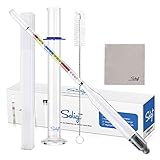
- Complete Set for Home Brewer- Package includes 1*triple scale hydrometer, 1*clear glass cylinder test jar, 1* bottle brush made of stainless steel, 1*sturdy storage case to protect hydrometer from breakage, 1* instruction sheet with conversion chart and 1*microfiber cleaning cloth.
- Accurate & easy to read- Get the perfect measuring result with our high quality hydrometer which comes with detailed markings on specific gravity from 0.99-1.17, brix /balling from 0-35 and potential alcohol by volume from 0%-20% and our glass test tube which you can easily read - for nearly all of your spirit-making needs!
- Save precious liquid- You only need 125ml rather than 250ml beer or wine for testing. Our jar is with narrow opening plus tall enough to help you get the best readings. Waste less, drink (or share) more!
- Perfect packaging- All of our home brewing supplies and equipment are packed in heart designed package box and is drop tested to minimize breakage, which makes it a perfect gift for your friends, family and colleagues.
- How much fruit is required for the grape matrix and any repeat analysis?
- Should clusters remain intact, or should berries be removed and mixed?
- What container, temperature and maximum shipping time are required?
- Does the lab want separate samples for free phenols and bound phenols?
- What sample identification and chain-of-custody information must accompany the shipment?
Follow those instructions exactly. Confirm whether the laboratory accepts fresh grapes, frozen material or both; do not assume that a protocol for wine or juice applies to intact fruit. Keep a written map of collection points and retain a duplicate portion only if the lab recommends it.
Document conditions that affect interpretation
Record smoke dates, rainfall or irrigation after exposure, harvest date, variety, block size and any treatments. Tell the laboratory whether the sample is intended for a commercial lot, an insurance assessment or a preliminary screen. Those details help the laboratory and later decision-makers understand what the result does and does not represent.
Step 3: Request a fit-for-purpose laboratory panel
Core free-phenol screening
Ask whether the method measures free guaiacol and 4-methylguaiacol in grape samples. These are common marker compounds and provide a useful first screen for smoke exposure.
Expanded volatile-phenol panels
Depending on the provider, an expanded panel may add cresols, syringols and other smoke-related compounds. A broader panel can identify patterns that a two-compound screen misses, but panels are not standardized across all laboratories. Request the laboratory’s analyte list, reporting units, detection limits and matrix validation for grapes.
Bound-phenol analysis
Ask explicitly whether the laboratory can assess bound phenols, sometimes called glycosylated or nonvolatile forms. A free-phenol-only result may understate the pool that could be released during fermentation or aging. Bound-phenol methods are not universally available, so confirm capability before shipping.
Questions to send before submitting
- Do you accept fresh wine-grape samples, and what mass or number of clusters is required?
- Which free volatile phenols are reported, and can you test bound phenols?
- Are results reported in micrograms per kilogram (µg/kg or ppb) for grapes?
- What are the current turnaround time, intake limits and rush options?
- How should the sample be packed, cooled, labeled and shipped?
- Can you explain the method’s detection limits and whether the result is suitable for an insurance or contract decision?
Industry directories have stated that many laboratories return results within about three business days, but that figure is a dynamic directory estimate, not a guarantee. Verify timing directly with the laboratory during the current smoke season.
How to read guaiacol and 4-methylguaiacol numbers
One OSU protocol, revised and reviewed in 2024, gives contextual examples: “Most labs consider a value greater than 0.5 ug/kg (ppb) in grape samples or 1.0 ug/L (ppb) in wine or juice as an elevated level for these compounds.” These figures are screening examples, not universal sensory thresholds. They should not be converted into a rule that a lot below the number is safe or a lot above it is automatically rejected.
The same guidance notes that guaiacol and 4-methylguaiacol can occur naturally. A positive result may not correlate with smoke taint unless you have appropriate baseline information for the grape variety, site and matrix. Ask the laboratory whether it can compare your sample with an unaffected control or historical baseline.
Rank #3

- Acid testing kit for wine
- Easy to Use
- Includes standard sodium hydroxide solution, acid indicator solution, calibrated syringe, test tube and instructions
- Sufficient for 50 to 100 tests
Concentration also depends on what was tested. A grape result in µg/kg cannot be compared directly with a wine result in µg/L without considering dilution, extraction, fermentation and aging. Keep the matrix and units attached to every number in your records.
The USDA Risk Management Agency has not established specific threshold levels for smoke compounds in grapes or wine for determining smoke damage. OSU notes that, in the insurance context it describes, laboratory results must support a finding of elevated guaiacol and 4-methylguaiacol. Because policy language and evidence requirements can differ, consult the crop-insurance adjuster before sampling or harvesting.
Laboratory analysis versus microfermentation
| Assessment | What it measures | Strength | Important limitation |
|---|---|---|---|
| Laboratory grape analysis | Selected free phenols and, where available, bound phenols in the submitted fruit | Objective concentration data; useful for screening, lot comparison and documentation | Marker concentrations alone do not reliably predict finished-wine flavor; natural background and bound forms complicate interpretation |
| Microfermentation with sensory evaluation | A small wine made from representative fruit, assessed for smoky, ashy or related characteristics | Directly samples the fruit-to-wine pathway and can reveal effects released during fermentation | Requires time and controlled handling; results can differ from commercial-scale winemaking and sensory judgments vary |
| Post-fermentation analysis | Free and possibly bound phenols in the microfermented wine | Connects chemical data to the same small lot that was tasted | Still does not create a universal acceptability cutoff or exactly reproduce a commercial wine |
Use laboratory testing to prioritize and document risk, and use a microferment when the decision needs a wine outcome. Neither method replaces the other.
Step 4: Run a representative microfermentation
When it is worth doing
Run a microferment when analytical results are equivocal, when the lot is economically important, or when a buyer and grower need evidence about likely wine character. The fruit should represent the same block and harvest lot submitted for laboratory testing.
Keep the small lot comparable to the intended wine
Use a documented protocol that matches the planned commercial style as closely as practical: variety, crush decisions, skin-contact duration, temperature, yeast or other processing inputs and pressing timing. A red-wine microferment with unusually short skin contact cannot answer the same question as a commercial red made with extended maceration. Record every deviation so the result is not overgeneralized.
Analyze the resulting wine if needed
The microferment can be submitted for post-fermentation volatile-phenol analysis. This is particularly useful when grape results show bound phenols or when sensory observations need chemical context. It remains a model of the commercial process, not a guarantee of the final tank or barrel.
Step 5: Use controlled sensory evaluation
Sensory testing is powerful because it evaluates the attribute buyers ultimately experience, but it is subjective and vulnerable to fatigue, expectation and aroma carryover. Use a repeatable setup:
Do these 3 things before closing this tab:
1Fix the driver behind crashes, sound loss and screen glitches2Repair Windows errors before they cause bigger problems3Scan for outdated or missing drivers - takes under a minute- Code samples with neutral identifiers and taste blind.
- Include an unaffected reference wine and, where available, an impacted reference to check evaluator sensitivity.
- Use at least four evaluators where possible.
- Conduct at least two tastings rather than relying on one session.
- Leave at least two minutes between samples to reduce carryover.
- Record descriptors separately—smoky, ashy, medicinal, burnt, bitter or drying—rather than forcing a single yes/no judgment.
- Serve samples in a consistent order or randomize the order, and keep serving temperature and glassware consistent.
Do not treat one taster’s reaction as a laboratory-equivalent result. If evaluators disagree, repeat the session and check whether the reference samples reveal differences in sensitivity.
Rank #4

- Tailored for Wine-Making: The hBARSCI pH Test Strips are ideal for home winemakers, measuring the precise 2.8 to 4.4 pH range essential for perfect wine acidity. Use these wine pH test strips to ensure every batch hits the right note
- Generous 100 Strip Supply: With 100 pH strips per vial, this kit is perfect for repeated batch testing, minimizing the need for constant restocking. Enjoy the convenience of frequent testing without interruption, keeping your wine-making process smooth
- Easy pH Assessment: Simply place a drop of wine on the pH paper and match the color to the chart for an accurate acidity reading. These pH testing strips provide a straightforward method for home winemakers looking to craft the finest wines
- Durable Design: Crafted with durable paper, these multicolor strips are built to withstand repeated use in any home brewing setup. The water-resistant color chart ensures reliable pH readings across repeated tests
- Perfect for Enthusiasts: Whether you're testing wine or water, these versatile strips are a must-have for any science enthusiast. They make an excellent gift for wine lovers and home brewers who appreciate precision and quality in their tools
Do grape results predict what the wine will taste like?
Only imperfectly. Grape concentrations can identify exposure risk, but they do not reliably establish finished-wine flavor. Bound phenols may be released during fermentation or aging; naturally occurring phenols can produce positive analytical results without obvious smoke character; and extraction varies with skin contact and wine style. Conversely, smoky sensory notes have occasionally been observed when guaiacol and 4-methylguaiacol were low or not detected.
The strongest practical prediction comes from combining a representative grape analysis, a microferment that reflects the planned production method and a controlled sensory evaluation. Treat that combination as decision evidence, not a promise. Commercial-scale fermentation, barrel toast, blending and aging can still change the sensory result.
Making the harvest, purchase or rejection decision
For growers
Share the lot identity, sample map, laboratory report, microferment protocol and sensory notes with the prospective buyer. Ask which evidence the buyer will accept before committing to harvest or delivery. Preserve chain-of-custody records and retain communications about criteria.
Quick wins for a faster PC:
Repair Windows errors before they cause bigger problemsFix Now →Scan for outdated or missing drivers - takes under a minuteDriver Scan →For wineries and buyers
Define acceptance criteria in writing: required analytes, reporting units, whether bound phenols are needed, whether a microferment is mandatory and who pays for repeat testing. A laboratory number without an agreed decision rule can create disputes, especially because no universal sensory threshold exists.
For insured crops
Contact the crop-insurance adjuster before sampling or harvesting. OSU’s guidance indicates that USDA’s Risk Management Agency has no single smoke-compound threshold for declaring damage, while some described claims require evidence of elevated guaiacol and 4-methylguaiacol. Follow the policy-specific process rather than assuming a commercial buyer’s standard will satisfy insurance documentation.
Troubleshooting common testing problems
The laboratory will not accept the sample
Ask whether the issue is matrix, quantity, temperature, packaging or current capacity. Obtain written instructions from another qualified laboratory only after confirming that its grape method and reporting units fit your decision.
The result is below detection but the fruit smells smoky
Check whether only free guaiacol and 4-methylguaiacol were tested, whether bound phenols are available, and whether the sample was representative. Proceed to a microferment and controlled sensory evaluation; low marker results do not rule out every smoke-related sensory effect.
The result is elevated but the wine tastes acceptable
Verify the matrix, units, method and variety baseline. Natural background compounds and differences in extraction can explain a mismatch. Repeat testing or microferment the specific lot before making a final commercial decision.
Best Value

- Test to control and monitor Malic Acid and completion of Malolactic Fermentation in wines
- Quantitatively measures from from 0 - 500 mg/L
- Every kit comes with ten strips and ten samplers and requires no extra chemicals or instrumentation for accurate readings
- Accuvin strips have a unique construction enabling the removal of pigments from red wines making them usable on any wine
- No sample prep required, enabling you to get actionable results in a matter of minutes!
Tasters disagree strongly
Use coded samples, include controls, wait at least two minutes between pours and repeat with multiple evaluators. Document the disagreement rather than averaging it into a false precision.
The microferment does not match the planned wine
Compare skin-contact time, processing, temperature, yeast, pressing and aging conditions with the commercial plan. A microferment is informative only to the extent that its protocol represents the intended wine.
A practical record-keeping checklist
- Block, variety, clone if relevant and intended wine style
- Smoke dates, duration and notable weather events
- Collection date, collector and mapped sampling points
- Laboratory instructions, sample mass and shipping conditions
- Analytes, units, detection limits, method and report date
- Whether free phenols, bound phenols or both were measured
- Microferment recipe, skin-contact period and processing notes
- Evaluator count, reference wines, tasting dates and coded results
- Buyer, winery and insurance criteria, including adjuster instructions
- Final disposition and the evidence supporting it
Frequently asked questions
Should I test leaves, berries or finished wine?
For a harvest decision, start with representative grape clusters and a grape-specific laboratory method. A finished-wine or microferment sample answers a different question and is most useful after you have modeled the intended winemaking process.
Windows Errors? Fix Them Before They Spread
Repair common Windows errors and clear accumulated junk for a smoother, more stable PC - no reinstall needed.Free scan · no reinstallOutdated Drivers Are Slowing You Down
One free scan finds every outdated or missing driver and matches the right update for your exact hardware.Free scan · exact hardware matchCan one sample represent several grape varieties?
Do not assume so. Varieties and wine styles can differ in background phenols, skin extraction and sensory response. Keep varieties and materially different blocks separate unless the laboratory and counterparties explicitly approve a composite design.
Is a home smoke-taint test kit sufficient?
General fermentation equipment can help produce a small wine, but it does not detect smoke taint. Analytical testing requires a validated laboratory method, and sensory work requires controls and repeatable procedures.
Frequently Asked Questions
How soon should I contact a laboratory after a wildfire?
Contact laboratories before collecting fruit. Capacity and turnaround can become limited during high-demand wildfire periods, and each provider sets its own sample, shipping and matrix requirements.
What should I do if I need an insurance decision?
Speak with the crop-insurance adjuster before sampling or harvesting. Follow the policy’s evidence and timing requirements rather than relying on a commercial buyer’s testing standard.
Quick Recap
Product prices and availability are accurate as of the date/time indicated and are subject to change. Any price and availability information displayed on Amazon at the time of purchase will apply.

