
iTechGuides is reader-supported. When you buy through links on our site, we may earn an affiliate commission. As an Amazon Associate I earn from qualifying purchases. Learn more
Wilting, smaller leaves, early color, premature leaf drop, brown or purple foliage, and scorched leaf margins can all occur when an aspen has endured prolonged drought. None proves drought by itself. The most useful check is to examine the symptom pattern, look closely at the leaves, and test soil moisture 8 to 10 inches below the surface before adding water. Wet soil, leaf-spot lesions, root disturbance, fertilizer exposure, and trunk or branch damage can produce similar symptoms.
This approach is especially relevant in Colorado and other arid parts of the western United States, where aspen watering needs vary with weather, soil, tree age, planting conditions, and root disturbance.

What drought stress looks like on an aspen
Drought stress is a shortage of usable water in the tree, not simply a hot afternoon or a dry-looking surface. Short-term stress can be hard to see. Colorado State University Extension states: “It is difficult to detect short-term drought stress in trees.” Visible symptoms usually become more informative after water shortage has continued long enough to affect growth, leaves, or fine feeder roots.
Symptoms associated with prolonged drought
- Wilting or limp foliage
- Leaves that are smaller than normal
- Leaf margins that turn tan or brown (leaf scorch)
- Purpling or general browning of foliage
- Color change that arrives earlier than normal autumn coloration
- Premature leaf drop or early dormancy
- Reduced shoot or twig growth
- More insect or disease pressure because the tree is under stress
These signs describe a pattern, not a diagnostic test. A tree can show one of them for reasons unrelated to drought, and an aspen can be experiencing water stress before its leaves look dramatically different. Severe stress may kill fine feeder roots, which slows recovery even after the soil is rewatered. Depending on severity and site conditions, decline can develop over weeks or months, or continue over several years.
#1 Best Overall
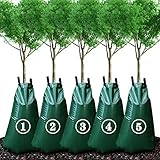
- 【BIG CAPACITY】Holds up to 20 gallons of water for deep watering to keep trees hydrated longer, especially in drought or hot weather areas. Most bags typically empty within 5–9 hours, while actual watering time may vary depending on soil type, weather, tree size, and water pressure. In some cases, it may take 5–24 hours to fully empty. Based on our testing, this release rate helps water reach the roots effectively while reducing evaporation in hot or dry conditions.
- 【EASY TO USE】Very easy to use, just wrap this water bag around the trunk, tighten the zipper and pour water in it. For larger trees, you can pull two of these drip irrigations together.
- 【HEAVY DUTY MATERIAL】Made of durable PVC tarpaulin material, UV resistant. Designed with wide water fill hole suitable for universal size hose, and sturdy handle for long time use.
- 【TIMELY HYDRATION】Our carefully tested watering system efficiently nourishes trees, saving you time and water. It guarantees water reaches the roots, preventing waste and evaporation, especially important during hot summers or droughts. Plus, It reduces the risk of waterlogging and root rot for too slow release. These are essential for newly planted or transplanted trees growth.
- 【BUY WITH CONFIDENCE】Thank you very much for your great support. Product quality and customer satisfaction is our top priority. If you're not completely satisfied with anything you get from us, contact us and we'll make it right.
Why one symptom is not enough
Leaf scorch is often interpreted as proof that an aspen needs water, but scorch simply means leaf tissue has been injured. Drought is one possible cause. Restricted or lost roots, construction or tilling, excess fertilizer, a nearby soil sterilant, dehydration during a dry winter and spring, overirrigation, and trunk or branch injuries that interrupt water movement can all produce scorch. Do not use a brown edge alone to decide that more irrigation is appropriate.
Read the timing as well as the appearance
Note whether symptoms appeared after an extended dry period, an unusually dry winter or spring, a heat or wind event, or a change in irrigation. Early fall color and leaf drop can be a drought response, but they can also follow disease or wet-soil root injury. A gradual decline over several seasons suggests a different level or duration of stress than a sudden change after construction, trenching, or a chemical application. Date photographs and repeat them from the same viewpoint so you can tell whether the crown is stabilizing, spreading, or losing leaves in successive waves.
A step-by-step drought check
Use the following sequence before changing irrigation. It is designed to separate a genuinely dry root zone from lookalike problems while preserving observations that a diagnostician can use.
Quick wins for a faster PC:
Fix the driver behind crashes, sound loss and screen glitchesFind Drivers →Clear out junk files and repair common Windows errorsFree Scan →- Survey the entire tree. Stand far enough away to see the crown, then inspect the trunk, major branches, and ground around the root zone. Note whether symptoms are concentrated at the top, on one side, in the interior, or throughout the crown. Record when the change began and whether it is getting worse. Also note whether leaves on sun-exposed and shaded sides look different.
- Compare the crown pattern. Drought-related symptoms commonly become apparent higher in the crown and progress downward. Damage associated with excess soil moisture more often starts in the lower, inner crown and moves upward. This is a clue from Colorado State University Extension, not a guarantee; wind, sun exposure, branch injury, and other site differences can alter the pattern.
- Examine several leaves closely. Look at both sides of leaves from healthy-looking, affected, and newly damaged areas. Decide whether discoloration is mostly uniform along margins or appears as discrete spots, halos, patches, rings, or raised black structures. Photograph representative leaves in good light and keep a note of their location in the crown. A hand lens can help reveal small flecks, but a photograph is still useful for an Extension diagnostician.
- Test soil moisture at root depth. Dig or probe approximately 8 to 10 inches below the surface in several locations beneath the canopy, avoiding the immediate trunk flare. Feel the soil rather than judging by its surface appearance. Under the cited Colorado State guidance, soil that feels wet or holds together as a ball when squeezed does not need irrigation. If one spot is unusual, test additional spots because compacted soil, mulch, rocks, and irrigation coverage can make moisture uneven.
- Review recent site conditions. Check local rainfall and irrigation history, unusual heat or wind, a dry winter or spring, new pavement or construction, trenching, grading, root cutting, fertilizer application, herbicide or soil-sterilant use, and any broken or injured limbs. These details can explain water-transport failure even when the surrounding soil is moist.
- Compare nearby aspens. If several trees in the same stand show the same timing and pattern, a shared weather or soil factor becomes more plausible. If one tree is affected while nearby trees remain normal, investigate root loss, trunk injury, drainage differences, or a localized pest or disease problem. Similar symptoms in nearby trees do not prove a common cause, but they are important context.
- Document and escalate when needed. Keep dated photographs and notes about soil moisture and crown progression. If symptoms persist, spread, or remain unexplained, contact a local Extension office or qualified tree diagnostician. Colorado State University Extension recommends submitting a branch sample that still has leaves attached or providing clear photographs.
How to distinguish drought from common lookalikes
Use four questions together: where in the crown did symptoms begin, what do the leaf surfaces look like, is the root-zone soil dry or wet, and what happened at the site recently? No single answer identifies the cause, but the combination can prevent harmful overwatering.
| Clue | Pattern more consistent with drought | Pattern suggesting another cause |
|---|---|---|
| Crown progression | Symptoms appear higher in the crown and move downward. | Excess-moisture injury often begins in the lower, inner crown and moves upward. |
| Leaf appearance | Wilting, smaller leaves, early color, premature drop, or fairly uniform marginal scorch. | Distinct flecks, yellow halos, tan-to-brown patches, concentric rings, or raised black bodies point toward a foliage disease. |
| Soil 8–10 inches down | Dry soil supports a drought hypothesis, especially after a dry period. | Wet soil or soil that forms a ball when squeezed is a reason not to add irrigation under CSU guidance. |
| Site history | Extended heat, low precipitation, dry winter or spring, or inadequate irrigation. | Construction, root cutting, compacted or poorly drained soil, fertilizer, sterilant, or trunk and branch injury. |
Overwatering and poor drainage
Aspen is susceptible to injury from saturated or poorly drained soil. Broad-leaved trees affected by excess soil moisture often develop discoloration in the lower and inner crown first, then show symptoms higher in the tree. Interveinal discoloration and midsummer leaf fall with little marginal scorch are additional clues described by Colorado State University Extension. Because wet roots cannot function normally, adding more water to a wet root zone can worsen the problem rather than correct it.
Rank #2

- Package Include: You will receive 12 slow release tree watering bags, these are suitable for planting saplings in the arid areas or in the dry wheater, they can increase survival rate of saplings in the dry season well.
- Durable Material: These automatic tree drip irrigation bags are made of premium PE material and surface of these drip irrigation bags is sunlight-proof, so they are resistant to aging so you can keep them for a long time for not one-season use.
- Easy To Use: First, you need to place a tree watering bag around the bottom of the trunk, then tighten the zipper on the drip irrigation bag, finally you can put the water pipe into the water injection port at the top of the bag and fill the tree watering bag with water.
- Efficiently Work: These tree drip irrigation bags are all with a large capacity fo 20 gallon, and after you install these irrigation bag and fill them with water, the water in the bag body will slowly release and penetrate into the soil and trunk within 4-5 hours to keep the roots of the saplings moist.
- Of Great Benefits: These tree drip irrigation bags can save more than 30% of water than traditional irrigation methods, they are also very adaptable and do not pick soil, at the same time, they save lobor and can be used with nutrient solutions to improve the quality of tree growth.
Do not infer that a dry-looking surface means the roots are dry. Conversely, do not assume that recent irrigation reached the full root zone. Check at depth in more than one place and consider differences caused by compacted soil, slopes, or uneven emitters. Mulch can keep the surface looking moist while deeper soil is dry, or can hide a saturated area after repeated irrigation.
Leaf scorch from non-drought causes
Scorch can follow poor or restricted root growth, root loss during tilling or construction, excess fertilizer, a nearby soil sterilant, dehydration during a dry winter and spring, overirrigation, or damage to a trunk or branch that disrupts water movement. A tree with a girdled or otherwise injured stem may have moist soil but still fail to deliver water to leaves. Look for the relevant site event and inspect the trunk and major branches instead of treating scorch as an automatic watering signal.
Marssonina leaf spot
Marssonina commonly starts as dark-brown or nearly black flecks, often surrounded by yellow halos. Heavy infection can cause leaves to fall early, making the tree look drought-stressed. Distinct spots and halos on individual leaves are more informative than an even brown edge. Colorado State University Extension notes that this disease develops readily in wet, cool weather, so weather history matters when interpreting the pattern.
Ink spot
Ink spot, a disease commonly associated with mountain aspen, begins as tan-to-brown areas. Lesions may develop concentric rings and later form raised black fungal bodies. Those ink-like structures are a strong reason to seek a disease diagnosis rather than simply increasing irrigation. As with Marssonina, early leaf loss can occur.
Insects, cankers, and borers
Aphids, scale insects, cankers, and borers are among the other problems described by the Colorado State Forest Service. Borers are more likely to attack injured or already stressed trees. Inspect bark, branch junctions, and twigs for abnormalities, but do not assume that an insect is the primary cause without matching the timing and symptom pattern. Drought can increase susceptibility to secondary pests, so both conditions may be present.
What to do when the soil is actually dry
Provide supplemental water carefully
In arid parts of the western United States, aspens may need supplemental irrigation during dry periods. If soil is dry at 8 to 10 inches and the crown pattern and leaf symptoms fit water shortage, provide water according to local Extension or arboricultural guidance for the site. Recheck moisture at depth rather than relying on a fixed calendar schedule. Soil type, tree size, weather, slope, mulch, and irrigation equipment all change how quickly the root zone dries.
Avoid both extremes. Applying water to already wet soil can injure roots, while a brief surface sprinkling may leave deeper roots dry. The goal is to restore an appropriate root-zone moisture condition and then monitor it, not to keep the ground continuously saturated. If only one part of the canopy is affected, check moisture and irrigation coverage on that side rather than assuming the entire site has the same condition.
Understand what irrigation cannot repair
Watering cannot reverse leaf tissue that has already been scorched or killed. Proper care can support new growth and the tree’s future recovery, but brown margins will not turn green again. If fine roots have died, improvement may be delayed even after moisture is corrected. Continue observing new leaves, crown progression, and soil moisture rather than judging success solely by old damaged foliage. A delayed response does not necessarily mean that additional water is needed.
What to do when the soil is wet
If soil at the tested depth is wet or forms a ball when squeezed, the cited CSU guidance says it does not need irrigation. Pause additional watering while you investigate drainage, irrigation coverage, recent heavy rain, and the lower-crown pattern. Look for interveinal discoloration, midsummer leaf drop, or other evidence of wet-soil injury. Persistent symptoms warrant a local diagnosis because correcting the wrong problem can extend root damage.
When a professional diagnosis is the safest next step
Seek help when the cause is unclear, symptoms continue despite appropriate soil moisture, several possible causes overlap, or the tree is losing foliage rapidly over successive observations. Contact a local Extension office, municipal tree service, or qualified tree diagnostician familiar with regional aspens. Send a branch with leaves attached when requested, or provide sharp photographs showing whole-tree architecture, affected crown areas, leaf close-ups, trunk and branch injuries, and the surrounding soil. Include dates, watering and rainfall history, construction or root disturbance, fertilizer or chemical applications, and whether nearby aspens are affected.
Outdated Drivers Are Slowing You Down
One free scan finds every outdated or missing driver and matches the right update for your exact hardware.Free scan · exact hardware matchWindows Errors? Fix Them Before They Spread
Repair common Windows errors and clear accumulated junk for a smoother, more stable PC - no reinstall needed.Free scan · no reinstallRank #4

- 🌳 Made Tree Watering Easy:Keep your trees stronger and healthier with this premium tree watering bag designed for slow release irrigation. It delivers water directly to the root zone over 5–8 hours, ensuring deep soil penetration, reducing runoff, and improving water absorption. Ideal for newly planted trees and young saplings that need consistent hydration.
- 💧 Efficient Slow Release Irrigation System:This tree irrigation bag provides an eco-friendly and efficient watering solution by gradually releasing water where trees need it most. Compared to traditional watering methods, it minimizes waste while maintaining evenly moist soil—perfect for hot summers, drought conditions, and long-term tree health.
- 🛡️ Durable, UV-Resistant & Leak-Proof Design:Built from heavy-duty, UV-resistant materials, this tree water bag is designed to withstand harsh outdoor environments season after season. Reinforced seams and a secure zipper system ensure reliable performance and leak-free watering, even with repeated use.
- ⚙️ Easy to Install & Use No digging, staking, or tools required. Simply wrap the watering bag around the tree trunk, zip it up, and fill through the wide 3” opening. The setup takes just minutes, making it an easy tree irrigation solution for homeowners, landscapers, and gardening professionals. Refill as needed 1–2 times per week.
- 🌿 Versatile Use & Ideal for New & Established Trees Suitable for street trees, garden trees, park trees, shrubs, and newly planted trees, this watering bag for trees is ideal for both residential and professional landscaping use. It helps reduce transplant shock, improve survival rates, and ensure long-term healthy growth in all environments. Great for homeowners, landscapers, and anyone looking for an easy tree irrigation solution.
Regional advice matters. The practical guidance summarized here comes primarily from Colorado State University Extension and the Colorado State Forest Service, with a USDA Forest Service Rocky Mountain field guide supporting the general drought symptom cluster. Conditions outside Colorado or the Rocky Mountain region may change disease prevalence, soil behavior, and irrigation recommendations.
Independent reader supportYour contribution helps us test, update, and keep practical guides available for everyone.A practical decision path
Use this short sequence whenever an aspen suddenly looks wilted, brown, or early-dormant:
- Dry soil plus a higher-crown, downward pattern: drought is plausible; provide carefully controlled supplemental irrigation suited to the site and continue monitoring.
- Wet soil plus lower-inner discoloration that moves upward: do not add water; investigate saturation, drainage, and root function.
- Distinct dark flecks with yellow halos: investigate Marssonina or another leaf-spot problem.
- Tan-to-brown patches with rings or raised black bodies: investigate ink spot, particularly on mountain aspen.
- Scorch with construction, root cutting, fertilizer, sterilant, or trunk injury: treat the site history as a major diagnostic clue rather than assuming drought.
- No clear pattern or continuing decline: submit photographs or a leaf-bearing branch to a local diagnostic service.
The central rule is simple: use symptoms to decide what to investigate, and use soil moisture and a complete site history before deciding to water.
Frequently Asked Questions
Can wilted aspen leaves prove the tree needs water?
No. Wilting can accompany prolonged drought, but scorch, root loss, wet-soil injury, chemical exposure, and trunk or branch damage can produce similar symptoms. Check soil 8 to 10 inches deep and compare the crown pattern before irrigating.
The Tool Desk
Outbyte Driver Updater FREEScan for outdated or missing drivers - takes under a minuteDriver Scan →Outbyte PC Repair FREEClear out junk files and repair common Windows errorsFree Scan →How deep should I check soil moisture?
Check approximately 8 to 10 inches below the surface in several locations beneath the canopy. If the soil feels wet or holds together as a ball when squeezed, Colorado State University guidance says it does not need irrigation.
Best Value

- Time-saving: if you got sick of manually watering trees in the Hot Summer over and over again with the hose.Tree Watering Bags Simply fill the bags with a hose or bucket, and they will provide continuous hydration for your plants, requiring only one simple operation from you.especially for maintaining large areas of trees
- Drought Savior: The stable water release function ensures continuous moisture at the roots of trees, sparing you the hassle of manually watering them repeatedly during hot summer days. Providing timely hydration for trees ensures their healthy growth.
- Strong Material: tree watering bags are made of Sturdy PVC material, ensuring durability and reliability for long-term use. they are resistant to tearing, eliminating concerns about damage if snagged. The sturdy material can easily withstand the pressure when the bags are filled.
- Slow Release Design: Each tree watering bag has a capacity of 20 gallons, ensuring that trees receive sufficient water during drought seasons or in the early stages of planting. The water is released slowly, penetrating into the ground to avoid wastage. Release time is between 8 hours.
- Easy Installation and Use: Ensure that trees are at least 25 inches above the ground with branches, and that one bag fits tree trunk diameters of 2-8 inches. Wrap the bag around the base of the tree, zip it up, insert the hose, and start filling. For larger trees, multiple bags can be connected together for use.
Why is my aspen brown even though the ground is wet?
Wet or poorly drained soil can injure aspen roots and cause discoloration, often beginning in the lower, inner crown and moving upward. Overirrigation, fertilizer, root damage, or disease may also be involved. Do not add water until the cause is clearer.
What leaf details suggest disease instead of drought?
Dark flecks with yellow halos suggest Marssonina leaf spot. Tan-to-brown patches that develop concentric rings or raised black fungal bodies suggest ink spot. These distinct lesions differ from more uniform marginal scorch.
Will watering turn scorched leaves green again?
No. Dead or scorched tissue cannot be reversed. Correct moisture can support future growth, but recovery may be delayed if drought has killed fine feeder roots.
Free tools Windows power users keep installed
One-click scans. No signup required.
When should I ask for a professional diagnosis?
Ask when symptoms persist, spread, recur despite appropriate soil moisture, or do not fit a clear pattern. A local Extension office or qualified diagnostician can use clear photographs or a branch sample with leaves attached.
The Bottom Line
Do not diagnose drought from brown leaves alone. Inspect the crown pattern, look for spots or fungal bodies, test soil 8 to 10 inches deep, and review recent site disturbance. Water only when the root zone is genuinely dry; wet soil, disease, root injury, and chemical damage require a different response.
Quick Recap
Product prices and availability are accurate as of the date/time indicated and are subject to change. Any price and availability information displayed on Amazon at the time of purchase will apply.

