
Free tools Windows power users keep installed
One-click scans. No signup required.
iTechGuides is reader-supported. When you buy through links on our site, we may earn an affiliate commission. As an Amazon Associate I earn from qualifying purchases. Learn more
Do not store a Ryobi battery in a car. Remove the pack whenever you park and keep it indoors in a dry, sheltered place away from heat, direct sunlight and conductive metal objects. The RYOBI 18V RB1840C operator manual says, “To reduce the risk of serious personal injury, do not store outside or in vehicles.” RYOBI Australia gives the same instruction, and the U.S. Fire Administration (USFA) specifically warns against putting lithium-ion batteries in direct sunlight or keeping them in hot cars.
A battery carried briefly to a job site is a transport situation, not permission to leave it in a parked vehicle. The available manufacturer and agency guidance does not establish a universal number of safe hours for in-car transport, so treat the car as a transit point and take the battery inside at your destination.
The direct answer: take the battery out when you park
A RYOBI ONE+ 18V lithium-ion pack should not be stored in a parked car, regardless of whether it is in the trunk, glove box, center console or a tool bag. The cited RB1840C manual prohibits storage “outside or in vehicles,” while the USFA says, “Don’t put lithium-ion batteries in direct sunlight or keep them in hot cars.” A shaded parking space or a closed compartment does not turn the vehicle into a controlled storage environment.
When you finish using the tool, remove the battery, check it for obvious damage and bring it indoors. Store it in a dry, sheltered location away from heaters, radiators, windows receiving strong sun and loose metal items. Use the operator manual supplied with your exact battery model for any model-specific limits.
#1 Best Overall
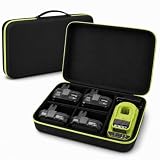
- For ryobi case fits for: For ryobi 18v battery box fits for TTI 18 Volt for Ryobi Charger PCG002/ for Ryobi P118B 18V Battery Charger/ P119 ONE+NiCad Lithium Ion battery charger/ for ryobi 12v battery charger. For ryobi battery bag is also compatible with various types of batteries -- for Ryobi PBP005 ONE+18V Lithium Ion 4.0 Ah/3.5Ah/1.5Ah/3.0Ah/2.0Ah/3.8Ah battery. Note: For ryobi 18v battery charger holder is not suitable for 5.0/6.0/6.5AH batteries (Only tool box)
- Separate storage for ryobi battery charger and batteries: For ryobi 18v battery and charger combo organizer is equipped with removable partitions, two long ones and four short ones. The partitions can be placed according to the size for ryobi 18v charger and for ryobi batteries, so as to better fix for ryobi 18v battery and charger, and reduce their friction and collision.
- Strong for ryobi tools combo kit case: For ryobi 18v container made of -quality materials, is against dust and shockproof. So for ryobi 18v tool box protects for ryobi one chargers and 18v for ryobi battery from dust intrusion and prolong their service life. For ryobi charger 18v storage holder with soft line, better protects for ryobi charger station and for ryobi replacement batteries .
- For ryobi one 18v battery bag with smooth zipper: The sturdy zipper for ryobi 18v battery 4.0 ah carrying holder provides good sealing protection for 18 volt for ryobi battery and charger. Double zipper allows you to quickly open and close for ryobi lithium 18v battery organizer and easily access for ryobi 18 volt battery. The color for roby battery container is consistent with color for ryobi batteries 18v lithium, which is simple and beautiful.
- Easy to carry for ryobi one battery case: Batteries for ryobi box has a sturdy handle, for easily carrying cordless tool battery packs to your workplace. For ryobi 18v lithium battery holder is light and compact. You can also put for ryobi replacement battery organizer behind your toolbox and boot, and it won't take up much space. External dimensions of lithium 18v for ryobi battery storage bag: 15.35 * 8.67 * 3.35 inches.
Why a car is a poor battery-storage environment
Heat and direct sunlight
A closed vehicle can become hot even when the outdoor air feels comfortable. A battery exposed to a dashboard, window or metal trunk floor can also receive direct solar heating. The USFA’s lithium-ion guidance therefore names both conditions—direct sunlight and hot cars—as situations to avoid. The agency recommends room-temperature storage when possible.
The manufacturer warning is broader than “avoid hot days”
It is tempting to interpret the advice as a summer-only rule. That is too narrow. The RB1840C manual does not merely say to avoid excessive heat; it says not to store the pack in vehicles. RYOBI Australia’s battery-care guidance likewise says, “Do not store in a vehicle,” and recommends sheltered storage away from temperature extremes and humidity. Follow the stronger manufacturer instruction even on a cool or cloudy day.
Temperature can vary inside one vehicle
The temperature around a battery may differ substantially from the weather report. A pack on a sunlit seat, under a windshield or against a hot body panel is not experiencing the same conditions as one in the shade. Moving it to the trunk or placing it in a case changes its location, not the fact that it is being stored in a vehicle. No source establishes a particular compartment as safe for storage.
What the published instructions actually say
The following table separates the instructions from their scope. The numeric limits come from one identified 18V manual or from general USFA guidance; they are not a universal specification for every RYOBI pack.
| Source | Instruction | How to apply it |
|---|---|---|
| RYOBI 18V RB1840C operator manual | Do not store outside or in vehicles. | Use as the controlling warning for the RB1840C manual’s model and market. Remove the pack from a parked car. |
| RB1840C manual, for storage longer than 30 days | Keep below 27°C and in a “charged” condition of at least 30–50%. | These are the cited manual’s long-storage directions, not verified settings for every RYOBI model. |
| U.S. Fire Administration, Battery Fire Safety | Store lithium-ion batteries at room temperature when possible; do not put them in direct sunlight or hot cars. | General lithium-ion safety advice that reinforces taking the pack indoors. |
| USFA charging guidance | Do not charge lithium-ion batteries below 0°C or above 40°C. | These are general charging limits, not Ryobi storage limits. Check the exact battery and charger manual. |
| RYOBI Support Australia | Do not store in a vehicle; use sheltered storage away from temperature extremes and humidity. | Corroborating regional guidance. Apply its market-specific details with the appropriate local manual. |
Storage versus transporting a battery to a job
The title’s key distinction is whether the vehicle is merely carrying the pack or being used as its storage location. The sources prohibit vehicle storage but do not define a universally safe duration for temporary transport. Use this conservative decision framework:
Rank #2

- Note:External dimensions L*W*H: 13.7*9*4.9 inches. Selling box only; no other items available(18V Battery and Charger Combo for Ryobi 18 Volt Cordless Tools Battery and other accessories are not included).
- I've tried many EVA case, but they were low-quality. So I created my own using EVA material. Tested results: waterproof, scratch-proof, and shock-resistant.
- For the inner materials, I chose three options: velvet (great for Velcro integration), super-soft fabric for maximum protection, and common Jersey fabric.
- To create a perfect-fit case, I'll first get an 18V Battery and Charger Combo for Ryobi 18 Volt Cordless Tools Battery,then customize the case specifically for it. It takes time, but that's what makes the fit just right.
- Tourmate Hard Case is here! With a sturdy shell, soft lining, plus handle, clasps, and straps—all custom-designed for Tourmate's needs. Made to bring you tidy, hassle-free convenience!
| Situation | Recommended action | What is established |
|---|---|---|
| Driving directly to a job or workshop | Carry the pack secured against movement, then take it indoors when you arrive. | The sources address storage, not a universal transport-time limit. |
| Leaving the car while running an errand | Remove the battery rather than leaving it in the vehicle. | The RB1840C manual says not to store packs in vehicles. |
| Leaving it overnight, for a weekend or between jobs | Bring it indoors and store it in a dry, sheltered place. | No safe in-car duration is established by the cited sources. |
| Keeping a spare pack permanently in the trunk | Do not do this; establish an indoor storage spot instead. | “Do not store in a vehicle” applies regardless of whether the pack is a spare. |
A bag, organizer or hard case may prevent scratches or movement, but the available guidance does not show that any accessory makes vehicle storage safe. Do not use an accessory as a reason to ignore the manufacturer’s prohibition.
A safe routine after every use
- Switch off and remove the pack. Detach the battery from the tool rather than leaving the tool-and-pack assembly in the car.
- Check the housing and terminals. Look for cracks, swelling, leakage, discoloration, unusual odor, excessive heat or other abnormal changes before putting the pack away.
- Keep it dry. Wipe away surface moisture and place the pack in a sheltered indoor location. RYOBI Australia specifically advises protection from humidity and temperature extremes.
- Separate it from conductive objects. Do not drop a loose battery into a pocket, drawer or toolbox with keys, coins, screws, nails or other metal items. The RB1840C manual warns that bridging the terminals can create a short circuit.
- Use the correct charger and manual. If charging is needed, follow the instructions for that battery and charger. Do not charge a pack that is hot, frozen or visibly damaged.
- Return it to indoor storage. The car should be empty of batteries when parked, even if the weather is mild.
Long-term storage: the 30-day guidance
For the RB1840C manual specifically, storage longer than 30 days calls for a temperature below 27°C and a “charged” condition of at least 30–50%. The wording and figures belong to that manual; they should not be presented as verified universal settings for every RYOBI 18V battery, newer pack or regional edition.
How to use those figures correctly
- Identify the model number printed on the battery and open its own operator manual.
- If your manual gives a different long-storage charge level or temperature, follow that manual instead of copying the RB1840C figures.
- Keep the pack indoors in a stable, sheltered location rather than trying to maintain a target temperature inside a vehicle.
- Do not interpret “30–50%” as a requirement to discharge a battery aggressively. If the pack is already outside the specified range, use the approved charging or tool procedure in the manual.
The RB1840C document does not establish a safe way to leave the pack in a car for 30 days—or for any other fixed period. Its long-storage advice assumes an appropriate storage place, not a vehicle.
What to do if you accidentally left a Ryobi battery in the car
1. Remove it as soon as you can do so safely
Take the battery out of the parked vehicle and move it to a dry, shaded indoor area. Do not continue storing it in the glove box, trunk or a tool case inside the car while you decide what to do.
2. Do not charge it while it is hot or cold
Inspect the pack before connecting a charger. USFA’s general guidance says not to charge lithium-ion batteries below 0°C or above 40°C. Those limits concern charging, not a universal Ryobi storage range, and they do not override the exact battery manual. If the pack is outside the permitted condition, allow it to return to an appropriate indoor temperature and consult the model instructions.
Rank #3

- COMPATIBILITY CHECK: This battery storage case fits compact batteries for Ryobi ONE+ 18V in 1.5Ah, 2.0Ah, 3.0Ah, 3.5Ah, 3.8Ah and 4.0Ah sizes, plus select chargers including PCG002, P118B and P119. Not designed for 5.0Ah, 6.0Ah or 6.5Ah batteries. Case only
- CUSTOM 6-DIVIDER STORAGE: Two long and four short removable dividers create dedicated sections for battery packs, a charger and small accessories. The separated layout helps reduce contact, shifting and workshop clutter
- HARD-SHELL EVERYDAY PROTECTION: The structured shell and soft lining help shield stored power tool batteries from dust, scratches and light bumps during normal storage and transport. No batteries, charger or tools are included
- FAST ACCESS & EASY CARRY: Dual zippers open wide for quick battery selection, while the reinforced handle supports trips between the garage, workshop, vehicle and jobsite
- SIZE BEFORE YOU BUY: External dimensions are 15.35 x 8.67 x 3.35 in. Compare the dimensions of your complete battery-and-charger setup with the case size and divider layout before ordering
3. Look for warning signs
Do not use or charge a pack that has an odor, color change, excessive heat, shape change, leakage or unusual noises. These are warning signs listed by USFA. A battery that only became warm in the car but shows no damage still should be removed from the vehicle; the incident is not a reason to make vehicle storage routine.
Quick wins for a faster PC:
Clear out junk files and repair common Windows errorsFree Scan →Fix the driver behind crashes, sound loss and screen glitchesFind Drivers →Repair Windows errors before they cause bigger problemsFix Now →4. Isolate a suspect pack without creating another hazard
Keep a damaged or abnormal battery away from people, flammable materials and metal objects, and follow local hazardous-battery disposal or service instructions. Do not puncture, crush, open or attempt to repair the pack. The cited sources do not authorize a consumer repair procedure.
Car locations that do not solve the problem
Dashboard or passenger seat
These areas can receive direct sunlight through the windshield or side windows. They are especially poor locations under the USFA’s hot-car and direct-sunlight warning.
Glove box or center console
Enclosing the battery blocks some sunlight but does not remove the vehicle-storage prohibition. Interior compartments can still heat up, and they may contain coins, keys or other metal objects that could contact the terminals.
Trunk or cargo area
A trunk may be darker, but it remains part of the vehicle and can experience temperature extremes. The RB1840C instruction does not provide an exception for cargo areas.
Rank #4

- COMPATIBILITY CHECK: This battery storage case fits compact batteries for Ryobi ONE+ 18V in 1.5Ah, 2.0Ah, 3.0Ah, 3.5Ah, 3.8Ah and 4.0Ah sizes, plus select chargers including PCG002, P118B and P119. Not designed for 5.0Ah, 6.0Ah or 6.5Ah batteries. Case only
- CUSTOM 6-DIVIDER STORAGE: Two long and four short removable dividers create dedicated sections for battery packs, a charger and small accessories. The separated layout helps reduce contact, shifting and workshop clutter
- HARD-SHELL EVERYDAY PROTECTION: The structured shell and soft lining help shield stored power tool batteries from dust, scratches and light bumps during normal storage and transport. No batteries, charger or tools are included
- FAST ACCESS & EASY CARRY: Dual zippers open wide for quick battery selection, while the reinforced handle supports trips between the garage, workshop, vehicle and jobsite
- SIZE BEFORE YOU BUY: External dimensions are 15.35 x 8.67 x 3.35 in. Compare the dimensions of your complete battery-and-charger setup with the case size and divider layout before ordering
Tool bag or organizer left inside
A container can keep a pack from rolling around, but it does not establish a safe temperature or make in-car storage compliant with the manual. Take the entire bag indoors when you park.
Independent reader supportYour contribution helps us test, update, and keep practical guides available for everyone.Preventing terminal short circuits
A loose battery’s contacts must not touch conductive objects. The RB1840C manual specifically warns against bridging the terminals with metal. In practical terms:
- Do not place a battery in the same unpartitioned compartment as coins, keys, screws, nails, drill bits or loose wire.
- Do not let the terminals contact another battery’s terminals or exposed metal tool parts.
- Keep the original protective packaging or a purpose-designed compartment if your manual permits it, but do not treat that protection as permission to store the pack in a car.
- If a terminal is visibly damaged or contaminated, stop using the battery and seek model-specific service or disposal advice.
Temperature, humidity and seasonal conditions
Hot weather
Hot weather is the clearest reason to reject car storage, but it is not the only one. Direct sun and heat can affect a pack even during a short stop. Remove the battery before leaving the vehicle.
Cold weather
The cited RYOBI Australia guidance addresses cold-weather care and still says to store the battery in a sheltered place away from temperature extremes and humidity. Do not infer that freezing conditions make a vehicle acceptable. If a cold pack needs charging, use the exact model’s instructions; USFA’s general guidance says not to charge lithium-ion batteries below 0°C.
Crashes, No Sound, or Screen Glitches?
Random freezes, missing sound and display glitches usually trace back to one bad driver. Find and replace yours safely.Free scan · under a minutePC Slower Than It Used to Be?
A free scan shows the junk files, broken settings and background clutter dragging Windows down - then fixes them in one click.Free scan · Windows 10 & 11Rain, condensation and humidity
A car can protect a battery from falling rain while still exposing it to condensation and changing humidity. Store the pack indoors in a dry, sheltered location, and do not put a wet battery on a charger.
Best Value

- Tool battery organizer, designed for 12v/18v/40V battery and charger case, this battery organizer is suitable for ryobi 12v/18v/40V (PBP002 PBP003 PBP004 PBP005 PBP006 PBP007 P102 P103 P104 P105 P106 P107 P108 P189 P190 P191 P192 P193 P194 OP4040 OP4050) battery and charger, size of the hard case: 13.5 x 12.2 x 3.7 inches
- The hard case is suitable for different sizes of ryobi 18v lithium battery and contains 5 removable dividers for free DIY storage space inside the hard case, each ryobi oneplus battery can be separated by removable and adjustable baffles to avoid 18 volt ryobi battery from being bumped
- This hard case replacement for ryobi 40 volt battery is made of high quality EVA material, shockproof, dustproof and waterproof, protect your ryobi 40v lithium battery from impact and splash
- The hard shell can ensure your ryobi lithium 18v battery is safe and convenient, with light weight. The classic zipper design makes it easy to open and close.
- Note: Only case is sold, ryobi battery and charger are not included.
Recognizing a battery that should be retired
USFA lists several abnormal signs that warrant stopping use:
- Unusual odor
- Color change
- Excessive heat
- Change in shape, including swelling
- Leaking
- Odd noises
These signs are not normal “heat soak” that can be solved by moving the battery to shade. Stop using the pack and follow safe service or disposal guidance for your area. Do not place a suspect battery back in a vehicle for a trip to an unknown destination without first obtaining appropriate instructions.
If a lithium-ion battery catches fire
Leave the area, get other people away and call emergency services. USFA says that when a lithium-ion battery fire occurs, you should get out and call 911 rather than trying to extinguish it yourself. Do not re-enter a vehicle or enclosed space to retrieve tools or another battery.
What’s actually slowing this PC down?
Pick the symptom - the matching free tool is one click away.
Check the manual for your exact Ryobi model
The strongest numeric details available here come from the RB1840C 18V battery manual, while the supporting storage statement comes from RYOBI Australia. Battery labels, model numbers, editions and regional instructions can differ. Before setting a long-term storage routine:
- Read the model number printed on the battery.
- Locate the operator manual supplied for that model and your market.
- Check its storage temperature, charge condition, charging limits and damaged-battery instructions.
- Use the stricter instruction when general advice and the model manual appear different, or contact RYOBI support for clarification.
Until that check is complete, the safe default remains simple: remove the pack from the vehicle and store it indoors, dry, sheltered and away from conductive metal.
Quick Recap
Quick checklist
- Battery removed from the car whenever you park.
- Indoor, dry and sheltered storage location selected.
- No direct sunlight, heaters or other heat sources nearby.
- No keys, coins, screws or other conductive objects touching the terminals.
- Exact model manual consulted for long-term charge and temperature instructions.
- Pack rejected if it smells unusual, changes color or shape, leaks, becomes excessively hot or makes odd noises.
- Emergency response planned: leave and call 911 for a lithium-ion battery fire.
Product prices and availability are accurate as of the date/time indicated and are subject to change. Any price and availability information displayed on Amazon at the time of purchase will apply.

