
iTechGuides is reader-supported. When you buy through links on our site, we may earn an affiliate commission. As an Amazon Associate I earn from qualifying purchases. Learn more
Decision drift is a useful name for the widening gap between what you say matters and what your choices and attention actually serve. It is not an established diagnosis or a validated productivity theory. To narrow that gap, turn a priority into a specific if–then plan, then record when you will revisit it rather than assuming your first decision must stand forever.
What decision drift means—and what it does not
In this article, decision drift means the gradual gap between your stated priorities and the decisions or actions that consume your attention. You might intend to make progress on a major project, for example, but repeatedly choose small, immediate tasks instead. The term describes a recognizable experience; it does not identify a clinical condition or a settled research construct.


The phrase also has other meanings. In Jeff Winter’s organizational framework, “decision drift” describes how algorithmic recommendations can acquire practical authority without an explicit transfer of accountability; he writes, “Before long, the organization is acting as if formal authority has been delegated even though no explicit decision was ever made.” That is an author’s organizational interpretation, not evidence about individual productivity. In technical decision modeling, a “drift rate” refers to evidence accumulation during a choice, not priorities gradually moving out of alignment. Winter’s “12 Laws of Industry 4.0” and a technical paper on decision drift rates use the term in those distinct ways.
Windows Errors? Fix Them Before They Spread
Repair common Windows errors and clear accumulated junk for a smoother, more stable PC - no reinstall needed.Free scan · no reinstallCrashes, No Sound, or Screen Glitches?
Random freezes, missing sound and display glitches usually trace back to one bad driver. Find and replace yours safely.Free scan · under a minuteWhy good intentions can lose to the next thing
A goal intention says what you want: “I want to work on the proposal.” It does not necessarily specify what you will do when the day fills with interruptions or when starting feels inconvenient. An implementation intention makes the next action conditional on a cue: “If it is 9 a.m. and I have opened my laptop, then I will draft the proposal for 25 minutes before checking messages.”
#1 Best Overall
This distinction has meaningful evidence behind it, though not specifically under the label “decision drift.” A 2006 meta-analysis by Peter M. Gollwitzer and Paschal Sheeran covered 94 independent tests and reported an effect of d = .65 for implementation intentions on goal attainment. The authors describe plans that specify when, where, and how goal-directed behavior will begin. They also discuss how such plans can help initiate goal pursuit, protect ongoing efforts from unwanted influences, disengage from failing courses of action, and preserve capacity for later goals. The result is broad evidence across studies and contexts—not a guarantee that any particular routine will work for every person. Read the 2006 meta-analysis on implementation intentions and goal achievement.
Turn one priority into a plan you can actually follow
- Name the priority as an outcome. Replace “be more productive” with something observable, such as “send the revised budget to my manager.”
- Choose a cue you can recognize. Use a time, place, event, or action: “When I finish my first meeting,” or “At 10 a.m. at my desk.”
- Attach one small action to that cue. Write an if–then statement: “If I finish my first meeting, then I will open the budget and revise the staffing section for 20 minutes.” The action should be concrete enough that you know when you have started.
- Decide what will happen when the plan is blocked. Add a fallback if a predictable obstacle could derail it: “If the meeting runs past 10:30, then I will use the first 20 minutes after lunch.” Avoid making the fallback so elaborate that it becomes another task.
- Set a review point. Note when you will check whether the plan still fits the priority. A review date or trigger is a practical way to make a decision revisitable; the cited studies do not directly test a personal decision-review ritual.
A paper notebook, digital note, or calendar entry can all hold the same short record: priority, cue, action, obstacle plan, and review point. A dedicated decision journal is optional; the evidence supports the planning strategy, not a particular notebook or app.
Rank #2
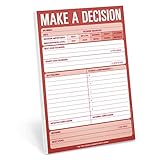
- Give good guidance—whether it's a commonplace or life-altering choice
- Pad is 6 x 9 inches and has 60 sheets
- Reduce your chances of regret by more than 83.4 percent
- Knock Knock is a maker of clever gifts, books, and whatever else they can think up; their mission is to bring humor, creativity, and smarts to everyday life
Review decisions without turning every choice into a debate
Not every choice deserves repeated reconsideration. For a routine, low-consequence decision, a simple default may protect attention. For a meaningful decision that could become stale, record the reason for choosing it and a concrete condition that would justify reopening it. For example: “Keep the current reporting schedule unless the project deadline changes.” The trigger makes review intentional instead of letting every doubt restart the decision.
What’s actually slowing this PC down?
Pick the symptom - the matching free tool is one click away.
This is a practical application of planning and self-regulation, not a review method proven by the cited studies. Keep notes brief: what you chose, why it matched the priority, what action follows, and what specific change would prompt a review. If the trigger never occurs, you do not need to revisit the choice just because it is on your mind.
Why a plan is not a promise of success
Evidence for implementation intentions should not be stretched into the claim that any prompt or plan reliably changes behavior. A randomized field experiment involving 877 gym participants found that a simple planning prompt did not improve repeated exercise behavior. The study-specific participant count is not a population estimate, and the available account does not provide an estimated treatment effect. Its authors leave open whether more elaborate interventions could help. See the 2018 gym field experiment.
The useful takeaway is not to abandon planning, but to match confidence to the evidence: a broad meta-analysis found benefits across goal-attainment tests, while one field study found no improvement from a simple prompt for repeated gym attendance. If a plan is not working, examine whether the cue is clear, the action is manageable, and the circumstances have changed; do not assume that writing down an intention is enough.
Independent reader supportYour contribution helps us test, update, and keep practical guides available for everyone.Fewer choices can reduce effort without improving the choice
Filtering a list or shortlisting options can make a decision feel easier, but ease is not the same as quality. A 2026 article’s search-result summary reports that choice-overload performance effects remained in two experiments even when options were filtered or shortlisted. The full article page was not accessible, so this should be treated as a limited high-level report, not a basis for claims about all choices or all people. The 2026 choice-overload article is available from its publisher.
Recommended Free Tools
For a consequential choice, first define the criteria that matter to your priority, then compare the remaining options against those criteria. Shortlisting can reduce the work of looking; it cannot by itself establish that the final option best serves your goal.
Quick Recap
Best Value
Product prices and availability are accurate as of the date/time indicated and are subject to change. Any price and availability information displayed on Amazon at the time of purchase will apply.

