
What’s actually slowing this PC down?
Pick the symptom - the matching free tool is one click away.
iTechGuides is reader-supported. When you buy through links on our site, we may earn an affiliate commission. As an Amazon Associate I earn from qualifying purchases. Learn more
Yes—you can run one large language model across several Apple-silicon Macs. MLX and MLX LM shard the model, while JACCL carries the inter-Mac traffic over Thunderbolt RDMA. The practical recipe is to connect the Macs with Thunderbolt 5, enable RDMA on supported macOS systems, generate a topology-aware hostfile with mlx.distributed_config, and start the workload with mlx.launch.
Choose tensor parallelism when you need concurrent work on every layer and have a low-latency, fully connected mesh. Choose pipeline parallelism when fitting the model is the main problem, communication simplicity matters, or the model implements pipeline support. Neither mode guarantees linear speedups: results vary by model, context length, Mac generation, and topology.
What “splitting an LLM across Macs” means
A model normally loads its weights and runs its layers on one machine. Distributed MLX instead places portions of that same model on multiple Apple-silicon Macs. The machines cooperate during inference, so the model can use the aggregate unified memory of the cluster rather than the memory of a single Mac.
Do these 3 things before closing this tab:
1Clear out junk files and repair common Windows errors2Scan for outdated or missing drivers - takes under a minute3Repair Windows errors before they cause bigger problemsDistribution solves two different problems:
- Capacity: a model that cannot fit in one Mac may fit when its weights and runtime buffers are divided among several Macs.
- Throughput or latency: some workloads can run faster when computation is shared, although communication overhead can erase much of the theoretical gain.
Every node still needs MLX and MLX LM installed, and the executable path used by the launcher must exist on every node. Aggregate memory is not the same as usable model capacity: leave room for the runtime, temporary tensors, attention state and the context length you intend to serve.
#1 Best Overall

- Peak Performance with Thunderbolt 5: Experience superior performance, enabling 80Gbps data transfers and 240W fast charging for powerful multi-display setups.
- Lightning-Fast File Transfers: Move 5GB files in just 1 second with advanced 80Gbps transfer speeds.
- 8K Display Capabilities: Support for dual 8K displays at 60Hz delivers stunning clarity and detail with up to 120Gbps bandwidth.
- 240W USB-C Charging: Charge a 16-inch MacBook Pro (M3 Pro) to 50% in just 26 minutes with ultra-fast 240W USB-C charging.
- What You Get: Anker Prime Thunderbolt 5 Cable (3.3 ft, 80Gbps, 240W), welcome guide, 18-month warranty, and our friendly customer service.
Pipeline versus tensor parallelism
| Characteristic | Pipeline parallelism | Tensor parallelism |
|---|---|---|
| What is divided | Contiguous groups of layers by model depth | Each layer’s weight matrices and computation by model width |
| Communication pattern | Activations move between layer groups | Collective communication occurs through the layers and for each token |
| Network requirement | Simpler links can be sufficient, depending on the implementation | Low latency and a fully connected mesh are important |
| Model requirement | The model implementation must expose pipeline support | Use the standard tensor-sharding path when the model and topology support it |
| Decode behavior | Apple describes decode speed as generally similar to one machine | Can improve token rate, but scaling is workload-dependent |
| Best reason to choose it | Fit a model that exceeds one Mac’s memory or avoid tensor divisibility constraints | Increase inference speed with a suitable, tightly connected cluster |
Pipeline parallelism
Pipeline mode assigns consecutive layers to different Macs. A token’s hidden state travels from one stage to the next, so the stages remain sequential during decoding. That limits decode acceleration, but large-context prefill can overlap work across stages. Apple’s described 65,536-token benchmark reached up to approximately 1.8× prefill beziehungsweise time-to-first-token improvement; that figure is specific to the cited workload, model and hardware, not a universal promise.
Pipeline mode does not require tensor-parallel divisibility rules. Its non-negotiable constraint is software support: the model architecture must implement the pipeline interface expected by MLX. If it does not, adding --pipeline will not make it compatible.
Tensor parallelism
Tensor mode shards every layer across the Macs. Each node holds a portion of each layer and participates in the same token computation. This can raise token rates, but it also creates communication at every layer and token. A slow or incomplete network mesh can therefore dominate runtime.
MLX LM uses tensor parallelism by default in Apple’s multi-Mac walkthrough. Use that default only after verifying that every node can communicate with every other node through the intended JACCL topology.
How much hardware do you need?
Apple-silicon Macs and memory
Use Apple-silicon Macs with enough combined unified memory for the model and inference overhead. The nodes do not have to be identical for the software to launch, but mixed hardware can make the fastest node wait for a slower one and complicate capacity planning. Treat the smallest-memory node as a constraint when deciding how to shard.
Very large models illustrate why clustering matters. Apple’s 2026 Machine Learning Research article says the BF16 parameters of Muse Spark Open exceed 1.6 TB and that its 4-bit NVFP4 footprint is about 493 GB before intermediate inference memory. A multi-Mac setup can make such a footprint conceivable, but the quoted sizes are parameter or model-footprint figures, not a guarantee that a particular cluster can run the model at a chosen context length.
Rank #2

- 240W Superfast Charging: Empower your devices with Superb 240W PD 3.1, charging a MacBook Pro 16" to 56% in 30 minutes. Backward compatible with 140W/100W/65W devices, ensuring future-proof performance for laptops, phones, and accessories
- Lightning 80Gbps Data Transfer: Transfer a 20GB 4K movie in just 3 seconds with USB4 Gen4's 80Gbps bandwidth, 8x faster than standard USB C cables. Perfect for photographers, developers, or anyone moving massive files between SSDs, NAS, or dual computers
- Industry Leading HD Display: Unlock cinematic visuals with DisplayPort 2.1 mode, supporting up to 16K@60Hz and extending to dual 8K@60Hz or triple 4K@144Hz Display. Ideal for gaming rigs, 3D rendering workstations, or multi screen traders demanding ultra smooth, zero lag visuals
- All-in-One Solution: A single USB C to C cable handles 240W charging, 80Gbps data syncing, and 16K max video output. Seamlessly connect USB C laptops, such as MacBook Pro Air, Dell XPS, phones,such as iPhone 16, Galaxy S24, tablets like iPad Pro, monitors, and accessories. Supports Thunderbolt 4 3, USB4, USB 3.2 3.1 3.0, and more
- Sturdy and long-lasting: Solid and durable nylon braided cable ensures longer service life up to 10,000 bends. Double sided USB C connectors with over molded strain relief are designed for frequent insertions, Aluminum housing, high purity copper wire, and triple shielding will keep long lasting fast charging performance
Thunderbolt cabling
For the documented JACCL path, use Thunderbolt 5 cables and direct Mac-to-Mac links. Tensor parallelism requires a fully connected mesh: with four Macs, each Mac needs a direct Thunderbolt connection to each of the other three. MLX can use multiple cables between a pair when the topology and hardware support it.
A ring is not a JACCL mesh. If your physical layout is a ring, use the ring backend and its corresponding configuration rather than claiming it is a fully connected JACCL network. Check cable certification, length and current retailer specifications before buying; those details are separate from MLX configuration.
Software and access prerequisites
- Install MLX and MLX LM on every Mac.
- Ensure the Python executable and MLX LM module path are the same, or otherwise valid, on every node.
- Give the controller Mac SSH access to each node. The distributed launcher uses SSH to start the remote command.
- For automatic network setup, provide passwordless
sudoon each node. Without it, the utility prints commands that you must run manually. - Use systems supported by the JACCL RDMA workflow described below; the documented path starts with macOS 26.2 and Thunderbolt 5.
Enable Thunderbolt RDMA for JACCL
JACCL uses RDMA over Thunderbolt to reduce communication latency between Macs. On supported macOS 26.2-or-later systems, MLX documentation describes enabling Thunderbolt RDMA from macOS Recovery with rdma_ctl enable, then rebooting.
- Start each Mac in macOS Recovery using Apple’s normal Recovery procedure for that model.
- Open the Recovery environment’s command-line utility and run
rdma_ctl enable. - Reboot the Mac into macOS.
- Verify that the RDMA device is visible with
ibv_devices. - Repeat the enablement and verification on every node that will participate in JACCL.
If ibv_devices does not show an RDMA device, stop before launching MLX. Check that the Mac is on a supported macOS release, that the Thunderbolt links are physically connected, and that the Recovery command was applied to every node.
Discover the topology and generate a hostfile
Run mlx.distributed_config from a controller Mac that can SSH to all nodes. The utility checks SSH reachability, discovers physical Thunderbolt connectivity, verifies the mesh and RDMA state, configures interfaces, and writes a hostfile for the launcher.
Free tools Windows power users keep installed
One-click scans. No signup required.
This representative four-node command uses the JACCL backend and Thunderbolt transport:
Rank #3
![Cable Matters [Intel Certified] 80Gbps Thunderbolt 5 Cable, 3.3ft / 1m](https://m.media-amazon.com/images/I/41LqXZjTBYL._SL160_.jpg)
- Unparalleled Speed and Efficiency: Elevate your connectivity with Thunderbolt 5 technology that boasts data transfer rates up to 80 Gbps of bi-directional data transfer and up to 120 Gbps of video bandwidth. The future-proof Thunderbolt cables allow for the rapid synchronization and transfer of large files such as high-resolution videos and complex 3D models, ensuring maximized productivity. Ideal for professionals and enthusiasts who demand the highest data throughput for their workflows.
- Universal Compatibility: Designed for versatility, this Thunderbolt 5 cable seamlessly connects with a wide range of devices, including all Thunderbolt 3, Thunderbolt 4, USB4, and USB-C equipment. Whether you are connecting to the latest laptops, docking stations, or high-resolution displays, this cable ensures you can build a flexible and efficient workspace with widespread compatibility. Performance depends on the capabilities of your host and display/dock.
- Dual 6K or 8K Display Support: Empower your visual experience by connecting dual 6K or dual 8K or triple 4K @144Hz displays, which provide stunning, detailed visuals that are crucial for graphic design, video editing, and other professional applications that require superior display clarity and detail. This cable is optimized for multimedia professionals and content creators who rely on precise color accuracy and sharp image quality for their projects.
- High Power Delivery: With the capability to deliver up to 240W of power and support for PD 3.1, this Thunderbolt 5 cable is a powerhouse for charging high-performance laptops, tablets, and other devices efficiently. Eliminate the clutter and hassle of multiple cables and power adapters in your workspace, as this Thunderbolt cable for Mac provides a high-speed charging solution alongside superior data and video capabilities.
- Thunderbolt 5 Laptop Compatiblity: Fully compatible with newly released Thunderbolt 5 laptops featuring USB-C / Thunderbolt 5 ports, including Acer Predator Helios 16 AI / Helios 18 AI, Alienware 16 / 18 Area-51, MacBook Pro 14 & 16 (M4 Pro / M4 Max), ASUS ROG Strix SCAR 18 G835, Gigabyte AORUS Master 16 AM6H, HP ZBook Fury 18 G1i, Lenovo Legion 9i Gen 10 (18" Intel), MSI Titan 18 HX AI / Raider 18 HX AI / Vector 16 HX AI (A2XW series), and Razer Blade 18.
mlx.distributed_config --verbose --backend jaccl --hosts m3-ultra-1,m3-ultra-2,m3-ultra-3,m3-ultra-4 --over thunderbolt --auto-setup --output m3-ultra-jaccl.jsonReplace the hostnames with resolvable names or addresses for your Macs. The output filename is arbitrary; keep it somewhere the controller can read when you launch the job.
What the configuration command validates
- SSH: the controller can reach every listed host.
- Physical topology: the expected Thunderbolt links are present.
- Mesh completeness: tensor-parallel JACCL operation has a direct path between every pair.
- RDMA: each node exposes the required device.
- Interface setup: MLX’s communication interfaces are configured for the discovered links.
- Hostfile generation: the resulting JSON records the hosts and backend information needed by
mlx.launch.
--auto-setup may need passwordless sudo. If that privilege is unavailable, the command reports the setup commands instead. Run those commands on the appropriate Macs, then rerun discovery without assuming the configuration succeeded.
Launch distributed MLX LM inference
Use the generated hostfile with mlx.launch. The command below follows Apple’s documented pattern:
Quick wins for a faster PC:
Repair Windows errors before they cause bigger problemsFix Now →Scan for outdated or missing drivers - takes under a minuteDriver Scan →Clear out junk files and repair common Windows errorsFree Scan →mlx.launch --verbose --backend jaccl --hostfile m3-ultra-jaccl.json -- /path/to/remote/python -m mlx_lm chat --model mlx-community/DeepSeek-R1-0528-4bitThe model name and remote Python path are deployment-specific. Replace /path/to/remote/python with an interpreter that exists at that path on every node, and use a model identifier that MLX LM can load in your environment. Keep --backend jaccl consistent with the hostfile generated for JACCL.
Confirm that the job is actually distributed
- Use
--verboseand inspect startup output for every host in the hostfile. - Confirm that each Mac launches the MLX LM process rather than only the controller.
- Watch memory usage on all nodes; a node that fills its unified memory can fail even when the cluster total appears sufficient.
- Run a short prompt before testing a long context or sustained generation.
MLX LM handles model sharding and coordination once the distributed command is launched. You do not manually split individual layer files.
Choosing the right mode for your goal
Choose tensor parallelism when speed is the priority
- You have a complete, direct Thunderbolt mesh.
- RDMA is visible on every node.
- The model works with MLX’s default tensor sharding.
- The workload has enough computation to offset per-layer communication.
Apple’s WWDC26 demonstration reported nearly three times the token rate for Qwen 3.6 on four M3 Ultras compared with one M3 Ultra. That is a workload-specific demonstration, not a scaling law for all Mac generations, models or context lengths.
Rank #4

- Featuring a black braided design that coils without tangling, this 1-meter cable supports Thunderbolt 5 data transfer up to 120Gb/s;¹ Thunderbolt 3, Thunderbolt 4, and USB 4 data transfer up to 40Gb/s; USB 3 data transfer up to 10Gb/s; DisplayPort 2.1 video output; and charging up to 240W.
- Use this cable to connect a Mac with Thunderbolt 3, 4, or 5 (USB-C) ports to Thunderbolt (USB-C) and USB displays and devices such as Studio Display, Pro Display XDR, docks, and external drives.
- You can also use this cable to connect iPhone and iPad models with USB-C to your Mac.
Choose pipeline parallelism when capacity or simplicity is the priority
- The model implementation explicitly supports pipeline execution.
- The model is too large for one Mac, but decode acceleration is less important than fitting it.
- You want to avoid tensor-parallel divisibility constraints.
- Your topology is better suited to staged activation transfers than all-to-all layer communication.
Add --pipeline to the distributed launch only after confirming model support. If the architecture lacks the required pipeline interface, use tensor parallelism or select a compatible model instead.
Recommended Free Tools
Performance: what to expect and what not to assume
Do not promise linear token-rate scaling. Tensor parallelism can accelerate a suitable workload, but every layer communicates. Pipeline decoding remains sequential across stages, so Apple describes it as generally close to single-machine decode speed even though long-context prefill can improve.
Context length changes the balance. A short interactive prompt may spend more time in synchronization, while a large prefill can provide enough work for overlap. Model quantization, layer dimensions, node speed, cable count and host-process overhead also affect the result.
The community project mlx-cluster reports a three-node example using 64 GB M1 Max MacBook Pros and Qwen3-235B-A22B at 4-bit. Treat that as a project-specific report, not an independent, standardized benchmark or a guarantee for another cluster.
Troubleshooting common failures
The configuration utility cannot reach a host
Test SSH from the controller to the named Mac, verify hostnames resolve consistently, and confirm that MLX and the intended Python executable are installed on that node. A hostfile cannot repair an SSH or path problem.
The utility reports an incomplete mesh
Inspect the physical cabling. JACCL tensor parallelism needs a direct Thunderbolt link between every pair, not merely a chain or ring. Add the missing pairwise cables, or change to the backend and topology designed for a ring. Multiple cables between a pair may be used where supported, but they do not replace links to the other Macs.
Best Value
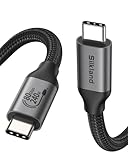
- 80Gbps Data Transfer: Silkland USB 4 Version 2.0 cable delivers a lightning-fast 80Gbps bidirectional data. Backup 6GB files in 1 second – drastically reduce wait times. It is USB-IF certified, meets full USB4 specs (TID:12800, verified by USB-IF official). *Actual speed depends on your device.
- 120Gbps Display Powerhouse: Boast 120Gbps unidirectional bandwidth, 3X the bandwidth of Thunderbolt 4/USB4 (40Gbps). Connect dual 8K/6K or triple 4K@144Hz displays for professional workflows. Enables 16K resolution & 4K@540Hz for ultimate creative/gaming.
- 240W Max Fast Charging: 240W meets power-hungry charging needs(like laptops). Supports PD 3.1 & backward compatible (60W/100W/140W). Equipped with an E-Marker chip for safety, stability, and battery protection.
- Full Thunderbolt 5 Cable Compatible: Future-proof and backward compatible with Thunderbolt 4/3, USB4, and USB 3.2. Works seamlessly with MacBook M4 Pro/Max, iPhone 17/16, Mac Mini, iPad, SSDs, docks, USB C Monitors, etc. Plug and play, OTG supported, and no driver needed.
- Premium Durability & Design: Slim Case-Friendly Shell fits phone cases effortlessly. Aluminum dissipates heat. Tangle-free 48-strand braided nylon ensures worry-free usage. Triple Shielding (EMI tinplate, 28 AWG OFC, stainless connectors) ensures signal integrity.
RDMA is missing
Run ibv_devices on each Mac. If no device appears, repeat the documented Recovery enablement with rdma_ctl enable, reboot, and verify the macOS version and Thunderbolt connections before rerunning topology discovery.
Automatic setup stops for elevated privileges
--auto-setup requires passwordless sudo on each node. If policy prohibits that, execute the commands printed by mlx.distributed_config manually with an administrator present, then rerun the checks.
The model fails when --pipeline is added
Pipeline support is an architectural feature, not a generic MLX switch. Check the model implementation for the required pipeline interface. Remove --pipeline and use the default tensor path if the model does not implement it.
The cluster is slower than one Mac
First determine whether the workload is communication-bound. Tensor mode may pay synchronization costs on every layer and token; pipeline mode may leave decode close to single-node speed. Compare the same model, quantization, prompt and context length, and verify that all nodes are using the intended backend rather than silently falling back to a slower path.
Considering MLX_METAL_FAST_SYNCH=1
MLX documentation describes this setting as a way to reduce CPU–GPU synchronization overhead, but marks it unreliable and capable of deadlocking. It is off by default. Treat it as an experimental troubleshooting variable, not a standard production setting, and change it only when you can recover a hung job.
A practical preflight checklist
- All Macs are Apple-silicon systems with sufficient combined unified memory and per-node headroom.
- MLX, MLX LM and the remote Python executable are installed and discoverable on every node.
- Thunderbolt 5 cables are connected directly between the required Mac pairs.
- Every node runs a supported macOS release and reports an RDMA device with
ibv_devices. - SSH from the controller works for every hostname in the host list.
- Passwordless
sudois available if you plan to use--auto-setup. mlx.distributed_configconfirms the intended backend, links and mesh, and produces a hostfile.- You have checked whether the model supports pipeline parallelism before using
--pipeline. - You are evaluating speed with a workload that resembles the real prompt and context length.
Bottom line for planning a multi-Mac cluster
Start with the model’s memory requirement and your topology, not with a headline token-rate multiplier. Use a fully connected Thunderbolt 5 JACCL mesh and tensor parallelism when low-latency communication and speed justify the cabling. Use pipeline parallelism when the model supports it and fitting a large model is the primary objective. The documented MLX workflow—enable RDMA, inspect the links, generate a hostfile, then launch with mlx.launch—does the orchestration, but the final result remains bounded by model support, memory headroom and the exact workload.
Quick Recap
Product prices and availability are accurate as of the date/time indicated and are subject to change. Any price and availability information displayed on Amazon at the time of purchase will apply.
The Tool Desk
Outbyte PC Repair FREEClear out junk files and repair common Windows errorsFree Scan →Outbyte Driver Updater FREEFix the driver behind crashes, sound loss and screen glitchesFind Drivers →
