
Outdated Drivers Are Slowing You Down
One free scan finds every outdated or missing driver and matches the right update for your exact hardware.Free scan · exact hardware matchWindows Errors? Fix Them Before They Spread
Repair common Windows errors and clear accumulated junk for a smoother, more stable PC - no reinstall needed.Free scan · no reinstalliTechGuides is reader-supported. When you buy through links on our site, we may earn an affiliate commission. As an Amazon Associate I earn from qualifying purchases. Learn more
An ergonomic standing desk is adjusted to your body in two separate positions: seated and standing. Set the keyboard surface near elbow height, keep shoulders relaxed and wrists straight, place the monitor directly in front of you with its top at or below eye level, and support your feet and back when seated. Then change position and move regularly instead of treating standing as an all-day posture.
The measurements below are useful starting references, not universal prescriptions. Your elbow height, chair, monitor, footwear and the tasks you perform determine the final setting.
What an ergonomic sit-stand workstation is
A sit-stand workstation lets you keep the same neutral alignment while the work surface moves. In either position, your shoulders should stay relaxed, elbows should remain close to your sides, forearms should be approximately parallel with the floor, and wrists should continue the straight line of the forearms. If raising the desk makes you shrug or bend your wrists, the desk is too high for that position; if lowering it makes you hunch, it is too low.
What’s actually slowing this PC down?
Pick the symptom - the matching free tool is one click away.
Use the keyboard as the primary height reference because it is where your hands spend the most time. The desk, chair, monitor and accessories are then adjusted around that reference. A height-adjustable desk is therefore the central piece of equipment, while a tray, riser, monitor arm or footrest is useful only when a particular mismatch remains.
#1 Best Overall

- Electric Height Adjustable Standing Desk for Comfortable Work - Switch effortlessly between sitting and standing with this electric standing desk. The smooth height adjustment from 28.35" to 46.46" helps promote a more comfortable working posture and keeps your energy flowing throughout the workday. Ideal for home offices, gaming setups, and productivity workspaces.
- Powerful Motor with Memory Presets - Equipped with a quiet, powerful lift motor, this sit stand desk allows seamless adjustments at the touch of a button. Save up to 4 preferred height settings so you can instantly return to your perfect working position every time.
- Exceptional Stability Steel Frame - Built with a heavy-duty alloy steel frame and aerospace-grade lifting columns, this adjustable desk remains stable even at maximum height. Tested for 100,000 lift cycles, it delivers long-lasting durability for daily work, studying, or gaming.
- Easy Assembly & Low-VOC Materials - Designed with low-VOC materials to help reduce indoor emissions and create a healthier workspace. With simplified assembly and included tools, you can set up your new adjustable standing desk workstation quickly and start working comfortably.
Reference dimensions, with their limits
| Item | Reference from OSHA guidance | How to apply it |
|---|---|---|
| Keyboard height for seated work | 22–30 inches, from the OSHA purchasing guide | Use as a purchasing and fitting range; set the final height by elbow position and relaxed shoulders. |
| Keyboard height for standing work | 36–46.5 inches, from the OSHA purchasing guide | Use as a starting range, then fine-tune for your elbow height, footwear and posture. |
| Monitor viewing distance | Generally preferred at 20–40 inches | Choose a readable distance that lets you keep your head and torso upright rather than leaning toward the screen. |
These figures are equipment references, not population averages or guarantees that one setting fits every user. The complete purchasing guidance is available from OSHA’s Computer Workstations Purchasing Guide.
Step 1: Fit the seated position
Adjust the chair and work surface before you set the standing height. A correct seated position gives you a reliable baseline and exposes any need for a footrest or keyboard tray.
- Set chair height for the keyboard. Raise or lower the chair until the keyboard is close to elbow height while your shoulders remain down and your elbows stay near your torso. Do not lift your shoulders to reach the keys.
- Check your forearms and wrists. Keep forearms roughly parallel to the floor. Your wrists should be straight, not cocked upward, downward or sideways. Move the keyboard rather than bending your wrists to compensate.
- Support your back. Sit back so the chair supports your back instead of forcing you to perch on the front edge. Adjust the backrest or seat depth if those controls are available.
- Place your feet. Both feet should rest fully on the floor. If the chair must be high enough for keyboard alignment and your feet then dangle, add a stable footrest rather than lowering the chair and compromising your arm position.
- Check your thighs and knees. Keep your thighs approximately parallel to the floor and leave enough room behind your knees to avoid pressure from the seat edge. Reposition the chair or desk if the work surface prevents this alignment.
Make these adjustments with the keyboard and mouse in their normal working locations, not pushed to the back of the desk. A laptop used as the only screen can force a compromise between screen and keyboard height; an external keyboard and mouse let you place the screen separately.
Step 2: Fit the standing position
Stand on the surface and in the shoes you normally wear for work. Footwear changes your effective height, so set the desk while dressed for the task rather than relying on a measurement taken barefoot.
- Raise the work surface to elbow height. Bring the keyboard up until your shoulders are relaxed, elbows are close to your sides and forearms are approximately level with the floor. Treat the standing range in the table as a starting reference, not a target you must reach.
- Keep wrists neutral. The keyboard should not require you to bend your wrists upward. If its feet create a steep angle, flatten them or change the desk height; do not use the wrist bend as a substitute for correct height.
- Align your trunk. Keep your head and torso generally upright, without leaning over the desk. Place your feet slightly apart so you can shift weight comfortably.
- Leave room to move. Stand close enough that the keyboard and mouse are easy to reach without extending your shoulders. Keep frequently used items within the same easy reach zone.
- Recheck after loading the desk. A monitor arm, laptop stand or other equipment can change where your hands land. Reassess shoulder and wrist position after everything is in place.
Standing height is personal. Two people using the same desk may need different settings, and one person may need a small change when switching between flat shoes and raised footwear.
Rank #2

- Electric Height Adjustment – Sit or Stand Any Time: Quiet motor (under 52 dB) with memory presets. Easily switch between sitting and standing from 28.3" to 46.5" to help reduce sedentary time
- Sturdy & Stable – Stays Solid at Full Height: Strong steel frame remains stable even when fully extended. Performance may vary slightly by floor type and load weight, but reliable for daily work, gaming, or study
- Spacious 55" Desktop with Cable Management: Large 55-inch surface fits multiple monitors and gear. Built-in cable management keeps cords tidy for a clean, organized workspace
- Quiet & Smooth Height Adjustment: Powerful motor enables seamless height changes and stable transitions, helping create a peaceful workspace that sparks creativity
- Easy Assembly & Great Value: Clear instructions and straightforward setup in 10–30 minutes. Offers electric height adjustment, memory presets, and solid build quality(The desktop is composed of two boards)
Step 3: Place the monitor, keyboard and mouse
Monitor position
Center the monitor directly in front of your body so you do not rotate your neck to read it. The top line of the display should be at or below eye level. You should be able to read normal text without tilting your head up or bending your neck down. Keep the screen at a distance that remains readable without leaning forward; OSHA describes 20–40 inches as a generally preferred viewing range in its monitor guidance.
When a single monitor is shared between seated and standing heights, adjust it after each desk-height change. If the monitor cannot travel far enough, a height-adjustable arm or riser can solve the mismatch. Do not raise the screen so high that its top is above eye level merely to make room for the keyboard.
Do these 3 things before closing this tab:
1Scan for outdated or missing drivers - takes under a minute2Repair Windows errors before they cause bigger problems3Fix the driver behind crashes, sound loss and screen glitchesKeyboard and mouse placement
Keep the keyboard and mouse on the same working level and close together. Place them near the front of the desk or tray so you are not reaching across the surface. The mouse should be close enough that your upper arm remains near your body; a long reach can pull one shoulder forward even when the keyboard height is correct.
Use the keyboard guidance in OSHA’s keyboard component page when checking clearance and tray design. A tray is helpful only if it supports both the keyboard and mouse, leaves adequate legroom when seated, and can be adjusted to the required heights.
Step 4: Alternate positions and add movement
Changing position is the goal, not standing continuously. OSHA’s positions guidance warns that remaining in one posture or sitting still for prolonged periods is not healthy and recommends frequent changes, brief walking, stretching and performing some tasks while standing. The guidance does not establish a single evidence-based minute-by-minute sitting-to-standing ratio.
Rank #3
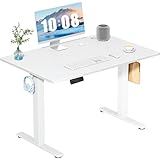
- Spacious Desktop for Productivity: Maximize your workflow with our 40" x 24" dual-panel desktop. This electric standing desk offers an expansive, sturdy surface for multiple monitors, laptops, and accessories, supporting an organized and efficient workspace for professionals and gamers seeking an ergonomic upgrade to enhance focus and output
- Quiet Electric Height Adjustment: Effortlessly transition between sitting and standing with our near-silent motor (under 55 dB). This standing desk adjusts smoothly from 28.7" to 46.5", ensuring seamless, disruption-free movement ideal for focused work, shared home offices, and important video calls, promoting comfort without noise distractions
- Programmable Memory Presets: Customize your ergonomic comfort with 3 smart memory presets. The intuitive LED controller allows you to save and recall your preferred heights instantly, eliminating repetitive adjustments. This key feature for the electric standing desk encourages consistent posture changes, aligning with behaviors that drive long-term user satisfaction
- Sturdy & Durable Construction: Experience rock-solid stability with a reinforced steel frame and wide T-leg base. This electric desk reliably supports up to 176 lbs, ensuring your dual-monitor setup or gaming gear remains secure even at maximum height. Rigorously tested for 50,000+ cycles, it delivers the trusted durability that influences purchase decisions
- Quick, Tool-Free Assembly: Get your standing desk ready in under 30 minutes with our hassle-free, tool-free assembly system. Pre-labeled parts and clear, step-by-step instructions mean you can start enjoying the health benefits of an electric standing desk immediately, removing a common barrier to purchase and enhancing customer satisfaction
Build a flexible routine around your work rather than a rigid timer:
- Begin a task in the position that makes the task easiest, then change when the task or your comfort changes.
- Use natural transitions—such as starting a call, reading a long document or waiting for a process—to stand, walk briefly or stretch.
- Shift your weight and take short walks instead of locking your knees or standing motionless.
- When you notice yourself leaning, shrugging, fidgeting or losing focus, treat that as a cue to change position and recheck the setup.
- Return to sitting when your legs or back need support. Standing longer is not automatically more ergonomic.
This approach deliberately avoids promising a health outcome from a particular schedule. Your workload, mobility, floor space and comfort determine how often you can change. The useful measure is whether you avoid long, static stretches and can maintain neutral alignment in either position.
Which desk and accessories do you actually need?
| Equipment | What it should solve | When it is warranted |
|---|---|---|
| Height-adjustable sit-stand desk | Moves the keyboard to an appropriate seated and standing height. | Best central solution when you want to alternate positions without rebuilding the workstation. |
| Adjustable keyboard tray | Separates keyboard height from a fixed desktop and can preserve leg clearance. | Useful when a fixed desk and chair cannot place the keyboard near elbow height together. |
| Monitor arm or riser | Changes screen height and, with an arm, can also change depth. | Useful when the monitor cannot stay with its top at or below eye level in both positions. |
| Footrest | Supports feet when the chair must remain high for keyboard alignment. | Conditional fix for unsupported feet; it is not required if both feet already rest comfortably on the floor. |
| Chair with back support | Supports the back and helps maintain a stable seated posture. | Needed when the current chair leaves your back unsupported or forces you to perch forward. |
OSHA’s chair guidance covers seat support and foot positioning, while the purchasing checklist helps evaluate adjustability and clearance. Neither page ranks brands or establishes product prices, so choose by fit and usable adjustment rather than marketing claims.
How to compare standing desks before buying
Measure your own seated and standing elbow heights, then compare those measurements with the desk’s actual usable range—not merely its advertised maximum and minimum. A desk that technically reaches both positions may still be awkward if its controls are difficult to use or if the keyboard cannot share the surface with the mouse.
- Adjustment range: Does the lowest setting let your seated keyboard reach elbow height, and does the highest setting do the same while standing?
- Keyboard and mouse space: Can both devices sit together without forcing your wrists to the edge or making you reach?
- Monitor compatibility: Can the screen remain at or below eye level after the surface moves, or will you need an arm or riser?
- Leg clearance: When seated, is there room for your knees, thighs and chair without the tray or frame blocking you?
- Ease of adjustment: Can you change height smoothly and often enough that you will actually use both positions?
- Surface area: Is there room for the equipment you use without placing the monitor off-center or the mouse far away?
Check the desk with your real equipment. A bare desktop may fit a keyboard, while a laptop, dock, notebook and monitor stand consume the space needed for a neutral reach.
Rank #4

- Electric Height Adjustment – Sit or Stand Any Time: Quiet motor (under 52 dB) with memory presets. Easily switch between sitting and standing from 28.3" to 46.5" to help reduce sedentary time
- Sturdy & Stable – Stays Solid at Full Height: Strong steel frame remains stable even when fully extended. Performance may vary slightly by floor type and load weight, but reliable for daily work, gaming, or study
- Spacious Desktop with Cable Management: Large surface fits multiple monitors and gear. Built-in cable management keeps cords tidy for a clean, organized workspace
- Quiet & Smooth Height Adjustment: Powerful motor enables seamless height changes and stable transitions, helping create a peaceful workspace that sparks creativity
- Easy Assembly & Great Value: Clear instructions and straightforward setup in 10–30 minutes. Offers electric height adjustment, memory presets, and solid build quality(The desktop is composed of two boards)
Troubleshoot common fit problems
Shoulders are raised or tense
The keyboard surface is probably too high, or the mouse is too far away. Lower the desk or tray in small increments, bring the mouse beside the keyboard, and confirm that your elbows remain near your sides. Do not solve shoulder tension by leaning your torso backward.
Wrists bend upward while typing
Lower the keyboard surface, flatten any keyboard feet that create an angle, and remove objects that tilt the front edge upward. Keep the forearms approximately parallel to the floor. A wrist rest may cushion contact, but it does not correct a desk that is at the wrong height.
Feet do not reach the floor when seated
If lowering the chair would put the keyboard below elbow height, keep the chair at the height needed for your arms and use a stable footrest. Adjust the footrest so both feet are supported rather than balancing on its edge.
You lean toward the screen
Move the monitor closer within a readable range, enlarge text or adjust display scaling, and check that the screen is centered. If the top is too low or too high, raise or lower it with the stand, an arm or a riser. Do not push your head forward to compensate for a distant or poorly positioned display.
Recommended Free Tools
Your neck twists to one side
Center the primary monitor with your keyboard and chair. If you use two screens, place the one used most directly in front of you; arrange the second beside it so you do not spend the entire day rotated toward the less-used display.
Best Value

- One-Touch Height Adjustment: Easily adjust the FEZIBO electric standing desk from 28.3" to 46.5". With 3 customizable memory presets, switch seamlessly between sitting and standing. Ideal for home offices, gaming setups, study areas, and productive workspaces
- Outstanding Stability: Built with a reinforced steel frame, this 47.2" x 23.6" standing desk supports up to 176 lbs, providing a sturdy and wobble-free workspace at any height
- Powerful Motor: Uprated lifting performance with reliable long-term operation, tested for up to 50,000 lift cycles, with lower noise levels under 45dB during running
- Multiple Sizes & Colors: Crafted from FSC-certified wood for a sustainable choice, the splice desktop comes in a range of sizes to fit small spaces or larger setups. Multiple color options make it easy to match your home office, bedroom, or workspace style
- Effortless Assembly: Most components come pre-assembled for quick, hassle-free setup. With a detailed manual and video guide, you can setup in just about 30 minutes and start working comfortably
The desk works seated but not standing
Set and record two separate heights, then move the monitor with the surface. If the desk reaches the correct keyboard height but the screen does not, add a monitor arm or riser rather than compromising your neck position. If the standing surface leaves no room for a mouse beside the keyboard, increase the usable surface or use a tray designed for both devices.
You feel uncomfortable after changing position
Return to the position that provides support, make a smaller adjustment and add brief movement instead of forcing a longer standing period. Persistent or worsening pain, numbness or other symptoms deserve individual advice from a qualified health professional; an online workstation guide cannot diagnose a condition.
A practical daily checklist
- Before work, confirm that the keyboard is near elbow height for the position you are using.
- Relax your shoulders and keep elbows close to your body.
- Keep wrists straight and forearms approximately parallel to the floor.
- Center the monitor, keep its top at or below eye level, and read without leaning.
- When seated, support your back and place both feet on the floor or a footrest.
- When standing, keep feet slightly apart and avoid locking into one rigid stance.
- Change position, walk briefly or stretch at natural task transitions.
- After moving the desk, recheck the monitor and mouse as well as the keyboard.
What the guidance establishes—and what it does not
The recommendations are about fitting equipment and avoiding prolonged static posture. They do not say that standing all day is ergonomic, that a desk alone guarantees weight loss or disease prevention, or that one sit-stand ratio works for everyone. OSHA’s wording is direct: “Regardless of how good your working posture is, working in the same posture or sitting still for prolonged periods is not healthy.” Read the full explanation on OSHA’s Computer Workstations—Positions page.
Free tools Windows power users keep installed
One-click scans. No signup required.
Use the dimensions as starting points, observe your alignment in both positions, and make the smallest adjustment that lets you work comfortably and move frequently. The best setup is the one you can fit to your body and use consistently without turning either sitting or standing into a prolonged, motionless posture.
Quick Recap
Product prices and availability are accurate as of the date/time indicated and are subject to change. Any price and availability information displayed on Amazon at the time of purchase will apply.

