
Recommended Free Tools
iTechGuides is reader-supported. When you buy through links on our site, we may earn an affiliate commission. As an Amazon Associate I earn from qualifying purchases. Learn more
Connect the wireless transmitter to the video source (laptop, console, media player or set-top box), connect the receiver to an HDMI input on the TV or projector, power both units with the method specified for that kit, select the receiver’s HDMI input, and wait for the units to pair. The source and display must also share a resolution, refresh rate and (for protected video) HDCP support that the wireless kit can carry.
Wireless HDMI kits are not interchangeable. Connector styles, USB-C video requirements, power arrangements, range, obstruction tolerance, latency, audio support and pairing procedures vary by model. Use the exact manual for your transmitter and receiver, then use the steps and diagnostic checks below to isolate problems.
What you need before connecting anything
A wireless HDMI system has two ends:
- Transmitter: installed at the video source.
- Receiver: installed beside the TV or projector and connected to its HDMI input.
The basic path is source → transmitter )) receiver → display. Some systems use a transmitter with an integral HDMI plug; others use an HDMI cable, USB-C video input, multiple source inputs or a pass-through output. The receiver may connect by HDMI, or by HDMI/VGA on models that provide both.
The Tool Desk
Outbyte Driver Updater FREEScan for outdated or missing drivers - takes under a minuteDriver Scan →Outbyte PC Repair FREERepair Windows errors before they cause bigger problemsFix Now →Check the source output
Confirm exactly what the source can output. A laptop may expose HDMI, mini-HDMI or USB-C. USB-C is only suitable when that particular port carries video through DisplayPort Alternate Mode; charging-only USB-C ports cannot send a picture. ViewSonic’s PJ-WPD-700 documentation explicitly requires DisplayPort Alternate Mode on the source. The transmitter’s connector and input arrangement must match the source, and any adapter must be supported by the kit maker.
#1 Best Overall
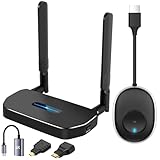
- 【SCREEN MIRRORING VIDEO/AUDIO to BIG SCREEN】 Wireless hmdi transmitter and receiver supports video resolution up to 1080P@60Hz resolutions,Built-in chip can prevent delay and lag caused by signal interference, you can enjoy clear and vivid images in a large screen. This Mirroring Dongle is perfect for learning, business meeting, family party and playing games and gives you a great screen experience.
- 【MORE ADAPTATIONS】Additional features include a mini adapter and a portable USB C to HDMI adapter (1080P@ 60Hz), USB-C (4K HDMI), suitable for MacBook Pro, Air, iPad pRPelbook, XPS, Galaxy, and more. Make this kit perfectly compatible with your commonly used machines and also compatible with more products.
- 【PLUG & PLAY】HDMI wireless transmitter and receiver No drive or APP needed, without messy wires, it’s easy to connect and pair TV and will not affect other wireless devices,Wirelessly mirror and share all contents on the big screen,include: pictures,videos,online game,online movies,web browsing,online shopping,documents and more.
- 【POWERFUL FUNCTION】HDMI Wireless adapters support stream 1080P@60Hz 3D movies,TV shows, video, games, presentations wirelessly from your Laptop,PC,Mac,Smartphone,Satellite Box,HDSLR Camera to HDTV,Projector or Monitor.
- 【50M/165FT LONG RANGE TRANSMISSION】The hdmi sender and receiver wireless allow for stable signal transmission at a distance of up to 165FT/50M by utilizing an updated wireless frequency band with multiple channels.This ensures that you won't experience signal interruptions even at long distances. This means you don't have to buy a long HDMI cable to extend video signals.NOTE:If in different rooms, or on different floors, where the rooms are separated by cement walls, the signal transmission may be affected,and the transmission distance may be reduced to 3-5Meters.The extent of the impact will depend on the thickness of the cement walls.Therefore,this distance is only for reference.
Check the display input
Identify an unused HDMI input on the TV or projector. If the receiver offers VGA as an alternative, verify whether the model carries audio and what adapter or cable arrangement its manual requires. Do not assume that an HDMI-to-VGA adapter will work in either direction or that it will preserve protected content.
Check format, power and copy protection
- Compare the kit’s supported resolution and refresh rate with the source and display. A 4K source may need to be set to 1080p if the wireless link is a 1080p system.
- Confirm whether the transmitter, receiver or both require USB power, a dedicated adapter or a particular voltage/current rating.
- For streaming services, discs or other protected video, check HDCP support across the source, wireless kit and display. A specification for one model cannot establish compatibility for another.
- Read the stated range conditions. A maximum distance measured in unobstructed line of sight is not a guaranteed through-wall distance.
Physical installation: transmitter at the source, receiver at the display
1. Connect the transmitter to the source
With the source switched off where the manual recommends it, insert the transmitter’s HDMI plug into the source output, or connect the supplied HDMI cable between the source and the transmitter input. If the kit has more than one input, use the input identified in its instructions. A pass-through output, where provided, can feed a nearby display but does not change the wireless signal path.
2. Connect the receiver to the TV or projector
Plug the receiver into an available HDMI input on the display, or use the receiver’s specified cable. Remember the input number; you will select it with the TV or projector remote. If the receiver must be positioned away from the display for better reception, use only the cable length and type approved by the manufacturer.
3. Provide power to both ends
Power requirements are model-specific. Some receivers can draw power from a TV USB socket, while others need a wall adapter. For its TDD20/TDD21 systems, Nyrius gives a TV USB port or a 5V, 1A USB wall adapter as receiver-power options. UGREEN’s referenced wireless extender instructs users to provide USB power to both transmitter and receiver. These examples do not make TV USB power a universal standard: a socket may not supply enough current, and a transmitter may have a different requirement from its receiver. Use the supplied adapters or the exact rating in the manual.
Complete the first-time setup
- Turn on the display. Select the HDMI input to which the receiver is connected. A powered receiver on the wrong input will look like a dead system.
- Turn on the source. If it is a computer, open its display controls and choose the mode that duplicates or extends the desktop as intended.
- Choose a compatible format. Set resolution and refresh rate to a combination supported by the source, transmitter, receiver and display. Start with a conservative mode such as 1920×1080 at 60 Hz when the kit is specified for 1080p/60, then increase only if every component supports the higher mode.
- Wait for the link. Pre-paired kits may reconnect automatically. Other systems show a pairing prompt or require a button sequence. Watch the status lights or on-screen message and follow that model’s pairing instructions; there is no universal wireless-HDMI pairing sequence.
- Position the units. Keep them within the manufacturer’s stated range. For initial testing, place them with as clear a path as possible, then move them toward their permanent locations one at a time.
- Test picture and sound. Play a local video or desktop animation first. This makes it easier to distinguish a display-format problem from a streaming-service or HDCP problem.
Nyrius describes the receiver going to the TV HDMI input and documents its 5V/1A power example in its wireless HDMI setup guide. UGREEN’s instructions cover connecting the transmitter to the source, the receiver to an HDMI or VGA display, powering both units over USB and selecting the source display mode in its product documentation.
Rank #2

- True Plug & Play with ZeroDrop Tech: No Wi-Fi, apps, or Bluetooth needed—just plug and play in under 10 seconds. Our wireless HDMI transmitter and receiver eliminate cable clutter while delivering seamless, high-quality streaming. ZeroDrop Technology ensures virtually zero latency for ultra-smooth gaming, presentations, and live streaming
- Stable Long-Range Transmission – Up to 400ft / 120m: Experience flexible device placement with a strong, clear signal up to 400 feet away. Wireless HDMI transmitter and receiver equipped with a 5.8G + 2.4G dual-band chip and Dynamic Stability Equalizer Engine, this system actively scans and avoids interference across 20+ frequency bands—keeping your connection rock-solid in any environment
- 4K Ultra HD Output with AI Clarity Enhancement: Wireless HDMI transmitter and receiver support 4K Decoding, Deliver crisp, smooth, and immersive visuals—perfect for cinematic streaming, and detailed presentations. AI Noise Eraser: Next-Gen Tech, the intelligent system selectively removes digital noise while preserving authentic film grain and texture. Dark scenes gain visible detail without losing atmosphere, delivering truly clean and natural image quality
- Professional Color & HDR Signal Pipeline: This Wireless HDMI is a pro-grade signal pipelineIt ensures the video signal leaving your source arrives at your display with studio-level integrity and enhanced impact. (D65 white point calibration, 10-bit 4:2:2) and uses FPGA processing——bringing you closer to a true HDR viewing experience with deeper blacks, brighter highlights, and a more immersive picture
- Dual Display Modes: Mirroring & Extended Screen: Hdmi wireless transmitter and receiver choose between mirroring or extending your screen to adapt to your needs. Effortlessly project content from laptops, cameras, or TV set-top boxes to HDTVs, projectors, or monitors, offering a versatile, multi-functional experience
USB-C laptops and other non-HDMI sources
A USB-C transmitter is convenient, but the port must support video output. Check the computer’s specifications for DisplayPort Alternate Mode, Thunderbolt video support or the exact capability named by the transmitter maker. A USB-C port that only charges or transfers data will power an accessory without producing a picture.
Connect the transmitter directly to the video-capable USB-C port, power it as directed, and then select the display mode in the operating system. ViewSonic’s connection instructions include the explicit warning, “Ensure the projector is also turned ON.” Follow that sequence when using its PJ-WPD-700 and read the full PJ-WPD-700 connection instructions for the source and projector order.
Placement, distance and interference
Wireless HDMI performance depends on the radio path as well as the HDMI electronics. Furniture, walls, cabinets and nearby radio sources can reduce reliability. Begin with transmitter and receiver in the same room and a clear path. If the picture is stable there, add distance or an obstruction separately so you can identify the limit of the installation.
Do not convert a marketing maximum into a guaranteed room layout. UGREEN lists a maximum 50 m distance at 1080p/60 with unobstructed line of sight for the referenced product. Epson says its WirelessHD range can vary with furniture and walls and notes, for the referenced projector system, that the projector cannot communicate through walls. That limitation applies to that WirelessHD implementation, not automatically to every wireless HDMI technology.
Keep the receiver out from behind a metal rack or inside a closed cabinet during diagnosis. If the system must remain enclosed, test it in that final location before permanently mounting anything. A short HDMI cable between receiver and display can also make it easier to move the receiver to a better radio position.
Rank #3
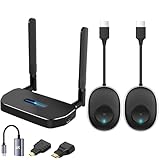
- 【HD@60Hz Home Theater Experience】This wireless HDMI transmitter and receiver supports video resolutions such as 1080p Full HD and 720p, allowing you to enjoy crisp, vivid images on a large screen. Its built-in chip effectively prevents delays and stuttering caused by signal interference, ensuring a smooth viewing experience. Wireless HDMI devices are ideal for studying, business meetings, family gatherings, and gaming, providing an exceptional screen experience that lets you fully enjoy the visual feast of high-definition picture quality.
- 【2 Transmitters and 1 Receiver】The convenience of HDMI wireless adapter lies in the fact that you no longer have to worry about cumbersome connection cables.and with 2 transmitters (output devices) and 1 receiver (TVs), you can easily switch display screens between two computers.This allows for seamless integration during meetings.It also enables wireless transmission of high-definition TV programs,videos,games,presentations,and more.Whether you are watching movies at home,giving presentations in the office,you can effortlessly mirror the screen content of devices such as laptops,PCs,Macs,smartphones,PS,switches,satellite boxes,cameras,and more onto HDTVs,projectors,or monitors.
- 【Plug & Play】The plug-and-play feature of the wireless HDMI transmitter and receiver allows you to start using them immediately without the need for complicated setup steps.This simple and efficient design not only saves you time but also helps maintain a tidy office or room.Each device comes pre-paired from the factory,eliminating the need for additional applications, Bluetooth,or WiFi connections. With 2 transmitters and 1 receiver,you can easily duplicate screens or extend different screens to a monitor.By freely switching transmitters on the computer,you can complete work tasks more conveniently.The convenience and flexibility of this device will bring more convenience to your work.
- 【High-Quality Transmission】In an open field, The distance of the wireless transmission high-definition HDMI audio/video signals is as high as 164ft/50m. If in different rooms, or on different floors, where the rooms are separated by cement walls, the signal transmission may be affected, and the transmission distance may be reduced to 3-5 Meters. The extent of the impact will depend on the thickness of the cement walls. Therefore, this distance is only for reference.
- 【5.8G/2.4G Dual-Band】This device supports 5.8GHz and 2.4GHz dual-band Wi-Fi. The wireless HDMI receiver will automatically select different frequency bands for connection to achieve a more stable and faster network experience. With dual-band Wi-Fi, users can achieve stable transmission across devices without worrying about signal interruptions or delays. Additionally, the device has an ultra-low latency of only 0.1 seconds, ensuring users can enjoy smooth network connections and efficient data transmission. Whether it's online gaming, video conferencing, or HD video playback, dual-band Wi-Fi can provide users with a more stable and faster network connection experience.
Troubleshoot a blank screen or unstable picture
No picture at all
- Verify that the transmitter and receiver indicators show power. Try the supplied adapters rather than assuming the display’s USB socket is sufficient.
- Use the TV or projector remote to select the exact HDMI input used by the receiver.
- Confirm that the source is actually outputting to the transmitter. On a laptop, use the operating system’s duplicate/extend display command and look for the newly detected display.
- Set a supported resolution and refresh rate. If the source was left at an unsupported 4K, ultrawide or high-refresh mode, temporarily choose 1920×1080 at 60 Hz when the kit supports that format.
- Remove splitters, docks and adapters during the first test. Reconnect them only after a direct source-to-transmitter path works.
The units will not establish a wireless link
Move the units close together with a clear path and reboot both ends. Then use the pairing or reset procedure for that exact model. Pairing buttons, hold times and indicator meanings are not standardized, so a sequence from another kit can make the problem worse. If a pre-paired system still fails nearby, check whether one unit has been replaced with a receiver or transmitter from a different product family.
Do these 3 things before closing this tab:
1Repair Windows errors before they cause bigger problems2Scan for outdated or missing drivers - takes under a minute3Clear out junk files and repair common Windows errorsThe picture drops out or freezes
- Improve line of sight and move the units away from large furniture, walls and metal enclosures.
- Test at a shorter distance. If the signal returns, the installation is exceeding the practical range even if it is below the advertised maximum.
- Lower the source format to a mode explicitly supported by the kit.
- Make sure both power connections are tight and that USB cables are not being shared with a low-current hub.
- Separate the receiver from other wireless equipment and high-power electronics while testing.
Epson’s WirelessHD support material specifically warns that furniture and walls affect range. Use the Epson WirelessHD connection guide for that projector family rather than applying its placement rules to a different technology.
Protected video fails while the desktop works
This symptom points toward HDCP negotiation rather than radio range. Check the HDCP versions and compliance statements for the source, wireless kit and display, and remove intermediate splitters or converters. Extron states HDCP compliance for its eLink 100, but that statement does not prove that another kit will pass the same content. A local, unprotected test file can confirm that the basic link remains functional.
A USB-C source powers the transmitter but shows no video
Check the port’s video capability first. DisplayPort Alternate Mode is required by the ViewSonic PJ-WPD-700. If the computer has several USB-C ports, try the one marked for display or Thunderbolt output, then reselect the display mode in the operating system.
Epson 5040UBe WirelessHD pairing recovery
Epson documents a model-specific recovery sequence for the 5040UBe when its WirelessHD transmitter no longer connects:
Rank #4

- 【328FT/100M Wireless Transmission】Wireless display adapter utilizes dual frequency wireless transmission. The wireless HDMI transmission distance reaches up to 328 feet/100 meters, utilizing a 5G/2.4G HDMI 1.3 transmission protocol for stronger and more stable signals. ( Note: Transmission distance and speed may be affected when the product passes through walls or encounters obstacles. )
- 【Plug-and-Play Wireless Transmission】Our wireless HDMI transmitter and receiver require no WiFi, App or Bluetooth. Featuring plug‑and‑play operation, it establishes a stable connection in under 10 seconds. Ditch tangled HDMI cables to keep your space well‑organized. Ideal for business meetings, home‑theater viewing, classroom lessons, church presentations and outdoor gatherings, it brings simple‑to‑set‑up connections and suits multiple usage‑oriented scenarios.
- 【Wide Compatibility】The wireless hdmi transmitter and receiver supports projecting from PC/Laptop/Cameras/DV/TV box or Smartphone (Only Compatibility with S21/for iPhone15/iPad 10th Or Above Models) to projector/monitor/HDTV. Enjoy movies, photos, or watch business report on a larger screen. Please note, that if you take this product to connect to tablets and cell phones to use, please first make sure that the port you connect itself supports HDMI signal output.
- 【Wireless HDMI Transmitters and Receivers】Our wireless hdmi extender support for screen mirroring and screen extension capabilities, enabling the projection of content from various devices such as laptops, cameras, and cable set-top boxes onto HDTVs, projectors, and monitors for a versatile application experience. Important Note: Both the Transmitter (TX) and Receiver (RX) must be powered by the included USB‑to‑USB‑C cables for proper operation. The HDMI port alone cannot deliver power.
- 【Audio Sync & HD Image Quality】The Wireless HDMI Transmitter and Receiver supports 4K decoding, can stream 1080P/60Hz video and audio to big display with nearly no delay, offering exceptional visual experiences for learning, business meetings, family gatherings. Tips: Wireless hdmi adapter also backward compatible with lower resolutions.
- Temporarily connect the projector’s HDMI1 (HDCP 2.2) port to the WirelessHD transmitter’s HDMI Out port.
- Switch the transmitter on while holding its Input and Output buttons for 15 seconds.
- Check the indicator behavior and color-bar result described on Epson’s support page, then restore the normal connections and retry the WirelessHD link.
This is not a general reset recipe. Use the complete Epson 5040UBe recovery instructions and do not apply the button sequence to another model.
Independent reader supportYour contribution helps us test, update, and keep practical guides available for everyone.How to choose a wireless HDMI kit
Choose for the room and source you actually have, not for the category name. The following manufacturer-published figures illustrate why each specification must stay attached to its model; they are not independent tests and should not be treated as a head-to-head performance ranking.
| System | Published capability | Important qualification |
|---|---|---|
| UGREEN wireless HDMI/VGA extender | 1080p at 60 Hz; maximum 50 m | The 50 m figure is specified for unobstructed line of sight. See the UGREEN product page. |
| Extron eLink 100 | Up to 1920×1080 at 60 Hz; stated 100-foot capability; less than 1 ms latency; HDCP compliance | These are Extron’s published specifications for a professional system. See Extron eLink 100. |
| BenQ WDP02 | Maximum 30 m line of sight; less than 1 ms latency; HDCP support | The range is a line-of-sight maximum published by BenQ. See its WDP02 specifications. |
Resolution and refresh rate
Match the wireless link to the display task. Office mirroring and most 1080p projectors need a different class of product from a high-refresh gaming display. Verify both resolution and refresh rate together: “1080p” alone does not promise 60 Hz, and a display’s maximum does not raise the transmitter’s limit.
Latency for games and live control
Latency matters when a mouse, controller or instrument must respond immediately. Use the exact manufacturer figure for the model under consideration. Extron and BenQ publish less-than-1-ms figures for the systems above, but a specification is not an independent measurement and does not describe every source, mode or installation.
Crashes, No Sound, or Screen Glitches?
Random freezes, missing sound and display glitches usually trace back to one bad driver. Find and replace yours safely.Free scan · under a minutePC Slower Than It Used to Be?
A free scan shows the junk files, broken settings and background clutter dragging Windows down - then fixes them in one click.Free scan · Windows 10 & 11Range and obstructions
Look for the test condition attached to the distance number. “Line of sight” means the transmitter and receiver have a relatively clear radio path; it is not a promise that the same distance will work through several walls. If the room requires a wall penetration, favor a product whose documentation specifically addresses that layout, then test before mounting.
Best Value

- 4K Decode Input 1080P Output: Experience stunning clarity with 4K decoding that outputs a smooth 1080P@60Hz signal. This ensures your content, from high-resolution presentations to dynamic videos, is displayed in sharp, lifelike detail .
- Unique Cooling Design:With a more advanced Cooling design than other wireless hdmi kits, our wireless hdmi transmitter and receiver operate at significantly lower temperatures, effectively preventing overheating and signal loss, ensuring a smoother and more stable connection,thus enhancing the product's lifespan.
- 360FT/110M Range & 2.4G+5.8G Dual-Band Stability: Built with advanced 2.4G+5.8G dual-frequency chips for superior anti-interference, This wireless hdmi kit transmits signals up to 360ft/110m in open spaces or 165ft/50m indoors. It maintains a stable connection even when faced with obstacles such as furniture or partitions, making it a reliable choice for large homes, warehouses, exhibitions, bars, or backyards.(Note: Walls may have some impact on transmission distance and speed)
- Ultra-Low Latency for Real-Time Action: Designed for scenarios where every millisecond counts, our technology achieves near-zero latency. This is critical for live sports, professional presentations, and video monitoring, providing perfect synchronization between the source and display with no noticeable lag .Perfect for tidying up your home theater, office, or conference room, it's ideal for business presentations, classroom teaching, church services, live events, family movie nights, outdoor parties, or even weddings.
- Plug and Play & Mirror and Extend Mode: Get started instantly—no complicated apps, Wi-Fi, or software required. Just plug in the devices, and they connect automatically within seconds.Say goodbye to messy cables and complicated setups, and make your office or room tidier. Support both Extended and Duplicate screen modes to present or multitask seamlessly on a larger display, making every meeting, class, or any multimedia playback more efficient.
HDCP and audio
For protected films, television apps or disc players, verify HDCP support throughout the chain. Also check supported audio formats and whether audio travels over HDMI, is extracted separately or is unavailable on a VGA path. A picture with silent audio can be an audio-format or adapter limitation rather than a wireless fault.
Ports, adapters and power
Count the HDMI inputs and outputs you need, identify whether the transmitter is an integral plug or a separate box, and list every required cable. Confirm whether the receiver needs its own USB lead or AC adapter and whether the display’s USB port can provide the specified current. The Nyrius 5V/1A example and UGREEN’s requirement to power both ends demonstrate why a kit’s power diagram matters.
Pairing and installation style
A pre-paired, plug-and-play kit is convenient for occasional presentations. A system with multiple inputs, pass-through or professional mounting options may be preferable for a permanent installation. In either case, retain the model-specific pairing and reset instructions with the equipment; generic button sequences are unreliable.
A reliable test routine before permanent mounting
- Place both units in the same room, connect the source and display directly, and power them with the supplied equipment.
- Select the receiver’s HDMI input and set the source to a conservative supported mode.
- Play an unprotected local video and confirm picture and sound.
- Test the intended protected-content source if HDCP is required.
- Move the receiver and transmitter to their planned positions, testing one change at a time.
- Run the system for the longest expected session. A link that appears briefly during setup can still fail when heat, distance or interference changes.
If the system fails during this routine, record which stage changed: power, HDMI input, source format, distance, obstruction or protected content. That observation points to the relevant manual section far faster than repeatedly re-pairing the units.
Quick Recap
Product prices and availability are accurate as of the date/time indicated and are subject to change. Any price and availability information displayed on Amazon at the time of purchase will apply.

