
iTechGuides is reader-supported. When you buy through links on our site, we may earn an affiliate commission. As an Amazon Associate I earn from qualifying purchases. Learn more
Low-impact movement can help manage knee osteoarthritis pain, stiffness and loss of function without the repeated pounding of high-impact exercise. Start with an activity you can access and tolerate—such as walking, cycling, water exercise or tai chi—then build duration in small steps. Exercise is symptom management, not a cure, and there is no single “best” form for every knee.
If pain is severe, walking is difficult, or a new routine causes symptoms that do not settle, ask a clinician or physical therapist for an individualized plan.
What low-impact exercise can do for knee osteoarthritis
The 2019 American College of Rheumatology (ACR)/Arthritis Foundation guideline, published in 2020, places exercise at the center of osteoarthritis care. It does not rank walking, cycling, aquatic exercise, strengthening or other formats as universally superior. Its practical message is to make the advice specific to the person rather than offering only a general instruction to exercise.
The Tool Desk
Outbyte PC Repair FREEClear out junk files and repair common Windows errorsFree Scan →Outbyte Driver Updater FREEScan for outdated or missing drivers - takes under a minuteDriver Scan →Movement can help you maintain the ability to walk, climb steps, get up from a chair and perform daily tasks. The right dose is the one you can repeat consistently without a worsening pattern of symptoms. Your response may differ from another person’s because of joint changes, muscle strength, balance, other health conditions, confidence, cost and access to facilities.
#1 Best Overall

- 5 Level Resistance(3-20pounds): You will get a set of resistance bands including five colors, different colors represent different stretching forces. Each stretch strength (color) is suitable for different exercise levels and different exercise purposes. And unisex.
- Resistance Levels: Gym resistance bands come in 5 different resistance levels: Yellow Band (X-Light, 0.25mm), Red Band (Light, 0.3mm), Green Band (medium, 0.35mm), Blue Band (heavy, 0.4mm), Gray Band (X-heavy, 0.5mm).Five levels of workout bands, which can be easily switched at any time according to your preferences and needs.
- High-Quality Material: Open-ended Pilates flex bands is 59 inches(4.9FT) long and 6 inches wide, made of high-quality TPE material, latex-free, skin-friendly,odorless, smooth surface, safe and durable, can maintain long-term elasticity, not easy to break.
- Training And Rehabilitation: It is a high-quality Pilates elastic band product for resistance training and rehabilitation. It is ideal for Pilates, resistance training, physical therapy and mobility training. Simple and effective resistance bands can stretch and tone muscle groups and improve your posture.
- Suitable For People: Suitable for athletes, exercisers, the elderly, rehabilitation trainers, and the stretch bands can be used for physical therapy, rehabilitation, wrestling, bodybuilding, Pilates, yoga, etc. Simple but effective exercises will build strength and speed recovery.
Do not treat an exercise plan as a way to repair or reverse osteoarthritis. The goal is better day-to-day comfort and function. No reviewed source provides a single percentage or guaranteed amount of pain reduction from low-impact exercise, so be wary of promises that a particular routine will eliminate pain.
Compare the main low-impact options
The Centers for Disease Control and Prevention (CDC) lists brisk walking, cycling, swimming or water exercise, tai chi, dancing and light gardening as joint-friendly activities. The Arthritis Foundation also groups exercise for arthritis into aerobic, range-of-motion, strengthening and aquatic work.
| Option | Why it may suit an arthritic knee | How to make it practical | Things to monitor |
|---|---|---|---|
| Walking | It requires little equipment and can be done indoors or outdoors. You can vary pace, surface and duration. | Begin with a short, comfortable route or several brief walks. A shopping centre, hallway or indoor track can provide a predictable surface. | Long hills, uneven ground or a sudden jump in distance may aggravate symptoms. Reduce one variable at a time if the knee reacts. |
| Cycling | A stationary or outdoor bicycle lets you exercise without repeated foot strikes. A stationary bike can be used in any weather. | Use an easy resistance and a seat position that allows comfortable knee movement. Start with a few minutes and add time gradually. | Stop if the motion causes sharp pain or the knee becomes increasingly swollen. A physical therapist can help adjust the setup when movement is limited. |
| Water exercise | Buoyancy reduces the load on weight-bearing joints while the water still provides resistance, according to the Arthritis Foundation. | Try walking in a pool, aquatic aerobics or swimming at a pace you can control. Check pool access, changing facilities and water temperature before committing. | Wet floors, getting into the pool and fatigue can create safety problems. Use available rails and ask for help if balance is uncertain. |
| Tai chi | Slow, controlled weight shifts and flowing movements can combine gentle activity with balance practice. | Choose an instructor who can offer seated or smaller-range alternatives. A stable chair or wall can be nearby when learning. | Do not force a deep bend or unstable stance. Modify any position that causes pain or loss of balance. |
| Dancing | It can make aerobic activity more enjoyable and can be adapted to a slower tempo or smaller steps. | Choose low-step routines, avoid jumps and turn less sharply. Dancing in a clear, non-slip area is safer than on a crowded surface. | Fast pivots, hops and sudden direction changes may be too demanding. Substitute marching or side steps if needed. |
| Light gardening | Short bouts of digging, watering or planting add movement to a daily task. | Use raised beds or a stool, alternate tasks and take frequent breaks rather than kneeling for long periods. | Repeated squatting, kneeling or carrying heavy loads can exceed what the knee tolerates. |
| Range-of-motion work | Gentle movement through a comfortable range helps you practise bending and straightening without a heavy load. | Use movements prescribed by a clinician or physical therapist, especially if the knee is stiff after sitting. | Do not bounce, force the joint or treat a fixed limitation as something to push through. |
| Strengthening | Resistance exercise supports the muscles used for walking and transfers. It can be done with body weight, weights or elastic bands. | Start with resistance that does not cause joint pain. A therapist can select exercises and positions that match your ability. | More resistance is not automatically better. Persistent or severe symptoms require professional advice. |
The ACR/Arthritis Foundation guideline says preferences, affordability and access influence whether a plan works. Pick the option you can realistically repeat, not the one that sounds most impressive.
How to start when the knee is painful
- Check whether you need individual advice first. If pain is severe, movement is very restricted, or you have another condition that affects exercise, contact a health care provider or physical therapist before starting. The CDC and NHS both advise seeking tailored guidance in these circumstances.
- Choose one familiar activity. Select the option with the fewest practical barriers. A short indoor walk may be easier than travelling to a pool; a stationary bike may be more comfortable than walking if each step hurts.
- Begin with five minutes or less if necessary. The CDC specifically notes that five minutes can be a valid starting point. You can split the time into short periods during the day instead of completing it in one session.
- Keep the first sessions easy to judge. Use a route, bike setting or pool area you know. Avoid changing distance, speed, terrain and resistance at the same time.
- Observe the response during the activity and afterward. Some pain, stiffness or swelling can occur when a person begins being more active. A pattern that is severe or does not improve is a reason to contact a provider, not a signal to keep increasing the workload.
- Increase only one small step at a time. Add a little time, an extra short session or a modest amount of resistance after your current level feels manageable. If symptoms worsen, return to the last tolerable level and obtain advice if they do not settle.
- Record what you did. Note the activity, duration, resistance or terrain, and how the knee felt later that day and the next morning. This gives a therapist useful information and helps you identify a dose you can sustain.
An example of gradual progression
The following is an illustration, not a prescription. Your starting point may be shorter, and you may progress more slowly. The CDC’s five-minute starting point and its advice to build gradually support the approach; the exact schedule should follow your symptoms and clinician’s recommendations.
Rank #2

- High End Exercise Bands. Our 12"³ By 2"³ Heavy Duty Loop Resistance Bands Come In 5 Varying Resistance Levels. This Makes Them Perfect Whether You Are Just Starting To Workout Or A Seasoned Workout Warrior. Our Extra Light And Light Bands Are Great For Beginners, While Our Medium, Heavy And Extra Heavy Exercise Bands Are Targeted For More Intermediate And Advanced Strength Training.
- Great With Any Workout. This Resistance Band Set Can Be Integrated Seamlessly With Various Popular Workout Program. Or Use Them For General Exercise, Stretching, Strength Training, Power Weight Programs. The Included Carry Bag Makes It Easy To Take Your Bands With You And Do Any Workout Away From Home Or Your Home Gym.
- Multiple Uses. While These Resistance Bands Are Often Used For Sports And Fitness, Physical Therapists Love These Physical Therapy Bands (Rehab Bands) To Help Them Rehabilitate Their Patients. Our Stretch Bands Work For People Suffering From Leg, Knee And Back Injuries. They Are Also Perfect For Use By Women After Pregnancy And Birth To Keep Their Bodies In Shape.
- Superior Quality. All Of Our Exercise Resistance Bands Are Thoroughly Tested Before We Ship Them Out To You. This Ensures Your Bands Are Easy On Skin And Will Provide You With A Worry Free Experience. The Instruction Booklet Includes Dozens Of Different Illustrated Exercises That Demonstrate How To Use Our Resistance Bands For Legs, Arms, Back, Shoulders, Ankles, Hips And Stomach.
- What You Get: Five Exercise Bands With Color-Coded Resistance Levels, Portable Travel Carry Bag And Instruction Guide.
| Period | Possible target | Adjustment rule |
|---|---|---|
| Days 1–7 | Five minutes of walking, cycling or water exercise on three to five days, or several one- to two-minute bouts. | Keep the same duration if the knee is still adapting. Focus on learning which setting feels comfortable. |
| Days 8–14 | Add a few minutes to one or two sessions, or add another short session on a separate day. | Do not increase duration and resistance together. Hold at the previous level if symptoms are worse. |
| Days 15–21 | Work toward roughly 10–15 minutes on selected days, divided into bouts if needed. | Use an easier surface, lower bike resistance or shorter pool interval when the knee becomes irritable. |
| Days 22–28 | Continue the amount you can repeat comfortably; some people may reach 15–20 minutes, while others remain at shorter bouts. | Consistency matters more than reaching a particular number. Ask a professional to review the plan if progress stops. |
This staged example is deliberately flexible. A flare, illness, poor sleep or an unusually demanding day may require a temporary reduction. Resuming at a previously tolerated level is preferable to trying to “make up” missed exercise.
How much activity should you aim for?
The Arthritis Foundation describes a general adult target of 150 minutes of moderate-intensity aerobic activity or 75 minutes of vigorous-intensity activity per week, often expressed as a 30-minute brisk walk or bike ride five times weekly. That figure is not a knee-osteoarthritis-specific prescription. If your symptoms or fitness make it unrealistic, begin below it and build according to ability and clinical advice. Short periods still count toward your overall activity.
Do not label an activity moderate or vigorous solely by its name. A brisk walk for one person may be too demanding for another. Your plan should leave room for recovery and should not create a worsening symptom pattern.
Include more than aerobic exercise
Range of motion
Gentle bending and straightening can be useful when stiffness makes ordinary movement difficult. Keep the motion controlled and within a comfortable range. If the knee cannot move as expected, a physical therapist can determine whether a particular exercise, position or hands-on assessment is appropriate.
Rank #3

- THICK FABRIC RESISTANCE LOOPS THAT STAY PUT — Wide cloth weave grips your thigh and legs without rolling or pinching bare skin during squats, lunges, and hip circle exercises for a booty workout
- 5 RESISTANCE LEVELS FROM MINI TO EXTRA HEAVY — Light through heavy exercise bands for legs let beginners warm up and advanced lifters push through glute activation and physical therapy sessions
- BUILT FOR DAILY USE — Woven polyester-latex blend keeps consistent tension after hundreds of stretches so your leg bands perform the same on day one and day ninety of working out
- TRAIN LEGS, HIPS, AND GLUTES ANYWHERE — Compact loop bands for exercise fit in a gym bag for home workouts, park sessions, or travel and add variety to booty bands for working out routines
- SIZED FOR REAL WORKOUTS — Each band measures 12 by 2 inches with tension from 40 lb to 180 lb so these fabric resistance bands for working out fit above the knee for every body type
Strengthening
Strength work can use elastic resistance bands, weights or body weight. The CDC advises selecting a weight or band that does not cause joint pain. Start with the amount of resistance you can control, and ask for instruction if you are unsure how to align the knee or modify a movement. Equipment supports the exercise; it is not the treatment by itself.
Aerobic conditioning
Walking, cycling and aquatic activity raise activity levels without requiring impact-heavy movements. You can alternate them to reduce boredom or to use the option that feels best on a particular day. The guideline does not establish one format as superior for everyone.
Make each activity easier on the knee
Walking adjustments
- Start on a level, predictable surface before adding hills or uneven trails.
- Use shorter routes with a place to sit or turn back.
- Wear footwear that feels stable and does not create new pain; the exercise guidance does not require a special shoe or insert.
- If walking stability or pain is substantially affected, ask a clinician whether a cane is appropriate. A cane is an assistive device for selected people, not a universal exercise aid.
Cycling adjustments
- Begin with low resistance and a cadence you can control.
- Adjust the seat so the knee is not forced into an extreme bend at the top or a locked position at the bottom.
- Use a stationary bike if traffic, weather or balance makes outdoor cycling impractical.
Water-exercise adjustments
- Use the pool edge or a flotation aid only as instructed by staff; buoyancy does not remove all balance risks.
- Start in a depth where you feel secure and where entering and leaving the pool is manageable.
- Choose a class that offers alternatives instead of trying to match every movement.
Tai chi, dancing and gardening adjustments
- For tai chi, reduce the depth of bends and use a support while learning.
- For dancing, remove jumps and fast pivots; smaller steps still provide movement.
- For gardening, raise work surfaces, alternate standing and sitting, and divide heavy tasks into smaller loads.
When supervision is worth arranging
Home exercise can be useful, but the ACR/Arthritis Foundation guideline reports that supervised programs tend to be more effective than home exercise alone. Supervision is particularly valuable when you are unsure how to modify a movement, have difficulty walking, or repeatedly flare after increasing activity.
Free tools Windows power users keep installed
One-click scans. No signup required.
A physical therapist can assess movement, select strengthening and range-of-motion exercises, adjust a bike or walking plan and help you progress. The CDC also suggests that people with arthritis may benefit from seeing a physical therapist when beginning activity. NHS guidance recommends discussing a new exercise plan with a GP or physiotherapist.
Rank #4

- Skin-Gentle TPE Material – Crafted from premium Thermoplastic Elastomer, these long exercise bands are entirely latex-free, odorless, and soft to the touch. Giving you a durable and comfortable tool for daily stretching, strength work, and therapy sessions.
- 5 Resistance Levels, 1 Versatile Set – Includes five clearly marked bands at 5, 10, 15, 20, and 30 lbs. Use them individually for targeted toning or combine multiple bands to reach up to 80 lbs of total resistance, making it easy to progress from beginner pilates to advanced muscle work.
- Full-Body Training Anywhere – Designed for pilates, yoga, barre, physical therapy, and general fitness. These stretch bands support flexibility, mobility, and low-impact strength for your arms, legs, glutes, hips, shoulders, and core—no extra handles, straps, or bulky equipment needed.
- Unmatched Portability – Ultra-light and compact, the set easily fits into a bag, drawer, or suitcase. Roll them up and take your workout to the office, gym, park, or on the go—enjoy an effective bodyweight and resistance session with zero setup wherever you are.
- Built for Women & Men Alike – With smooth, even-drag stretch, these bands suit different body sizes and fitness levels. An ideal choice for home exercisers, physical therapy patients, seniors staying active, and anyone wanting to add consistent, joint-friendly resistance training to their daily routine.
Ask for help rather than abandoning exercise if access, cost or confidence is the barrier. The guideline identifies those practical factors as part of choosing an effective plan. Community classes, pool programs, a home routine and brief supervised visits are different ways to obtain support; availability varies by location.
Independent reader supportYour contribution helps us test, update, and keep practical guides available for everyone.Recognize a normal adjustment versus a problem
When activity increases, temporary soreness, stiffness or swelling can occur. That does not establish a universal “safe pain number”: the ACR/Arthritis Foundation guideline does not identify one pain cutoff that applies to everyone. Instead, judge the overall pattern and your ability to function.
- Reduce the next session if symptoms are noticeably worse after increasing time, terrain or resistance.
- Contact a health care provider when pain or swelling is severe, movement becomes much harder, or symptoms do not improve.
- Pause a new exercise if it causes sharp or escalating pain and ask a professional how to modify it.
- Seek individualized assessment when you cannot tell whether a symptom is coming from the knee, another joint or a separate health problem.
Do not use a flare as a reason to test a harder workout. Return to a shorter, easier activity only when you can do so safely and follow professional advice if the pattern persists.
Recommended Free Tools
Equipment: what is optional and what is useful
You do not need special equipment to begin. A clear walking route, comfortable clothing and a way to track short sessions may be enough. Elastic resistance bands can support strengthening, and a stationary exercise bike can make cycling accessible at home. Choose resistance that does not cause joint pain, and learn technique before increasing it.
Best Value
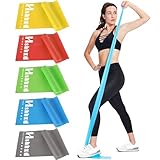
- Good Quality Exercise Bands - Made of TPE material, TPE is environmentally friendly, non-toxic and safe, has a wide range of hardness, soft touch, weather resistance, fatigue resistance and temperature resistance, used TPE old products can be recycled after simple regeneration, reducing Environmental pollution, expanding the source of renewable resources. The product is latex and powder free and fragrance free.
- 5 Levels Of Resistance - 5 resistance bands are 59in (150cm) long and 5.9in (15cm) wide, the resistance bands is yellow band (5 lbs), red band (10 lbs), green band (15 lbs), blue strap (20 lbs), gray strap (30 lbs).
- Multi-Functional - It can be resistance bands, exercise bands, yoga bands,elastic exercise bands, pilates bands, exercise arm bands, physical therapy resistance bands, stretching bands, workout bands, leg shaping exercise bands, stretch bands for exercise. You can use it at home, yoga studio, gym , Pilates studio, travel, and anywhere else, it's compact and easy to carry.
- Easy To Maintain Your Body - The resistance bands for working out can help you relieve problems like joint pain and prevent potential health problems, and are the preferred equipment for physical therapy. Advanced stretching bands can target muscles such as arms, buttocks, legs, and abdomen to shape your perfect ideal body.
- Great Holiday Present - Resistance bands are great for any age, from children to seniors, resistance bands have been proven to provide as many benefits in terms of fitness health and strength gains as weight training equipment. Plus, by knotting the resistance band you get a loop for double the resistance!
A cane may help some people whose arthritis affects walking pain, stability or confidence. It should be fitted and used correctly; it is not a requirement for exercise and is not suitable for everyone.
NHS England’s knee-osteoarthritis decision aid says there is no good evidence that TENS machines, acupuncture, insoles, glucosamine or chondroitin help knee osteoarthritis. Do not substitute these for a tolerable movement plan or present them as proven fixes. Other treatments, including topical non-steroidal anti-inflammatory medicines, may be considered for some people, but suitability and risks belong in a discussion with a clinician.
Use evidence-based programs when you need structure
As of June 10, 2026, the CDC says it recognizes more than 20 arthritis-appropriate, evidence-based lifestyle-management programs intended to improve arthritis symptoms, flexibility, movement and daily activities. That is a count of recognized programs, not a measurement of how much pain any one program will reduce. Program names, locations and delivery formats can change, so check the CDC’s current listing before enrolling.
Such programs can provide education, activity planning and peer or professional support. They are an option when a written routine is hard to maintain, not a replacement for an assessment when symptoms are severe or unusual.
Quick Recap
A simple decision framework
- Ask what movement is most accessible. Consider whether you can walk safely, use a bike, reach a pool or attend a class.
- Ask what the knee tolerates now. Choose the activity with no or little pain during the movement and no worsening pattern afterward.
- Ask what you will actually repeat. Preference is clinically relevant because an activity that is enjoyable and affordable is easier to sustain.
- Ask whether supervision is needed. Severe symptoms, limited movement, uncertainty about technique or repeated flares are reasons to involve a clinician or physical therapist.
- Reassess from your own response. Keep what helps function and is manageable; change the activity, dose or setting when it is not.
Key takeaways
- Walking, cycling, water exercise, tai chi, adapted dancing, light gardening, range-of-motion work and strengthening are reasonable low-impact choices.
- There is no exercise hierarchy that fits every person with knee osteoarthritis.
- Five minutes can be a valid starting point; add time or resistance in small steps.
- Some early soreness, stiffness or swelling can occur, but severe or persistent worsening warrants medical advice.
- Elastic bands, a stationary bike and a cane are optional tools for selected needs, not cures.
- A physical therapist or supervised program can make the plan safer and more specific when home exercise is not enough.
Product prices and availability are accurate as of the date/time indicated and are subject to change. Any price and availability information displayed on Amazon at the time of purchase will apply.

