
The Tool Desk
Outbyte Driver Updater FREEFix the driver behind crashes, sound loss and screen glitchesFind Drivers →Outbyte PC Repair FREEClear out junk files and repair common Windows errorsFree Scan →iTechGuides is reader-supported. When you buy through links on our site, we may earn an affiliate commission. As an Amazon Associate I earn from qualifying purchases. Learn more
A fuel shortage can mean fuel is unavailable, a station cannot operate, or a power outage has disabled pumps and distribution—not necessarily that a region has run out of fuel. Prepare before disruption: keep your vehicle fueled ahead of forecast extreme weather, avoid optional trips, assemble small car and household kits, plan water and food, and set up reliable communications. The guidance below is based on U.S. federal sources; local authorities, fire codes, weather and station conditions control what you should do in your area.
What a fuel shortage actually means
The U.S. Department of Energy (DOE) describes liquid-fuel disruptions as an access and distribution problem as well as a supply problem. Demand spikes, production interruptions, transport failures or problems at terminals can prevent gasoline or diesel from reaching retail stations. A long power outage can disable terminals, pumps, payment systems and communications even when fuel remains in storage. See the DOE’s Energy Emergency Response Playbook for States and Territories.
DOE’s approximately 2022 playbook says supply disruptions typically take several days to cascade into widespread end-user shortages, while panic buying can accelerate the effects. That is a general system observation, not a prediction for any particular city or current event. Prices, station hours, purchase limits and availability are local and can change quickly.
For that reason, preparation is about preserving mobility and household continuity rather than trying to predict a national “day zero.” You want enough fuel and supplies to complete essential travel, remain safely at home when possible, receive official updates and adapt if pumps or electronic payments stop working.
#1 Best Overall

- The Road Guardian- The portable roadside assistance kit is designed and hand picked by a group of experienced veterans and experts to provide every essential tools you need in roadside emergencies. The automotive safety bag contains accessories such as repair cable ties, bungee cords, electrical tape, space blanket, rain poncho, reflective warning triangle, glass breaker, seatbelt cutter, safety gloves, tow rope and more to get your vehicle back on the road and continue your travel.
- Top-Notch Digital Auto Tire Inflator- lightweight and compact air compressor can inflate your standard vehicles tire in seconds. With auto shutoff function, simply plug it into the 12v power outlet and attach the stem to the tire valve, preset the tire pressure and press the power button. The compressor starts the inflating process and stop once your tire reaches at your preset level. This cool gadget also has led light for winter nighttime and three extra nozzles for inflammable bed, others
- Copper-Clad Aluminum 12 Feet 8 Gauge Jumper Cable- A durable battery starter cable is a must-have for your trip. Unlike other kits on the market, our jumper cable has reasonable length to get your cars connected. 8 gauge wires and 300 amp output is more than enough to get your standard vehicle started. UL listed heavy-duty battery jumper cables make you physically and environmentally safer and more reliable.
- Completed 108 Pieces First Aid Kit- By having a completed first aid kit, provide you and your family proper basic wound/hygiene treatment before it possibly get worsened during your road trip. Our kit includes alcohol pads, bandages, cotton tips, knuckle bandages, butterfly bandages, wound pad, sting relief pads, gloves, tape, dressing, PBT bandage, CPR mask, tweezer, safety pins, soap wipe, disinfect wipe, adhesive wound pad, triangular bandage, finger bandage.
- Veteran Owned Company 5-Star Customer Support- Everlit is committed into providing the most comprehensive customer service. We proudly offer the exclusive 60-days hassle-free return among all products. We stand behind the quality of our inventory; all original Everlit products are covered with a 1-year satisfaction warranty.
A disruption can also be uneven. One neighborhood may have electricity and open stations while another loses power, has flooded roads or receives no delivery. Diesel availability can differ from gasoline availability, and a station shown as open online may have no staff, a broken card reader or a line that makes it impractical. Plan for changing conditions instead of treating any single map, price or social-media post as a guarantee.
What to do before a forecast disruption
Fuel the vehicle early
Ready.gov/FEMA’s 2024 power-outage fact sheet says: “Make sure your vehicle’s gas tank has plenty of fuel before extreme weather events in case there’s a power outage.” The advice deliberately does not specify a universal tank percentage. Fuel the vehicles you expect to use before conditions deteriorate, without making a last-minute rush to stations or buying more than you can safely and legally handle.
Check the owner’s manual for the correct fuel type and note the vehicle’s normal range. If your household has more than one vehicle, decide which one is best for essential trips and keep its keys, registration and roadside supplies together. Electric vehicles and plug-in hybrids need a separate charging plan: identify compatible public chargers, charge before a forecast outage and preserve battery for essential travel.
For an electric vehicle, check whether your home charger works during an outage and whether a public charging site has backup power. Keep the charging cable where it can be reached quickly, and know the vehicle’s estimated range under cold, hot or heavily loaded conditions. Do not assume a gasoline station can charge an EV or that an EV charging site will remain open.
Reduce the trips you will need
Combine errands, refill prescriptions, collect necessary medical supplies and arrange deliveries or remote work before the disruption. Map an alternate route to work, school, medical care and an evacuation destination. Check whether bridges, mountain roads or flood-prone routes are likely to close. A full tank is less useful if a road is impassable or you spend fuel queuing at several closed stations.
Ask schools, employers and caregivers how they will communicate if transportation is interrupted. Arrange in advance for a trusted person to collect a child, check on an older neighbor or transport someone who cannot drive. If you rely on paratransit, home health visits or oxygen delivery, confirm the provider’s emergency number and backup procedure while phone service is available.
Inspect the vehicle
- Check tire pressure, tread, spare-tire condition and the jack or tire-inflation equipment.
- Confirm that headlights, brake lights, wipers and defrosters work.
- Keep the maintenance schedule current and address warning lights before severe weather.
- Carry insurance, registration, emergency contacts and any roadside-assistance details in a place you can access without an internet connection.
- Check fluid levels and make sure the fuel door, charging port and doors open normally.
- Secure loose objects and confirm that child seats, mobility equipment and cargo are fastened correctly.
These checks reduce the chance that a preventable breakdown consumes the fuel reserved for an essential trip. Keep the vehicle manual and any roadside-assistance instructions with the documents, not only in an app that may be inaccessible during an outage.
Quick wins for a faster PC:
Fix the driver behind crashes, sound loss and screen glitchesFind Drivers →Clear out junk files and repair common Windows errorsFree Scan →Scan for outdated or missing drivers - takes under a minuteDriver Scan →Build two kits: one for the car and one for the household
DOE’s NOVA Home Guide to Emergency Preparedness recommends a smaller emergency kit in the vehicle and a broader household kit. Treat them as continuity kits, not as a way to create fuel. Tailor contents to medications, infant supplies, dietary restrictions, disabilities, pets, climate and the ages of household members.
Car kit
Keep the kit secured so it cannot become a projectile in a crash, and replace expired or heat-damaged items. Useful categories include:
Rank #2

- Portable & Compact: The car safety kit is designed to fit neatly into an organizer bag, allowing for easy storage in either the backseat or trunk of your vehicle. This ensures that all essential safety items are kept together and easily accessible in case of an emergency. By keeping the kit organized and readily available, you can be better prepared for unexpected situations while on the road
- Fully Prepared: This kit should include essential tools and supplies to help you in case of an emergency. By being prepared, you can feel more secure while driving and have the necessary resources to handle unexpected situations
- Multi-Purpose Emergency Kit: This emergency kit contains everything you need for emergencies. It's suitable for different occasions such as winter weather, commuting and road trips
- Premium Material: The cable surface is covered by PVC material and the interior is made of premium copper wire. The use of premium materials can significantly enhance the overall quality and value of a product. This universal cable is suitable for small vehicles
- Wonderful Car Safety Kit: This kit is ideal for family and friends, especially for teenagers who are about to own their first car. It's a thoughtful and practical present that will undoubtedly be appreciated by the recipient
- First-aid supplies and essential personal medication for a short delay.
- Drinking water and ready-to-eat snacks that tolerate temperature changes.
- A flashlight, spare batteries, reflective clothing or warning equipment and basic hand tools.
- Seasonal clothing, blankets, rain protection and supplies appropriate to local heat or cold.
- A compatible phone charging cable and car charger, plus a charged power bank if you use one.
- Paper maps, a written contact list, vehicle documents and any accessibility equipment needed by passengers.
- Jumper cables or another manufacturer-approved roadside aid, if you know how to use it safely.
Do not leave medicines, aerosol products or batteries in conditions that exceed their manufacturer’s storage limits. Check the kit at the start of each severe-weather season. Replace food, water and batteries after use, and verify that the charger still fits the current phone or vehicle.
Household kit
Organize home supplies so you can find them during a blackout and so one person can carry or use them if another household member is injured. Include water, food, first aid, clothing, tools, lighting, sanitation items, medications, pet supplies and documents. Keep a manual can opener if stored food requires one, and plan for foods that need little or no preparation, refrigeration or added water.
What’s actually slowing this PC down?
Pick the symptom - the matching free tool is one click away.
Place flashlights where people actually sleep and work, rather than relying on candles. Keep batteries in their original packaging or another protected container, and test battery-powered radios and lights periodically. Store copies of prescriptions, identification, insurance information, utility contacts and emergency plans in a waterproof location that household members can reach.
Households with infants, older adults, disabilities or medical equipment should list the exact consumables and power needs for each person. Include formula or feeding supplies, incontinence products, backup glasses, hearing-aid batteries, mobility-device charging equipment and pet food as applicable. A neighbor or relative who may provide assistance should know where these supplies and instructions are kept.
Plan water and food for a fuel-related disruption
The DOE household guide gives these planning quantities:
| Supply | Planning quantity | How to apply it |
|---|---|---|
| Water | One gallon per person per day | Use the quantity for drinking and basic needs; account for pets, heat and medical requirements. Label stored water and rotate it as the guide recommends. |
| Nonperishable food | Three to five days per person | Choose foods requiring little or no preparation, refrigeration or water. Include medically necessary or culturally appropriate foods. |
The guide’s publication year is not established in the available record, so treat these as planning quantities rather than a guarantee that every household’s needs are covered. Hot weather, pregnancy, illness, physical work and larger pets can increase water needs. If your local emergency-management agency publishes a different standard, follow that current local guidance.
Recommended Free Tools
Make supplies usable during a blackout
- Store water and food where everyone can reach them without an elevator.
- Write purchase or opening dates on containers and rotate older supplies into normal use.
- Keep a small amount of cash available for an outage that disables card readers, while following local advice about personal safety.
- Plan for refrigeration-dependent medicines and food; ask a pharmacist or clinician about safe handling before an outage.
- Keep sanitation supplies and a way to dispose of waste if water service is interrupted.
- Use foods that household members can eat without cooking if power, fuel or water is limited.
Do not wait for a shortage warning to discover that a can opener, prescription refill or infant-food ingredient is missing. Build the supply gradually during normal shopping, use older items first and replace them. This approach reduces both waste and the temptation to make a hurried bulk purchase.
Keep communications and charging working
DOE’s Keeping Mobile Devices Charged guidance recommends spare batteries and a compatible car charger. Charge power banks before the event, verify that the cable fits each critical phone and label chargers so they are not misplaced. Turn on low-power mode, reduce screen brightness, disable unnecessary radios and use text messages when voice networks are congested.
If you run a vehicle to charge a device, place it outdoors in a well-ventilated location. Never run a vehicle in an enclosed garage, even with the door open: exhaust can contain deadly carbon monoxide. Do not sit in a running vehicle in a place where exhaust can collect, such as beside a building wall or under a partially enclosed carport. Stop the engine when charging is complete or when ventilation conditions change.
Rank #3
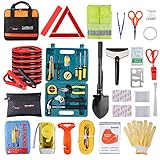
- ESSENTIAL RESOURCES: Packed with practical supplies from jumper cables, reflective triangle and vest to tow rope, and tire presure gauge, we've got everything you need to stay safe during an roadside emergency. But that's not all - it also includes rarely used but essential items like safety hammer, emergency blanket, and survival whistle. With these, you'll be prepared for almost everything the road throws your way.
- RELIABLE JUMPER CABLES: Say goodbye to uncoated jumper cable clamps! Our clamps are fully covered with premium PVC material to protect you from electrical shocks and make sure you can use them safely. The four giant alligator clamps are equipped with strong jagged teeth and springs for an excellent grip force. With a 6 gauge thick inner core, our cables are reliable even in cold winter weather.
- FOLDABLE SURVIVAL SHOVEL: At 16.5 inches, it's a portable size and comes with a carrying pouch. Its versatile design allows for shoveling, digging, hoeing, sawing, and chopping, making it the perfect tool to get you out of any tight situation.
- CAR REPAIR TOOL SET: This handy kit contains all the necessary tools for emergency vehicle repairs and basic household DIY projects, including hammer, wrench, plier, tape measure, PVC tape, digital display test pen, 3 screwdrivers, and 5 hex key. Each tool is neatly organized in a handy case for easy storage and portability.
Write down phone numbers, meeting places, school contacts, utility numbers and medical information. Identify an out-of-area contact who can relay messages if local circuits are overloaded. A battery or hand-crank radio can provide another path to official updates when mobile data is unavailable.
Decide how the household will communicate if members separate. Set a meeting place outside the home and another outside the neighborhood, and tell everyone who has authority to change the plan. Keep alerts enabled for your address and routes, but verify urgent instructions through the issuing agency. Battery conservation matters: download maps or instructions while connected, then use airplane mode when communication is not needed.
Choose equipment by purpose
A car emergency kit and a household continuity kit solve different problems. The car kit is compact and must tolerate travel, temperature swings and a roadside delay. The household kit supports several days of sheltering, sanitation, food and communication. A portable phone power bank or car phone charger addresses charging, but neither guarantees that a station, road or cellular network is operating.
Compare products by the job they must perform, their contents, compatibility with your devices and vehicle, storage conditions and ease of replacement. Check connector types, capacity ratings, flashlight operation and battery availability before buying. Keep instructions with unfamiliar equipment and test it periodically. Category-level gear is sufficient; no particular brand or package should be treated as a substitute for planning or official instructions.
Use reliable, current information
Follow state and local emergency-management agencies, transportation authorities, utilities and law enforcement for instructions about closures, travel restrictions, evacuation and station operations. DOE’s Staying Informed page cites AAA and GasBuddy as examples of services that publish gasoline or diesel price and availability information. Such listings can be delayed, incomplete or wrong during a fast-moving disruption; they do not guarantee that a station has fuel, power, an open register or a working pump.
Before leaving home, check at least two current sources and confirm the station’s status if a phone number is available. Do not rely on a social-media photograph or an old crowd-sourced report. Save official webpages or phone numbers while you still have connectivity, and keep alerts enabled for your address and planned routes.
Information to verify before an essential trip
- Whether the destination and route are open.
- Whether stations have fuel, power and a functioning payment method.
- Any purchase limits, odd-even rules, restricted hours or emergency-vehicle priorities.
- Weather, road hazards and the location of open medical facilities.
- Whether a bridge, tunnel, border crossing or public-transit connection is operating.
Prices and availability services are useful for locating possibilities, not for deciding that a trip is safe. If official authorities direct people to stay off roads, shelter or evacuate, those instructions take priority over an app listing.
Manage fuel during the shortage
Prioritize essential travel
Rank trips before fuel becomes scarce. Medical care, evacuation, caregiving, obtaining safe drinking water and maintaining critical work generally outrank convenience shopping or recreational driving. Combine stops and avoid idling. If public transit, a ride from a trusted person, walking or remote service can replace a trip safely, preserve fuel for a higher-priority need.
Share a ride only when it is safe and lawful, and do not transport people or animals in unsafe cargo areas. Keep enough range for an unexpected detour, road closure or emergency return rather than planning to arrive at a station with an empty tank or battery.
PC Slower Than It Used to Be?
A free scan shows the junk files, broken settings and background clutter dragging Windows down - then fixes them in one click.Free scan · Windows 10 & 11Crashes, No Sound, or Screen Glitches?
Random freezes, missing sound and display glitches usually trace back to one bad driver. Find and replace yours safely.Free scan · under a minuteRank #4

- If your car is parked at the scene of an accident waiting to be rescued, you may need this car emergency kit
- If this roadside assistance kit can help a novice driver or a family member or friend in the event of an accident on the road, they will surely thank you for gifting him this car emergency kit
- Lightweight and compact tire inflator inflates standard vehicle tires in seconds. The surface of the reinforced cable is made of high-quality PVC, which has the characteristics of anti-freezing, anti-cracking, and anti-tangling
- Roadside emergency car kits come in handy during winter weather, hiking, camping, road trips, or traveling in a car or other vehicle
- All of our products are stowed inside a high quality bag to keep our products in the trunk. Perfect for teens, novices, and experienced car enthusiasts
Queue safely and follow local rules
Obey police, fire and station staff. Do not block intersections, emergency lanes, driveways or access for people with disabilities. Keep children and pets out of dangerous traffic areas, and leave enough space for emergency vehicles. Never argue over a pump or bypass a posted purchase limit. If a station is closed, leave rather than creating a queue that obstructs traffic.
Turn off the engine when directed or when waiting conditions make idling unsafe, while considering heat, cold and medical needs. Keep windows closed if fumes are strong, and move away from spills or damaged equipment. Report a dangerous condition from a safe location rather than attempting repairs.
Do not panic-buy or create an unsafe stockpile
DOE notes that panic buying can speed a disruption’s spread. Buying more than your household can use also deprives neighbors and creates storage hazards. This guidance does not establish a universal safe or legal household quantity of gasoline or diesel. Before storing any fuel, consult your local fire code, landlord or housing rules, and the fuel-container and vehicle manufacturers’ instructions. Do not fill arbitrary containers, store gasoline indoors or place containers near ignition sources. If local authorities prohibit storage, do not do it.
Never transfer fuel in a container that is not designed and approved for that fuel, and never leave a container in a passenger compartment. Keep children away from fuel and follow the product label for handling and disposal. If you are unsure whether storage is permitted, ask the local fire department or other authority before purchasing fuel for storage.
Do these 3 things before closing this tab:
1Scan for outdated or missing drivers - takes under a minute2Clear out junk files and repair common Windows errors3Fix the driver behind crashes, sound loss and screen glitchesIf a power outage is part of the event
Assume that a station may be unable to pump or process payment even if fuel deliveries are nearby. Preserve vehicle fuel for trips that cannot wait, and keep the vehicle outside when charging devices. Follow utility instructions about downed lines and restoration; never approach damaged electrical equipment.
Use generators only as their manuals and local authorities direct. A generator must remain outdoors, away from doors, windows and vents, and should never be connected to household wiring through an improvised cable. Because generator requirements vary by model and jurisdiction, use the current instructions for your equipment and local emergency guidance rather than a generic setup.
During an outage, protect refrigerated food and medicines according to current public-health or medical advice. Do not use a grill, camp stove or fuel-burning appliance indoors. If the home becomes dangerously hot or cold, follow local instructions for cooling or warming centers rather than improvising with unsafe combustion equipment.
Independent reader supportYour contribution helps us test, update, and keep practical guides available for everyone.Household decisions by disruption length
| Situation | Best response | Avoid |
|---|---|---|
| Several hours, stations open | Complete only essential errands, charge devices and monitor official updates. | Unnecessary driving or topping off repeatedly. |
| Stations closed or queues widespread | Stay home when safe, use stored water and food, and confirm restrictions before traveling. | Driving from station to station based on unverified reports. |
| Power outage with unsafe weather | Follow local shelter or evacuation instructions, keep communications available and preserve fuel for evacuation or medical needs. | Running a vehicle in a garage or ignoring evacuation orders. |
| Evacuation ordered | Leave by the route and time authorities specify; take the car kit, medications, water and documents. | Waiting for a preferred station or taking a closed route. |
Reassess at each stage. A short disruption may require only canceled trips and charged devices; a longer one may require staying with relatives, using a shelter or arranging a welfare check. Tell household members who makes decisions and where the latest official instructions will be posted.
Free tools Windows power users keep installed
One-click scans. No signup required.
After access returns
Continue following official notices until utilities and transportation systems are stable. Refill normal household supplies gradually rather than triggering another rush. Inspect the vehicle and kit for damage, heat exposure or expired items; recharge power banks; replace used medication and first-aid supplies; and record what failed so the next plan is better. Report dangerous spills, damaged pumps or downed lines to the responsible authority from a safe location.
Best Value

- 【Things you may need】: This roadside assistance packages is a perfect gift.Contain the necessary roadside kits, snow shovel, flashing lights, reflective triangle warning signs, advanced jumpers (8.2 foot), powerful towing rope, safety hammer and seat belt cutters, life blankets, raincoats, compasses and more!
- 【Safe and durable】: UL certified jumper cables are safer and more reliable than other non-UL certified cables. Four huge alligator clips provide excellent grip. The grip of the clip is covered with an insulating rubber sleeve. The surface of the reinforced cable is made of high-quality PVC, which has the characteristics of anti-freezing, anti-cracking, and anti-tangling.
- 【Car repairs tool box】: Small and compact, suitable for any place, the tools are neat and orderly. Including hammer, pliers, utility knife, tape measure, PVC tape, digital display test pen, 3 screwdrivers. Each kit has a separate location. Clean, safe, convenient, light and strong plastic shell can withstand pressure
- 【Upgrade kit】: Our hammer head is made of high-quality high-carbon steel, with a pointed and flat hammer. It helps to use any side of the car escape tool to quickly break the window in an emergency. We provide raincoats and reflective safety clothing, which can be safer to wear when you repair a broken down car.
- 【Emergency car kit】: This emergency kit car, It’s lightweight, compact. that can fit anywhere in your backseat, trunk or even in your spare tire compartment, can handle unexpected things,it also includes preparedness survival tools for outdoor activities like camping, hiking, hunting, act. perfect for family use at home.
Review which information sources were timely and which were not. Update paper contacts, route maps, medical details and out-of-area contacts. If a neighbor, caregiver or employer helped, confirm how that arrangement could work again. Dispose of spoiled food and damaged batteries safely according to local instructions, and do not use fuel or equipment that may have been contaminated by floodwater.
Quick preparation checklist
- Fuel the primary vehicle before forecast extreme weather without relying on an arbitrary tank percentage.
- Cancel or combine optional trips and map alternate routes.
- Pack and inspect a small car emergency kit.
- Store household water at one gallon per person per day and three to five days of suitable food, adjusting for local needs.
- Charge phones and power banks; keep spare batteries and a compatible car charger.
- Write down contacts, meeting points, medical information and official alert sources.
- Plan for children, older adults, disabilities, pets, medicines and refrigerated needs.
- Check local rules before considering any fuel storage; never store fuel indoors or in unsuitable containers.
- During the disruption, prioritize essential travel and follow current state and local instructions.
- Afterward, replace used supplies and revise the plan based on what actually happened.
Frequently Asked Questions
How full should my gas tank be before a fuel shortage?
Ready.gov/FEMA advises having plenty of fuel before extreme weather that could cause a power outage, but it does not set a universal percentage. Fuel early, avoid a last-minute rush and follow local rules.
Should I store extra gasoline at home?
There is no universal safe or legal quantity for every household. Check local fire codes, landlord rules and the fuel-container and vehicle manufacturers’ instructions first. Never store gasoline indoors, in arbitrary containers or near ignition sources.
What food and water quantities should I plan for?
The DOE household guide uses one gallon of water per person per day and three to five days of nonperishable food per person. Adjust for pets, climate, health and medical needs, and follow newer local guidance when it differs.
Can I charge my phone by running my car?
Yes, if necessary, but run the vehicle only outdoors in a well-ventilated location. Never run it in an enclosed garage or where exhaust can collect. A charged power bank and compatible car charger reduce the need to idle.
Are AAA or GasBuddy fuel listings guaranteed to be accurate?
No. DOE cites them as examples of price or availability information, but listings can be delayed or incomplete. Confirm station status and follow current state and local instructions.
What should I do if a fuel station has a long line?
Follow police, fire and station staff directions, obey purchase limits, keep emergency lanes clear and do not block intersections or accessible entrances. If the station is closed or unsafe, leave rather than creating an obstruction.
Free tools Windows power users keep installed
One-click scans. No signup required.
What belongs in a car emergency kit?
Keep a compact kit with water, ready-to-eat food, first aid, needed medication, light and spare batteries, seasonal clothing, warning equipment, a compatible charger, paper contacts and vehicle documents. Tailor it to passengers and climate.
What changes if the shortage follows a power outage?
Pumps, payment systems and communications may fail even when fuel is nearby. Preserve fuel for essential travel, monitor utility and emergency alerts, and use generators or fuel-burning appliances only as current manuals and local authorities direct.
The Bottom Line
Prepare before disruption: fuel the vehicle early, reduce optional driving, build car and household kits, plan water and food, and maintain more than one way to communicate. During a shortage, verify current local conditions, prioritize essential travel and never create an unsafe fuel stockpile. U.S. federal guidance is a starting point; state and local emergency instructions and fire codes control the decisions in your community.
Quick Recap
Product prices and availability are accurate as of the date/time indicated and are subject to change. Any price and availability information displayed on Amazon at the time of purchase will apply.
Quick wins for a faster PC:
Clear out junk files and repair common Windows errorsFree Scan →Fix the driver behind crashes, sound loss and screen glitchesFind Drivers →
