
iTechGuides is reader-supported. When you buy through links on our site, we may earn an affiliate commission. As an Amazon Associate I earn from qualifying purchases. Learn more
Armed Police Batrider is an arcade shoot-’em-up built around a simple loop: steer with an eight-way joystick, hold the Fire button to attack, use Bomb when danger overwhelms you, collect shot and option items to raise weapon levels, and keep every medal in a pickup chain. The character you choose is also your ship and weapon package, while the button used to select that character adds a separate style trade-off between firepower, options and speed.
What you need to know about the arcade versions
The game is associated with a 1997–1998 arcade release. Arcade History identifies a Japanese Revision 1 using software A and a Japanese Revision 2 using software B; an alternate Korean Revision 2 is also documented. The Museum of the Game lists 1998 as the production year, while older player documentation treats the date as uncertain. In practice, the board revision, region, cabinet wiring and DIP-switch settings can change which commands and modes are available.
This guide describes the common arcade rules first, then identifies commands that depend on a particular revision. It uses community references and an archived manual rather than a newly tested cabinet, so treat very specific timing, autofire and advanced-extend details as revision-sensitive.
Recommended Free Tools
A 2022 release for Sega Astro City Mini V is documented as the first home port, 24 years after the original arcade release, with some music changes. Inclusion, regional compatibility and current availability depend on the particular product listing.
#1 Best Overall

- Officially licensed Atari titles. Titles include Asteroids, Centipede, Millipede, Breakout, Missile Command, Crystal Castles and many more. Game save options.
- Packed with over 200 built-in Atari games + bonus titles. Pac-Man & Galaga not included. Full Game list listed below.
- Includes Atari console, games instructions, 2 wireless joysticks, USB power cable, HDMI cable, and user manual. System connects directly to TV.
- Includes two 2.4 GHz wireless joysticks, inspired by the original Atari joysticks, include paddles for paddle games like Breakout, Warlords and many more.
- User Guide Languages: English, French, Spanish, Italian, Portuguese, German, Dutch, Japanese and Arabic. Dynamic RGB LED lights.
The basic control loop
Move with the eight-way joystick
The arcade control layout uses an eight-way joystick. You can move horizontally, vertically or diagonally, which is essential when threading between aimed bullets while staying aligned with enemies. Small, deliberate movements are safer than holding a direction for long periods: Batrider’s stages mix broad formations with narrow lanes, and overcorrecting can carry the ship into a projectile that was not aimed at your original position.
Fire with A, and bomb with B
Cabinets normally label the two action buttons Fire and Bomb. The specialist guide uses the equivalent notation A for shooting and B for bombing. Thus, “press A” means the cabinet’s Fire button, while “press B” means its Bomb button. Hold Fire to maintain your normal attack.
The specialist guide also describes a charge or aura attack: leaving A unpressed allows a close-range aura to build, and pressing A releases a stronger attack. It is a guide description rather than a universal rule for every character, so check how the selected ship behaves before building a strategy around it. In ordinary play, continuous Fire is the reliable default; charge deliberately when an enemy is about to enter close range and you have room to stop firing.
Do these 3 things before closing this tab:
1Clear out junk files and repair common Windows errors2Scan for outdated or missing drivers - takes under a minute3Repair Windows errors before they cause bigger problemsUse Bomb as both defense and offense
Bomb is not merely a panic button. It can clear threats and damage enemies while you reposition. Steven Ives’s version 0.97 FAQ (updated December 28, 2000) describes bomb use as granting temporary invulnerability and destroying enemy projectiles. That is an older player account, not an official universal measurement, so the exact duration and interactions should be treated as board- or character-dependent.
- Bomb before a dense bullet pattern reaches your path rather than after the ship is already trapped.
- Use it to preserve a medal chain when collecting the next medal would otherwise require an unsafe route.
- Do not spend every bomb immediately: later waves and bosses can demand a defensive reserve.
Choose a character, ship and style
Character selection determines the ship’s weapon identity. Characters differ in their main shot, option weapons and special weapon, so two ships using the same selection style can still feel completely different. The specialist reference describes front, wide, search or homing, and Garegga-style trajectories, along with power properties such as Vulcan, beam, laser and napalm.
Examples of weapon identities
- D.D. is described with a broad Vulcan-style main shot, useful for covering multiple targets across the screen.
- Shorty has a homing or search-oriented weapon, helping shots find enemies outside a narrow forward line.
- Tag-T uses a homing laser, giving the ship a distinct guided-attack behavior.
These examples are not a complete roster table. They illustrate why “ship choice” matters: trajectory and weapon property determine what you can hit, how quickly you can damage a boss, and how much positioning the run demands.
The selection button adds a style
On the character-select screen, the button used to confirm the choice sets an additional style. The documented trade-offs are:
| Selection input | Main shot | Options | Movement | Listed starting fire rate |
|---|---|---|---|---|
| A (Fire) | Strong | Weak | Normal | 15 Hz |
| B (Bomb) | Weak | Strong | Normal | 12 Hz |
| C, or A+B on some setups | Strong | Strong | Slower | 20 Hz |
| Start | Weaker | Weaker | Faster | 10 Hz |
“Strong” and “weak” describe the balance between the two weapon components, not a universal damage percentage. A style with strong options may still be the better choice for a ship whose option attack does most of its useful work. The C style gives the most complete weapon package but slows movement, while Start favors mobility at the cost of both attack components. The machine’s revision or control panel can affect whether C or the A+B combination is available.
How to select a practical first ship
- Pick a weapon pattern you can read on screen. A wide or homing attack reduces the amount of perfect horizontal alignment required while learning stages.
- Try A style first if you want a strong, straightforward main shot and can manage weaker options.
- Try B style if your chosen character’s option weapon covers targets your main shot misses.
- Use C only when you can accept slower movement; the extra weapon strength does not compensate for a collision you could have avoided with a faster ship.
- Use Start style when movement and survival are your immediate problem, recognizing that the lower firepower can lengthen enemy encounters.
Power-ups and the five shot levels
Small shot items accumulate toward the next weapon level. A large shot item advances the shot level immediately once. The specialist reference lists five shot levels and gives the following small-item requirements after the initial state:
| Target level | Small shot items required | Effect of a large shot item |
|---|---|---|
| Level 2 | 1 | Raises one level immediately |
| Level 3 | 2 | Raises one level immediately |
| Level 4 | 4 | Raises one level immediately |
| Level 5 | 8 | Raises one level immediately |
The increasing counts make early pickups valuable: losing a life can cost the accumulated progress needed for the next level, while a large item is an immediate recovery opportunity. Keep collecting ordinary shot items rather than waiting only for large ones.
Special level-ups
The guide describes a special level-up in which you drop three shot or option icons, then collect the next icon of the corresponding type. This is an advanced routing technique, not a beginner requirement. It also carries a warning: triggering these special level-ups early can cause additional bosses at the end of Stage 5. If you are learning the game, prioritize a stable weapon and survival route before experimenting with this setup.
Quick wins for a faster PC:
Clear out junk files and repair common Windows errorsFree Scan →Fix the driver behind crashes, sound loss and screen glitchesFind Drivers →Repair Windows errors before they cause bigger problemsFix Now →Rank #2
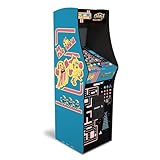
- Classic Arcade Experience: Enjoy 12 legendary games from 1981 on a full-size cabinet with real-feel joysticks, buttons, and authentic arcade-style gameplay
- Vibrant 17" Display: Features a crisp BOE 17" LCD screen that brings retro graphics to life with bright colors and sharp details for immersive gaming fun
- Wi-Fi Leaderboards: Connect to Wi-Fi and compete with players nationwide by posting high scores on global leaderboards—no subscription required
- Premium Retro Design: Over 5 feet tall with a sleek cabinet, light-up marquee, and faux coin door for a nostalgic look that enhances any game room or space
- Crisp Stereo Sound: Dual speakers deliver classic arcade soundtracks and effects just like you remember, bringing every game to life with rich audio
Medal chaining: the first scoring skill
Medals are worth more when you catch them continuously. The documented sequence begins at 100 points, then rises through 200 and 300 to 1,000, after which it increases in 1,000-point steps until reaching 10,000 points. The value is attached to the chain, not just to the individual medal.
- Collect the first medal to establish the chain at 100 points.
- Catch every following medal in the wave so the next value increases.
- When the chain reaches 1,000, continue collecting to move through 2,000, 3,000 and the later 1,000-point increments.
- Protect the next pickup: missing one medal resets the next wave’s medal value to 100.
“Catch” means positioning the ship so the medal is collected before it leaves the practical pickup area. A medal route can be more important than firing at a low-value enemy. If collecting it would put the ship into a bullet, clear the pattern with movement or Bomb first; a broken chain is preferable to losing a life, but a maintained chain is a major source of score.
Extends and the score target
The regular score extend
Arcade History and the specialist reference list an extra life at each 1.5 million points. This is a gameplay threshold, not a guarantee that every board uses identical life limits or continuation settings; cabinet configuration can affect the surrounding rules.
Additional advanced extend conditions
The specialist guide describes three other methods. Because these are detailed community instructions, verify them against the relevant board revision before relying on them:
What’s actually slowing this PC down?
Pick the symptom - the matching free tool is one click away.
- Destroy the large blue Highway hovercraft after it stops in the tunnel.
- Miss three max or large Bomb items.
- Miss three extend items. The resulting extend fills empty life slots without the rank increase associated with ordinary extends, according to the guide.
These conditions are best treated as route-planning discoveries after you can consistently survive the stages. Chasing an advanced extend while abandoning medals or weapon power usually loses more than it gains.
Independent reader supportYour contribution helps us test, update, and keep practical guides available for everyone.Rank: why a successful run can become harder
Rank is a changing difficulty value. The specialist reference explains that it can rise during a run and that credits and extend collection can affect it. Community documentation includes technical values and memory-address details, but those are not a universal official formula. For a beginner, the practical lesson is enough: a run that collects power, score and lives efficiently may also face more demanding enemy behavior or patterns.
- Learn routes that remain safe when patterns intensify, rather than memorizing only the easiest early behavior.
- Do not assume that collecting every possible extend always makes the next stage easier.
- Compare observations only on the same revision and similar DIP-switch setup; changing boards can change the result.
Optional cabinet commands and revision limits
Autofire and option formation
The specialist guide describes a Start-plus-button combination for displaying score information and adjusting autofire rate. It also says that C changes option formation only for Battle Garegga characters. These are configuration and optimization commands, not controls needed to begin a run.
Revision B’s missing C button
Revision B lacks a C button for one of the documented autofire commands and instead uses Start + Up to lower the autofire rate. Do not apply a C-button instruction to a Revision B cabinet that physically has no C input.
The Tool Desk
Outbyte PC Repair FREERepair Windows errors before they cause bigger problemsFix Now →Outbyte Driver Updater FREEScan for outdated or missing drivers - takes under a minuteDriver Scan →DIP switches and mode names
The archived Raizing manual scan documents DIP-switch settings for starting rank, timer rank and coin configuration. Those settings can alter the opening conditions, so record the board revision and switch state when comparing scores.
An older FAQ names Beginner, Normal, Advance and Special courses. The specialist guide uses Normal, Advanced and Boss Rush terminology. These labels should not be assumed to describe one identical mode set: unlock conditions and names can differ by board version or setup.
A first-session practice plan
- Confirm the controls. Identify Fire and Bomb on the cabinet, then verify that the game’s A/B notation matches those buttons.
- Practice diagonal movement. Use the eight-way joystick to make short diagonal corrections without leaving the safe lane.
- Choose one ship and style. Start with A style for a strong main shot, or choose a wider or homing weapon if lining up shots is difficult.
- Watch the weapon meter. Collect small shot items steadily and take large items when available to advance immediately.
- Use Bomb deliberately. Spend it before an unavoidable pattern, not after the ship is already inside the bullets.
- Protect medal chains. Learn where medals appear, but abandon a pickup when the route is genuinely unsafe.
- Track the board. Note whether you are playing Revision 1, Revision 2 or the Korean Revision 2, plus any DIP-switch changes, before comparing behavior or scores.
Common beginner mistakes
- Treating every character as interchangeable: the ship’s trajectory, weapon property and option behavior determine how it must be positioned.
- Choosing C without accounting for speed: stronger weapons do not help if the slower movement causes collisions.
- Saving every Bomb: an unused Bomb cannot protect the current life; spend one when it preserves position, power or a medal route.
- Chasing score before learning survival: a broken medal chain costs points, but a lost life also removes weapon progress and future scoring opportunities.
- Assuming arcade commands are universal: C-button and autofire instructions can fail on Revision B or a differently wired cabinet.
- Reading rank as a fixed difficulty setting: rank changes during a run and may interact with credits and extends.
The short version
Move with the eight-way joystick, hold Fire/A to shoot, and use Bomb/B before a pattern becomes unavoidable. Select a character for its weapon identity, then choose A, B, C or Start to trade main-shot strength, option strength and movement speed. Build shot levels with small pickups and immediate large pickups, preserve medal chains from 100 toward 10,000 points, and treat 1.5 million points as the documented regular extend threshold. Once those fundamentals are consistent, investigate special level-ups, advanced extends and rank behavior on the exact arcade revision you are playing.
Quick Recap
Product prices and availability are accurate as of the date/time indicated and are subject to change. Any price and availability information displayed on Amazon at the time of purchase will apply.

