
Free tools Windows power users keep installed
One-click scans. No signup required.
iTechGuides is reader-supported. When you buy through links on our site, we may earn an affiliate commission. As an Amazon Associate I earn from qualifying purchases. Learn more
Keep a live warehouse running by treating automation installation as a staged operations project, not as a construction job that happens beside normal work. Before equipment arrives, the integrator and your internal project manager should agree the site survey, delivery route, staging footprint, work boundaries, shift schedule, interfaces, written procedures, safeguards, acceptance tests, training, and ownership. Involve operators, maintenance, facilities, safety staff, and supervisors in task-based risk assessments. Use temporary controls and energy-isolation procedures during installation, then commission, test, train, and sign off before returning the equipment to routine operation.
This approach addresses both capacity and safety. Robot-related incidents frequently occur during programming, maintenance, testing, setup, and adjustment—periods when people may enter a robot’s working envelope—not only during normal automatic operation. OSHA describes warehouse risks that include powered industrial trucks, material handling, ergonomics, conveyors, labelers, automated pallet wrappers, slips and falls, chemicals, and robotics. The plan therefore has to protect live operations while each new machine and interface is being built, tested, and changed.
What makes an automation installation different from normal warehouse work?
Installation is a non-routine operating phase with changing hazards. Guards may be incomplete, software may be in a test mode, temporary cables or barriers may be present, and people from several companies may be working in the same footprint. OSHA notes that robot incidents often happen during programming, maintenance, testing, setup, and adjustment, when workers can enter the robot’s working envelope. The same principle applies to conveyors, palletizers, sortation equipment, labelers, scanners, and other automated machinery: a machine that is safe in its final production state may not be safe while it is being assembled or integrated.
The Tool Desk
Outbyte PC Repair FREEClear out junk files and repair common Windows errorsFree Scan →Outbyte Driver Updater FREEScan for outdated or missing drivers - takes under a minuteDriver Scan →Start with the warehouse outcome you must preserve, then design the installation around it. Define the orders, storage areas, shipping lanes, receiving functions, shifts, and emergency access that must remain available. Identify what can be paused, for how long, and under whose authority. Do not promise a standard outage duration or a universal productivity improvement; the workable window depends on the building, equipment, demand pattern, labor model, and commissioning complexity.
#1 Best Overall

- LOCKOUT TAGOUT KIT: Lockout pouch is made of heavy duty nylon with metal belt loops for convenient tagging on the go, Compliant with OSHA's Lockout Standard
- SAFETY PADLOCKS: The personal lockout kit contains two keyed different padlocks for reliable lockout safety, the key is one use one spare.
- LOCKOUT DEVICES: Kit contains 3 clamp-on circuit breaker lockout, 3 Universal Multi- Pole Breaker ,3 different size lockout hasps,15 heavy duty lockout tags,4 keyed-different safety padlocks:Stainless Steel Lock Beam, with PA Shell ,Vertical Clearance: 1-1/2”, 38mm,Horizontal Clearance: 4/5”, 20mm ,Shackle Dia.: 1/5”, 6mm ,Body Size: 1-4/5” x 1-2/5”, 45 x 37mm
- OSHA COMPLIANT LOCKOUT KIT: Compliant with OSHA's Lockout Standard designed to address risk and safety tagging in any facility
- We have confidence in our product. If you are not satisfied with our products, please contact us and we will reply to you within 24 hours.
OSHA’s warehousing overview lists the hazard categories and general requirements that may apply. Its robotics overview explains that non-routine robot work creates particular exposure. OSHA does not list a single robotics-specific standard that replaces all other requirements, so identify the rules applicable to your equipment, tasks, jurisdiction, and facility rather than treating the absence of one dedicated standard as an absence of regulation.
Build the project team and decision rules first
Put one accountable project manager in charge of the operational plan and give that person authority to resolve conflicts between production and installation. The integrator, the employer, and the people who perform the work must share a common change-control process. OSHA recommends a risk-assessment leader with expertise in process operations, the robotic application, and the assessment method, together with employees who understand the tasks.
Core roles
- Internal project manager: owns the integrated schedule, dependencies, access approvals, decisions, and escalation path.
- Operations lead: defines required capacity, permitted shutdowns, alternate routes, staffing changes, and release criteria for returning areas to service.
- Integrator and commissioning lead: provides installation specifications, interface information, test procedures, risk controls, and evidence that the system meets the agreed design.
- Safety lead: coordinates phase-specific risk assessments, worker consultation, temporary safeguards, emergency arrangements, and energy-control requirements.
- Facilities and maintenance: verifies structural, electrical, fire-protection, utility, access, and maintainability constraints.
- Supervisors and affected workers: explain the actual tasks, traffic patterns, picking and replenishment practices, foreseeable workarounds, and abnormal conditions.
- Rigger or specialist contractors: confirm lifting plans, building entry, equipment handling, anchoring, and delivery controls.
Decisions to record before work starts
- Which functions remain live and the minimum service level for each one.
- Which aisles, docks, electrical rooms, mezzanines, or work cells will be unavailable, and the exact boundaries.
- Who may authorize a change to the schedule, work boundary, software mode, safeguard, or traffic route.
- Who can stop work, who investigates a stop, and what evidence is required before restarting.
- Which documents are controlled: drawings, risk assessments, method statements, lockout/tagout procedures, test scripts, training records, punch lists, and acceptance sign-off.
Publish the decision rules where supervisors and contractors can see them. A short daily coordination meeting should confirm the day’s work area, live routes, isolations, lifts, test modes, and the person in charge.
Recommended Free Tools
Use a phase plan with a defined output for every gate
A gate-based plan prevents the project from jumping from delivery directly to production. The exact names can vary, but every phase should have an owner, entry conditions, controls, and evidence that permits the next phase.
| Phase | Primary question | Required output before moving on |
|---|---|---|
| Scope and design | What must the system do, and what must remain operating? | Approved scope, roles, interfaces, constraints, milestones, and acceptance criteria. |
| Pre-site survey | Can people and equipment reach the work area safely? | Verified route, dimensions, utilities, floor and structural constraints, staging map, and delivery window. |
| Preparation | Is the area ready without exposing live operations? | Released work zone, temporary barriers, traffic plan, permits, isolations, and communications. |
| Mechanical and electrical installation | Can the equipment be assembled without uncontrolled energy or interference? | Installation inspection, completed connections, updated drawings, and phase risk review. |
| Integration and testing | Do equipment, software, people, and existing systems work together safely? | Functional tests, emergency-stop and safeguard checks, defect log, and approved test evidence. |
| Commissioning and acceptance | Does the installation meet the agreed requirements? | Site acceptance test results, resolved critical defects, customer sign-off, and operating restrictions if any. |
| Handover | Can the warehouse own the system safely? | Trained operators and maintainers, procedures, records, spares, contacts, and KPI baseline. |
Survey the facility before equipment is delivered
Conduct the pre-site survey with the integrator, rigger or vendor, facilities, operations, and safety representatives. MHI’s brownfield guidance recommends agreeing the final project plan after surveying the site, choosing an appropriate building entry, mapping floor space, planning delivery timing, and deciding staging arrangements. Record measurements and photographs in a controlled site pack rather than relying on assumptions made during design.
Check the physical route
- Measure dock doors, external approaches, internal doors, corridors, turning radii, aisle widths, lift capacities, ramps, and overhead clearances.
- Locate columns, sprinkler drops, fire doors, low beams, guardrails, drains, uneven floors, and other obstructions.
- Confirm the equipment’s shipping dimensions, center of gravity, lifting points, rigging requirements, and final orientation.
- Verify floor loading, anchoring locations, slab condition, vibration constraints, and any need for permits or engineering approval.
- Identify where delivery vehicles, cranes, forklifts, pallet jacks, and pedestrians will wait or pass.
Check utilities and existing equipment
- Confirm electrical capacity, disconnect locations, voltage, grounding, cable routes, network drops, compressed air, vacuum, ventilation, drainage, and lighting.
- Map interfaces with existing conveyors, scanners, warehouse-management or control systems, fire alarms, doors, elevators, charging areas, and emergency stops.
- Identify nearby powered industrial truck routes, pedestrian crossings, picking faces, replenishment points, and maintenance access.
- Confirm whether new guarding, fencing, interlocks, light curtains, signage, or emergency-stop circuits will affect existing equipment.
Produce a movement and staging map
Draw the route from the building entry to the final position, including every temporary stopping point. Show the unloading area, component staging, waste removal, contractor parking, tool storage, pedestrian detours, powered-industrial-truck routes, fire exits, and emergency-equipment access. Mark dimensions and capacities, not just labels. The map should show what is live, what is isolated, and who controls each boundary on every installation day.
Rank #2

- LOCKOUT TAGOUT KIT: Lockout pouch is made of heavy duty nylon with metal belt loops for convenient tagging on the go, Compliant with OSHA's Lockout Standard
- SAFETY PADLOCKS: The personal lockout kit contains two keyed different padlocks for reliable lockout safety, the key is one use one spare.
- LOCKOUT DEVICES: Kit contain 3 Safety Padlocks with number 1-3, 2 Lockout Hasp ,1 Nylon hasp ,15 Loto Tags, 20 Nylon ties , 1 Lockout Tool Bag
- OSHA COMPLIANT LOCKOUT KIT: Compliant with OSHA's Lockout Standard designed to address risk and safety tagging in any facility
- We have confidence in our product. If you are not satisfied with our products, please contact us and we will reply to you within 24 hours..
Schedule the work around real operating demand
Build the installation schedule against actual shifts, inbound and outbound peaks, labor availability, inventory commitments, and space for staging. Ask operations to identify the periods when a lane, dock, storage location, or process can be unavailable without causing an unsafe workaround. Ask the integrator to identify the activities that need a quiet or isolated area, a lift, a network outage, a controlled test mode, or a full stop.
Choose a schedule using explicit criteria
| Criterion | Questions to answer | Evidence to capture |
|---|---|---|
| Operational capacity | How much receiving, storage, picking, or shipping capacity is affected at each stage? | Area-by-area capacity plan and approved contingency route. |
| Worker exposure | How many people enter or pass the work zone, and what temporary controls separate them? | Task risk assessment, barriers, spotters, permits, and supervisor assignments. |
| Access and delivery | Which delivery window avoids conflicts with trailers, replenishment, and emergency access? | Booking, route plan, lift plan, and traffic marshal arrangement. |
| Staging footprint | Can components remain stable, protected, identifiable, and out of escape routes? | Scaled staging layout and maximum dwell time. |
| Interface complexity | What existing systems must be changed or tested together? | Interface matrix, test sequence, rollback plan, and named owners. |
| Training and acceptance | When can operators and maintainers train on a stable system before ownership changes? | Training roster, competency checks, test records, and sign-off criteria. |
Weekend or overnight work may fit one warehouse and be a poor choice in another. MHI uses weekend work as an example while making clear that the required time is case-dependent. Select windows from your demand and risk analysis, not from a calendar rule. If the project needs several short interventions, publish each intervention as its own work package with a separate boundary, rollback action, and release check.
Keep live routes understandable
Use consistent floor markings, signs, barriers, and terminology. Tell every shift what has changed at the start of the work period. Supervisors should be able to answer three questions immediately: where may people walk, where may vehicles drive, and who may enter the installation zone? When routes change, remove obsolete signs and markings so workers do not have to interpret conflicting instructions.
Perform risk assessments for every project phase
Do not write one generic assessment and file it. Assess assembly, delivery, installation, integration, testing, commissioning, normal operation, maintenance, cleaning, recovery from faults, and foreseeable abnormal conditions. OSHA’s technical guidance calls for documented risk assessments at each development stage, worker involvement, written procedures, training before assignment, and temporary risk-reduction measures during installation.
“Preparation and implementation of thorough risk assessments (RAs) with workers are critical for worker safety.” — OSHA Technical Manual, Section IV, Chapter 4
Do these 3 things before closing this tab:
1Fix the driver behind crashes, sound loss and screen glitches2Clear out junk files and repair common Windows errors3Scan for outdated or missing drivers - takes under a minuteSpecial offer. See more information about Outbyte and uninstall instructions. Please review EULA and Privacy policy.
Use task language: who does what, with which energy source, in which location, while what else is operating? Include struck-by, caught-between, crushing, unexpected start-up, electrical, pneumatic, hydraulic, gravity, stored-energy, ergonomic, noise, slip and trip, chemical, fire, and emergency-egress hazards where applicable.
Rank #3
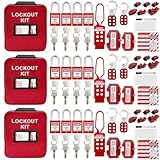
- 1、 What You Get. 3 x Complete LOTO Kits (Each Contains): 4 Safety Padlocks、2 Steel Hasps、1 Nylon Hasp、15 LOTO Tags、20 Cable Ties、1 Big Nylon Pouch、4 clamp-on circuit breaker lockout, 3 Universal Multi- Pole Breaker, 2 Electrical Plug Lockout + SAFBY's 2-Year Support。
- 2、OSHA-Compliant Safety:Meets all lockout/tagout (LOTO) standards for electrical, mechanical and industrial safety,Complete 3-Kit Set Perfect for teams or multiple workstations。Each kit is self-contained with all essential LOTO devices。
- 3、Superior Durability:Reinforced steel hasps withstand tough environments,Weather-resistant tags and nylon components。
- 4、 Clear Hazard Communication:Bright red safety tags with bold warnings,Numbered padlocks for easy identification。
- 5、Convenient Portability:Compact nylon pouch with metal belt loops,Keeps all devices organized and accessible。
Involve people who perform the work
Operators can identify shortcuts that a drawing misses; maintainers know hidden isolation points; drivers know where sight lines disappear; and contractors know how a lift or test actually proceeds. Ask them to walk the task, identify credible deviations, and verify that controls are workable. Document names, dates, assumptions, residual risks, and the person responsible for each action.
Trigger a review when conditions change
- The equipment, guarding, software, operating mode, or interface changes.
- The work boundary or traffic route moves.
- A test requires bypassing, muting, or temporarily removing a safeguard.
- A different contractor, shift, tool, lifting method, or energy source is introduced.
- An incident, near miss, unexpected machine behavior, or repeated alarm reveals a new hazard.
The integrator should give the employer its assessment before commissioning. The employer still has to determine whether controls work in the actual facility and whether workers understand them.
Separate installation work from live warehouse traffic
Physical separation is the first control where people, vehicles, and automation can interact. Use rigid barriers or fencing appropriate to the hazard, controlled gates, clearly marked crossings, and a named person responsible for the boundary. Do not rely on tape or a verbal instruction where a vehicle, suspended load, moving conveyor, or robot envelope could reach a person.
Windows Errors? Fix Them Before They Spread
Repair common Windows errors and clear accumulated junk for a smoother, more stable PC - no reinstall needed.Free scan · no reinstallCrashes, No Sound, or Screen Glitches?
Random freezes, missing sound and display glitches usually trace back to one bad driver. Find and replace yours safely.Free scan · under a minuteControl powered industrial trucks and pedestrians
- Reroute trucks around the work zone rather than asking drivers to pass close to lifts or open machinery.
- Provide a pedestrian route with adequate width, visibility, lighting, and protection from falling or moving objects.
- Use spotters for reversing, blind turns, deliveries, and movements that cross a live route.
- Schedule lifts and large-component moves when adjacent traffic can be stopped and the area cleared.
- Keep fire exits, eyewash stations, electrical disconnects, fire equipment, and emergency access unobstructed.
OSHA’s warehouse hazards and solutions guidance warns that conveyors, labelers, and automated pallet wrappers can create struck-by and caught-between hazards when they are not properly integrated. Treat the interface between old and new equipment as a hazard in its own right: a conveyor may start because a downstream sensor changes state, or a wrapper may cycle while someone is working at an adjacent station.
Plan energy isolation and temporary safeguards
Write the energy-control method before installation and servicing. Identify electrical, pneumatic, hydraulic, mechanical, thermal, gravity, vacuum, chemical, and stored energy. Show every isolation point, dissipation step, verification method, and restoration check. OSHA advises that warehouse operations need a lockout/tagout program so machinery is isolated and rendered inoperative before servicing or maintenance.
Lockout/tagout supplies can support the program, but a generic kit does not make a task safe. Devices must fit the machine and its energy sources, and authorized employees must follow the site’s written procedure. Include group lockout arrangements, contractor coordination, shift handover, removal rules, and a method for testing that energy is absent before work begins.
Rank #4

- COMPLETE ELECTRICAL LOCKOUT KIT: Designed for electricians, maintenance teams, and industrial facilities, this complete LOTO kit includes safety padlocks, breaker lockouts, hasps, tags, ties, and storage bag to manage hazardous energy safely and efficiently.
- 4 KEYED-DIFFERENT SAFETY PADLOCKS: Each lock has a unique key configuration for personal lock control. Durable safety locks help prevent unauthorized equipment operation during maintenance and service procedures.
- UNIVERSAL CIRCUIT BREAKER LOCKOUTS: Includes clamp-on and multi-pole breaker lockout devices designed to fit a wide range of electrical panels, helping technicians handle different lockout applications with one kit.
- MORE COMPLETE LOCKOUT OPTIONS: Includes plug lockout, lockout hasps, safety tags, and nylon ties for electrical equipment isolation, group lockout procedures, and daily maintenance tasks.
- READY FOR INDUSTRIAL USE: Store and organize all LOTO devices in the durable portable bag. Ideal for factories, workshops, electrical rooms, machinery maintenance, and facility safety programs.
Use temporary controls during installation
- Install temporary guards, barriers, covers, or exclusion zones before energizing partially assembled equipment.
- Control test modes with restricted access, a designated test leader, clear communication, and a stop-work signal.
- Prevent automatic restart after power restoration, fault reset, network recovery, or sensor changes unless the design and procedure explicitly require it.
- Verify emergency stops, interlocks, light curtains, scanners, gates, and warning devices before people enter the affected area.
- Remove temporary bypasses and document any approved residual restriction before releasing the system.
Keep an isolation register showing the machine, isolation owner, lock or tag identification, start time, affected area, and release authorization. Reconcile it at every shift change. If a safeguard must be defeated for a test, the risk assessment and procedure must specify who may do it, what compensating control applies, and how normal protection is restored.
What’s actually slowing this PC down?
Pick the symptom - the matching free tool is one click away.
Integrate the new system with existing warehouse processes
Automation rarely operates alone. Build an interface matrix that names each connection between the new equipment and people, conveyors, scanners, sensors, warehouse-control or warehouse-management software, fire systems, doors, elevators, charging areas, and emergency circuits. For every interface, specify the signal or physical condition, expected response, owner, test method, and recovery action.
Test normal and abnormal cases
- Normal product flow, empty locations, full locations, mixed cases, damaged labels, and planned replenishment.
- Loss of power, network, air pressure, sensor signal, scanner input, or upstream and downstream equipment.
- Blocked conveyor, jam, door open, guard open, emergency stop, fire alarm, and manual intervention.
- Restart after a fault, shift change, maintenance release, and controlled return from a safe state.
- Human-machine interactions at loading, unloading, picking, replenishment, cleaning, and fault recovery points.
Write the recovery sequence in operator language. “Reset the fault” is not enough; specify how to make the area safe, who checks for people and product, which energy state is required, what may be reset, and when production can resume.
Define commissioning and acceptance before the first test
Acceptance criteria should be agreed during scope definition, not negotiated after a failed demonstration. Include functional requirements, safety requirements, interfaces, documentation, training, permitted open items, and the evidence needed for sign-off. Separate critical defects that prevent operation from minor punch-list work that can be completed under a documented restriction.
Commissioning sequence
- Verify installation: check location, anchoring, wiring, utilities, guarding, labels, drawings, and access against the approved specifications.
- Verify safeguards: test emergency stops, interlocks, protective devices, warning signals, restricted access, and safe states before production trials.
- Run controlled dry tests: exercise sensors, actuators, communications, and sequences without normal product volume.
- Run representative product tests: use agreed products, labels, cases, pallets, and exception conditions; record results rather than relying on observation.
- Test failure and recovery: create the approved abnormal conditions and verify alarms, stops, recovery steps, and restart behavior.
- Review defects: assign each issue an owner, severity, containment, due date, and retest requirement.
- Conduct site acceptance testing: execute the agreed script with customer and integrator representatives present, preserving signed evidence.
- Authorize release: confirm that critical defects are closed, restrictions are documented, procedures are available, and the accountable customer representative signs off.
OSHA recommends checking safeguards and risk-reduction measures during initial commissioning. MHI describes site acceptance testing, customer sign-off, operator training, and post-implementation KPI measurement as parts of a brownfield implementation. Sign-off should identify exactly what was accepted, what remains restricted, and who owns each open item.
Train operators and maintainers before handover
Training is part of commissioning, not a presentation after the equipment is declared complete. Train each role on the equipment and the actual warehouse procedure: normal operation, permitted adjustments, alarms, safe clearing of jams, emergency stops, evacuation, isolation, cleaning, inspection, escalation, and restart. Maintenance training should cover energy sources, diagnostic modes, access points, spare parts, software backups, and contractor interfaces.
Best Value

- LOCKOUT TAGOUT KIT: Lockout box is made of 304 steel with PP which is heavy duty and portability, Compliant with OSHA's Lockout Standard
- SAFETY PADLOCKS: The personal lockout kit contains two keyed different padlocks for reliable lockout safety, the key is one use one spare.
- LOCKOUT DEVICES: Kit contains 9 clamp-on circuit breaker lockout, 3 Universal Multi- Pole Breaker ,6 different size lockout hasps, 20 heavy duty lockout tags, 5 keyed-different safety padlocks, 1 plug lock, 1 cable lock, 1 gas valve lockout, 1 ball valve lockout
- OSHA COMPLIANT LOCKOUT KIT: Compliant with OSHA's Lockout Standard designed to address risk and safety tagging in any facility
- We have confidence in our product. If you are not satisfied with our products, please contact us and we will reply to you within 24 hours.
Verify competence
- Use a controlled procedure and have the trainee perform the task, not merely acknowledge a slide deck.
- Observe a normal cycle, an alarm response, a safe stop, and a restart or recovery sequence.
- Record the trainer, trainee, equipment version, date, assessment result, and any restrictions.
- Provide shift-specific coverage so the night or weekend team is not left with undocumented differences.
- Define refresher triggers: software or hardware changes, incidents, revised procedures, long gaps in exposure, or reassignment.
Do not transfer ownership while only the integrator knows how to recover a fault. The handover pack should include approved drawings, manuals, risk assessments, test records, certificates where applicable, maintenance schedules, recommended spares, passwords and access ownership, training records, emergency contacts, and the final punch list.
Measure the result without inventing a benchmark
Agree KPIs before implementation so the team can distinguish a commissioning problem from a demand or process change. The measures depend on the project; choose only those that answer the operating requirement and can be collected consistently.
- Availability or scheduled operating time of the automated process.
- Throughput or completed units against the agreed workload and product mix.
- Order or task cycle time, queue time, and manual touch points.
- Fault frequency, mean time to recover, and repeat alarm categories.
- Quality, misroute, damage, or inventory-accuracy measures where the automation affects them.
- Safety observations, near misses, blocked routes, unauthorized entries, and completion of corrective actions.
- Training completion and the percentage of shifts able to perform documented recovery tasks.
Capture a baseline using the same definitions and time window you will use after go-live. MHI recommends measuring the agreed KPIs after implementation; it does not establish a universal improvement percentage or commissioning duration. Report the measurement conditions, exclusions, product mix, staffing, and downtime causes so the result is interpretable.
Quick wins for a faster PC:
Repair Windows errors before they cause bigger problemsFix Now →Scan for outdated or missing drivers - takes under a minuteDriver Scan →Use practical checklists at each gate
Before delivery
- Scope, roles, escalation, and acceptance criteria approved.
- Pre-site survey complete; route, floor, utilities, obstacles, and staging verified.
- Delivery booking, rigging plan, traffic controls, and emergency access approved.
- Work-zone drawings, temporary barriers, signs, and alternate routes ready.
- Phase risk assessment and written procedures reviewed with affected workers.
- Energy-control points identified and lockout/tagout procedures available.
- Shift communications, contractor induction, and daily coordination process scheduled.
Before energizing or testing
- Installation inspection complete and drawings updated.
- Guarding, interlocks, emergency stops, warning devices, and safe states verified.
- Test boundary closed, personnel accounted for, and test leader identified.
- Interface owners present or reachable; rollback and stop-work actions understood.
- Product, labels, software versions, test data, and recording forms ready.
Before production release
- Site acceptance tests completed with signed evidence.
- Critical defects closed; remaining restrictions have owners and due dates.
- Operators, maintainers, supervisors, and emergency responders trained and assessed.
- Procedures, drawings, risk assessments, backups, spares, and contacts handed over.
- Live routes restored or permanently marked; temporary controls removed only after verification.
- KPI baseline and post-go-live review date agreed.
Common failure modes and how to recover
Equipment arrives before the route is ready
Stop unloading if the planned route, floor capacity, staging area, or emergency access is not verified. Keep the load secured in an approved holding area, re-plan with the rigger and facilities lead, and record the change before moving it. Improvising a route under delivery pressure transfers risk to drivers, pedestrians, and the building.
Operations bypasses the work boundary
Pause the affected task, restore the barrier or control, and have the supervisor explain the route at the next shift briefing. If people repeatedly need to cross the zone to do their jobs, redesign the route or work method; repeated violations usually indicate an impractical control rather than a worker-information problem alone.
A test exposes an unexpected interaction
Put the equipment in a safe state, preserve the event information, and stop testing until the interface risk assessment is updated. Identify whether the cause is a sensor state, software sequence, energy source, human action, or physical access issue. Retest the changed control under the same conditions and add the scenario to the acceptance record.
Commissioning slips into production
Do not accept a system merely because it moves product. Return to the release gate, verify safeguards and recovery behavior, close critical defects, and confirm that trained personnel and procedures are available on every shift. If production must continue with a restriction, document the restricted mode, compensating controls, owner, end date, and stop criteria.
Bottom line for a live warehouse
The safest and least disruptive installation is planned as a sequence of controlled operational changes. Survey the building and movement routes before delivery; schedule around real demand; separate people, vehicles, and test zones; assess every phase with the workers who perform it; isolate energy and use temporary safeguards; test interfaces and abnormal conditions; then train, accept, and measure before handing over ownership. That sequence gives operations leaders a defensible way to keep necessary work moving without treating installation hazards as ordinary warehouse activity.
Quick Recap
Product prices and availability are accurate as of the date/time indicated and are subject to change. Any price and availability information displayed on Amazon at the time of purchase will apply.

