
The Tool Desk
Outbyte Driver Updater FREEScan for outdated or missing drivers - takes under a minuteDriver Scan →Outbyte PC Repair FREEClear out junk files and repair common Windows errorsFree Scan →iTechGuides is reader-supported. When you buy through links on our site, we may earn an affiliate commission. As an Amazon Associate I earn from qualifying purchases. Learn more
Make the entire robot application safe—not just the robot arm. A credible safety program starts with a documented, lifecycle risk assessment of the robot, end-effector, workpiece, surrounding equipment, software, tasks, people and environment. It then applies validated safeguards for normal and non-routine work, implements and maintains those safeguards, and trains every person who may install, program, operate, maintain or repair the system before assignment. A “collaborative” label alone cannot establish safety.
What makes an industrial robot safe to work alongside?
Safety is a property of the complete application. ISO describes collaborative robotics as an application or system in which automated equipment shares a workspace with people. That definition places the focus on the shared task and environment rather than on a particular robot model.
The system boundary should include:
- the robot, controller, software and programmed motion;
- the end-effector, tooling, grippers, cutters and any stored energy;
- the workpiece, fixtures, pallets and material that the robot moves;
- nearby machines, conveyors, utilities and other robot cells;
- the cell layout, access points, visibility and floor space;
- normal production, startup, programming, setup, testing, adjustment, cleaning, maintenance and repair;
- the people who perform those duties, their expected movements and foreseeable errors; and
- environmental conditions and application-specific processes such as welding, laser cutting or machining.
Only after those factors are understood can an employer decide whether people and the robot should share a task, merely share a workspace, or be separated during particular operations.
Why a “collaborative robot” label is not a safety guarantee
A robot marketed or configured as collaborative can still present crush, impact, laceration, burn, electrical, pneumatic, projectile and process hazards. A low nominal speed does not by itself make contact harmless. The tool, workpiece, geometry, motion, stopping performance and the body region that could be contacted all affect the consequence of an incident.
#1 Best Overall
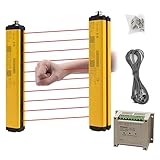
- ROBUST HOUSING- Thick aluminum alloy shell, stable performance, powerful output , and reliable safety.
- ACCURATE MONITORING- The detection is accurate and the response speed is as fast as 10ms. Meets International Electrotechnical Society IEC61496-1/2 standard, designed according to European standards, and has passed CE certification.
- SECURITY PROTECTION- This safety light curtain emits infrared light, resulting in a protective screens. When the light curtain is blocked, the device emits a blackout signal and control potentially dangerous machinery and equipment stops working, or an alarm signal, control and alarm devices to achieve the purpose of security.
- WIDE APPLICATIONS- Reliably protect people or objects in paper machinery, leather machinery, woodworking machinery, injection molding machine, forging machine, punching machine tools, security monitoring etc. Mainly used for the pipeline restricted area, bending machine, injection molding machine,stereo garage and and other dangerous equipment
- High Performance- Built-in amplifier, using modulated light source, programming synchronous scanning mode, strong resistance to external interference, easy to install
ISO’s guidance makes the application and work environment central. Carole Franklin, Secretary of ISO/TC 299/WG 3, states: “The fact is,” explains Carole Franklin, Secretary of ISO/TC 299/WG 3, “when robots work alongside humans, we have to be very careful that the application does not put a human in danger.”
ISO also records Roberta Nelson Shea, Convenor of the ISO Industrial Robot Safety Working Group (ISO/TC 299/WG 3), describing the underlying design question: “When working on the standards for safety of industrial robots (ISO 10218-1 and ISO 10218-2), a philosophical discussion arose. If an application will not hurt and injure a human, why not allow contact?” The answer depends on measured, application-specific limits and safeguards, not on a product category.
Start with a lifecycle risk assessment
OSHA recommends that risk assessment be performed and documented at design, manufacturing, integration, operation and maintenance stages. Treat the assessment as a living engineering record: a change in the task, program, tooling, material, layout or safeguard can change the risk.
PC Slower Than It Used to Be?
A free scan shows the junk files, broken settings and background clutter dragging Windows down - then fixes them in one click.Free scan · Windows 10 & 11Outdated Drivers Are Slowing You Down
One free scan finds every outdated or missing driver and matches the right update for your exact hardware.Free scan · exact hardware match1. Define the intended use and system boundaries
Describe what the robot is supposed to do, where it can move, what it can carry and who can enter the area. Include neighboring cells and peripheral equipment. Restricted spaces can overlap, so a person working on one system may be exposed to another robot or a moving workpiece.
2. List every task, including non-routine work
Document programmed production cycles as well as startup, programming, setup, testing, adjustment, troubleshooting, cleaning, scheduled maintenance, unscheduled maintenance, repair and recovery from faults. These activities can place a worker inside the robot’s working envelope while unintended movement remains possible.
Identify each role that may be exposed: assemblers, installers, programmers, integrators, operators, maintenance workers and repair personnel. Record what each person must do, what controls they use and what access they require.
Rank #2

- ROBUST HOUSING- Thick aluminum alloy shell, stable performance, powerful output , and reliable safety.
- ACCURATE MONITORING- The detection is accurate and the response speed is as fast as 10ms. Built-in amplifier, using modulated light source, programming synchronous scanning mode, strong resistance to external interference, easy to install
- SECURITY PROTECTION- This safety light curtain emits infrared light, resulting in a protective screens. When the light curtain is blocked, the device emits a blackout signal and control potentially dangerous machinery and equipment stops working, or an alarm signal, control and alarm devices to achieve the purpose of security.
- Self-check function: When the safety screen protector fails, ensure that the wrong signal is not sent to the controlled electrical appliances.
- High Performance- Built-in amplifier, using modulated light source, programming synchronous scanning mode, strong resistance to external interference, easy to install
3. Identify hazards in the complete application
OSHA identifies several robot-specific exposure patterns:
- Struck-by hazards: a robot, arm, fixture, workpiece or material can hit a person.
- Trapping and crushing: a person can be caught between a robot and a peripheral machine, fixture, conveyor or other fixed object.
- Projectiles: an end-effector can release a part, or material can break loose and be thrown.
- Unexpected motion: a fault, programming error, sensor failure or recovery sequence can initiate movement when a worker is in the envelope.
- Process hazards: welding, laser cutting, machining and the associated heat, light, fumes, chips or noise can add risks beyond robot motion.
Also examine electrical, pneumatic, hydraulic, gravity, thermal and stored-energy hazards where the application contains them. The risk assessment should address normal operation, emergencies, malfunctions, environmental conditions, installation location and foreseeable worker errors.
4. Evaluate interaction and exposure
Ask whether people need to share a task with the robot, only pass through the same workspace, or enter the area only for service. Determine whether contact is expected, where contact could occur, how close a person may approach, how quickly the system can detect intrusion, and what happens during a fault or loss of a protective function.
5. Select and validate controls
Choose a combination of measures that addresses the identified hazards. Employers should review and approve the selected safeguards and other risk-reduction measures, implement them fully, and verify that they work for the actual task. Reliability and timely maintenance are part of the control: a safeguard that is bypassed, degraded or unavailable cannot provide its intended protection.
6. Record the decision
Keep the assessed tasks, hazards, selected safeguards, operating limits, validation evidence, procedures, training requirements and reassessment triggers together. Documentation should make clear which assumptions—such as a particular tool, workpiece, speed or layout—must remain true for the controls to be valid.
Choose the collaborative operating approach for the actual risk
ISO identifies four collaborative techniques. They are design options, not a shopping list. Compare them by whether contact is expected, how proximity or contact is detected, the hazards of the end-effector and workpiece, and the behavior required during setup, faults and maintenance.
Rank #3

- Cutting-Edge Technology - Utilizing infrared scanning detection technology, this safety light curtain sensor system embodies the most recent innovations in automatic control products, ensuring exceptional performance.
- Fast Response & Anti-Interference: Experience quick response times and robust anti-interference capabilities with this light curtain sensor switch, ensuring reliable safety in diverse industrial environments.
- Robust Aluminum Alloy Construction: Built to last, this safety grating security device is crafted from high-quality aluminum alloy, offering longevity and dependable protection for forging machines, automation equipment, and more.
- Versatile Application: From shearing machines to industrial robots, this sensor is designed for a variety of machinery. It's ideal for use in production lines, packaging equipment, and solid garages, providing a versatile safety solution.
- Enhanced Efficiency: Featuring low energy consumption and fast response times, this sensor not only saves energy but also enhances operational efficiency, contributing to overall productivity in industrial settings.
| Technique | How it works | When the design question matters most | Key limitations to resolve |
|---|---|---|---|
| Safety-rated monitored stop | The robot enters a safety-rated stop while a person is in the shared workspace. | People need access to the workspace for a task, but robot motion can be halted safely during that access. | The implementation must be validated for the system; stopping must address the actual motion, load and surrounding hazards. |
| Hand guiding | A worker guides robot motion through a purpose-designed safety control arrangement. | The process benefits from direct human guidance of the robot. | The control arrangement, guided motion and tool or workpiece must be assessed together; hand guiding does not remove other cell hazards. |
| Speed-and-separation monitoring (SSM) | A protective presence-sensing device detects worker intrusion. The application stops during the intrusion and resumes only after the area is clear. | The robot can operate without a person nearby and needs controlled access when a person approaches. | Detection coverage, stopping distance, response time, blind areas and adjacent equipment must be validated for the layout. |
| Power-and-force limiting (PFL) | Contact is expected and permitted only where contact forces and pressures are limited. | A process requires people and the robot to occupy the same task space and incidental contact is foreseeable. | Force and pressure limits require a system-specific assessment. Tool shape, workpiece mass, geometry, motion and vulnerable body regions all matter. |
SSM and PFL can be combined. OSHA describes a possible arrangement in which the application runs faster when nobody is near and slows as a person approaches. The combined behavior still requires application-specific controls; it is not an automatic safety solution.
For any technique, consider what happens after power loss, a sensor fault, a communication failure, a protective-device trip, a restart request and a worker entering for maintenance. A safe response must be defined and validated rather than assumed.
Design the cell around real hazards
Control the robot and the process together
Robot-level motion controls cannot address every hazard created by the tool or process. A sharp gripper, cutting tool, hot weld, laser beam, rotating spindle, unsecured load or brittle workpiece may require additional safeguarding and operating restrictions. ISO 10218-1:2025 specifically notes that applications such as welding, laser cutting and machining can create additional hazards that must be addressed in application design.
What’s actually slowing this PC down?
Pick the symptom - the matching free tool is one click away.
Account for adjacent cells and peripheral equipment
Draw the complete reach and access envelope, not just the robot’s nominal operating area. A worker servicing one cell may be struck by another robot or workpiece, trapped between systems, or exposed to equipment that was not considered part of the original robot purchase. Overlapping restricted spaces need coordinated controls and procedures.
Use presence sensing only where it is suitable
An industrial safety light curtain is one example of a presence-sensing protective device that may be selected for an SSM application. It is appropriate only when the validated risk assessment shows that its sensing range, position, response time and stopping distance protect the relevant access route. A generic light curtain is not suitable for every robot cell, and installing one does not by itself establish compliance or make the system safe.
Preserve visibility and avoid new hazards
OSHA advises that safeguards should not introduce hazards or block the visibility workers need to perform the task. Review whether a guard, sensor, cable route or protective device creates a new trip point, pinch point, unexpected blind zone or temptation to bypass the control.
Rank #4

- ROBUST HOUSING- Thick aluminum alloy shell, stable performance, powerful output , and reliable safety. Beam Pitch 40mm, Beams 26, Protection Height 1000mm, Total Height 1080mm
- ACCURATE MONITORING- The detection is accurate and the response speed is as fast as 10ms. Meets International Electrotechnical Society IEC61496-1/2 standard, designed according to European standards, and has passed CE certification.
- SECURITY PROTECTION- This safety light curtain emits infrared light, resulting in a protective screens. When the light curtain is blocked, the device emits a blackout signal and control potentially dangerous machinery and equipment stops working, or an alarm signal, control and alarm devices to achieve the purpose of security.
- WIDE APPLICATIONS- Reliably protect people or objects in paper machinery, leather machinery, woodworking machinery, injection molding machine, forging machine, punching machine tools, security monitoring etc. Mainly used for the pipeline restricted area, bending machine, injection molding machine,stereo garage and and other dangerous equipment
- High Performance- Built-in amplifier, using modulated light source, programming synchronous scanning mode, strong resistance to external interference, easy to install
Implement and maintain the safeguards
Implementation is more than selecting a control function in software. The employer should ensure the approved safeguards are installed as designed, connected to the appropriate safety-related functions, tested under the conditions in the risk assessment and available during every relevant operating mode.
Free tools Windows power users keep installed
One-click scans. No signup required.
- Validate normal automatic operation and each defined access mode.
- Test protective-device trips, safe stops, restart behavior and fault responses.
- Check that the robot cannot resume unexpectedly after an intrusion, interruption or power restoration.
- Confirm that tooling, workpieces and payloads match the assumptions used in the assessment.
- Inspect sensors, stops, controls and physical components at a defined frequency.
- Repair or remove from service any safeguard that is damaged, defeated or unreliable.
- Keep maintenance records and update the assessment when reliability, performance or the process changes.
Maintenance deserves the same rigor as production. A worker who enters to clear a jam, adjust a fixture or diagnose a fault may face more exposure than an operator watching an automatic cycle. Procedures must specify how the system is placed in the required safe state, how residual energy is controlled and how work is verified before restart.
Write procedures for integration, operation and maintenance
Integration and commissioning
- Confirm the approved application boundary, robot program, end-effector, payload and workpiece.
- Verify that the safeguards and safety-related control functions match the documented design.
- Test all operating modes, access points, protective-device trips, stops and restart conditions.
- Check interactions with neighboring cells, conveyors and peripheral equipment.
- Record the validated configuration and the conditions that must not change without reassessment.
Routine operation
- Inspect the cell and safeguards before starting the assigned work.
- Use only the approved program, tooling, payload and operating mode.
- Keep people outside restricted areas unless the procedure specifically authorizes controlled access.
- Stop and report unexpected motion, a failed safeguard, a changed workpiece or any condition outside the assessment.
- Follow the defined recovery and restart sequence after a protective stop or fault.
Setup, programming and testing
These are not automatically low-risk modes. The person may be inside the working envelope while motion is being taught or tested. Procedures should define who may enter, which safety functions remain active, what motion limits apply and how another person is prevented from initiating movement.
Maintenance and repair
Specify the safe state, isolation of relevant energy, permitted access, verification before work and controlled return to service. Include unscheduled work and emergency recovery; a procedure that covers only planned maintenance leaves a predictable exposure unaddressed.
Independent reader supportYour contribution helps us test, update, and keep practical guides available for everyone.Train people before assigning robot work
OSHA says people who assemble, install, program, integrate, operate, maintain or repair robot systems should receive adequate safety training and demonstrate competency before assignment. Training should match the duties and the actual application rather than being a generic presentation about robots.
Recommended Free Tools
- Assemblers and installers: understand the cell boundary, hazards created during installation and the safeguards that must be present before commissioning.
- Programmers and integrators: understand approved operating modes, safety-related functions, application limits, validation and change control.
- Operators: recognize normal status, protective stops, unexpected conditions and the approved recovery path.
- Maintenance and repair personnel: follow access, energy-control, troubleshooting and return-to-service procedures.
Demonstrated competency should cover the person’s assigned tasks: for example, correctly responding to a protective-device trip, recognizing a changed end-effector, reporting a degraded safeguard or following the maintenance access procedure. Re-training is warranted when the program, tooling, process, layout or safeguards change.
Best Value
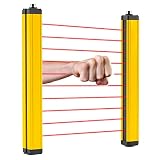
- [Fast Reaction] - The light curtain sensor responds as fast as 0.01 seconds. And the detection distance between transmitter and receiver can be up to 5m. NOTICE: the beam pitch of all types of the safety light curtains is 40mm, which is suitable for wrist or body detection.
- [Security Guard] - This safety grating is mainly used to protect personal safety and reduce work-related injuries. According to research, 90% of work-related injuries are due to lack of safety protection.
- [Stable Output] - It does not need a synchronization line since the power supply can be supplied separately. And it can resist electromagnetic interference and has stable output.
- [Wide Application] - It is applicable to machine tool operation area, production line, automatic welding line, automatic equipment, cutting and pressing equipment, etc. In addition, it has a high protection grade (IP65) and can be suitable for various working environments.
- [Good Quality] - The safety light curtain has a high-brightness indicator light, which makes its working state easy to identify. And the surface is treated with high-quality baking varnish, which makes it waterproof, oil-proof and well sealed.
Reassess whenever the application changes
Reopen and document the assessment when any of these changes occur:
- the robot program, speed, path, payload or operating mode;
- the end-effector, fixture, workpiece, material or process;
- the cell layout, access route, neighboring equipment or restricted space;
- a safeguard, sensor, stop function or protective-device setting;
- the maintenance method, staffing, task sequence or emergency procedure;
- a malfunction, near miss, unexpected contact or recurring bypass; or
- new evidence that the original assumptions about force, pressure, stopping or separation no longer hold.
Reassessment is also appropriate at the lifecycle transitions OSHA identifies: design, manufacture, integration, operation and maintenance. Treat a change request as incomplete until its effect on people, tasks, hazards and safeguards has been considered.
Which standards and rules apply?
Compliance depends on jurisdiction, the machine, the process and the market in which the equipment is placed. The following context helps separate legal requirements from voluntary or consensus guidance.
| Jurisdiction or document | Current context | How to use it |
|---|---|---|
| United States — OSHA | OSHA’s robotics overview states that there are currently no specific OSHA standards for the robotics industry. | Employers must still comply with applicable OSHA regulations. The absence of a robotics-specific standard is not an exemption from workplace duties. |
| United States — OSHA Technical Manual | The manual describes lifecycle risk assessment, hazards, collaborative techniques, safeguards and training. Its standards references include older ISO editions. | Use its safety guidance with current ISO publication information; do not present the manual’s older references as the newest ISO editions. |
| ISO 10218-1:2025 | Edition 3, published February 2025, covers safety requirements for industrial robots as machines. | Use it for the robot-level requirements within the applicable conformity and engineering process. |
| ISO 10218-2:2025 | ISO identifies this part as covering integration and robot applications. | Use it when addressing the integrated cell and application rather than the robot alone. |
| ISO/TS 15066:2016 | This technical specification supplements ISO 10218-1 and ISO 10218-2 for collaborative industrial robot systems and the work environment. ISO says it was reviewed and confirmed in 2022 and remains current, with a lifecycle status of “to be revised.” | Use its collaborative-robot guidance with the current 10218 editions and the application risk assessment. |
| Europe | EU-OSHA’s OSHwiki reports that revised EN ISO 10218 editions were published in 2025 and incorporated collaborative-robot requirements previously set out in ISO/TS 15066. | Confirm harmonization, national implementation and legal status for the specific European market before making a compliance claim. |
OSHA also describes consensus standards as guidance from their originating organizations, not OSHA regulations. A standards citation therefore does not replace an assessment of the regulations and legal obligations that apply to the employer, machine and workplace.
How common is collaborative-robot use?
EU-OSHA’s 2024 European Working Conditions Survey reported that 10% of respondents in the industry sector said they used cobots at work. That figure applies to the reported respondents and sector; it is not a general estimate of all workplaces or all industrial robots. Increasing use makes disciplined application assessment more important, not less, because each deployment can combine different tools, materials, layouts and tasks.
A practical approval checklist for a robot cell
Before assigning work, the responsible team should be able to answer “yes” to each applicable question:
- Has the complete application—not only the robot—been bounded and assessed?
- Are normal, startup, programming, setup, testing, maintenance, repair, malfunction and emergency tasks included?
- Have struck-by, trapping, projectile, process and adjacent-cell hazards been considered?
- Are the end-effector, workpiece, payload, geometry and vulnerable contact areas part of the evaluation?
- Does the selected collaborative technique match whether contact is expected and how proximity is detected?
- Have safeguards been reviewed, approved, implemented and validated for the actual layout and operating modes?
- Do protective stops, intrusion responses, faults and restarts behave as the procedure requires?
- Are safeguards reliable, maintained and free of new hazards or unnecessary visibility problems?
- Have all people assigned to assemble, install, program, integrate, operate, maintain or repair the system demonstrated competency?
- Is there a documented trigger to reassess after a change, malfunction, near miss or process modification?
If any answer is no, the cell is not ready for the affected work. Resolve the gap, validate the result and update the documentation before assigning the task.
Do these 3 things before closing this tab:
1Fix the driver behind crashes, sound loss and screen glitches2Repair Windows errors before they cause bigger problems3Scan for outdated or missing drivers - takes under a minuteQuick Recap
Product prices and availability are accurate as of the date/time indicated and are subject to change. Any price and availability information displayed on Amazon at the time of purchase will apply.

