
PC Slower Than It Used to Be?
A free scan shows the junk files, broken settings and background clutter dragging Windows down - then fixes them in one click.Free scan · Windows 10 & 11Crashes, No Sound, or Screen Glitches?
Random freezes, missing sound and display glitches usually trace back to one bad driver. Find and replace yours safely.Free scan · under a minuteiTechGuides is reader-supported. When you buy through links on our site, we may earn an affiliate commission. As an Amazon Associate I earn from qualifying purchases. Learn more
An AI watermark can be a useful signal, but its presence alone does not establish who made a file, how it was edited, or whether its claims are true. Zero trust offers a helpful way to think about that signal: ask what it actually indicates, who checked it, and what other evidence supports the conclusion. This is an analogy, not a rule NIST applies to watermark systems.
What zero trust can teach us about AI watermarks
NIST defines zero trust as a cybersecurity approach that protects users, assets, and resources without granting implicit trust just because something is inside a network or owned by an organization. As NIST puts it, “Zero trust assumes there is no implicit trust granted to assets or user accounts based solely on their physical or network location (i.e., local area networks versus the internet) or based on asset ownership (enterprise or personally owned).” That statement concerns access to enterprise resources, not the authentication of AI-generated content. NIST SP 800-207
In that security context, authentication and authorization are distinct checks performed before a session to an enterprise resource is established. NIST SP 800-207 Applied by analogy to content, the useful lesson is procedural: do not let a label settle more than it can establish. First identify the claim, then examine how the evidence was produced and verified.
Quick wins for a faster PC:
Fix the driver behind crashes, sound loss and screen glitchesFind Drivers →Clear out junk files and repair common Windows errorsFree Scan →What does an AI watermark establish?
A watermark is one approach to synthetic-content transparency. NIST’s 2024 report also surveys provenance, labeling, detection, testing, and auditing and maintaining content. These approaches address related questions, but they are not interchangeable. NIST, Reducing Risks Posed by Synthetic Content
#1 Best Overall

- Upgraded AI-Powered Detection: Military-grade technology detects hidden cameras, listening devices, and GPS trackers with precision. Enjoy peace of mind in hotels, offices, and even your own home. Stay one step ahead of hidden threats!
- Simple, Fast & Effective: Just turn it on, sweep the area, and let the audible alarm + LED alerts notify you of threats. No technical skills needed - Press, Search, Relax! Skip expensive private investigators - protect yourself in seconds.
- Compact & Travel-Ready: Lightweight, rechargeable, and pocket-sized for discreet, on-the-go security. Toss it in your bag, purse, or pocket - perfect for travel, work, and public spaces.
- Total Privacy Protection: Don’t gamble with your security. Safeguard against spying in hotel rooms, changing rooms, offices, cars, dorms, and more. Know for sure if you’re being watched, recorded, or tracked.
- Trusted by Experts & Customers: Designed with cybersecurity and counter-surveillance professionals. Join 300,000+ satisfied users who rely on our detectors for ultimate privacy & safety.
- Watermarking: A signal embedded in content may indicate generation or another specified property. The meaning depends on what the watermarking system is designed to mark and what its verification establishes.
- Provenance information: A record associated with content can provide information about its origin or editing history. It answers a different question from whether an embedded watermark is present.
- External detection: A detector analyzes content and attempts to classify it as synthetic. That classification is not the same thing as an embedded signal or a history record.
These distinctions follow the approaches NIST covers; they are an organizing framework, not a NIST-prescribed test for evaluating watermarks. A reader should ask what the signal or record asserts, where the evidence resides, and what entity or process checked it. Verification can confirm only the claim and scope supported by that check.
Can an AI watermark prove that content was made by AI?
Not by itself in every case. A watermark may support a conclusion within the limits of the system that created and verifies it, but the mere appearance of a watermark does not tell you who supplied it, what exactly it marks, or whether the content’s claims are accurate. Those require separate evidence.
Likewise, missing watermark evidence is not automatically proof of human authorship. That conclusion is justified only if the particular method supports it. NIST’s overview identifies several transparency approaches, but its abstract does not establish that any one approach is conclusive or universally reliable. NIST, Reducing Risks Posed by Synthetic Content
Can I trust an AI-content detector?
Treat a detector result as a classification to evaluate, not as a final verdict. Ask what content and claim the detector evaluates, who operates it, and what its result actually says. A detector’s output is distinct from a watermark embedded in a file or a provenance record attached to it.
Rank #2
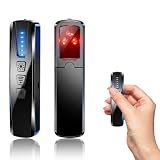
- AI-Powered Smart Signal Analysis – This camera detector, built in intelligent AI chip processes RF signals in real time, reducing background interference and false alarms for more reliable detection of hidden wireless cameras, audio bugs, and GPS trackers. The adjustable sensitivity dial lets you fine-tune scanning levels to match different environments – from busy hotels to quiet homes – so you get precise alerts without constant beeping.
- 4-in-1 Detection with 5-Level Sensitivity – As a reliable hidden camera detectors, it scans for wireless cameras, hidden pinhole lenses, GPS trackers, and magnetic field devices, giving you complete coverage against various surveillance threats. The 5-level adjustable sensitivity lets you dial in the right detection range for any setting – turn it up for weak signals in large spaces, or lower it in crowded areas to reduce interference. Works great at home, in hotel rooms, and while traveling, so you always know your privacy is protected.
- Easy Operation with 4 Modes – With a built-in GPS tracker detector, switch between wireless signal scanning, hidden camera finder, magnetic field detection, and flashlight – all in one compact device. Select between sound or vibration alerts for quiet, discreet scanning in any environment.
- Long Battery Life & Portable Design – Built-in 800mAh rechargeable battery provides up to 25 hours of continuous use. Fully charges in just 1.5 hours via USB. Small enough to carry anywhere – weighs next to nothing, so you can take it on every trip.
No comparative accuracy figures or universal reliability ranking for watermark methods or detectors are established by the NIST publications cited here. Without method-specific evidence, it would be misleading to claim that one approach is always more reliable, or to make broad claims about false positives, false negatives, removal, or transformation effects.
Independent reader supportYour contribution helps us test, update, and keep practical guides available for everyone.A practical way to assess a watermark claim
- Identify the claim. Is the signal said to indicate AI generation, record editing or origin, or classify content as synthetic? Do not treat these as equivalent.
- Locate the evidence. Determine whether it is embedded in the content, provided as provenance information, or generated by an external detector.
- Check who verified it. Find out what system or organization checked the signal or record and what that check attests to. A verified signal is not automatically a verification of every claim made by the content.
- Look for context. If the question concerns origin or editing history, consider whether provenance information or other records address what the watermark alone does not.
- Interpret absence carefully. Do not infer human authorship from a missing signal unless the method supports that conclusion.
- Keep the conclusion proportional. State what the available evidence supports and leave unresolved questions unresolved.
What NIST’s zero-trust examples do—and do not—show
NIST’s implementation guide describes 19 example zero-trust architecture implementations built with 24 collaborators. Those numbers describe the guide project; they are not adoption figures or measurements of effectiveness. NIST also says the examples are voluntary and are not regulations or mandatory practices. NIST NCCoE, Implementing a Zero Trust Architecture NIST NCCoE, Zero Trust Architecture Project Builds 19 Example Implementations
The project is useful context for zero trust as an architecture, but it does not validate a particular AI watermark or establish how well watermark systems perform. The connection to watermarks remains an editorial analogy: apply disciplined verification, without mistaking a security framework for a content-authentication standard.
Quick Recap
Product prices and availability are accurate as of the date/time indicated and are subject to change. Any price and availability information displayed on Amazon at the time of purchase will apply.

