
iTechGuides is reader-supported. When you buy through links on our site, we may earn an affiliate commission. As an Amazon Associate I earn from qualifying purchases. Learn more
You usually do not need to replace a legacy application or industrial controller to use AI. The safer pattern is to add an integration layer: inventory the existing system, collect data through supported interfaces, translate and normalize it, expose it through a controlled broker or API, and let the AI application consume that governed data. In operational technology (OT), keep the AI path separate from safety and control paths unless a formal engineering process proves that a write or closed-loop function is appropriate.
The design depends on the equipment, available protocols, data rate, latency budget, network boundaries, and whether AI is advising a person or participating in control. This guide lays out a practical architecture, implementation sequence, security controls, validation tests, and selection criteria for both enterprise software and industrial systems.
Define what “AI integration” is supposed to do
Start with an operational outcome, not a model. “Use AI with the plant” is too broad to design safely. A useful first statement identifies the decision, the data required, who remains accountable, and what happens if the AI is unavailable or wrong.
- Advisory analytics: detect anomalies, summarize work orders, forecast demand, or recommend a maintenance action while a person approves the result.
- Workflow assistance: create a draft ticket, classify an incident, or retrieve information from a legacy system without changing the system of record automatically.
- Decision support near operations: provide a recommendation to an operator or engineer within a defined response time.
- Control participation: write a setpoint, command, or transaction. This is the highest-risk category and should be treated as an engineered change to the control system, not as a normal software integration.
Document the intended action direction (read, recommend, write), acceptable latency, availability target, data retention, and fallback procedure. A read-only predictive-maintenance pilot has very different requirements from an AI component that could affect a process interlock.
#1 Best Overall

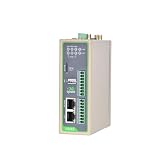
- Multiple Internet access methods is offered: Global frequency LTE 4G/3G & Ethernet port & ADSL.
- Router fucntion is supported: Routing, VPN and firewall.
- Support graphical programming (Node-RED) to quickly develop edge computing functions to meet unique functional requirements.
- Suitable for a variety of industrial IoT scenarios, supporting Modbus RTU/TCP protocol conversion and other popular PLC common protocols.
- Modular design, uses can expand different types of IO modules: DI, DO, AI, AO, IO. Easily slide to achieve quick access to the IO expansion machine, to meet the needs of more scenarios.
Inventory the legacy environment before choosing a connector
Legacy systems often have undocumented interfaces, inconsistent naming, old operating systems, and limited processing capacity. The inventory is the foundation for deciding whether an API, database adapter, protocol gateway, historian, or file exchange is appropriate.
Record the system and ownership details
- Application, PLC, HMI, historian, database, or instrument name and model.
- Vendor, firmware or software version, support status, maintenance window, and replacement constraints.
- Business and technical owner, system of record, and person authorized to approve changes.
- Safety role, criticality, maximum tolerable outage, and any regulatory or quality requirements.
- Network zone, reachable hosts, existing firewall rules, and approved remote-access method.
Map interfaces and data behavior
- Supported APIs, database drivers, export formats, file drops, and native industrial protocols.
- Signals or fields available, units, scaling, timestamps, quality flags, and whether values are raw, calculated, or operator-entered.
- Update rate, burst behavior, clock source, buffering, and what happens during a network outage.
- Read and write permissions, transaction semantics, rate limits, and whether an interface is officially supported.
- Data sensitivity, personal information, intellectual property, and retention obligations.
Do not assume that a database connection is equivalent to an application API. Direct table writes can bypass validation, audit trails, and business rules. If a supported API exists, prefer it for actions and use a separate extraction path for analytics where practical.
Use an integration layer instead of connecting an AI client directly
The integration layer isolates the AI application from legacy quirks and gives operations a place to enforce identity, authorization, logging, schemas, retries, and change control. It can be a small service, an enterprise integration platform, an industrial edge gateway, a message broker, or several of these components together.
The Tool Desk
Outbyte PC Repair FREEClear out junk files and repair common Windows errorsFree Scan →Outbyte Driver Updater FREEScan for outdated or missing drivers - takes under a minuteDriver Scan →Pattern 1: API or database integration for enterprise software
For an older ERP, CRM, warehouse, laboratory, or maintenance application, use the vendor-supported API when one is available. If the only supported export is a database view or scheduled file, place an extraction service between that source and the AI workload.
- Create a read-only service identity for the initial use case.
- Select only the tables, fields, and records needed for the decision.
- Convert source-specific codes, dates, and units into a documented canonical schema.
- Apply validation, deduplication, rate limiting, and error handling in the integration service.
- Expose the normalized data through an internal API, queue, or governed data store.
- For actions, call the application’s supported command or workflow endpoint; do not let the model issue arbitrary SQL updates.
- Log the source record, model request, recommendation, human approval, and resulting transaction.
This approach preserves the legacy application as the system of record while allowing AI to use a stable interface. It also makes it possible to replace the model without rewriting the connection to the old application.
Pattern 2: Protocol adapter or edge gateway for industrial equipment
PLCs, drives, robots, sensors, and older supervisory systems may expose proprietary or generation-specific protocols. A protocol adapter or industrial gateway reads the supported native interface and publishes a northbound representation suitable for analytics.
One documented Siemens Industrial Edge v26.09 example uses an OPC UA Connector to read PLC data, translates the data to MQTT, and sends it through a Databus. An Industrial Information Hub component then makes a machine representation available through a REST API. Siemens also documents connectors that translate OPC UA, Ethernet/IP, or S7 into MQTT. These documents describe that vendor’s interfaces and versioned implementation; they do not establish compatibility with every PLC or prove independent performance.
The OPC Foundation’s 2025 cloud reference architecture notes that legacy assets using non-OPC UA protocols may require connectivity software to translate their interfaces to OPC UA. Where a suitable model exists, support for OPC UA Companion Specifications can improve semantic consistency. The adapter still has to map the individual asset’s tags, units, quality states, and operating modes correctly.
Rank #2
- Reliable North America LTE Cat 1: Specifically designed for North American carriers (Verizon, AT&T, T-Mobile). LTE Cat 1 provides a cost-effective and highly stable connection for IoT applications, featuring Band 2/4/5/12/13/25/26 for extensive coverage and carrier-grade reliability.
- Edge Computing & Python Programmable: Powered by a high-performance ARM Cortex-A8 processor. Supports Python secondary development, allowing you to perform data pre-processing, filtering, and local logic control at the edge, reducing cloud bandwidth costs and latency.
- Rich Industrial I/O & Interfaces: Equipped with 1x RS232 and 1x RS485 serial ports, plus 4x Digital Inputs (DI) and 4x Digital Outputs (DO). It offers a versatile solution to bridge the gap between legacy serial equipment and modern sensors for comprehensive data acquisition.
- Extensive Protocols & Cloud Ready: Supports industrial protocols including Modbus RTU/TCP, MQTT, OPC UA, and HTTP. Seamlessly integrates with major cloud platforms like AWS IoT Core and Azure IoT Hub, as well as InHand’s DeviceManager for centralized remote management.
- Industrial-Grade Durability & Security: Built with a rugged metal housing and designed for harsh environments with a wide operating temperature range (-20°C to 70°C). Features multi-level security with IPsec/OpenVPN and hardware watchdog for 24/7 unattended operation.
Pattern 3: DMZ, historian, or broker boundary
For OT-to-IT exchange, place a governed boundary between control networks and enterprise or cloud services. UK National Cyber Security Centre guidance recommends a DMZ and secure standardized protocols such as OPC UA over TLS, MQTT over TLS, or HTTPS. It recommends that IT systems query a historian in the DMZ through a secure HTTP API with strong authentication instead of connecting directly to OT systems.
The principle is more important than a particular product: minimize paths, broker the data, and keep the control network from becoming a general-purpose data source for every application. The actual zones, conduits, firewall rules, and protocol choices must follow the site’s architecture and risk assessment.
Normalize data before giving it to a model
AI quality is limited by the meaning and history of the data, not just by model selection. A normalized model should define names, units, timestamps, quality, provenance, and relationships.
Minimum fields for time-series signals
- Asset identity: stable equipment ID, site, line, and location.
- Signal identity: tag name, human-readable description, engineering unit, and source protocol.
- Value and type: numeric, Boolean, enumerated state, text, or event.
- Time information: source timestamp, ingestion timestamp, timezone, and clock-synchronization status.
- Quality: good, uncertain, bad, substituted, stale, or unavailable, using the source system’s semantics where possible.
- Operating context: product, batch, recipe, shift, mode, maintenance state, and relevant ambient conditions.
- Lineage: source device, connector version, transformation, and retention location.
Preserve the original value alongside converted values when possible. For example, store both the raw PLC reading and the normalized temperature in degrees Celsius, with the conversion rule and timestamp. This makes an unexpected model output auditable.
Handle missing and changing data explicitly
- Distinguish a measured zero from a missing value and from a sensor that is out of service.
- Attach quality and freshness limits so the model can refuse stale input.
- Version schemas when a tag is renamed, a unit changes, or a firmware update alters behavior.
- Align clocks and document whether a reading represents an instantaneous value, an average, or a cumulative counter.
- Keep event records, maintenance actions, and production context so a model can separate normal changeovers from faults.
Build the connection in controlled stages
A staged implementation reduces the chance that an integration project becomes an uncontrolled production change.
- Choose one bounded use case. Define the asset or application, decision, users, success measure, and prohibited actions.
- Complete the inventory. Confirm owners, interfaces, data sensitivity, network zone, update rate, lifecycle status, and safety role.
- Select the supported interface. Prefer an official API, read-only database view, historian feed, or protocol connector over screen scraping or undocumented writes.
- Design the boundary. Place brokers, collectors, and APIs in approved zones. Define firewall rules, identities, certificates, and allowed data directions before installation.
- Build a read-only path. Collect a representative period of data, including normal production, changeovers, maintenance, and communication outages.
- Normalize and validate. Check units, timestamps, quality flags, ranges, duplicates, missing intervals, and tag-to-asset relationships with operations personnel.
- Run the model offline. Measure false alarms, missed events, drift, explainability, and response time without allowing the model to affect operations.
- Introduce human-reviewed recommendations. Display the source data, confidence or uncertainty, model version, and reason for the recommendation. Require an accountable person to approve any action.
- Test failure modes. Disconnect the broker, delay messages, send malformed values, rotate certificates, restart the connector, and verify that the fallback behavior is safe.
- Approve a limited production release. Use change control, a rollback plan, maintenance-window procedures, and explicit authorization for every new permission.
- Monitor continuously. Track data freshness, connector health, latency, model quality, access attempts, schema changes, and operator overrides.
Compare protocols, connectors, and gateways on the right axes
No single gateway or protocol is correct for every site. Use the following criteria when comparing an adapter, broker, or managed integration service.
| Evaluation area | Questions to answer | Why it matters |
|---|---|---|
| Device and protocol compatibility | Does it support the exact PLC, controller, firmware, driver, and native protocol? Is the interface officially supported? | A protocol name alone does not guarantee that a particular device or data type will work. |
| Security boundary | Can it operate in the approved zone, use strong identities and certificates, restrict direction, and produce audit logs? | The connector becomes part of the OT attack surface. |
| Data semantics | Can it preserve units, quality, timestamps, events, asset relationships, and suitable OPC UA companion models? | Correct transport without correct meaning produces unreliable AI input. |
| Latency and availability | What update rate, buffering, retry, and offline behavior are required? Where will the component run? | Analytics can tolerate delay that a control-related function cannot. |
| Deployment location | Can it run locally, at the edge, in a data center, or in a cloud environment approved by the organization? | Placement affects connectivity, data handling, maintenance, and outage behavior. |
| Read versus write capability | Can permissions be limited to read-only, and can any write function require a separate approval path? | Reducing action authority limits the consequences of a model or integration error. |
| Lifecycle support | How are patches, certificates, connector versions, backups, and end-of-support dates managed? | A pilot that cannot be maintained becomes an operational dependency. |
| Testing and change control | Can the integration be tested with representative data and existing engineering approval procedures? | Safe deployment depends on fitting the site’s established process. |
Choose local, edge, or cloud deployment deliberately
Local or edge inference can keep data near equipment and reduce dependence on an external connection. Cloud services can provide centralized computing, fleet management, and model operations. Neither is automatically safer or more reliable.
Evaluate latency, network availability, data handling, update and monitoring paths, vendor transparency, and who retains authority over critical functions. Joint CISA and partner guidance advises owners and operators to prioritize organizational control over critical functions when hosting AI locally or in the cloud.
Rank #3
- Multiple Internet access methods is offered: Global frequency LTE 4G/3G & Ethernet port & ADSL.
- Router fucntion is supported: Routing, VPN and firewall.
- Super Powerful Edge Computing Capabilities
- Support graphical programming (Node-RED) to quickly develop edge computing functions to meet unique functional requirements.
- Suitable for a variety of industrial IoT scenarios, supporting Modbus RTU/TCP protocol conversion and other popular PLC common protocols.
When an edge deployment may fit
- The site needs an answer during loss of wide-area connectivity.
- Raw data is voluminous or sensitive and can be reduced before leaving the plant.
- Response time is short but does not require a certified safety function.
- Local staff can patch, monitor, back up, and replace the edge hardware.
When centralized or cloud processing may fit
- Multiple sites need a common model, feature pipeline, or dashboard.
- The organization has approved identity, network, and data-governance controls for the service.
- Workloads require computing capacity that is impractical to operate at each plant.
- The design can tolerate a defined outage and has a local fallback.
If a cloud dependency exists, document exactly what happens when authentication, connectivity, the model endpoint, or the update service is unavailable. Do not let a temporary cloud outage silently become a control-system failure.
Keep OT safety and security requirements in the design
Joint guidance from CISA, Australia’s ACSC, the NSA AI Security Center, the FBI, and partner agencies states that older OT equipment may lack standardized data formats and computing resources, complicating AI data integration and analysis. The guidance also says OT system design may need to evolve to accommodate secure AI integration.
Separate analytics from control wherever feasible
- Use a read-only collector for the first deployment.
- Keep safety instrumented functions, interlocks, emergency stops, and manual overrides independent of the AI path.
- Require a defined authorization and engineering review before adding any write capability.
- Use allowlists for commands, ranges, destinations, and operating modes rather than accepting arbitrary model output.
- Provide a deterministic fallback and a way for operators to reject or disable recommendations.
Apply normal cybersecurity controls to the new components
- Use least-privilege identities, multifactor administration where supported, certificate management, and network allowlists.
- Encrypt connections appropriate to the design, such as OPC UA over TLS, MQTT over TLS, or HTTPS.
- Patch and back up gateways, brokers, APIs, and model hosts according to an approved maintenance process.
- Log authentication, configuration changes, data access, model versions, recommendations, approvals, and overrides.
- Include external connections, vendor access, update behavior, and changes to engineering workflows in procurement and security review.
- Integrate AI-specific risks into the wider cybersecurity strategy alongside access control, encryption, monitoring, and intrusion detection.
Validate latency, interoperability, and operational behavior
AI-connected components should be tested as new OT-connected systems. Joint guidance specifically calls for assessing impacts such as latency and interoperability and checking the new system against existing device-management policy.
PC Slower Than It Used to Be?
A free scan shows the junk files, broken settings and background clutter dragging Windows down - then fixes them in one click.Free scan · Windows 10 & 11Outdated Drivers Are Slowing You Down
One free scan finds every outdated or missing driver and matches the right update for your exact hardware.Free scan · exact hardware matchUseful validation tests
- Timing: measure source-to-display and source-to-recommendation delay under normal and peak load.
- Data loss: interrupt links and verify buffering, replay, duplicate handling, and stale-data alarms.
- Protocol behavior: test reconnects, malformed messages, unsupported data types, certificate expiration, and device restarts.
- Model behavior: use known normal, abnormal, maintenance, and changeover cases; record false positives and missed events.
- Human factors: confirm that operators can understand the recommendation, identify its source and age, and override it quickly.
- Security: verify segmentation, identity enforcement, audit records, secret rotation, and response to unauthorized access.
- Recovery: restore from backup, roll back a connector or model version, and operate manually while services are unavailable.
Continuous monitoring and validation are required after deployment. Production data distributions, equipment condition, recipes, and model dependencies change over time; a model that performed acceptably during a pilot can become unsafe or unhelpful without drift detection and periodic review.
Independent reader supportYour contribution helps us test, update, and keep practical guides available for everyone.Common failure modes and practical fixes
The connector works, but the model sees meaningless data
Symptoms: implausible ranges, mixed units, duplicate tags, or unexplained gaps. Fix: involve controls and operations engineers in a tag dictionary, preserve quality flags and raw values, align clocks, and test mappings against known operating states.
A direct database integration breaks the legacy application
Symptoms: locked tables, failed transactions, missing audit entries, or unexpected business-rule violations. Fix: stop direct writes, use a supported API or approved workflow endpoint, and retain database access for controlled read-only extraction unless the application owner authorizes another method.
AI recommendations arrive too late
Symptoms: recommendations are stale by the time an operator sees them. Fix: measure each segment of the path, reduce unnecessary transformations, place processing closer to the source where justified, and define a freshness threshold that suppresses stale output.
Free tools Windows power users keep installed
One-click scans. No signup required.
A network outage makes the process dependent on AI
Symptoms: operators lose essential information when a broker, cloud service, or identity provider is unavailable. Fix: provide local displays or procedures, cache only what is safe and necessary, define an outage mode, and verify manual operation during drills.
Rank #4

- Cybersecurity benefits: Watch video for detailed understanding
- Remote monitoring of UPS system through Building Management System
- Customize and schedule actions such as shutdown protocols and load shedding
- Immediate notifications during power events, without onsite presence
- Combines features of SNMP agent, HTTP/web server, and Modbus card
The model triggers alarm fatigue
Symptoms: too many low-value alerts or repeated recommendations that operators ignore. Fix: tune thresholds with domain experts, group related events, show confidence and evidence, measure operator acceptance, and keep a documented route for reporting false alarms.
A vendor update changes the integration unexpectedly
Symptoms: renamed fields, altered connector behavior, expired certificates, or an incompatible model endpoint. Fix: pin and record versions, test updates in a representative environment, review release notes, maintain rollback artifacts, and include lifecycle commitments in the contract.
Plan governance, accountability, and lifecycle ownership
Assign ownership for every layer: source system, connector, broker, normalized schema, model, user interface, and action workflow. The person who owns the model is not automatically authorized to change a PLC or business record.
Recommended Free Tools
- Define who approves a recommendation and who approves a command.
- Record model purpose, training and validation data, limitations, owner, version, and retirement criteria.
- Set review intervals for permissions, certificates, schemas, model drift, and vendor access.
- Document what data leaves the site, where it is retained, and how it is deleted.
- Maintain an incident process covering bad recommendations, compromised credentials, corrupted data, and loss of connectivity.
- Keep a manual or previously approved automated fallback for the operational task.
Vendor transparency matters. Ask whether the component makes external connections, how it receives updates, what telemetry is collected, how administrators are authenticated, and whether the organization can export logs and configuration. These questions apply equally to an edge appliance, a managed broker, and a cloud AI service.
Use current OT guidance without confusing final standards and drafts
NIST Special Publication 800-82 Revision 3 is the final edition dated September 2023. NIST’s Revision 4 page describes an initial public draft dated September 21, 2026, with comments due November 30, 2026. Treat Revision 4 as a draft until NIST publishes a final version; do not cite its draft status as if it were a completed standard.
The December 3, 2025 joint CISA and partner guidance on secure AI integration in OT is useful for evaluating latency, interoperability, device-management policy, vendor transparency, and organizational control over critical functions. Combine that guidance with the site’s existing safety lifecycle, change control, network architecture, and incident-response requirements.
A practical decision framework
Choose the least complex architecture that satisfies the use case while preserving control and auditability.
What’s actually slowing this PC down?
Pick the symptom - the matching free tool is one click away.
- If the source has a supported API and the task is enterprise workflow assistance: use an authenticated integration service, normalized schema, and human-approved action endpoint.
- If the source is a PLC or industrial device with a supported protocol: use a protocol connector or edge gateway, publish through a broker or historian, and expose only the required data northbound.
- If IT needs OT data: use an approved DMZ path and query the DMZ historian or API rather than connecting directly to control assets.
- If timing or connectivity is demanding: evaluate local or edge processing, but retain central monitoring, patching, and governance.
- If anyone proposes AI writes or closed-loop control: stop treating it as an ordinary integration. Require hazard analysis, engineering approval, bounded commands, independent safeguards, extensive testing, and a tested fallback.
What a successful first project looks like
A strong first project is narrow, read-only, and measurable: for example, detecting an abnormal vibration pattern on one production line and presenting a maintenance recommendation. The connector reads approved signals, the broker publishes normalized records, the model evaluates fresh data, and the maintenance system receives a draft ticket for human approval. Operators can see the source values and timestamps, reject the recommendation, and continue using the established process if any component fails.
Once that path is stable, the organization can decide whether another asset, model, or workflow deserves the same treatment. Reusing a documented schema, identity pattern, boundary design, test plan, and ownership model is safer than copying an unexamined connection into every system.
Bottom line
Integrate AI around legacy systems rather than forcing legacy systems to become AI platforms. Inventory first, use supported adapters, normalize data, broker OT traffic through an approved boundary, and keep read-only analytics separate from safety and control functions. Select local, edge, or cloud placement according to latency, availability, data handling, and organizational control—not fashion. Validate interoperability, timing, security, human response, and recovery before production, then monitor the model and the integration for as long as the system remains operational.
Quick Recap
Product prices and availability are accurate as of the date/time indicated and are subject to change. Any price and availability information displayed on Amazon at the time of purchase will apply.
Quick wins for a faster PC:
Clear out junk files and repair common Windows errorsFree Scan →Scan for outdated or missing drivers - takes under a minuteDriver Scan →
