
Do these 3 things before closing this tab:
1Scan for outdated or missing drivers - takes under a minute2Repair Windows errors before they cause bigger problems3Fix the driver behind crashes, sound loss and screen glitchesiTechGuides is reader-supported. When you buy through links on our site, we may earn an affiliate commission. As an Amazon Associate I earn from qualifying purchases. Learn more
Start by fully reseating the plug, then test the headphones and the source device in both directions. A dirty or partly inserted connector, a case blocking the jack, an incompatible adapter, a mono output, or a damaged cable can all leave one channel silent. If the headphones fail on two compatible devices while another pair works on the original device, the headphones themselves are the likely fault; if they work elsewhere, investigate the original jack, adapter, output selection, or compatibility.
The goal is not to guess which earcup failed. It is to identify the point at which the left or right channel disappears. Change one part of the setup at a time, record what happens, and stop flexing or forcing anything that appears damaged.
What one-sided sound tells you
“Only one ear works” describes a symptom, not a diagnosis. The left or right channel can disappear because the plug is not making all of its contacts, debris is preventing full insertion, the source is not providing stereo, an adapter does not match the headset, or a conductor in the cable has failed. The fastest way to identify the fault is to change one part of the setup at a time instead of repeatedly plugging the same combination into the same device.
What’s actually slowing this PC down?
Pick the symptom - the matching free tool is one click away.
Before testing, pause playback and keep the volume at a comfortable level. Do not use a damaged connector if its metal parts are loose, and do not put liquid into a phone, tablet, computer, or headphone jack. A simple written note of which device, cable, adapter, and pair produced each result can prevent a mistaken conclusion.
#1 Best Overall

- Universal Compatibility: Perfectly compatible with any devices with a 3. 5mm aux port. Such as Apple iPhone, iPod, iPad, Headphones, Hi-Fi, Car Stereos, Tablet, Laptop, Smartphones, MP3 Player, Speaker and any other audio-playing devices. (ATTENTION: Incompatible with Life proof Cases And Otter Box cases)
- Unparalleled Sound Quality: Polished 24K gold-plated connectors ensure reliability and eliminate signal loss and noise possible, offer clear and stereo sound to your devices.
- Ultra Durable And Tangle-Free: With an 15000+ ultra-durable bend lifespan several times longer than original audio cables. You can wind it without having to worry about knots or kinks.
- Easy Carrying And Storage: Double shielding significantly enhances protection against interference, and with the specially designed organizer, no messy or tangled cable any more.
- What You Get - Sync wire 3.3 ft. Nylon Braided Aux Cable, 3 Years Free Card, User Guide and Customer Service
| Test result | Most likely area to investigate | Next action |
|---|---|---|
| Headphones work normally on a second compatible device | Original device, jack, adapter, output selection, or source media | Check the selected output, remove any case or adapter, and test another app or recording on the original device. |
| Headphones fail on multiple compatible devices, but another pair works on those devices | Headphones, plug, or integrated cable | Inspect the plug and cable. If the design has a detachable cable, verify whether a model-compatible replacement is available. |
| Two different pairs lose the same channel on one device | Device jack, adapter, output configuration, or source | Check the physical connection and output device, then test without the adapter and with another audio source. |
| Sound changes when the plug or cable is moved | Loose connection or damaged conductor | Stop bending the cable at the fault point. Reseat the plug and arrange service or a correct replacement cable. |
| Only one particular app or recording has the problem | Source media or application routing | Try another track, video, recording, or app before touching the hardware. |
Run this troubleshooting sequence in order
1. Confirm that the problem is present in the playback itself
- Start a piece of audio that definitely contains sound and raise the volume to an audible level.
- Try a different app, track, video, or recording. A single file can have a channel problem that is unrelated to the headphones.
- Confirm that the device is sending audio to the intended output. On Windows, open Settings > System > Sound and select the intended output device. Disconnect other audio devices temporarily if the wrong output is being selected.
- If the device has several outputs, check that the headphones are connected to the output you are actually testing rather than a monitor, dock, or other audio device.
Do not diagnose the cable from a silent clip, a paused player, or an application that is routed to another output. Once a second source produces the same one-sided result, continue with the physical checks. If the result changes between apps, treat the source media or routing as the leading suspect rather than buying parts.
2. Reseat every connection
- Pause playback and unplug the headphone connector.
- Remove a phone case, sleeve, or protective cover if it prevents the plug from going fully into the jack.
- Push the plug straight in until it is fully seated. A properly connected cable should not wiggle; Sennheiser Hearing Support uses that lack of movement as a practical check for a secure connection.
- If the headphones use a detachable cable, disconnect and reconnect the headphone-side plug as well as the source-side plug.
- Engage the model’s twist, bayonet, or locking mechanism if it has one. A connector that looks inserted can still be electrically incomplete when its locking step has not been completed.
Play the same test audio again before changing another variable. If both channels return after reseating, the original fault was a poor contact or incomplete insertion. If one channel remains absent, continue without assuming the cable is permanently defective. A plug that repeatedly feels loose, cannot seat normally, or causes sound to cut in and out should be treated as a connection fault requiring service rather than forced into place.
3. Inspect and clean without forcing debris into the equipment
Use a light and look at the metal plug, the device jack, and each earbud or headphone opening. Check for lint, dust, corrosion, bent contact surfaces, kinks, fraying, flattened sections, or a plug housing that is separating from the cable. Inspect both ends of a detachable cable: damage at the headphone-side connector can look like a source-side failure.
- For earbud openings, Apple recommends a clean, dry, soft-bristled brush. Brush gently across the opening rather than pushing material inward.
- For a dirty plug, Audio-Technica recommends wiping it with a dry cloth.
- For cable connectors, Bose advises putting a small amount of isopropyl alcohol on a cloth, wiping the connector, and allowing it to dry completely before reconnecting.
Follow the instructions for your exact model if they differ. Do not pour liquid into a phone or computer jack, insert a sharp object, or reconnect a damp connector. If debris is lodged deep inside a port, professional cleaning is safer than forcing it farther in. Cleaning the earbud opening may remove an obstruction, but it cannot repair a broken conductor or failed internal component, so retest after cleaning rather than assuming the problem is solved.
4. Perform the two-device, two-headphone test
This is the most useful isolation step because it separates the headphone from the source. Use a second compatible device, such as another computer or phone, and a known-working pair of headphones. Keep the test audio and volume audible in each case.
- Connect the affected headphones to the second device. Note whether both channels play.
- Connect the known-working headphones to the original device. Note whether both channels play.
- If possible, repeat the first test with the adapter removed or replaced by one known to support the connection.
- Keep the same side of the headphones on the same ear while comparing results, so a loose earbud fit is not mistaken for an electrical failure.
Apple’s troubleshooting guidance takes the same approach: if a second pair works, contact the manufacturer of the initial pair about a replacement. That recommendation applies after the cross-test has shown that the source is functioning with another pair; it is not proof that every one-sided fault requires a new headset.
Rank #2

- 【Hi-Fi Sound Quality】: 24k gold-plated connector, Enameled wire core, which ensure seamlessly transmit stereo audio for premium sound experience.
- 【Copper connector】: Pure copper shell of this stereo aux cable provides reliable performance and reducing signal loss.
- 【Incredibly Durable】: 20000+ bend lifespan & double-braided nylon exterior make audio cables adding to the durability and tangle free.
- 【Universal Compatibility】: Our AUX cord works perfectly with any device with a 3.5mm aux port. Such as car stereos, speaker, iPod, headphones, etc.
- 【Plug and Play】: Tangle free design makes our 3.5mm audio cable more convienient to carry and storage. You can enjoy your music anytime and anywhere while commuting. Let the fun begin.
The combinations matter. If the affected pair works on the second device, the pair is less likely to be the cause. Investigate the original jack, case clearance, adapter, output selection, or media. If the affected pair fails on both devices while the known-working pair succeeds on the original device, concentrate on the affected plug, cable, or headphone hardware.
Quick wins for a faster PC:
Fix the driver behind crashes, sound loss and screen glitchesFind Drivers →Clear out junk files and repair common Windows errorsFree Scan →Scan for outdated or missing drivers - takes under a minuteDriver Scan →Check the connector and adapter before blaming the headphones
Mono and stereo jacks are not interchangeable
A stereo headphone output must provide separate left and right channels. Audio-Technica notes that a 3.5 mm mono mini jack outputs only the left channel by design. If your source has a mono jack, one-sided playback is expected behavior rather than a failed earcup. Confirm the source’s jack type in its documentation or specification before attempting a repair.
This check is especially important when using older equipment, specialist audio hardware, or a socket whose purpose is not clearly labeled. A plug can fit mechanically while the socket still supplies only a single channel. Compare the result with a known-working stereo setup instead of judging compatibility by the 3.5 mm size alone.
Headset plugs and device jacks may have different conductor arrangements
Some wired headsets use a four-conductor plug for headphones plus a microphone, while a device jack may be designed for a three-conductor stereo plug. Bose warns that this mismatch can cause partial-audio problems. An adapter can solve the problem only when it is designed for the exact combination of source jack and headphone plug; a generic mechanical converter may fit while still wiring the channels incorrectly.
When checking a plug, count its insulating rings only as a clue and then verify the device and headset specifications. The microphone function is not the only concern: incorrect contact assignments can affect one or both audio channels. Remove unnecessary adapters, extensions, splitters, and hubs for the first direct test.
USB-C and Lightning connections require model compatibility
Digital USB-C and Lightning headphones or adapters can depend on electronics and device-specific compatibility, not just the shape of the connector. Audio-Technica advises checking compatibility lists for these connections. Verify that the adapter supports headphones, stereo output, and your source model. Test without extra hubs or splitters whenever possible.
Rank #3
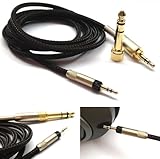
- Replacement Audio upgrade HIFI Cable is Compatible with Sennheiser HD598, HD620S, HD598 SE, HD598 Cs, HD 400 PRO, HD518, HD598 SR, HD560s, HD599, HD569, HD579, HD505 Headphones extension cords
- Length: 1.2meters(4ft), package include: 1 replacement cable ( there is no headphone include )
- Cable Diameter : 4mm,cable material:the inside cable is OFC wire,the outside cable is Braided Tangle-Free cable
- Connector: 3.5mm Male and 6.35mm adapter to 2.5mm Male(comes with the lock the same as the Original cable)
- The 2.5mm male on this cable only Compatible with For Sennheiser HD598, HD620S, HD598 SE, HD598 Cs, HD 400 PRO, HD518, HD598 SR, HD560s, HD599, HD569, HD579, HD505 Headphones
If the same headphones work through one compatible adapter but not another, the adapter is the part to investigate. Do not infer that a charging adapter, a data-only accessory, or a visually identical dongle supports stereo headphone output.
| Connection situation | What to verify | Why it matters |
|---|---|---|
| 3.5 mm plug directly into a device | The jack is stereo and the plug is fully inserted | A mono jack can intentionally provide only the left channel; partial insertion can omit a contact. |
| Four-conductor headset plug in a three-conductor jack | Whether the jack and headset are listed as compatible | Different conductor arrangements can produce incomplete or one-sided audio. |
| USB-C or Lightning adapter | Compatibility list, stereo support, and correct adapter type | Connector shape alone does not establish audio compatibility. |
| Splitter, extension, or hub in the path | Remove it and test a direct connection | An extra connector can introduce a bad contact or an incompatible wiring scheme. |
Use the symptoms to locate a cable fault
Intermittent audio when the cable moves
If the missing channel returns when the plug, strain relief, or cable is gently repositioned, a conductor or contact may be damaged. Do not repeatedly flex the cable to “find the sweet spot”; that can turn an intermittent break into a permanent one. Mark the location mentally, keep the cable straight, and move to a model-specific repair or replacement decision.
Movement at the plug is not proof that the earcup driver has failed. It points first to the mechanical connection, so repeat the test with the plug fully seated and, if possible, on another source. Avoid holding the cable at an angle during ordinary use while you decide on service.
A visible break, fray, or crushed section
Visible damage is strong evidence that the cable needs attention, but it does not identify whether the source jack or plug is also damaged. Confirm the diagnosis by testing the headphones on another compatible source. Tape or glue is not a reliable electrical repair and can make later service more difficult.
No physical damage and no change after reseating
A hidden break, failed solder joint, earbud driver, or source-side contact can still be responsible. The cross-test is more informative than appearance alone. If the headphones fail on several compatible sources while another pair works, treat the headphones as the primary suspect even when the outer cable looks perfect.
Decide whether to replace a detachable cable
A replacement headphone cable is a conditional fix, not a universal remedy. Consider one only after all of these checks:
Rank #4

- Note: This cable only Compatible with Hifiman Sundara, SUNDARA Planar, Ananda, Arya, Arya Organic, Arya Stealth, Ananda Unveiled, HE400SE, Edition XS, Edition XV, Deva-Pro, HE4XX (2 x 3.5mm Version), HE-400i (2 x 3.5mm Version) headphone. Must Confirm your Headphone is The Model with Dual 3.5mm port
- length : 1.2metre/4ft, package include: 1*replacement cable ( there is no headphone include )
- Cable Diameter : 4mm (After the bifurcation 3mm), cable material:the outside calbe is Braided cable,the inside cable is OFC wire
- Connector: 3.5mm male and 6.35mm adapter to Dual 3.5mm male
- It is compatible with Hifiman Sundara, SUNDARA Planar, Ananda, Arya, Arya Organic, Arya Stealth, Ananda Unveiled, HE400SE, Edition XS, Edition XV, Deva-Pro, HE4XX (2 x 3.5mm Version), HE-400i (2 x 3.5mm Version). if you are using the old version HE-400i with both 2.5mm plug, please choose the other one with both 2.5mm male to order.
- The headphones have a genuinely detachable cable.
- The existing cable shows damage or the cross-test points to the cable or plug.
- The replacement is made for the exact headphone model or an explicitly compatible model.
- The headphone-side connector has the same shape and locking method.
- The source-side plug and conductor arrangement match your device or adapter.
Bose recommends replacing a damaged cable for the covered AE2i model, but that guidance does not establish compatibility for other headphones. Do not buy a cable solely because it has the same apparent diameter or a 3.5 mm plug. Different models can use different wiring, contact layouts, microphone connections, or locking systems. Confirm the model number and connector specification before ordering; if either is uncertain, ask the manufacturer rather than relying on a marketplace photograph.
| Condition | Reasonable action | What not to assume |
|---|---|---|
| Detachable cable, visible damage, exact replacement confirmed | Replace the cable and retest both channels | That any cable with the same plug will work. |
| Detachable cable, no visible damage, headphones fail on multiple sources | Try a known-compatible cable if available, or ask the manufacturer about service | That the cable is the only possible failed component. |
| Integrated cable with a damaged section | Use manufacturer service or a qualified repair technician | That an external splice will restore safe, reliable stereo operation. |
| Device jack or adapter is the failing part | Repair or replace the source-side component after confirming compatibility | That replacing the headphones will correct a faulty source. |
When professional service is the right next step
Contact the headphone maker or a qualified repair service when the cable is integrated, the jack is physically damaged, a detachable cable has not solved the problem, or the headphones still fail after the source and compatibility checks. Include the exact model, connector type, the devices tested, and whether the missing channel is always the same. That information lets support distinguish a product fault from an adapter or source issue.
The available manufacturer guidance does not establish a universal repair price or say when repair is economical for an unspecified model. Compare the service quote with the headphone’s age, condition, warranty status, and the cost of an exact replacement only after the fault has been isolated. Avoid opening a sealed earbud or headphone unless you accept the risk of further damage and loss of warranty coverage.
When contacting support, describe the repeatable result rather than only saying “one side is dead.” For example: identify the source, adapter, second device, known-working pair, and whether reseating changed anything. If a replacement cable is suggested, ask for the exact model and connector specification in writing before purchasing.
Common mistakes that prolong a one-ear problem
- Testing only one song or app: a source recording can itself have a missing channel. Use at least one other item.
- Leaving a protective case on: a case can stop the plug before its contacts are fully engaged.
- Cleaning with liquid in the jack: moisture can create a new failure. Put any approved alcohol on a cloth, never into the port, and wait until the connector is dry.
- Forcing a connector: pressure can bend contacts or damage the socket. Insert straight and stop if it does not fit normally.
- Buying a generic replacement cable: connector shape does not guarantee wiring or locking compatibility.
- Assuming a mono source is broken: a mono 3.5 mm output can intentionally carry only the left channel.
- Wiggling the cable repeatedly: this can worsen a partially broken conductor and make diagnosis less reliable.
- Replacing headphones before cross-testing: the original device, jack, or adapter may be the part that failed.
- Testing through several accessories at once: a splitter, extension, hub, and adapter make it impossible to identify which connection is responsible. Test directly first.
- Ignoring the headphone-side connector: detachable cables can fail at either end, not only at the source plug.
A concise decision path
- Play a different app or recording and confirm the intended output device.
- Remove any case or sleeve, unplug the connector, and reinsert it firmly.
- Reseat the detachable end, including any twist or locking step.
- Inspect the plug, jack, cable, and earbud openings; clean only as the manufacturer permits and dry completely.
- Test the headphones on a second compatible device.
- Test a known-working pair on the original device.
- Verify stereo-jack, conductor, USB-C, Lightning, adapter, and splitter compatibility.
- Only after these checks, choose a compatible replacement cable, manufacturer service, qualified repair, or replacement headphones.
This order prevents the most common diagnostic error: treating a connection or source problem as a failed headphone before proving where the missing channel disappears.
Recommended Free Tools
Frequently Asked Questions
Why do my wired headphones suddenly play in only one ear?
A partly inserted or dirty plug, a case blocking the jack, an incompatible adapter, a mono output, or cable damage can all remove one channel. Test another app, reseat and inspect the connections, then cross-test the headphones on another compatible device.
Best Value

- ELIMINATE CABLE BENDING IN TIGHT SPACES: Our 90-degree right-angle design prevents stress and damage. Perfect for cramped car AUX connections or resting a gaming controller comfortably against your body without bulky, annoying interference.
- PRISTINE HI-FI STEREO SOUND WITHOUT STATIC: Engineered with pure copper cores and triple shielding for lossless audio. Enjoy your music or immersive gaming without lag, distortion, or the frustrating crackling background noise of standard cords.
- HEAVY-DUTY NYLON BRAIDING FOR MAXIMUM LIFESPAN: Built to withstand heavy daily use. This robust, tangle-free 3.5mm auxiliary cable features reinforced connectors tested for 20000+ bends, completely preventing fraying and unexpected breaks.
- FAILSAFE UNIVERSAL 3.5MM PLUG & PLAY: Seamlessly links to standard audio jacks. Instant, zero-driver setup for Car Stereos, PS5/PS4/Xbox Controllers, Home Speakers, Headphones, PCs, and Tablets. Upgrade your current audio setup effortlessly.
- CRUCIAL COMPATIBILITY NOTE & 24-MONTH SUPPORT: Designed for native 3.5mm ports. Modern devices without a jack require a separate adapter (not included). Nanxudyj stands by your purchase with 24-month dedicated support for a flawless experience.
How can I tell whether the headphones or my phone is faulty?
Use both directions of the test: connect the affected headphones to a second compatible device and connect a known-working pair to the original phone. If the affected pair works elsewhere, investigate the phone, jack, adapter, or settings. If it fails on multiple devices while another pair works, the headphones are the primary suspect.
Can a phone case cause one-sided headphone sound?
Yes. A case or sleeve can prevent the plug from fully entering the jack, leaving one contact incomplete. Remove the case and firmly reinsert the plug before diagnosing the cable.
Is a mono 3.5 mm jack broken if it plays only the left channel?
Not necessarily. Audio-Technica states that a 3.5 mm mono mini jack outputs only the left channel by design. Confirm that the source is a stereo headphone output before attempting repair.
Can I clean the plug or earbud safely?
Apple recommends a clean, dry, soft-bristled brush for earbud openings, and Audio-Technica recommends a dry cloth for a dirty plug. Bose advises a small amount of isopropyl alcohol on a cloth for cable connectors, followed by complete drying. Never pour liquid into a device jack or reconnect a damp connector.
Will any 3.5 mm replacement cable work?
No. Confirm a detachable design, exact model compatibility, connector shape and locking method, wiring or conductor arrangement, and source-side compatibility. A matching diameter or plug size alone is not enough.
Why does the sound return when I bend the cable?
Movement can temporarily restore contact at a damaged conductor, plug, or strain relief. Stop flexing it, because repeated bending can worsen the break. Reseat the connections and arrange a model-specific cable replacement or professional service.
When should I contact the manufacturer?
Contact the maker or a qualified repair service when the cable is integrated, a jack is physically damaged, an exact replacement cable is unavailable, or the headphones still fail after cross-device and compatibility checks. Give them the model, connectors, devices tested, and repeatable symptoms.
The Tool Desk
Outbyte Driver Updater FREEFix the driver behind crashes, sound loss and screen glitchesFind Drivers →Outbyte PC Repair FREERepair Windows errors before they cause bigger problemsFix Now →The Bottom Line
Find the failure point before spending money. Verify the playback and output, remove anything blocking the jack, reseat and gently clean every connection, then test the headphones and a known-working pair across two compatible devices. Check mono-versus-stereo and adapter compatibility before condemning the headphones. Only a confirmed detachable, model-compatible cable should be replaced at home; otherwise use manufacturer support or a qualified repair service.
Quick Recap
Product prices and availability are accurate as of the date/time indicated and are subject to change. Any price and availability information displayed on Amazon at the time of purchase will apply.

