
What’s actually slowing this PC down?
Pick the symptom - the matching free tool is one click away.
iTechGuides is reader-supported. When you buy through links on our site, we may earn an affiliate commission. As an Amazon Associate I earn from qualifying purchases. Learn more
Parsing a resume PDF reliably takes two separate jobs: recovering text and layout from the file, then interpreting that evidence as fields such as work experience, education, and skills. Keep page locations and source text through both stages, because a readable-looking text dump can still put columns, dates, or headings in the wrong order. Validate the structured result against the rendered pages before sending it to a model or downstream system.
What resume PDF parsing needs to produce
A PDF is a visual page description, not necessarily a neatly ordered document. Text may be stored in the sequence in which it was drawn, and separate columns may be interleaved or returned out of reading order. Apache PDFBox explains the underlying problem: “PDF is a graphic format, not a text format, and unlike HTML, it has no requirements that text one page be rendered in a certain order.” Its PDFBox 3.0 FAQ discusses why extracted text can appear in the wrong sequence.
For a resume parser, the useful output is therefore more than a single string. It should preserve the relationship between text, page, and position long enough to distinguish, for example, a job title from a date in an adjacent column. Only after that should the system assign normalized values to fields. Text extraction answers “what characters can I recover, and where are they?” Field interpretation answers “which part is the employer, date range, degree, or skill?” Combining those stages too early makes errors difficult to identify and repair.
Recommended Free Tools
A practical pipeline has four outputs at different levels:
#1 Best Overall
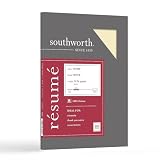
- Life Is Noteworthy. Create a resume that is noteworthy and will stand out from the crowd with this Southworth Resume Paper!Make a good first impression with this 100 percent Cotton Resume paper. Each sheet is lignin-free and acid-free to resist yellowing, and can be used in copiers as well as inkjet and laser printers for convenience. This Southworth Resume Paper comes 100 sheets per box to ensure there's enough on hand.
- Resume paper is ideal for resumes, cover letters, and thank-you notes
- Paper size: 8.5"W x 11"L
- Printer compatibility: laser, inkjet, copier
- Acid- and lignin-free
- Source representation: extracted text spans or blocks, with page association and coordinates when available.
- Document structure: reading order, columns, section headings, lists, tables, and page breaks.
- Resume fields: structured items such as contact details, experience entries, education, skills, certifications, and languages.
- Evidence and review status: the original span or source text, its location, and whether the extracted value has been checked or needs review.
Keep these levels distinct in storage or in your processing stages. For example, a corrected association between a date range and an experience entry should be traceable back to the spans and positions that prompted it. That makes it possible to diagnose whether an error came from extraction, reading-order reconstruction, or field interpretation instead of treating every bad field as one undifferentiated parser failure.
The exact resume schema depends on what the receiving application needs. There is no universal field schema established by the sources here; define and version one for your own use case rather than assuming every resume labels or groups information the same way.
First determine whether the PDF contains extractable text
Before choosing a parser, inspect what kind of PDF you have. A file that looks like text on screen may contain either actual text objects or only a page image. Ordinary text extraction works on the former; an image-only scan needs optical character recognition (OCR) before its words can be used as text.
PC Slower Than It Used to Be?
A free scan shows the junk files, broken settings and background clutter dragging Windows down - then fixes them in one click.Free scan · Windows 10 & 11Outdated Drivers Are Slowing You Down
One free scan finds every outdated or missing driver and matches the right update for your exact hardware.Free scan · exact hardware matchMachine-readable text
Attempt ordinary text extraction and inspect the result. If it contains recognizable words and plausible section content, proceed to layout-aware reconstruction. Do not infer success just because the extracted string is nonempty: verify that names, dates, bullets, and section labels look sensible and that text is associated with the correct page.
Scanned or image-only pages
If a page has no selectable text because it consists of an image, route it through OCR. The resulting words are still only an intermediate representation: OCR can confuse characters, and its output must be checked against the page image, especially for names, contact information, and dates. A mixed PDF may have extractable text on some pages and scanned images on others, so assess pages rather than assuming one method works for the entire file.
Keep the distinction between “no text was extracted” and “the resume has no content.” An image-only page can be visually complete while returning no useful text to a conventional extractor. Preserve the page association when OCR is introduced so the recognized text can be compared with the exact rendered page, rather than merged into an untraceable document-wide string.
Gibberish or missing text
Recognizable text may fail to emerge even when a page is not simply a scan. PDFBox documents custom font encodings that can yield gibberish during extraction and identifies OCR as a route for that case. Treat nonsensical output as a classification problem: compare it with the rendered page, then try OCR or another extraction strategy instead of passing corrupted characters into field mapping.
Password and extraction permissions
Some PDFs are protected. Respect their permissions and the authorization required to process them. PDFBox notes that a setting prohibiting text extraction may require the owner password to decrypt the file. Do not treat a parser error or an empty result from a restricted document as evidence that the resume has no text.
Rank #2

- Premium Quality Business Paper – This 70lb luxury resume paper offers a smooth, bright white finish, perfect for creating professional resumes, cover letters, and business correspondence. The 70lb weight ensures durability while maintaining a refined look and feel.
- Perfect for Printing and Writing – Designed for superior printability, this high-quality paper is ideal for inkjet and laser printers, ensuring crisp, sharp text and vibrant colors for your documents. It also provides a smooth surface for writing with pens or pencils.
- Versatile 8.5" x 11" Size – Standard letter-sized (8.5" x 11") paper that fits perfectly in most office printers and filing systems. Whether you're printing resumes, invitations, or professional documents, this paper is a great choice for any project.
- 100 Sheets per Pack – Comes with 100 sheets of luxury paper, offering excellent value and ensuring you have enough for multiple print jobs or professional documents. Ideal for office, home, or school use.
- Sustainable and Eco-Friendly – Made from high-quality, eco-conscious materials to support sustainability. This paper is sourced responsibly, making it a great choice for environmentally-conscious consumers.
Choose an extraction approach that preserves useful structure
Tool selection is a fit decision, not a universal ranking. The relevant questions are whether the tool runs locally or as a hosted service, what it returns beyond plain text, how it behaves on columns, and how easily you can compare its output with the PDF page. The documented options below have different deployment models and output capabilities; the available evidence does not establish a controlled accuracy winner.
| Option | Deployment and runtime | Documented output or controls | Important consideration |
|---|---|---|---|
| PyMuPDF | Local Python toolkit | Text extraction, sorting and layout-oriented options, and table extraction options are documented in its text extraction recipes. | Its documentation warns that extracted text may not follow a particular reading order. Sorting can help, but a global sort is not a substitute for reconstructing columns. |
| Apache PDFBox | Local Java library | Its version 3.0 FAQ documents positional sorting through setSortByPosition(true), as well as extraction problems involving custom encodings. |
Left-to-right, top-to-bottom sorting is a heuristic. Complicated multi-column pages still need spatial interpretation and visual checking. |
| Adobe PDF Extract API | Hosted extraction service | Adobe documents structured JSON and Markdown modes, contextual text blocks, table cells, figure extraction, and page layout or reading-order information in its PDF Extract API overview and Extract API how-tos. | Adobe positions JSON for structured downstream processing and Markdown for LLM ingestion. Those are vendor-documented capabilities, not an independent accuracy comparison. Check current service terms and data-handling requirements for your deployment. |
These options differ along several practical axes: local versus hosted deployment, input type and OCR needs, the amount of structure beyond plain text, reading-order behavior, and whether bounds or visual renditions make validation convenient. A local library can fit an in-process workflow; a hosted service may provide structured extraction modes without requiring you to build every extraction feature yourself. Those are operational considerations, not claims about relative accuracy or privacy.
The research reviewed does not establish pricing, free-tier availability, referral terms, or a cost comparison among these choices. Verify current service terms, data handling, supported formats, and implementation requirements directly before adopting a hosted option. The cited documentation does not establish those terms, and no tool should be selected on an assumed price or privacy guarantee.
Quick wins for a faster PC:
Clear out junk files and repair common Windows errorsFree Scan →Fix the driver behind crashes, sound loss and screen glitchesFind Drivers →Repair Windows errors before they cause bigger problemsFix Now →Reconstruct reading order before mapping fields
Text extraction order and visual reading order are not guaranteed to match. PyMuPDF warns that extracted text may not occur in a particular reading order; its documentation describes sorting from top-left to bottom-right and layout-preserving command-line output. A header positioned at the top of the rendered page can, for example, appear at the end of text extracted in the creator-determined sequence. Sorting is useful, but sorting every span on a page into one sequence can also wrongly interleave distinct columns.
Keep coordinates and page numbers in the intermediate representation whenever the tool provides them. Then interpret position alongside text cues. A date range near a role heading and employer name is more likely to belong to that experience entry than to a section elsewhere on the page. A sidebar’s skills should not be merged into the middle of a main-column work history simply because their text boxes have similar vertical positions.
- Keep pages separate initially. Attach each span or block to its page so that page breaks do not silently join unrelated sections.
- Group by spatial region. Identify columns, sidebars, and aligned blocks before concatenating text. Do not use one global top-to-bottom sort when the page contains independent columns.
- Use text and position together. Look for section labels, dates, bullets, and nearby descriptions. A date can be recognized as a date-like string, but its association with a role depends on layout as well as wording.
- Preserve element type and bounds. If available, retain whether an item is text, a table cell, or another element, along with its bounding box. Adobe documents structured element paths and bounds in its Extract API how-tos.
- Compare with the rendered page. Check representative one-column and multi-column resumes to see whether the reconstructed order matches what a person would read on the page.
A resume that looks like a table may not be encoded as a table at all: it may be ordinary text placed at aligned coordinates. That is why splitting on tabs or treating all extracted text as a simple string is fragile. Layout, including sidebars, labels, dates, and adjacency, is part of the input data.
When validating a reconstruction, inspect the transitions that are easiest to get wrong: a column boundary, a page break, the start of a new section, or a date next to an experience item. A plausible-looking sequence is not sufficient if a sidebar has been woven into the main column. Keep an alternative or uncertain grouping available for review instead of forcing every span into one confident reading order.
Map the reconstructed content into explicit resume fields
Once text and layout have been recovered, classify the spans into the fields your application actually consumes. Typical categories include contact information, summary, work experience, education, skills, certifications, and languages. Define the schema before writing extraction-to-field logic, and version it when the shape or meaning of fields changes. A downstream model may need different details than an applicant-tracking system, so do not add fields just because they are common in other schemas.
Rank #3

- Life Is Noteworthy. Create a resume that is noteworthy and will stand out from the crowd with this Southworth Resume Paper!Make a good first impression with this 100 percent Cotton Resume paper. Each sheet is lignin-free and acid-free to resist yellowing, and can be used in copiers as well as inkjet and laser printers for convenience. This Southworth Resume Paper comes 100 sheets per box to ensure there's enough on hand.
- Resume paper is ideal for resumes, cover letters, and thank-you notes
- Paper size: 8.5"W x 11"L
- Printer compatibility: laser, inkjet, copier
- Acid- and lignin-free
For a field that combines several source spans, retain the evidence for each value. An implementation might represent a normalized work-history entry as an object containing a role, employer, start and end dates, and description, while separately retaining the original text, page, bounds, and review state for every mapped value. That example is a design pattern, not a prescribed universal schema.
- Keep source text beside normalized values. A normalized date or title should be traceable to the exact text from which it was derived.
- Keep page and bounds when available. These make it possible to locate an uncertain value on the rendered page.
- Represent uncertainty explicitly. Store confidence or a review state rather than turning an uncertain interpretation into an apparently definitive fact.
- Do not discard relationships. Preserve which dates and descriptions belong to which employer or role, and which degree belongs to which institution.
- Keep extraction and interpretation separate. Correcting a role-to-date association should not require rerunning OCR or losing the original page evidence.
This also gives a model or downstream system a clearer boundary: it can receive the normalized fields it needs without losing the provenance needed to inspect a value. If a field is uncertain or conflicting, preserve that status rather than silently replacing the source wording with an unverified normalized guess. The available sources support preserving evidence as an engineering approach; they do not prescribe a particular confidence scale or field format.
This evidence-preserving approach follows from the documented variability in reading order and layout; it is an engineering recommendation, not a schema prescribed by PyMuPDF, PDFBox, or Adobe.
Do these 3 things before closing this tab:
1Scan for outdated or missing drivers - takes under a minute2Clear out junk files and repair common Windows errors3Fix the driver behind crashes, sound loss and screen glitchesValidate the output against the resume itself
Validation means comparing extracted and structured data with the rendered document, not merely checking that the output is valid JSON. Look for errors that change meaning: a date range assigned to the wrong position, two columns joined together, a section omitted, or an OCR character that changes a person’s name or contact detail. Retain enough evidence to find the original location and route low-confidence or conflicting fields to human review.
- Check section coverage. Compare the extracted sections with the visible page and note headings or content that did not reach the structured result.
- Check spatial associations. Confirm that dates, employers, roles, degrees, and descriptions are paired with the correct neighboring content.
- Check high-impact text. Review names, email addresses, phone numbers, dates, and qualifications for OCR or character-encoding errors.
- Review the page image for ambiguous layout. Adobe documents table image renditions that can support visual validation; its structured output also provides paths and bounds. See the API overview and how-tos.
- Test on a representative corpus. Include scanned pages, multi-column layouts, unusual fonts, and different resume conventions. Measure the kinds of errors that matter to your application rather than assuming a tool’s output format guarantees correct interpretation.
Make that test set reflect the cases your workflow is meant to handle rather than relying on one easy sample. Include pages with ordinary selectable text as well as image-only scans, and compare not just whether text was returned but whether sections, reading order, and field associations survived. Recheck after changing a library version, extraction configuration, or hosted-service behavior, since the cited tool capabilities and service details may change.
The reviewed sources do not establish a universal accuracy threshold or a controlled cross-tool benchmark. Set acceptance criteria for your own use case, and make human review available for uncertain cases rather than treating a single score as proof that all resume layouts are handled correctly.
Independent reader supportYour contribution helps us test, update, and keep practical guides available for everyone.Account for extraction omissions in downstream systems
Structured output is not necessarily a complete transcript of every visible word. Adobe documents that its default extraction excludes headers and footers, and that repeated headings are included only for their first occurrence. If a resume places relevant information in a header or footer, or repeats a heading across pages, inspect the rendered pages and account for those behaviors in your completeness checks. Do not assume that every returned JSON object contains every visible element.
Free tools Windows power users keep installed
One-click scans. No signup required.
Similarly, text in a table-like arrangement, a figure, or a sidebar may need a different treatment from ordinary prose. Use the extraction output’s element types and locations where available, and check whether the visible structure survives conversion before feeding it to a model. A Markdown representation can be convenient for model ingestion, but convenience does not demonstrate that the correct relationships or all visible content have been preserved.
Rank #4

- Premium Paper Set: Made from 90 GSM parchment paper for easy writing.Heavy-weight,avoid ink bleed through.Parchment paper is light enough in color for writing,all write smoothly on this paper.
- Vintage Design: Designed with vintage textures,these diploma papers have retro appearances,crafted with attention to detail,experience the appeal of vintage paper.
- Smooth Texture for Writing and Printing: It works well on a variety of laser and inkjet printers at home as well as professional printers in the office.Whether you prefer the printing or writing,our parchment paper offers a smooth and consistent surface.
- Product Specifications: Each pack contains 25 sheets,sized at 8.5 x 11 inches.The blank design allows for easy addition of text, graphics,catering to various personalized demand.
- Multi-Purpose: This paper is great for certificates, resumes,diplomas,business cards and invitations.Ideal for use in homes,schools,and businesses,as well as for artistic,crafts and more,offering possibilities for your creativity.
What published resume-extraction research does—and does not—show
A 2023 paper, “Resume Information Extraction via Post-OCR Text Processing”, describes extracting resume information after OCR and text-group preprocessing. Its authors report two study-specific datasets: 286 resumes in a text dataset drawn from five IT-industry job-description categories—education, experience, talent, personal, and language—and a separate 1,198-resume object-recognition dataset collected from open-source internet materials and labeled as sets of text.
Those counts describe datasets in that particular study; they are not estimates of the overall resume population, and they do not establish production accuracy for current parser products or a universal best approach. The useful lesson for implementation is narrower: resume information extraction can be treated as a stage after OCR and text grouping, rather than as a problem solved by raw text extraction alone.
Implementation checklist
- Classify each page as extractable text, scanned image, or problematic encoding, and use OCR when text is unavailable or unusable.
- Preserve page, coordinates, and source spans when the chosen tool provides them.
- Reconstruct columns and other spatial groups before building one reading sequence.
- Define and version the target schema before mapping content into fields.
- Carry source evidence and review state alongside normalized values.
- Validate fields and section coverage against rendered pages, with extra attention to columns, dates, and OCR-sensitive text.
- Test the actual resume layouts and operational constraints your system will encounter; the available documentation does not justify a universal parser ranking.
Frequently Asked Questions
Can I parse every resume PDF by extracting its text layer?
No. Image-only or scanned pages need OCR because they contain no selectable text to extract. Some PDFs also have custom font encodings that produce gibberish; compare the output with the rendered page and try OCR or another extraction strategy when text is unusable.
The Tool Desk
Outbyte Driver Updater FREEScan for outdated or missing drivers - takes under a minuteDriver Scan →Outbyte PC Repair FREERepair Windows errors before they cause bigger problemsFix Now →Does sorting extracted text fix reading order?
Not reliably. Positional sorting can help, but a single top-to-bottom sort may interleave columns or sidebars. Preserve page coordinates, group spatial regions, and check the reconstructed order against the rendered page.
Should I send raw extracted text directly to an LLM?
Not without checking its layout and completeness. Text may be out of order, columns can be joined incorrectly, and some extraction outputs omit visible material. Preserve spans and locations, reconstruct structure, and validate the result before model ingestion.
Which resume PDF parser is most accurate?
The reviewed sources do not establish a universal best parser or controlled cross-tool accuracy benchmark. Compare local tools such as PyMuPDF or PDFBox with hosted options such as Adobe PDF Extract API on representative resumes from your own corpus.
What should a model-ready resume record contain?
Use fields appropriate to the receiving application, such as contact details, experience, education, skills, certifications, or languages. Keep normalized values linked to source text and, when available, page, bounds, and a confidence or review status; no universal schema is established.
The Bottom Line
Reliable resume PDF parsing is a staged process: classify pages, extract text and layout, reconstruct reading order, map spans into a versioned schema, and validate fields against the rendered pages. Preserve source evidence and uncertainty throughout. No reviewed source proves one universally best parser, schema, or accuracy threshold, so test the tools and layouts your application will actually encounter.
Quick Recap
Product prices and availability are accurate as of the date/time indicated and are subject to change. Any price and availability information displayed on Amazon at the time of purchase will apply.

