
Free tools Windows power users keep installed
One-click scans. No signup required.
iTechGuides is reader-supported. When you buy through links on our site, we may earn an affiliate commission. As an Amazon Associate I earn from qualifying purchases. Learn more
Fair fast-play trivia comes from disciplined question design, not trick wording. Verify the fact, write the expected answer before polishing the clue, add qualifiers until only one answer is defensible, state the required answer format, set difficulty for the actual audience, and read-test every question at game speed. Publish the timing, scoring and accepted-answer rules before anyone plays, then keep the source and ruling for challenges.
What makes a fast-paced trivia question fair?
A fair question gives players a realistic chance to understand the same clue, retrieve or reason toward the intended answer, and receive the same ruling as every other player. Speed changes how much wording a player can process, but it does not justify ambiguity. The challenge should come from the knowledge or reasoning the game intends to test—not from a hidden definition, a misleading sentence or an obscure technicality.
Use this practical test before publishing a clue:
- Accuracy: an authoritative source supports the fact and the answer is current for the stated date, place or edition.
- Uniqueness: the wording rules out other answers that a reasonable player could defend.
- Understandability: a player can follow the sentence once, including when it is read aloud.
- Answerability: the required response—name, year, number, choice or estimate—is clear.
- Consistency: the same acceptance and scoring rule applies to every player.
- Audience fit: the subject, vocabulary and difficulty suit the people in the room.
BBC editorial guidance summarizes the underlying standard: “Questions and their answers should be accurate, legal, require a reasonable level of skill, and be appropriate in subject matter and tone for audience expectations.” The guidance also says participants should be clearly informed of the rules before taking part. See Section 17 of the BBC Editorial Guidelines (the consulted page is a mirror of the guideline text).
How do you write fair trivia questions?
1. Start with a verifiable fact
Choose a fact that can be checked rather than a claim remembered vaguely from a listicle or social post. Trace it to the original or another authoritative source when possible. Keep a private answer record containing the exact fact, the source URL, the date or edition that applies, and any definition used in the clue.
#1 Best Overall
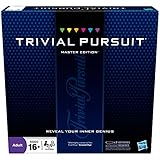
- The Trivial Pursuit Master Edition game is for the trivia buff who loves to show off how smart they are. Play traditional rules or quicker gameplay
- This Master Edition of the Trivial Pursuit board game includes 2,950 intriguing, challenging, and sometimes humorous questions
- This trivia game features 6 question categories including geography, entertainment, history, art and literature, science and nature, and sports and leisure
- Play the Trivial Pursuit Master Edition game following classic gameplay, or collect a wedge any time you answer a questions correctly, not just on the wedge spaces
- The Trivial Pursuit Master Edition game comes with a timer to keep up the pace
The verification guide published by GuessWho describes tracing claims to their origin and treating primary sources as sufficient for its own methodology. It also advises leaving unsupported quotations out. That is a publisher’s stated practice, not a universal industry rule, but it is a useful discipline for any quiz writer. Its process is described at How We Research and Verify Every Question.
Check details that commonly change or vary:
- Whether a record is measured by area, population, height, revenue or another metric.
- The date on which a ranking, officeholder, product feature or statistic is true.
- Whether a name is an official title, a common translation or a former name.
- Whether the rule applies worldwide or only to a country, league, edition or language.
Write the answer in a short answer key before you write the final clue. This exposes a problem early: if you cannot state exactly what counts as correct, the question is not ready.
2. Narrow the wording until one answer is defensible
Ask, “Could a well-informed player give another answer and support it with a reputable definition?” If the answer is yes, add the qualifier that changes the intended scope. A qualifier should do real work; decorative detail only makes a fast clue harder to hear.
| Ambiguous stem | Why it can fail | Narrower version |
|---|---|---|
| What is the world’s largest desert? | “Desert” can include polar deserts, so a player may answer Antarctica rather than the intended hot desert. | What is the world’s largest hot desert? |
| Which city is the biggest? | “Biggest” could mean population, area, metropolitan population or another measure. | Which city has the largest population within its municipal boundaries? |
| When did the company launch? | Announcement, first sale, public release and regional release can be different dates. | In what year was the product first released to the public in the United States? |
The pub-quiz writing guide gives the same kind of correction: specify “hot desert” rather than “desert,” and state that a city’s size is measured “by population” when that is the intended comparison. Its practical advice appears in How to Write Good Pub Quiz Questions (That Don’t Start Arguments), dated October 4, 2026.
Do not hide the qualifier in an answer key. Put it in the spoken or displayed clue so every player receives the same information at the same time.
3. Decide the accepted answer form before play
Players need to know not only what fact you want, but what form of response earns credit. Put the requirement in the question when it matters:
- “Give the person’s full name” rather than just “Who…?”
- “Name the year” rather than “When…?”
- “Give the exact number” when rounding is not acceptable.
- “Give the closest whole-number estimate” when an estimate is the intended skill.
- “Name the country, not the city” when both levels appear in the clue.
Before the first question, decide how you will handle spelling variants, diacritics, transliterations, abbreviations, married or former names, singular versus plural forms, and equivalent units. Record accepted variants in the answer key and apply that list to every team. If an answer requires a specific precision, state the tolerance—for example, “within one year” or “to the nearest million”—instead of arguing about it after the reveal.
Some formats require a particular response convention. Jeopardy!’s official explanation of its response rules, published July 30, 2021, describes that show’s requirement to respond in question form. That convention belongs to that show; a general trivia game should state its own rule rather than copy it implicitly.
Rank #2
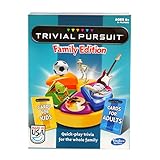
- TRIVIAL PURSUIT GAME FOR FAMILIES: Kids and adults can test their smarts with this Trivial Pursuit Family Edition game
- 1200 TRIVIA QUESTIONS FOR KIDS AND ADULTS: The Trivial Pursuit cards include 1200 questions from 6 categories! Choose from 100 blue cards for adults and 100 yellow cards for kids
- QUICK-PLAY TRIVIA: This edition's gameboard offers an opportunity to earn a wedge on any colored space for a faster game than the original Trivial Pursuit board game
- PLAY INDIVUALLY OR IN TEAMS: For 2 or more players, this Trivial Pursuit game is a great family board game for groups! Be the first to collect 6 different colored wedges and answer the final question correctly to win
- FUN FAMILY GAMES: Make some memories and break out this indoor game on family game night!
How can questions stay clear when players have only a short time?
Use one-pass language
Write for the ear if the host will read the clue. Put the category or subject first, then the essential qualifiers, then the actual ask. Prefer a short main clause over nested parentheses, long lists of names and several exceptions. Remove words that do not help identify the answer. A player should not have to remember an introductory story while waiting for the question’s final verb.
Read each clue aloud at the pace used in the game. The pub-quiz guide specifically recommends this check because long clauses, difficult names and spelling-dependent clues become harder in a noisy spoken setting. If the game is displayed or answered on a device, test that exact format too: a sentence that sounds clear may wrap awkwardly on a small screen, while a visually simple clue may be difficult to hear.
Keep the challenge in the knowledge, not the syntax
A fast game does not require trick wording, double negatives or near-identical decoys. Deliberately misleading phrasing tests resistance to traps rather than the subject knowledge you selected. If the answer is difficult, let the fact supply the difficulty and make the sentence straightforward.
The Tool Desk
Outbyte Driver Updater FREEScan for outdated or missing drivers - takes under a minuteDriver Scan →Outbyte PC Repair FREERepair Windows errors before they cause bigger problemsFix Now →Jeopardy! production guidance illustrates the pacing issue. The show’s official account says contestants are reminded to keep responses short because elaborate phrasing consumes game time and attention. That is a pacing choice for that format, not a requirement that every trivia answer be phrased as a question. Its contestant-test advice also includes the reminder, “There are no extra points for speed, and no need to rush through it,” from producer Maggie Speak. Head writer Billy Wisse advises test takers not to overthink straightforward general-knowledge material. Those comments concern the Jeopardy! contestant test, not a universal design formula; they are available in 6 Test Tips From The Jeopardy! Team.
Separate reading time from answering time when necessary
If a host must read a long clue, start the timer only after the complete question and its options or image have been presented, or publish a rule that says exactly when the clock begins. Otherwise teams with a different view of the screen or a slower audio connection may lose time for reasons unrelated to knowledge. For a short spoken clue, a single visible countdown can be enough; for a multi-part prompt, give players a fixed reading interval or shorten the prompt.
How should you choose a timer?
There is no evidence in the available guidance for one response-time number that fits every trivia format. Set the timer according to reading load, answer complexity, input method and the skill you intend to test. A one-word recall clue can use less time than a calculation, a multi-step deduction or a clue that requires typing a full name.
Jeopardy!’s current contestant FAQ gives a concrete, show-specific example: the Jeopardy! Anytime Test has 50 categories and 50 clues, allows 15 seconds per clue and takes approximately 13 minutes. The FAQ identifies that as the test’s format, not a general trivia standard; see Jeopardy! Contestant FAQs.
What’s actually slowing this PC down?
Pick the symptom - the matching free tool is one click away.
| Format decision | What to specify | Why it matters |
|---|---|---|
| Clock start | After the host finishes reading; after the full slide appears; or at a stated signal. | Players receive the same usable time. |
| Clock end | When the countdown reaches zero, when an answer is submitted, or at a host call. | Prevents disputes over answers spoken or typed on the boundary. |
| Answer changes | Whether a player may revise an answer before time expires. | Stops one team gaining a privilege others did not know existed. |
| Late or incomplete entries | How misspellings, blank fields and answers begun before the buzzer are treated. | Lets the judge apply a known standard rather than improvise. |
| Scoring | Points, penalties, partial credit and tie-break procedure. | Players can choose strategy with the same information. |
Publish these rules in the invitation, game screen or host briefing. Explain them again briefly before the first timed round, as the BBC guidance recommends for quiz participants.
Rank #3

- TRIVIAL PURSUIT GENERATIONS: An all-new trivia game for seniors! In this fun reimagined edition of Trivial Pursuit, each card has five generational questions, allowing you to play for your own generation or test your knowledge by playing as another. While made with older adults in mind, Joy for All's games offers multigenerational family game night fun for all ages, from Gen Z to The Greatest Generation.
- SENIOR-FRIENDLY DESIGN: Joy for All's Trivial Pursuit Generations is uniquely tailored to the needs of aging senior citizens. The improved gameboard and large card design ensure a comfortable and enjoyable experience for players with reduced eyesight and/or dexterity challenges.
- MEMORY BOOSTING TRIVIA: A fun brain game and memory care activity for older adults! Trivial Pursuit Generations helps keep minds sharp while offering hours of entertainment. Featuring generation-specific questions and fill-in-the-blank cards, this trivia game for seniors is perfect for sparking memories, stimulating mental agility, and promoting cognitive thinking.
- EASY TO READ CARDS: Trivial Pursuits Generations' bigger, easier-to-read cards are thoughtfully crafted for elder adults. Their enhanced readability makes this trivia game accessible for those with low vision or other eye issues.
- JOY FOR ALL GAMES: Explore reimagined classic board games designed specifically for older adults! Our collection includes Scrabble Bingo, The Game of Life Generations, and Trivial Pursuit Generations. With bigger cards and game pieces that are easy to read and grasp, Joy for All's elderly-friendly board games offer the perfect blend of nostalgia and fun. They're great activities for seniors of all physical and cognitive abilities to stay engaged and keep busy.
How should you balance easy and hard questions?
Difficulty should fit the people playing and the purpose of the round. A family game, a specialist league and a workplace icebreaker do not share the same baseline knowledge. Adjust topic selection, vocabulary, clue length and answer specificity before resorting to obscure facts.
One commercial pub-quiz publisher suggests that a ten-question round contain three or four easy questions, three or four middling questions and two or three hard questions. Treat that 3–4 / 3–4 / 2–3 split as practical advice from PubQuizzes.org, not an experimentally validated universal ratio. No independent evidence establishes an optimal difficulty mix or timer for every game.
| Difficulty band | Role in a round | Design approach |
|---|---|---|
| Easy | Builds confidence and confirms that teams understand the format. | Use familiar domains and direct wording; avoid adding a second trick just because the fact is common. |
| Middle | Separates teams with solid general knowledge. | Require a specific fact or one clear inference, with enough context to identify the scope. |
| Hard | Rewards depth without making the round feel arbitrary. | Use a less-common but well-sourced fact, a meaningful connection or a constrained estimate; keep the wording plain. |
Balance the round as a whole, not only the questions individually. Ten clues all from one specialist field may be fair to experts and inaccessible to everyone else. Conversely, ten universally obvious clues produce little separation. If teams miss a hard clue because two answers were equally plausible, that is a wording defect, not successful difficulty.
How do you test a question before the game?
Run a written review
- Write the intended answer and every accepted variant in the answer key.
- Attach the source and record the relevant date, definition, unit or geographic scope.
- Underline words that control meaning: “hot,” “by population,” “as of 2026,” “in the film,” or “nearest whole number.”
- List a reasonable alternative answer a knowledgeable player might offer.
- Add or replace a qualifier if that alternative remains defensible.
- Confirm that the scoring rule matches the response form requested in the clue.
Run an aloud, game-speed review
- Have someone who did not write the clue read it once at the host’s normal pace.
- Answer without pausing the clock. Note whether the key noun, qualifier and requested format were easy to retain.
- Repeat in the expected environment: background noise, a projector, a phone screen or a video call.
- Mark names, numbers and foreign terms that are easy to mishear. Rewrite the sentence or provide an unambiguous visual spelling when the format allows it.
- Ask the tester to explain what they thought the question was asking, not merely whether they liked it.
A clue that works only when the writer adds an explanation afterward is not ready. Put the necessary explanation into the clue or remove the clue.
Prepare for challenges
Keep the source and the reasoning behind each ruling available to the host. If a playtester proposes a reasonable alternative, revise the question or add that answer to the accepted list before the live game. Do not change the standard for a later team because the first team happened to use different wording. When the source itself supports multiple definitions, either state the definition in the clue or replace the question.
Common failure modes and repairs
| Failure | What players experience | Repair |
|---|---|---|
| Unstated measurement | Two answers fit “largest,” “oldest,” “best” or “biggest.” | Name the metric, population, area, rating system or date. |
| Out-of-date fact | The answer was once correct but changed with an election, transfer, release or ranking. | Add an “as of” date and verify against a current authoritative source. |
| Overloaded sentence | Players miss the final ask while remembering several clauses. | Cut background, split the clue or present context on a separate line. |
| Spelling trap | A team knows the answer but loses because the spoken format cannot show spelling. | Accept recognized variants, request a choice or show the spelling when spelling is the intended skill. |
| Hidden response format | One team gives a surname, another a full name, and the judge improvises. | State the required form and list equivalent answers before play. |
| False precision | A source gives an estimate but the clue demands an exact figure. | Ask for the nearest stated unit or provide an explicit tolerance. |
| Trick wording | The result depends on spotting a negation or decoy rather than knowing the topic. | Use direct syntax and let the subject matter supply the challenge. |
| Unannounced rule change | Later teams receive different timing, hints or partial credit. | Publish and repeat the rule; log any correction and apply it consistently. |
How do format and group size affect fairness?
Individual, team, cooperative and solo games create different paths to an answer. In a team game, a clue that is easy for one specialist may be hard for a group without that background, while a very short timer may prevent useful discussion. In an individual game, reading speed and typing speed become more prominent. Design the clue and timer for the actual mode rather than assuming that a question fair in one mode transfers unchanged to another.
A physical product can provide a useful setting for observing these effects. Hasbro’s official Trivial Pursuit board-game instructions describe 1,200 questions across six categories, 200 cards, and individual, team, cooperative and solo modes. Contents and availability can change. The game is an example of a test environment, not a guarantee that every question is fair and not a requirement for writing or playtesting your own set.
Recommended Free Tools
During a trial round, record more than whether an answer was right. Note how often teams ask for a repeat, whether discussion stops because the clue is unclear, how long adjudication takes, and whether one mode gives an accidental advantage. Those observations tell you whether to shorten the clue, adjust the timer, change the answer format or alter the difficulty mix.
Rank #4
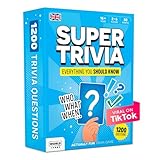
- 6 WAYS TO PLAY TRIVIA – More than question and answer: 1200 questions across 6 question types, including 200 picture questions and estimation rounds where the closest guess wins. A trivia game for adults that keeps every round surprising.
- GENERAL KNOWLEDGE FOR ALL AGES 16+ – Questions on daily life, culture, history, science and geography, balanced so they're not too easy and not too hard. Teens, adults and seniors can play together, which makes it a great family trivia game for mixed groups.
- EASY TO LEARN, QUICK TO PLAY – Roll the die, draw a trivia card and answer. Simple rules for 2-10 players or teams and about 50 minutes per game. Ready in a minute for board game night, parties or team building at work.
- TRAVEL CARD GAME – 202 trivia cards and a die in a compact travel-size box. Take it on road trips, flights, vacations and camping. A fun car game for adults and teens that fits in any bag.
- GIFT FOR TRIVIA LOVERS – A smart gift for adults, teens and trivia buffs: Christmas, birthdays, stocking stuffers or white elephant exchanges. Recommended for ages 16 and up.
A complete question-writing workflow
- Choose the learning or entertainment target. Decide whether the clue tests recall, identification, comparison, calculation or estimation.
- Verify the fact. Trace it to an authoritative source and record the applicable date, location, edition and measurement.
- Write the answer key first. State one intended answer and list spelling, translation and equivalent-form variants you will accept.
- Challenge your own answer. Search for a reasonable alternative under another definition or measurement.
- Add the decisive qualifier. Put the date, geography, category, metric, unit or scope in the clue itself.
- State the response form. Ask explicitly for a full name, year, number, closest estimate or other required form.
- Make the sentence speakable. Remove unnecessary clauses, double negatives and pronunciation traps.
- Place it in a balanced round. Mix difficulty for the intended audience, using publisher ratios only as a starting point.
- Set the operational rule. Define when the clock starts and ends, submission method, accepted variants, points, penalties and challenges.
- Test at realistic speed and format. Read, display or deliver it exactly as players will encounter it.
- Lock the ruling before play. Keep the source and accepted-answer list with the host and apply them identically to every team.
Worked examples
Geography: remove the competing definition
Weak: “What is the largest desert on Earth?”
Fairer: “What is the largest hot desert on Earth?”
The second version tells players which definition controls the answer. If the game instead wants the largest desert of any type, say so and accept the corresponding answer. Do not rely on the host to explain the distinction after teams have committed.
Statistics: name the metric and boundary
Weak: “Which city is the largest?”
Fairer: “Which city has the largest population within its municipal boundaries, according to the 2025 census?”
Quick wins for a faster PC:
Scan for outdated or missing drivers - takes under a minuteDriver Scan →Clear out junk files and repair common Windows errorsFree Scan →Fix the driver behind crashes, sound loss and screen glitchesFind Drivers →The revised clue identifies the metric, geographic boundary and date. If the source does not provide all three, choose a different fact or ask a narrower question.
Names: make the required form visible
Weak: “Who directed the film?”
Fairer: “Give the director’s full name for the 2019 film Example.”
If a surname alone earns the point, say that instead. If multiple people share a credit, ask for the role or the specific installment that distinguishes them.
Numbers: avoid false exactness
Weak: “How many people attended?” when the source reports an estimate.
Do these 3 things before closing this tab:
1Repair Windows errors before they cause bigger problems2Fix the driver behind crashes, sound loss and screen glitches3Clear out junk files and repair common Windows errorsFairer: “According to the organizer’s estimate, approximately how many people attended? Give the nearest thousand.”
The requested precision now matches the evidence, and the judge can apply a defined rounding rule.
Author’s final checklist
- Can I show the source and the exact statement that supports the answer?
- Does the wording identify the relevant date, place, edition and measurement?
- Could a reasonable, well-informed player defend a different answer?
- Have I put every necessary qualifier in the clue rather than in the answer key?
- Is the required answer form and precision explicit?
- Are spelling, translation, abbreviation and equivalent forms decided in advance?
- Can a player understand the clue after one reading or hearing?
- Does the timer match the reading load and the intended skill?
- Are the timing, scoring, submission and challenge rules public before play?
- Has the question been tested in the real delivery format and at realistic speed?
- Will the same ruling be available for every player?
If any answer is no, revise the question before adding it to the round. A shorter, plainly worded clue with a defensible answer is fairer—and usually more exciting—than a clever clue that creates an argument after the buzzer.
Quick Recap
Product prices and availability are accurate as of the date/time indicated and are subject to change. Any price and availability information displayed on Amazon at the time of purchase will apply.

