
Free tools Windows power users keep installed
One-click scans. No signup required.
iTechGuides is reader-supported. When you buy through links on our site, we may earn an affiliate commission. As an Amazon Associate I earn from qualifying purchases. Learn more
A gravity-fed water system works when stored water sits high enough above its outlet to create the flow your fixture or irrigation device needs. Design it from the lowest expected tank water level—not the full-tank level—then match catchment, storage volume, pipe route, fittings, overflow, and end-use equipment to that available head. A rain barrel feeding a nearby garden may work without a pump; a large cistern serving indoor fixtures or automated irrigation commonly needs one.
Begin by deciding whether the water is for exterior irrigation, indoor non-potable use, or drinking. Estimate how much water your roof can collect and how much the intended use consumes. Measure the vertical difference between the tank’s lowest operating water surface and the outlet, account for friction and restrictions, and test the system at the lowest level. Keep the tank covered and screened, provide a properly sized overflow, and prevent any unprotected connection to potable plumbing.
When gravity can deliver useful water
Gravity creates pressure because water has weight and the storage surface is above the outlet. The greater the elevation difference, the more pressure is available at the outlet. That pressure is not constant: it falls as the tank level drops, and every length of pipe, bend, valve, filter, and emitter consumes part of it.
Quick wins for a faster PC:
Repair Windows errors before they cause bigger problemsFix Now →Scan for outdated or missing drivers - takes under a minuteDriver Scan →The U.S. Environmental Protection Agency (EPA) describes the practical distinction this way: “Rain barrel systems and small cisterns can use a gravity fed distribution system.” It also says, “Most distribution systems for larger cisterns need a pump to convey harvested rainwater from the cistern to its final destination, whether inside the building, an automated irrigation system, or gradually discharged to a secondary stormwater treatment practice.” Those statements are useful scale guidance, not a rule that every small system works or every large system fails by gravity. Your elevation, route, desired flow, and end-use device decide the result. See the EPA’s National Pollutant Discharge Elimination System (NPDES) Compliance Inspection Manual (2017).
#1 Best Overall

- 50-Gallon Capacity: Provides ample storage for harvested rainwater, ideal for watering gardens, lawns, and plants.
- Durable Construction: Made from UV-resistant polyethylene for long-lasting durability and protection from the elements. Made of 100% Recycled plastic.
- Overflow Valve: Built-in overflow valve for managing excess water and the option to connect multiple barrels for increased storage.
- Convenient Spigot: Easy-to-use plastic spigot for quick and efficient water retrieval.
- Low Maintenance: Easy to install and maintain, offering a simple, sustainable solution for homeowners.
| Application | Typical gravity outlook | Design issues that decide the outcome |
|---|---|---|
| Rain barrel to a nearby garden bed | Often practical without a pump | Barrel elevation, hose length, filter cleanliness, and whether the emitter opens at the available pressure |
| Several linked barrels for a larger garden | Possible, but flow becomes less predictable as the water level falls | Equalizing connections, outlet size, route friction, and the lowest operating level |
| Large cistern for automated irrigation | A pump is commonly needed | Valve and sprinkler minimum-pressure requirements, long runs, elevation changes, and filtration |
| Indoor non-potable fixtures | Requires careful hydraulic and plumbing design; a pump is often necessary | Fixture pressure, building codes, backflow protection, treatment, and cross-connection control |
| Potable supply | Not a simple do-it-yourself gravity project | Water-quality treatment, sanitary protection, permits, professional design, and legally approved separation from potable mains |
Define the source and intended use first
Exterior garden irrigation
A roof, gutter, screened inlet, covered barrel or cistern, outlet, and drip or soaker line can form a simple system. Keep the outlet close to the garden when possible. Low-flow devices generally make limited gravity pressure more useful, but confirm the device’s required flow and pressure with its manufacturer.
Indoor non-potable water
Toilet flushing, clothes washing, or other indoor uses add plumbing, treatment, inspection, and cross-connection requirements. A tank that works for a hose bib does not automatically meet the requirements for a building connection. Plan the non-potable network as a separate system and obtain the approvals required where you live.
Potable water
Roof runoff is not automatically drinking water. Animal waste, roofing materials, dust, insects, tank sediment, and plumbing materials can affect quality. A potable design needs a treatment train and monitoring appropriate to the catchment and local health rules; the sources cited here do not establish one universal treatment train. Use a qualified water-system or plumbing professional before relying on harvested water for drinking or food preparation.
PC Slower Than It Used to Be?
A free scan shows the junk files, broken settings and background clutter dragging Windows down - then fixes them in one click.Free scan · Windows 10 & 11Outdated Drivers Are Slowing You Down
One free scan finds every outdated or missing driver and matches the right update for your exact hardware.Free scan · exact hardware matchEstimate how much rain you can collect
Oregon State University Extension gives this planning equation:
Harvested rainwater (gallons) = catchment area (square feet) × rainfall depth (inches) × 0.62.
The result is potential collection. Roof texture, gutter losses, evaporation, first-flush diversion, screens, leaks, and overflow reduce the amount that actually reaches the tank. Use rainfall data for your location and the season in which you will irrigate rather than an annual average that hides dry periods.
OSU’s coastal Oregon illustration assumes about 100 inches of annual rainfall and 75% collection efficiency. Under those assumptions, it estimates approximately 47 gallons per square foot of roof per year. That figure is an example for that rainfall and efficiency, not a transferable yield for every climate. The calculation and assumptions are explained in OSU’s Harvesting Rainwater for Use in the Garden.
Do these 3 things before closing this tab:
1Scan for outdated or missing drivers - takes under a minute2Repair Windows errors before they cause bigger problems3Fix the driver behind crashes, sound loss and screen glitchesEstimate demand and the reserve you need
For irrigation, determine the area to water, the intended watering depth, how often it will be applied, and the longest likely period without useful rain. Include other planned uses separately; a tank sized for a vegetable bed may be inadequate if it also supplies trees, washing, or toilets.
OSU’s worked example uses a 30-square-foot garden. Under its stated dry-summer assumptions and with no rainfall recharge, the garden needs about 49.5 gallons per week and at least 620 gallons for 90 days. The same guidance suggests a tank nearly twice the calculated need when the goal is to preserve some municipal or well water during peak summer demand. That is an example recommendation, not a universal sizing rule. Drip or soaker irrigation can improve efficiency, but the result depends on the equipment and soil.
Compare the seasonal demand with the collection estimate before buying a tank. If demand exceeds likely collection, either enlarge the catchment, reduce irrigation, add another source, increase storage for wet-season capture, or accept that a supplemental supply will be needed.
Measure gravity head at the worst case
Measure from the water surface at the tank’s lowest intended operating level to the outlet or irrigation device. Do not measure only from the top of a full tank. The usable head is reduced by the vertical rise to the destination and by friction in the pipe, elbows, tees, valves, filters, quick-connects, and emitters.
Rank #2
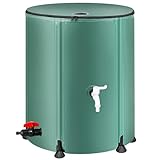
- 【Leak-Proof Design】Unlike typical rain barrels, our product features an integrated design with a straightforward screw-in faucet, eliminating the hassle of assembling multiple parts. This thoughtful construction guarantees a leak-proof system and simple installation
- 【Durable and Sturdy】Our collapsible rainwater collection system is made from premium three-layer PVC material, providing exceptional strength to endure even the toughest conditions. To enhance stability, the rain barrel includes circular footpads, effectively preventing any wobbling or tipping
- 【Easy to Store and Transport】 In contrast to bulky traditional wooden barrels, our rain barrel is foldable, making it easy to carry and store. Say goodbye to heavy, cumbersome containers and embrace convenience. Order our collapsible rain barrel today for effortless water conservation!
- 【Filtering Design】The top of our water storage container is equipped with a mesh design that prevents overflow and keeps leaves and debris out of your clean water. Rainwater collected through the faucet or overflow kit is clearer and can be reused for gardening, farm irrigation, car washing, and more—ideal for eco-conscious individuals
- 【Simple Installation and Exceptional Service】If you encounter any missing or damaged parts during installation, please contact us. We are dedicated to providing prompt replacements to ensure a worry-free experience for our customers
- Mark the lowest level at which you intend the system to operate.
- Measure the elevation difference to the highest or most distant outlet.
- Map the route length and count restrictive fittings and filters.
- Check the end-use device’s minimum pressure and flow requirements.
- Use the pipe and fitting manufacturer’s flow information for the selected diameter and material.
- Test at low tank level; performance with a full tank can be misleading.
An EPA learner guide for small public water systems reports 35 psi (about 81 feet of head) as a minimum operating pressure, 40–60 psi as preferred, and 100 psi as a maximum. Those are public-distribution figures, not a requirement that a garden rain barrel produce 35 psi. They illustrate why ordinary whole-house service can require substantial elevation and why systems covering different elevations may need pressure zoning. See How to Conduct a Sanitary Survey of Small Water Systems: A Learner’s Guide.
Choose and locate the storage tank
Food-grade barrels, linked barrels, and larger tanks are all possible starting points. Use a vessel that has not held toxic chemicals. An opaque tank limits algae growth; a cover and screened vents keep insects, animals, leaves, and debris out while allowing the tank to breathe. Provide an opening large enough for inspection and cleaning, and make the outlet and fittings serviceable.
Support the filled tank on a stable, level foundation designed for its load. Water weighs about 8 pounds per gallon, so a full 3,000-gallon tank weighs more than 24,000 pounds before the tank itself, fittings, or support structure are counted. Have the foundation and anchoring reviewed for the site, especially where soil, seismic conditions, flooding, or freezing can affect stability. Keep the tank and overflow away from the house foundation and septic drainfield.
| Tank decision | What to verify |
|---|---|
| Capacity | Seasonal demand, dry-period length, catchment yield, desired reserve, and any supplemental supply |
| Material and history | Food-grade construction for intended use and no prior storage of toxic substances |
| Light and access | Opaque walls, covered openings, screened vents, and a cleanout or inspection opening |
| Location | Enough elevation for the required head, safe access, freeze exposure, and a stable foundation |
| Structural load | Filled weight carried safely by the pad, deck, or stand |
Assemble the collection and storage components
A roof-to-tank arrangement commonly includes the following pieces. Not every project needs every optional component, but each item should have a defined purpose.
| Component | Purpose and design check |
|---|---|
| Roof catchment and gutters | Collect runoff and convey it without leaks; verify the roof material is suitable for the intended use. |
| Inlet screen | Keeps leaves, insects, animals, and large debris out; make it removable for cleaning. |
| First-flush diverter | Routes an initial portion of runoff away from storage when roof dust or debris is a concern; size and maintain it for the catchment. |
| Covered tank and screened vent | Limits light, contamination, and animal entry while allowing air movement. |
| Bulkhead or outlet fitting | Provides a watertight, serviceable connection at a height that leaves useful storage below it. |
| Level indicator | Shows when the system is near its operating minimum or overflow level. |
| Filter or sediment control | Protects valves and emitters; select a filter that can pass the required flow and clean it routinely. |
| Overflow assembly | Moves excess water safely when inflow exceeds use; it must not discharge against the foundation or erode soil. |
| Backflow protection | Separates harvested water from potable plumbing wherever the systems could be connected. |
| Pump, treatment, meter, or power supply | Optional items chosen for indoor use, potable treatment, measurement, or applications that exceed available gravity head. |
OSU’s component overview includes roof catchment, gutters, inlet screening, a first-flush diverter, covered storage, outlets, level indication, overflow, and optional treatment, pump, backflow prevention, flow meter, and power supply. Match the list to your use rather than installing components without a maintenance plan.
Design the overflow and discharge path
Overflow is a primary safety component, not an afterthought. The EPA’s 2017 inspection manual says overflow pipes should have capacity equal to or greater than the inflow pipes. The overflow should have enough diameter and slope to drain while preserving freeboard, be screened against small mammals and birds, and discharge to an acceptable flow path that will not cause erosion. Route it away from the building foundation, retaining walls, wells, and septic drainfields, and verify local stormwater or drainage rules.
Inspect the overflow screen and outlet after storms. A blocked screen can turn a correctly sized pipe into a failed overflow. If the discharge area erodes, add an approved energy-dissipation or drainage measure rather than allowing concentrated flow to undermine the site.
Size the distribution pipe and irrigation hardware
There is no universal pipe-diameter table for every home or garden. Select diameter and material from the required flow, route length, elevation change, allowable friction loss, temperature and freeze exposure, fittings, and local plumbing or irrigation guidance. A long, narrow route with several elbows can deliver less water than a short, larger route at the same tank height.
The Tool Desk
Outbyte Driver Updater FREEFix the driver behind crashes, sound loss and screen glitchesFind Drivers →Outbyte PC Repair FREERepair Windows errors before they cause bigger problemsFix Now →Keep the run as short and direct as practical. Minimize unnecessary bends and restrictive valves. Place filters where they can be removed and cleaned without draining the entire tank. Verify that the filter, pressure-sensitive valve, timer, drip manifold, or sprinkler will operate at the pressure available when the tank is nearly empty. If the device cannot operate on gravity alone, a pump or a different emitter may be required.
Drip and soaker lines can reduce application losses compared with less controlled watering, but their performance still depends on pressure, soil, spacing, and maintenance. Use the manufacturer’s flow data and check the farthest emitter, not only the one nearest the tank.
Build the system in a controlled sequence
- Classify the water use. Write down every intended outlet and mark exterior irrigation, indoor non-potable, and potable uses separately.
- Survey the site. Record roof catchment area, gutter paths, tank location, outlet locations, the highest destination, the lowest tank level, and a safe overflow route.
- Collect local rainfall data. Use the wet season and dry-season pattern relevant to your use, not only an annual total.
- Calculate potential collection. Apply the OSU equation, then reduce the result for realistic collection efficiency, first-flush diversion, leaks, and overflow.
- Calculate demand and reserve. Include the longest dry period and decide whether the reserve is for irrigation only or also for other uses.
- Choose the tank and foundation. Confirm material, opacity, access, filled weight, elevation, anchoring, and clearances before delivery.
- Install collection protection. Fit gutter screens, an appropriate inlet screen, and a first-flush device where justified; keep every opening covered and screened.
- Install the outlet and distribution route. Use serviceable fittings, avoid unnecessary restrictions, and size pipe and filters from the required end-use flow.
- Build the overflow before commissioning. Match or exceed inflow capacity, preserve freeboard, screen the outlet, and direct discharge to a stable, approved path.
- Separate potable plumbing. Where any connection to a building water system is contemplated, install the required backflow protection and obtain code review before opening a valve.
- Test progressively. Fill the tank partway, inspect for leaks, test the overflow, measure flow at the farthest outlet, then repeat at the lowest planned operating level.
- Document maintenance. Record filter cleaning, screen inspection, sediment removal, repairs, and any water-quality checks so failures are found before the next dry period.
Maintain water quality and reliability
Keep openings, screens, and filters clear
Inspect roof screens, inlet screens, tank vents, first-flush parts, filters, and overflow screens after major storms and on a regular seasonal schedule. Remove leaves and sediment before they reach the tank or clog an emitter. EPA inspection guidance identifies sediment, debris in filters or screens, poorly connected inlets, and leaking or cracked tanks as conditions to check.
Rank #3

- RELIABLE LONG-LASTING VERTICAL WATER STORAGE: The Elkhart Plastics 1500 Gallon Water Container is designed for a wide range of applications; Vertical tanks are versatile for bulk water, well water storage, rainwater collection, and fire suppression
- EASY TO USE: 2 16" Manway lids on the water tank give flexibility for top-down plumbing, filtrated catchment, and access; 1.5" fitting at highest point for optimized fill, 2" fittings at lowest point for maximum drainage; Air bleeds allow for max fill
- SAFE FOR DRINKING WATER: UV-resistant HDPE protects against the sun; Dark-colored tank will obstruct light from entering for pure, safe drinking water; Made from virgin polyethylene and compliant with FDA and NSF/ANSI 61 standards
- DURABLE WATER COLLECTION: Banded body and reinforced top make this tough water barrel sturdy and ready for a long service life; Built-in gallon indicators provide easy fill level identification; Rotomolded build is resistant to rust, chips, and cracks
- DELIVERY AND INSTALL: Tank is delivered via freight and may not fit in garage or through small gates; Recommended to sit on reinforced concrete block or pad for stability; Diameter: 72", Height: 94"
Control light, animals, and sediment
Keep the tank opaque or otherwise protected from light, cover every opening, and prevent small animals from entering. Provide a safe way to drain or remove settled sediment. Water clarity alone does not prove that water is safe to drink.
What’s actually slowing this PC down?
Pick the symptom - the matching free tool is one click away.
Inspect structural and drainage conditions
Look for bulging, cracking, leaking fittings, shifting supports, wet areas around the foundation, and erosion at the overflow outlet. A tank can remain apparently functional while its support or drainage fails. Recheck the foundation after installation and after severe weather.
Troubleshoot common failures
Flow is strong when full but weak later
This usually indicates that the system was evaluated at the wrong water level or has too much resistance for the remaining head. Confirm the low-level elevation, clean the filter and screens, inspect valves and fittings, shorten or enlarge the route where practical, and verify the end-use device’s minimum pressure. If the required flow still cannot be achieved, raise the tank, change the emitter, or add a properly sized pump.
The tank overflows unexpectedly
Check for a blocked inlet screen, clogged overflow screen, undersized overflow, insufficient slope, or a discharge path that backs up. Restore a free-flowing route with capacity at least equal to the inflow and keep the outlet away from structures and erodible soil.
Water is dirty, smells, or carries debris
Inspect the roof and gutters, clean the first-flush device, remove sediment, wash screens, and confirm that the cover and vents are intact. Review whether the water is being used for a purpose that requires treatment. Do not convert a garden system to potable service without a qualified assessment.
Leaks appear at the tank or inlet
Stop inflow if necessary, lower the water level safely, and inspect the tank wall, seams, bulkhead fittings, gaskets, and inlet connections. A cracked tank or damaged support is a structural issue, not a sealant-only repair. Keep the tank out of service until the repair is suitable for the filled load and intended water use.
Potable plumbing could be contaminated
Close the suspected connection, isolate the harvested-water system, and have the plumbing inspected. The EPA states: “A backflow preventer should be used to separate harvested rainwater from the main potable water distribution lines.” Backflow protection does not replace required treatment, labeling, air gaps, permits, or local cross-connection controls.
Understand permits and potable safeguards
Rules vary by jurisdiction, water source, storage size, building connection, and intended use. Oregon State University’s regulatory guidance is specific to Oregon: it says potable rainwater systems require a plumbing permit and design by a registered or licensed design professional in Oregon. Do not treat that Oregon requirement as law elsewhere; contact your building, plumbing, health, stormwater, and water-rights authorities for the rules in your location. Read OSU’s Rainwater harvesting in tanks or cisterns: Oregon regulations for the Oregon-specific discussion.
Before connecting to any building plumbing, confirm the required backflow device, pipe identification, air-gap or separation method, treatment, testing, and inspection. Keep harvested water physically and visibly separate from the potable supply unless the approved design and local authority explicitly allow the connection.
Use a decision check before buying parts
- Is the water strictly for a garden, for indoor non-potable fixtures, or for drinking?
- What are the local rainfall pattern, roof catchment area, and realistic collection efficiency?
- How much water is needed during the longest dry period, and what reserve is acceptable?
- What is the vertical head at the tank’s lowest operating level?
- What flow and minimum pressure does the farthest device require?
- Will pipe length, fittings, valves, filters, and emitters consume the available head?
- Can the foundation safely carry the filled tank, including a large tank’s many-ton load?
- Are the tank, vents, screens, first-flush parts, and cleanout accessible?
- Can overflow capacity match inflow and discharge without erosion or damage?
- Are local permits, water-quality rules, backflow protection, and professional design requirements satisfied?
- Who will clean screens and filters, remove sediment, inspect the tank, and test the system?
A gravity-fed design is successful when the lowest water level still provides the required service, the tank and support remain safe when full, overflow is controlled, and the harvested supply never compromises potable plumbing. If any of those conditions cannot be met, redesign the elevation, route, storage, or end-use equipment—or use a pump and the safeguards required for the application.
Quick Recap
Product prices and availability are accurate as of the date/time indicated and are subject to change. Any price and availability information displayed on Amazon at the time of purchase will apply.

