
Windows Errors? Fix Them Before They Spread
Repair common Windows errors and clear accumulated junk for a smoother, more stable PC - no reinstall needed.Free scan · no reinstallOutdated Drivers Are Slowing You Down
One free scan finds every outdated or missing driver and matches the right update for your exact hardware.Free scan · exact hardware matchiTechGuides is reader-supported. When you buy through links on our site, we may earn an affiliate commission. As an Amazon Associate I earn from qualifying purchases. Learn more
To convert a race start time to your local time, you need the event’s complete date, clock time, and stated source time zone, plus your own city or named time-zone identifier. Enter both locations and the event date in an up-to-date converter or calendar. Use the resulting local clock time and calendar date—an evening start at the venue can occur after midnight where you live.
What you need before converting the start time
A race listing is usable only when its date, time and time-zone context are complete. Collect these details before opening a converter:
- Complete event date: Record the day, month and year. “Saturday at 8 p.m.” is not enough if the schedule spans a date boundary or if you are comparing events in different seasons.
- Published start time: Copy the exact clock time and whether the listing uses a 12-hour or 24-hour format. Keep any qualification such as “race start,” “local time,” “broadcast time” or “ceremonial start.”
- Source time zone: Look for a named zone, a city, or an explicit UTC offset. Do not assume the host city’s current zone if the organizer specifies another zone for the event-wide schedule.
- Your destination: Select your city or a location-based identifier such as
America/New_York, rather than relying on a short abbreviation.
If the schedule supplies only an abbreviation such as CST, treat the listing as incomplete until you know what the organizer means. The same letters can refer to different offsets in different regions.
Why the date and location change the answer
The event date determines the applicable offset
A location does not have one permanent difference from UTC throughout the year. Its offset can change under daylight-saving rules, and those rules are applied according to the event date. A converter that accepts only “source city” and “destination city” but ignores the date cannot reliably answer what time the race is in your time zone.
#1 Best Overall
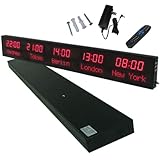
- 【GLOBAL MULTI-TIME ZONE DISPLAY】High-definition LED World Clock simultaneously showcases time across 5 countries/cities with intelligent time zone switching (customizable city+time layouts). Ideal for transnational operations and cross-time-zone collaboration.
- 【DUAL-MODE FLEXIBLE INSTALLATION】Innovative wall-mount + floating design. Aerospace-grade aluminum alloy frame with steel cable suspension system creates modern minimalist wall art or sci-fi inspired levitating time display.
- 【SMART WIFI AUTO-SYNC】Self-calibrating system syncs global clocks via primary city setting. Supports 99-minute custom rotation intervals. Zero manual adjustment ensures punctuality for international conferences.
- 【ULTRA-CLEAR ADAPTIVE DISPLAY】1000cd/m² high-brightness LEDs with 140° wide viewing angle remain legible beyond 15m. Auto-dimming light sensor adapts to environments – perfect for conference halls/airports/schools 24/7.
- 【INDUSTRIAL-GRADE DURABILITY】Aerospace-grade aluminum construction with 20W low-power operation. IP54-rated protection enables stable 24/7 performance. Transforms corporate HQs to boutique hotels into functional art installations.
The IANA time-zone database records historical and current rules for locations. Its guide explains that daylight-saving adjustments are commonly zero or one hour, but the SAVE value can in principle be something else. That is why adding or subtracting a memorized hour is not a dependable general method.
Location names are safer than abbreviations
Use an IANA-style location identifier, or choose a city from the converter’s location list. IANA states: “Alphabetic time zone abbreviations should not be used as unique identifiers for UT offsets as they are ambiguous in practice.” Its example is CST, which can describe different offsets in North America and China. A city-based selection carries the regional rules needed for the specific date.
Government decisions can change future results
Time-zone law is set by governments. IANA periodically revises its database when governments change boundaries or daylight-saving policy. There is no fixed release timetable, although releases typically occur every few months. Phone, computer and calendar vendors must then integrate and distribute those changes, and some older devices may never receive every update.
For a race several months or years away, regard the displayed conversion as provisional. Recheck it near race day, especially if the event is in a location that has recently changed its time-zone rules.
Step-by-step: convert a race start time to your local time
- Open the official schedule. Prefer the organizer, sanctioning body or venue schedule over an unsourced repost. Find the actual race start, not a preceding briefing, parade, qualifying session or broadcast pre-show.
- Copy the full source date and time. Include the year and preserve the event’s original time notation. If the page lists several sessions, identify the one labeled as the race start.
- Identify the source zone. Check the schedule header, footnote, venue information and event FAQ. Confirm whether the time is venue-local or an event-wide/broadcast time. If the page names a city but separately states a schedule zone, use the stated schedule zone.
- Choose your destination location. Select your city or a named location zone such as
America/New_York. Avoid entering a bare UTC offset when the tool offers a location choice, because the location preserves the rules for that date. - Enter the event date before reading the result. A date-aware converter should have fields for the source date, source time, source location and destination location. Submit the complete set together.
- Record both outputs. Write down the destination clock time and destination calendar date. If the result says the next day or previous day, keep that date in your reminder, calendar entry and viewing plan.
- Check the conversion again near the event. Revisit the official schedule and your converter close to race day. This catches schedule revisions and time-zone database updates that may not have reached every device at the same time.
How to choose a time-zone converter or calendar
IANA lists world-clock and time-zone-converter services as tools for converting between locations. It does not rank individual services in the guidance used here, so evaluate the tool by what it accepts and displays rather than by a brand name.
Rank #2

- Atomic Wall Clock Never Need Setting: Atomic clock has a built-in receiver that automatically synchronizes itself with the WWVB radio broadcast by the US Government's National Institute (NIST) in Fort Collins, Colorado. The Atomic Clock will always be accurate to within one second as it receives daily WWVB updates. (No Backlight)
- Atomic Clock with Indoor/Outdoor Temp: The Wireless outdoor sensor transmits the outdoor temperature to the atomic clock. The sensor should be placed within 100ft of the clock. Also, clock has a built-in high-quality indoor temperature sensor so that you can read the temperature both indoor and outdoor
- Digital Wall Clock Large Display: Jumbo 2.5 inch Height Time Digital Display - Use as either a wall clock or as a desk clock, it is easy to read, easy to Use and easy to set up. This atomic clock has been designed with absolute simplicity in mind, you can also set it manually. Excellent clocks for seniors, suitable for anyplace in your home or office
- Atomic Clock Digital: 12/24 Hour time formats with accurate and clear second minute and hour display; 4 time zone to choose (PST, MST, CST, EST); auto daylight saving time; temperature display units in Celsius or Fahrenheit
- Digital Wall Clock Battery Operated: Both clock and outdoor sensor are supported by batteries only, no need to plug or charge (Batteries not included). The existed alarm features can wake you up in the morning or help you keep track of dates and days of the week to avoid missing any important meetings or appointments
| Capability | What to verify | Why it matters for a race |
|---|---|---|
| Named source location | The tool lets you select a city or location-based zone, not only an abbreviation. | It prevents an ambiguous label such as CST from being interpreted for the wrong region. |
| Named destination location | Your city or an IANA-style identifier can be selected. | The destination’s date-specific daylight-saving rules are applied. |
| Event date input | The date is entered alongside the clock time. | The offset can differ by season and by year. |
| Destination date output | The result shows a local calendar date as well as a local clock time. | You can see whether the start falls on the previous or next day at home. |
| Current time-zone data | The service or calendar is maintained and your device receives updates. | Recent legal changes may not be reflected in stale software. |
For a one-off check, an online converter is usually enough. For a season of races, enter each start as a date-specific calendar event and retain the source zone in the event notes. A calendar can then show the local date and time while leaving the original schedule details available for verification.
Read the result as a local date, not just a clock number
The most common practical mistake is copying the converted hour while discarding the date. A start late in the source zone’s evening can become an early-morning start on the following local day. A start near midnight can also appear on the previous local day for a destination farther west.
Free tools Windows power users keep installed
One-click scans. No signup required.
When you save the result, use a format that includes all three components: local date, local time and destination zone. For example, your note should identify the day shown by the converter, not merely say “8:00.” If you share the time with friends in another region, include the source date and zone so they can perform their own check rather than assuming your local date applies to them.
Also distinguish the start you intend to watch from related schedule entries. A listing may contain a ceremonial launch, support race, formation lap, live broadcast and competitive start. Convert the entry that answers the reader’s actual question: when does the race begin?
Why manual arithmetic can fail
Offsets are date-dependent
Manual conversion works only when you already know the correct source and destination offsets for that exact date. Looking up today’s offset and applying it to a summer or winter race can produce the wrong answer.
Rank #3
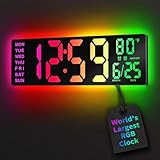
- 16.5 Inch Display: With its large 16.5 in screen, this RGB digital wall clock makes checking the time effortless from anywhere in the room. The large numbers are easy to read from any angle and distance, especially user friendly for the elderly
- RGB Dynamic Ambient Light: Choose from eleven eye-catching RGB colors and adjust the brightness to perfectly suit your mood and room. EASYERA digital wall clock turn your gaming room into an immersive haven and helping you unwind
- BT Auto Synct: Daily phone connection ensures accurate time, hands-free and hassle-free
- Do both for Wall Mounted and Desktop: Our digital wall clock can be easily mounted on the wall or placed on a desk.Whether you're looking to save space or add a stylish touch to your desk, this feature provides flexibility and convenience
- Auto DST Adjustment: Enjoy hassle-free timekeeping with automatic Daylight Saving Time (DST) adjustment, ensuring you're always on time
Transitions are not always a simple one-hour jump
IANA’s guide notes that a daylight-saving rule’s SAVE amount is usually zero or one hour but can, in principle, take other values. It also explains that a transition can be expressed in standard time, UTC or local wall-clock time. A simplistic “add one hour after this date” calculation can therefore misread the transition boundary, especially when a start is scheduled close to the change.
Fixed UTC offsets discard location rules
An offset such as UTC−05:00 describes a numerical difference at one moment; it does not identify the legal and daylight-saving history of a place. If a converter offers both a fixed offset and a city, choose the city for a real race location. Use a fixed offset only when the organizer explicitly defines the event that way and you understand that it is not a location rule.
What to do when the schedule is unclear
The listing uses only an abbreviation
Search the same official page for a legend, city name or statement such as “all times Eastern.” Check whether the organizer publishes a full time-zone name elsewhere in the event information. If the intended region is still unclear, ask the organizer which location or offset the abbreviation denotes. Do not choose an interpretation based on your own country or on the race venue alone.
The city and stated zone appear inconsistent
Some event pages use a venue city for logistics but publish one event-wide schedule zone for broadcasters and international participants. Compare the schedule header, footnotes and broadcast information. The stated source zone for the particular start takes precedence over an assumption about the city’s current local zone.
There are several “start” times
Separate the competitive start from opening ceremonies, warm-up sessions, support races and television coverage. If the page does not label the intended start, contact the organizer rather than converting every entry and guessing which one matters.
Quick wins for a faster PC:
Repair Windows errors before they cause bigger problemsFix Now →Scan for outdated or missing drivers - takes under a minuteDriver Scan →Rank #4
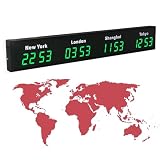
- 【Clear & Accurate Multiple Time Zones Clock】: This Multiple Time Zones Clock delivers precise time display for 3-5 global time zones, with each zone’s time shown independently and synchronized in seconds. The dot-matrix city name display lets you easily identify each time zone
- 【Wall Mounted LED Digital Multiple Time Zones Clock】: Our Wall Mounted LED Digital Multiple Time Zones Clock features high brightness, allowing you to set the perfect visibility for day or night use
- 【Easy Setup & Remote Control Operation】: Unlike complicated world clocks, this World Time Zones Clock comes with a remote control, making it easy to adjust time, and switch display modes
- 【Stylish Cities World Time Wall Clock】: This Cities World Time Wall Clock boasts an all-aluminum shell with an exquisite, sleek design that adds a touch of sophistication to any space. The digital static display ensures reliable performance, long service life
- 【Versatile Installation】: Choose between wall mounting or suspension for flexible placement—wall mounting creates a stylish wall feature, while suspension gives a floating illusion. It’s perfect for large family rooms, offices, multinational corporations
The date is missing or uses a local shorthand
Request the full calendar date, including year, and the zone used for that date. A phrase such as “Sunday night” can become Monday morning in another location, so it is not sufficient for an international audience.
Future races, database updates and last-minute checks
Long-range schedules are useful for planning but are not permanent time-zone contracts. IANA updates its database in response to political changes, and the release date is not synchronized with operating-system, browser or calendar updates. A converter can therefore disagree with an older device even when both are functioning normally.
Use a two-stage check:
- Planning check: Convert the announced date and time when you first add the race to your calendar.
- Race-week check: Reopen the official schedule and a current converter shortly before the event. Confirm that the source zone, start time and destination date still match your saved reminder.
If the event is far in the future and the relevant government has announced a possible rule change, treat any early result as an estimate until the change is reflected in current software. Older phones, computers and embedded devices may need operating-system updates before they display the revised rule.
Independent reader supportYour contribution helps us test, update, and keep practical guides available for everyone.Race-time conversion checklist
- Have you copied the complete date, including year?
- Is the time the competitive race start rather than a ceremony, warm-up or broadcast segment?
- Does the schedule state a source city or named time zone?
- Have you avoided interpreting an abbreviation such as CST without confirmation?
- Did you select your destination by city or location-based identifier?
- Did the converter accept the event date as well as the clock time?
- Did you record the destination calendar date as well as the hour and minute?
- Could a recent legal change or an outdated device database affect this far-future conversion?
- Have you checked the official schedule again near race day?
Common failure cases and fixes
The result is one hour different from another source
First compare the event date and the source zone, not just the displayed hour. One tool may be applying a current location rule while another uses a fixed offset or stale time-zone data. Verify that both tools selected the same city and that neither interpreted an abbreviation differently.
The Tool Desk
Outbyte PC Repair FREEClear out junk files and repair common Windows errorsFree Scan →Outbyte Driver Updater FREEScan for outdated or missing drivers - takes under a minuteDriver Scan →The date differs by one day
This is often a legitimate midnight crossing. Check the destination date shown by the date-aware converter and keep that date in your calendar. Do not “correct” it merely because the organizer’s page shows a different source-zone date.
Best Value

- 【5 Cities at a Glance】Display the current time of five cities or time zones simultaneously on one large LED screen. Ideal for international teams, multinational businesses and workplaces that coordinate operations across different regions.
- 【Customizable World Time Zones】Choose the cities or time zones relevant to your organization and create a dedicated global time display for international offices, hotel lobbies, reception areas, trading rooms and corporate environments.
- 【Large LED Display with 3 Brightness Levels】High-contrast LED digits provide clear long-distance visibility. Three adjustable brightness levels allow the display to remain easy to read in different indoor lighting conditions.
- 【Durable All-Aluminum Housing】Built with an aluminum alloy enclosure for a professional appearance, durability and corrosion resistance. Remote-control operation makes daily setup and adjustment convenient.
- 【Wall Mount or Suspended Installation】Supports both wall-mounted and suspended installation for flexible placement in offices, hotels and public spaces. A practical world time display for multinational enterprises, international departments and global business operations.
Your phone and computer disagree
Check each device’s operating-system time-zone data and update status. Vendors distribute IANA changes on their own schedules, so two devices can temporarily carry different rule versions. Until they agree, use a current converter and confirm against the official schedule.
The organizer changes the start time
Repeat the conversion with the revised date and time. Do not shift the old local reminder by the same number of minutes unless the source date, source zone and destination rules are unchanged; a rescheduled event can cross midnight or a daylight-saving transition.
A dependable habit for every race
Keep the original schedule information with your local reminder: source date, source clock time, source zone, destination location and converted local date/time. That record makes later corrections easy and prevents a shared message from losing its time-zone context.
Do these 3 things before closing this tab:
1Scan for outdated or missing drivers - takes under a minute2Clear out junk files and repair common Windows errors3Fix the driver behind crashes, sound loss and screen glitchesThe safest answer to “what time is the race in my time zone?” is therefore a date-aware conversion based on two named locations, followed by a race-week confirmation. When the organizer supplies an ambiguous abbreviation or omits the zone, clarification is more reliable than arithmetic.
Quick Recap
Product prices and availability are accurate as of the date/time indicated and are subject to change. Any price and availability information displayed on Amazon at the time of purchase will apply.

