
Recommended Free Tools
iTechGuides is reader-supported. When you buy through links on our site, we may earn an affiliate commission. As an Amazon Associate I earn from qualifying purchases. Learn more
Choose warehouse automation by fixing a measured bottleneck, not by buying the most advanced equipment. Map your warehouse, quantify errors and labor, improve transaction capture with barcodes and location labels, and then decide whether a warehouse management system (WMS) or physical automation earns its cost. A small operation with few stock-keeping units (SKUs) and rare errors may need only a capable ERP inventory module plus scanning. A WMS becomes sensible when the cost of inaccurate stock, rework, manual counts, and missing location visibility exceeds the software and rollout cost. Conveyors and robotics should come later, tied to a specific, repeatedly measured constraint.
What “warehouse automation” means at small-business scale
Warehouse automation is a range of tools rather than one product. It includes data-capture tools such as barcode scanners and thermal printers, software that directs warehouse work, and physical equipment that moves goods. Selecting the right level matters because complexity creates its own costs: training, integration work, maintenance, exception handling, and dependence on reliable data.
ERP inventory versus a WMS
An ERP inventory module generally records how much stock the business owns and what that stock is worth. A WMS adds floor-level control: it records the location of inventory, directs receiving and putaway, assigns replenishment and picking tasks, and confirms movement through scans. The systems normally work together. The ERP remains the financial and order authority while the WMS manages execution inside the warehouse.
A WMS typically directs and records receiving, putaway, replenishment, picking, packing, shipping, and cycle counting. Its value is not simply a larger item list; it is controlled work at the location and task level. If your team can find every item quickly, rarely mis-picks, and keeps the ERP accurate without excessive counting, a full WMS may add cost without solving a real problem.
#1 Best Overall

- Continuous Usage All Day: The EY-H2 USB barcode scanner is designed to always be ready for the next scan, which significantly reduces downtime and repair costs; it shortens checkout lines, improves customer service, and boosts business productivity
- Plug and Play: Eyoyo wired barcode scanner is connected via a USB cable, with no need to install any driver or software; It offers effortless connection and is compatible with Windows, Mac, Android, and Linux; Seamlessly works with Quickbook, Word, Excel, Novell, and all common software
- Supports Multiple 1D/2D Barcodes: Eyoyo QR code scanner scan with most 1D 2D barcodes with ease; 1D Barcodes: EAN, UPC, Code 39, Code 93, Code 128, UCC/EAN 128, Codabar, Interleaved 2 of 5, ITF-6, ITF-14, ISBN, ISSN, MSI-Plessey, GS1 Databar, Code 11, Industrial 25, Matrix 2 of 5, etc. 2D Barcodes: QR, DataMatrix, PDF417, and so on
- Supports Screen Scanning: The Eyoyo 2D scanner is capable of reading barcodes from smartphone screens, such as mobile coupons, digital wallets, and digital loyalty cards; Before scanning, simply turn your screen brightness to the maximum
- Sturdy Anti-Shock and Durable Design: The Eyoyo 2D barcode scanner features an ergonomic design made of high-quality ABS, enabling it to withstand repeated drops from 5 ft/1.5 m high onto the concrete ground; The durable plastic material ensures a long service life
Software automation versus physical automation
Scanning and workflow software automate decisions and transaction capture. Conveyors, sorters, autonomous mobile robots, and robotic picking automate movement or handling. Physical systems require suitable building layouts, safety controls, maintenance capability, and enough consistent volume to justify their fixed cost. The sources used for this guide do not establish a universal order-volume threshold at which robotics becomes worthwhile; the answer depends on your process, product mix, labor market, and peak pattern.
Begin with a measured process map
Do not start with a feature list. Spend several operating days documenting how an order actually moves and where information is lost. Include normal work and exceptions such as partial receipts, damaged cartons, substitutions, backorders, returns, and urgent orders.
- Receiving: Record appointment, unloading, inspection, identification, quantity verification, and the point at which stock becomes available to sell.
- Putaway and storage: Document how a location is selected, labeled, and confirmed. Note overflow locations and inventory that sits in staging.
- Replenishment: Record how forward pick locations are refilled, who notices shortages, and whether replenishment competes with picking.
- Picking: Measure travel, queueing, batching, substitutions, mis-picks, and the information workers use to find stock.
- Packing and shipping: Capture verification, carton selection, carrier choice, label creation, and handoff timing.
- Counting and adjustments: Identify who performs cycle counts, how variances are investigated, and how corrections enter the ERP.
For each step, mark duplicate data entry, handwritten notes, delays, unavailable locations, and decisions that depend on one experienced employee. These observations become requirements later. They also prevent buying automation for a symptom—for example, adding a conveyor when the real delay is an unconfirmed receiving transaction.
Do these 3 things before closing this tab:
1Fix the driver behind crashes, sound loss and screen glitches2Clear out junk files and repair common Windows errors3Scan for outdated or missing drivers - takes under a minuteSet a baseline before calculating a return
Use your own records rather than a vendor’s promised percentage improvement. Establish a baseline for at least several representative weeks, including a busy period if one exists.
- Inventory accuracy: Compare physical counts with system quantities by SKU and location.
- Pick accuracy: Track mis-picks per order line and the cost of reshipping, credits, and customer service.
- Receiving time: Measure labor hours from dock arrival to available inventory.
- Pick and count labor: Record hours per order and hours spent on scheduled or emergency counts.
- Order volume and profile: Separate average days from peaks; include lines per order, SKU velocity, and order cut-off commitments.
- Space and location use: Count active, reserve, overflow, and blocked locations.
- Service outcomes: Track late shipments, backorders caused by incorrect records, and return reasons linked to fulfillment.
Translate each problem into an annual cost. For example, multiply mis-picks by the average correction cost, or multiply avoidable counting hours by the loaded labor rate. Include supervisor time, expedited freight, write-offs, and lost sales where you can document them. A business case based only on labor reduction can miss the value of fewer errors and better customer commitments; a case based only on a supplier’s ROI claim is not reliable.
Does a small distributor need a WMS?
There is no size rule that answers this question. A small distributor with few SKUs, stable storage, low order volume, and rare discrepancies may operate well with its ERP, disciplined location labels, and barcode scanning. A WMS is more compelling when the measured burden of errors, labor, and lost visibility is larger than the software, integration, training, and transition costs.
Rank #2

- Plug and play, This laser handheld barcode scanner has simple installation with any USB port and Ideal for businesses, shops and warehouse operations. Its function is unbeatable and easy to use, design is stylish
- Compatible with Windows, Mac, and Linux; works with Word, Excel, Novell, and all common software
- Scanning Speed: 200 scans per second. Scanning angle: Inclination angle 55°, Elevation angle 65°. Operational Light Source:Visible Laser 650-670nm.
- Decode Capability: Code11, Code39, Code93, Code32, Code128, Coda Bar, UPC-A, UPC-E, EAN-8, EAN-13, ISBN/ISSN, JAN.EAN/UPC Add-on2/5 MSI/Plessey, Telepen and China Postal Code,Interleaved 2 of 5, Industrial 2 of 5, Matrix 2 of 5, etc ; 300 configurable options for prefix, suffix and termination strings, support turn on/off the beep.
- Color: Black. Dimensions: 3.6 x 2.6 x 6.1 inches. Type of Cable: 2M or 6ft straight cable. Shock: 1.5m drop on concrete surface. Regulatory Approvals: FCC CE.
Signals that your current system may be enough
- Most items have fixed, easily remembered locations.
- Receipts and shipments are entered once, promptly, and accurately.
- Cycle counts find few variances and do not consume disproportionate labor.
- Order growth can be handled by adding staff without losing service levels.
- Your ERP and sales channels already expose the inventory detail customers need.
Signals that a WMS deserves a business case
- Workers regularly search for stock or use unofficial spreadsheets to locate it.
- The same inventory is entered in several systems, creating timing or quantity differences.
- Mis-picks, short shipments, and emergency corrections are material costs.
- Multiple storage areas, overflow locations, lots, serial numbers, or expiration dates make manual control unreliable.
- Supervisors spend substantial time assigning work, checking progress, or reconciling counts.
- Growth, a new facility, or third-party logistics work will make today’s informal knowledge difficult to scale.
Ahearn & Soper summarizes the economic test this way in its guide for Canadian distributors and 3PLs, last reviewed October 1, 2026: “A WMS starts to pay when errors, labour and lost visibility cost more than the system.” The wording and spelling reflect that guide’s Canadian audience; labor costs, tax treatment, labeling rules, and data requirements should be evaluated for your own jurisdiction.
Free tools Windows power users keep installed
One-click scans. No signup required.
Use barcode scanning as the first automation layer
Scanning can improve accuracy without the scope of a full WMS. Label each storage location with a unique, readable identifier and scan receipts, moves, picks, and shipments at the point of work. The software must make the scan meaningful: it should validate the SKU and location, reject an invalid move, and post the transaction to the system that holds inventory truth.
Starter equipment and compatibility checks
For regular warehouse use, a dedicated handheld barcode scanner is a defensible, model-neutral starting category. ReadySpaces gives an illustrative price of $200–$500 per dedicated handheld scanner; the page does not state a publication year and was accessed October 13, 2026. That is a publisher-provided range, not a quote or market average. Confirm the scanner’s supported symbologies, wireless range, battery life, drop resistance, glove usability, and compatibility with your inventory application before buying.
A desktop thermal printer is useful for location and product labels. ReadySpaces gives an illustrative $150–$400 range, with the same no-year-stated qualification. Verify label size, ribbon or direct-thermal requirements, print volume, network connection, and whether the software can generate the exact barcode format you need.
ReadySpaces describes a $500–$2,000 barcode-scanning investment with a stated typical payback of three to six months. Treat both figures as that publisher’s illustration, not a forecast. Calculate your own return from reduced corrections, count time, and receiving labor, and include replacement devices, labels, charging equipment, setup, and training.
When scanning will not solve the problem
Scanning cannot correct an inaccurate item master, unlabeled locations, poor receiving discipline, or a process that allows workers to bypass confirmation. If a scan is captured but not synchronized with the ERP or order channel, the warehouse may appear automated while availability remains wrong. Pilot one receiving-to-shipping path, audit every exception, and make the scan the easiest way to complete the task.
Rank #3

- 【Battery Level Indicator and 2200mAh Capacity】Larger battery enables longer continuous usage and twice the stand-by time of others. With the unique battery indicator light showing the remaining battery level, no more Low Battery Anxiety.
- 【Ergonomic Design】 The curved handle is extended and thickened, tailor-made for North America customers. Specially designed smooth and flat trigger for better grip. 【Package Includes】Barcode Scanner x1, USB Cable x1, Dongle x1, User Manual x1.
- 【Anti-Shock Silicone】 The orange anti-shock silicone protective cover can avoid scratches and friction while falling from the height of 6.56 feet. IP54 technology protects the wireless barcode scanner from dust.
- 【2.4 GHz Wireless plus USB 2.0 Wired Connection】 Plug and play with the USB receiver or the USB cable, no driver installation needed. Easy and quick to set up. Wireless transmission distance reaches up to 328 ft. in barrier free environment.
- 【Digital and Printed 1D 2D QR Bar Code Symbologies】1D: Codabar, Code 11, Code93, MSI, Code 128, UCC/EAN-128, Code 39, EAN-8, EAN-13, UPC-A, ISBN, Industrial 25, Interleaved 25, Standard25, Matrix 2D: QR, DataMatrix, Aztec, Hanxin, Micro PDF417. (Note: Not compatible with Square.)
Define the WMS capabilities you actually require
Write requirements from your process map. Separate “must work on day one” from “useful later,” and avoid paying for modules that do not address a measured need.
Core workflow requirements
- Receiving against purchase orders, advance notices, or blind receipts, including shortages and damage.
- Directed putaway with location rules for size, velocity, hazard, temperature, lot, serial, or expiration constraints that apply to your goods.
- Replenishment triggers and tasks for forward pick locations.
- Pick methods suited to your order profile, such as single-order, batch, zone, or wave picking.
- Packing verification, cartonization rules where needed, and carrier-label handoff.
- Cycle counting by location, SKU, risk, or variance, with an approval trail for adjustments.
- Role-based permissions, audit history, and operational dashboards that supervisors will use.
Integration requirements
List every system that must exchange data: ERP, e-commerce storefronts, accounting, carriers, marketplaces, and any planned conveyor or robotics controller. Specify direction and timing for each message—orders, inventory availability, receipts, shipment confirmations, tracking numbers, cancellations, and returns. Ask whether integration is a maintained connector, an application programming interface, a file exchange, or custom work. The implementation plan should identify ownership, error handling, retry behavior, and reconciliation reports.
Hardware and user fit
Confirm support for the scanners, printers, mobile devices, network coverage, and operating environment you actually have. Test gloves, cold areas, reflective packaging, small barcodes, and damaged labels if those conditions occur. A technically capable system that workers cannot use quickly will produce workarounds and poor data.
Cloud or on-premise: choose an ownership model
Cloud and on-premise deployments can both support a small warehouse. The trade-off is where responsibility, cost, and control sit.
| Decision area | Cloud deployment | On-premise deployment |
|---|---|---|
| Infrastructure | The provider supplies and maintains hosted servers. | Your business supplies and maintains servers, networks, and related facilities. |
| Updates | The provider generally manages releases; confirm timing, testing, and rollback options. | Your team controls release timing but must plan, test, and execute updates. |
| Connectivity | Requires reliable internet or the provider’s documented offline mode. | Can continue on a local network during an internet outage, but local systems still need power and network availability. |
| Security and backups | Provider controls much of the platform; verify data location, retention, access controls, and export procedures. | Your business owns security configuration, backups, monitoring, and recovery testing. |
| Internal IT burden | Usually lower server administration, with ongoing vendor and connectivity dependence. | Higher internal responsibility for hardware, security, backups, patches, and specialist skills. |
| Cost pattern | Recurring subscription and service fees, plus implementation and integrations. | Up-front equipment and licenses, plus continuing maintenance, support, and upgrade costs. |
Compare a multi-year total, not a monthly subscription against a license alone. Include integration, migration, training, support, network upgrades, scanners, printers, downtime during transition, and the cost of replacing or retaining existing systems. Ask where data is stored and how you will retrieve it if the contract ends. A cloud system is not automatically simpler, and on-premise is not automatically cheaper.
Compare vendors with your real work
Invite a shortlist to demonstrate the same scenarios so that differences are visible. Supply sample SKUs, locations, orders, and exception cases under a confidentiality arrangement if necessary.
Rank #4

- CCD Image Scanning Technology - NetumScan 1D barcode reader is equiped with advanced CCD sensor, which can quick capture 1D codes from paper and screen, including CODE128, UPC/EAN Add on 2 or 5, that can read even deformed barcodes, i.e. smudged, damaged, fuzzy, reflective barcodes, etc. Reading faster and more accurate than laser scanner.
- Sturdy Anti-shock and Durable Design - Ergonomic design with high-quality ABS making it can support withstand repeated drops from 2m high to the concrete ground, durable to use. Durable plastic material guarantees long service life.
- Three scanning mode - Key trigger mode + Auto-induction mode + Continuous Mode. There is no need to pull the trigger in auto-sensing mode and continuous scanning. Sometimes the self-sensing scanning function is in the inactive stage, please contact us and be at your service at any time.
- Supported 1D Bar Code - 1D Decode Capability: UPC-A, UPC-E, EAN-8, EAN-13, ISSN, ISBN, Code 128, GS1-128, Code39, Code93,Code32, Code11, UCC/EAN128, Interleaved 2 of 5, Industrial 2 of 5, Codabar(NW-7), MSI, Plessey, RSS, China Post, etc.
- Widely Use Range - This NetumScan Handheld USB barcode scanner can be used in supermarkets, convenience stores, warehouse, library, bookstore, drugstore, retail shop for file management, inventory tracking and POS(point of sale), etc.
- Show the happy path: receive a purchase order, put stock away, replenish a pick face, pick, pack, ship, and post the result to the ERP.
- Show exceptions: partial receipt, overage, damaged unit, unknown barcode, empty location, short pick, substitution, cancellation after release, return, and cycle-count variance.
- Show a peak: process a realistic batch or wave while several users work concurrently. Ask how priorities and urgent orders are handled.
- Show failure recovery: disconnect a device, lose network access, duplicate a message, or reject a carrier label. Identify what is queued, what is rolled back, and how staff reconcile it.
- Inspect administration: create a location, change a role, add a printer, correct an item, and produce an audit report without vendor intervention.
Score each system against workflow fit, integration effort, hardware support, implementation method, training, references from businesses of similar size and complexity, data location, security, and ability to scale. Ask for a written statement of what is included, what requires customization, and who owns each integration. References should describe a comparable operation rather than a much larger showcase site.
The Tool Desk
Outbyte Driver Updater FREEFix the driver behind crashes, sound loss and screen glitchesFind Drivers →Outbyte PC Repair FREEClear out junk files and repair common Windows errorsFree Scan →Price the complete project
ReadySpaces gives an illustrative $5,000–$50,000 range for WMS implementation and states a typical payback of 12–24 months. The page does not state a publication year, and the figures are not a quote or independently verified market average. Scope can vary dramatically with locations, users, integrations, data cleanup, hardware, and process redesign. Obtain current local proposals and calculate the return from your baseline.
Your cost model should include:
- Subscription or license fees over the evaluation period.
- Implementation, configuration, integration, and testing.
- Data cleanup and migration, including SKU, unit-of-measure, location, and customer data.
- Scanners, printers, labels, charging stations, wireless improvements, and spare equipment.
- Training, temporary productivity loss, travel, and project management.
- Support, premium response options, upgrades, and ongoing administration.
- Decommissioning or parallel operation of legacy tools.
Use a conservative scenario, a likely scenario, and a downside scenario. If the project only pays back when every promised efficiency occurs, the risk is high. Set a review date after implementation and compare actual accuracy, labor, and service measures with the baseline.
Independent reader supportYour contribution helps us test, update, and keep practical guides available for everyone.Add conveyors or robotics only for a proven bottleneck
Physical automation should follow stable master data, labeled locations, reliable scans, and a documented workflow. Identify the constraint in measurable terms: for example, travel consumes a defined share of pick labor during a repeatable peak, or a sortation step creates a documented queue. Then test whether layout changes, slotting, batch rules, staffing, or better replenishment solve it more cheaply.
For any conveyor or robot proposal, document throughput, operating hours, product dimensions and weights, exception rates, safety zones, maintenance response, spare parts, and integration with the WMS. Model peak and off-peak utilization; equipment that is busy only a few hours a week may have a poor return. Confirm how workers handle damaged goods, irregular cartons, returns, and an equipment outage. The correct sequence and investment depend on the operation, and no universal volume cutoff is established by the available evidence.
A staged implementation plan
- Stabilize data: standardize SKU identifiers, units of measure, locations, and status codes. Remove duplicate items and document ownership of master data.
- Label and scan: label every active location, deploy compatible scanners and printers, and enforce scan confirmation for receiving, moves, picks, and shipping.
- Pilot one zone: choose a representative area, train a small group, and measure accuracy and time against the baseline.
- Integrate and reconcile: test order, inventory, receipt, shipment, return, and cancellation messages end to end. Reconcile totals before expanding.
- Roll out by risk: add zones, shifts, and users in controlled waves. Keep a documented fallback for outages and unresolved exceptions.
- Optimize: use actual data to adjust slotting, replenishment thresholds, pick methods, and staffing. Only then revisit physical automation.
Common failure modes and fixes
Buying features before defining the problem
Symptom: a long feature checklist but no agreed baseline or success measure. Fix: tie every requirement to a mapped task, a measured cost, or a compliance need; defer attractive extras.
Best Value
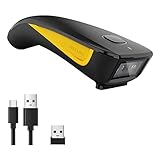
- 3-in-1 Connection Design: Bluetooth Connection: Support HID / SPP / BLE mode, Easily connected with your laptop, PC, mobile phone, tablet, iphone, ipad, POS. the transmission distance in the obstacles environment is about 10m / 33ft. 2.4G Wireless Connection: Support RF DONGLE HID-KBW and RF DONGLE AS VIRTUAL COM mode, Connect the scanner to your device via the USB dongle, Work with Windows XP/7/8/10, Mac OS, linux. the tansmission in the environment without any obstacles can reach up to 100m / 330ft. USB Connection: Support USB HID-KBW and USB COM Port Emulation mode, Connect the scanner to your device via the USB cable. In wired mode, user can scan barcode while charging
- 3 Trigger Modes Key Trigger Mode: Scanning light is only on when press the trigger. Continuous Scan Mode: Scanning light is always on when the scanner is electrified. Scanning barcode without pressing any button. Auto-induction mode: Scanning light is off until a barcode presented in front of the scanner. Once the barcode is detected, the scanning light will turn on automatically to read the barcode.
- Superior Scanning Performance Fast global shutter technology with auto exposure: Equipped with its CMOS sensor the device has a motion tolerance of 24 inches per second, offering fast and accurate scanning results. The 2D scanning engine offers decoding capability for 2D barcodes like PDF417, Data Matrix, QR Code, MicroQR as well as common 1D barcodes.
- Portable Pocket Size Design: Weighing at less than 3 ounces, the NETUM C850 is extremely light weight and portable, making it easily a convenient scanning solution wherever you go
- Manual Scan & Auto-sensing Scan & Continuous Scan. 1200mAh battery ensures 20 hours of continuous handsfree scanning, no pressing the button for efficiency.
Underestimating integration and data cleanup
Symptom: demonstrations work, but item units, locations, or order statuses do not reconcile in production. Fix: test real files and exception messages early, assign data owners, and budget migration and parallel validation.
Ignoring adoption and equipment conditions
Symptom: workers revert to paper or shared spreadsheets. Fix: observe the work environment, test devices with gloves and actual packaging, simplify screens, train by task, and monitor bypasses.
Assuming cloud removes continuity risk
Symptom: picking stops during a connectivity outage. Fix: document offline behavior, local contingency procedures, recovery-time expectations, and how queued transactions are reconciled.
Automating an unstable process
Symptom: a conveyor or robot magnifies misidentified products and blocked locations. Fix: stabilize labels, master data, scan discipline, and exception handling before mechanizing movement.
Decision checklist
- Have you mapped receiving through counting, including exceptions?
- Do you have baseline accuracy, labor, volume, and service measures?
- Can barcodes and location labels solve the immediate visibility problem?
- Is the WMS case based on your documented costs rather than a generic ROI claim?
- Are ERP, e-commerce, accounting, carrier, and automation interfaces specified?
- Have cloud and on-premise options been compared over multiple years?
- Did vendors demonstrate your data, peak workload, and failure scenarios?
- Are training, migration, hardware, support, security, and recovery funded?
- Is any physical automation tied to a measured bottleneck and a realistic utilization model?
The practical choice is usually the least complex layer that removes the largest measured constraint. For some businesses that is disciplined ERP use with scanning; for others it is a WMS that controls locations and tasks. Conveyors and robotics are justified only when the underlying process is stable and the bottleneck, cost, and expected return are specific enough to defend.
Quick Recap
Product prices and availability are accurate as of the date/time indicated and are subject to change. Any price and availability information displayed on Amazon at the time of purchase will apply.

