
iTechGuides is reader-supported. When you buy through links on our site, we may earn an affiliate commission. As an Amazon Associate I earn from qualifying purchases. Learn more
There is no single kettlebell weight that suits every person or every exercise. Choose a bell by the movement you will perform, your current strength-training experience, and whether you can control every repetition with sound technique. A weight that works for a two-handed hinge or goblet squat may be too heavy for an overhead press.
Start with a manageable load, learn the movement, and increase difficulty gradually. Traditional figures such as 18 pounds for women and 35 pounds for men are orientation points cited by the American Council on Exercise (ACE), not universal prescriptions; ACE advises beginners to use a lighter bell when necessary to develop correct technique (ACE guidance).
The short answer
Pick the lightest kettlebell that lets you perform the intended exercise through its full range of motion while maintaining control, posture, breathing and a consistent path. If your workout includes both lower- and upper-body movements, select the load for each movement separately rather than forcing one bell to do everything.
Recommended Free Tools
- For a new movement, prioritize learning and repeatable technique over load.
- For a press or other single-arm overhead exercise, you will usually need less weight than for a squat, deadlift pattern or two-handed swing.
- When the current load becomes comfortable, progress by adding repetitions or sets, changing tempo or rest, choosing a harder variation, or eventually moving to a heavier bell.
- Stop a set when technique changes. A chart should never be permission to use a load you cannot control.
Why one “correct” kettlebell weight does not exist
Kettlebells are used for movements with very different strength and stability demands. The same person can be ready for a heavier goblet squat than for a half-kneeling press. NASM specifically notes that a trainee may perform fewer repetitions in a half-kneeling press than in a goblet squat with the same bell (NASM exercise guidance).
#1 Best Overall

- VERSATILE STRENGTH TRAINING: Supports a wide range of resistance exercises for full-body workouts.
- SHIPMENT CONTAINS: Single 40-pound cast iron kettlebell designed for building strength and endurance
- DURABLE CONSTRUCTION: Made of solid cast iron for reliable, built-to-last strength through intense training sessions
- COMFORTABLE GRIP: Textured wide handle ensures a secure, comfortable grip whether holding with one hand or two hands
- COMPACT DIMENSIONS: Measures 8.5 x 5.5 x 9.8 inches (LxWxH) for easy storage in home gyms or workout spaces
Your starting point also depends on experience. Someone who regularly strength-trains may control a load that is inappropriate for a person learning both the exercise and the kettlebell’s offset center of mass. Body size alone does not reveal pressing strength, grip endurance, balance or familiarity with ballistic movements.
ACE’s often-repeated traditional reference loads—18 pounds for women and 35 pounds for men—are coaching conventions described in its article, not population statistics or safety thresholds. The same article recommends choosing a lighter, manageable bell when needed so that technique can be practiced correctly. Treat those numbers as rough orientation only.
Match the bell to the movement
Presses and other overhead exercises
A strict press, half-kneeling press or get-up demands shoulder and trunk control as well as arm strength. Choose a load you can guide smoothly without leaning, twisting, shrugging or using momentum. Because the bell is held away from your center of mass, a press commonly requires a lighter load than a squat or hinge for the same trainee.
Test the movement on both sides. Your weaker arm may determine the appropriate weight, and the set should end when either side can no longer remain stable. If you cannot set the bell safely at shoulder height or return it to the floor under control, it is too heavy for that exercise.
Goblet squats
A goblet squat holds the bell close to your chest and uses the legs and hips, so many people can use more weight than for a press. The correct load still allows a controlled descent, a stable bottom position and a deliberate stand without collapsing your torso or letting the bell pull you forward.
Rank #2

- VERSATILE STRENGTH TRAINING: Supports a wide range of resistance exercises for full-body workouts.
- SHIPMENT CONTAINS: Single 20-pound cast iron kettlebell designed for building strength and endurance
- DURABLE CONSTRUCTION: Made of solid cast iron for reliable, built-to-last strength through intense training sessions
- COMFORTABLE GRIP: Textured wide handle ensures a secure, comfortable grip whether holding with one hand or two hands
- COMPACT DIMENSIONS: Measures 7.4 x 4.4 x 8 inches (LxWxH) for easy storage in home gyms or workout spaces
Use the same standard whether you squat for repetitions or pause at the bottom: the bell must remain close, your feet must stay planted, and each repetition must look like the previous one.
Deadlift patterns and hip hinges
Kettlebell deadlifts and unloaded hip hinges teach you to move from the hips while keeping the spine organized. Select a bell that lets you hinge without rounding your back, squatting the weight up, or losing balance. Establish the hinge pattern before making the bell heavier.
The Tool Desk
Outbyte Driver Updater FREEFix the driver behind crashes, sound loss and screen glitchesFind Drivers →Outbyte PC Repair FREERepair Windows errors before they cause bigger problemsFix Now →Two-handed swings
A swing is a ballistic hip-hinge exercise, not a squat with the bell lifted by the arms. Before adding speed or load, you should be able to hinge, hike the bell and stand tall while controlling the return. The reviewed guidance supports technique-first practice but does not establish a universal repetition test or a single “swing-ready” weight.
Start with a bell that remains easy to redirect and park. If the bell pulls you onto your toes, makes you lean back at the top, or causes your back to move instead of your hips, reduce the load and practice the hinge. A heavier bell does not correct a faulty swing pattern.
Rows, carries and floor-based work
Rows and carries sit between lower- and upper-body demands. A row requires the trunk to stay still while the arm moves; a carry requires you to walk or stand without side-bending. Choose a weight that lets you keep the prescribed posture and grip. Floor presses, halos and Turkish get-up components have their own shoulder and coordination demands, so evaluate them independently rather than borrowing a number from your squat or swing.
Rank #3

- VERSATILE STRENGTH TRAINING: Supports a wide range of resistance exercises for full-body workouts.
- SHIPMENT CONTAINS: Single 15-pound cast iron kettlebell designed for building strength and endurance
- DURABLE CONSTRUCTION: Made of solid cast iron for reliable, built-to-last strength through intense training sessions
- COMFORTABLE GRIP: Textured wide handle ensures a secure, comfortable grip whether holding with one hand or two hands
- COMPACT DIMENSIONS: Measures 7 x 4 x 7.5 inches (LxWxH) for easy storage in home gyms or workout spaces
A step-by-step method for choosing your starting weight
- List the movements in the workout. Separate presses, carries and other upper-body or stability exercises from squats, deadlifts and swings. If one bell cannot be controlled for every movement, plan to use two loads or modify the workout.
- Account for your training background. Regular resistance training may give you more general strength, but it does not replace practice with the kettlebell’s handle position and offset load. If you are new to kettlebells, begin conservatively even when you are experienced in another activity.
- Choose a manageable candidate. Use ACE’s 18- and 35-pound figures only as broad orientation, never as a required starting point. Selecting lighter than those figures is appropriate when the movement is unfamiliar or control is uncertain.
- Rehearse the unloaded pattern. Practice the squat, hinge or press path without the bell, then with a light load if available. Confirm that you know where the bell starts, where it travels and how you will set it down.
- Perform controlled repetitions. Use a small, comfortable practice set. The load is suitable only if you can keep the intended range of motion, breathing, balance and alignment from the first repetition to the last.
- Check both sides for unilateral work. For a one-arm press, row or carry, the weaker side sets the ceiling. Do not compensate by twisting or shortening the range on that side.
- Record the result by exercise. Note the bell, movement and the point at which technique changed. A weight that is appropriate for one exercise may be recorded as too heavy for another.
- Build gradually. Keep the load until the movement feels consistently controlled. Then increase one variable at a time rather than making a large jump.
How to judge whether a weight is appropriate
Use observable technique rather than a predetermined number. A suitable bell lets you:
Outdated Drivers Are Slowing You Down
One free scan finds every outdated or missing driver and matches the right update for your exact hardware.Free scan · exact hardware matchPC Slower Than It Used to Be?
A free scan shows the junk files, broken settings and background clutter dragging Windows down - then fixes them in one click.Free scan · Windows 10 & 11- Start and finish each repetition in the intended position.
- Maintain a stable spine and pelvis for the movement.
- Keep the bell on its planned path without chasing it.
- Control the lowering, return or parking phase instead of dropping or catching it unpredictably.
- Repeat the movement without progressively shortening the range of motion.
- Stop the set because the planned work is complete, not because the bell has become unmanageable.
If any of these conditions disappears, put the bell down safely. The appropriate response may be fewer repetitions, more rest, a lighter bell or a simpler variation; it is not necessarily a test of willpower.
How heavy should a kettlebell be for swings?
Choose a swing bell only after you can perform the underlying hip hinge with control. The hinge should move your hips back and forward while your torso remains organized; your arms guide the bell rather than lifting it to shoulder height.
- Practice the hinge without a bell and learn to feel pressure through the feet.
- Use a light, easy-to-park bell for slow hike-and-return practice.
- Add speed only when the bell follows a predictable arc and you can stop without losing balance.
- Keep the load if every repetition remains crisp. Reduce it if your back rounds, your knees dominate the movement, your shoulders tense, or you must lean back to finish.
There is no evidence in the reviewed guidance for a universal swing readiness repetition count. A qualified trainer can watch your mechanics and help select a starting load when you cannot assess the hinge yourself.
Progress without immediately buying a heavier bell
Adding weight is only one form of progression. NASM’s beginner strength-training guidance recommends changing other training variables first when appropriate (NASM progression guidance).
Rank #4

- TURN OF A DIAL: With the turn of a dial, you can easily adjust from 8 to 40 lbs., rapidly switch from one exercise to the next, and perform a wide variety of full-body exercises.
- SPACE EFFICIENT: Replaces up to 6 kettlebell with weights at 8, 12, 20, 25, 35, and 40 lbs.
- 2-MONTH FREE TRIAL: Try our JRNY All-Access Membership for 2 months, free.
- JRNY MOBILE-ONLY MEMBERSHIP: Workout at home or on the go with inspiring trainers, and just-for-you adaptive workouts, from your phone or tablet.
- WIDE WEIGHT RANGE: Offers a variety of workouts, including swings, rows, squats, twists and more.
| Progression option | What changes | When it helps |
|---|---|---|
| Repetitions | Perform more technically sound repetitions with the same bell. | When the movement remains controlled but the current workload is no longer challenging. |
| Sets | Add another round while preserving the same quality. | When you need more total work without changing the movement. |
| Tempo | Slow the lowering phase or add a controlled pause. | For strength and control practice without a heavier bell. |
| Rest | Adjust the recovery interval between sets. | When conditioning is the goal and technique remains reliable. |
| Exercise selection | Move to a more demanding variation. | When the present variation is consistently easy with good form. |
| Load | Move to the next available kettlebell increment. | Only after the current bell is comfortable and controlled for the exercise. |
Change one variable at a time so you can identify what caused a technique problem or an improvement. A press may need a slower, smaller progression than a squat; do not assume every movement should advance together.
Choosing one bell or several
One fixed kettlebell
A single fixed bell is straightforward and durable. It can work well when your routine centers on one movement family and the weight suits the exercises you actually perform. The compromise is that one load may be too heavy for presses or too light for lower-body work.
Multiple fixed weights
Separate bells let you match the load to each movement and to changes in your strength. Compare the available weight increments before buying: very large jumps can make progression difficult, while closely spaced increments cost more and require more storage.
Adjustable kettlebell
An adjustable design can provide several loads in less floor space. Check how quickly it can be changed, whether the handle remains comfortable at every setting, and whether it sits stably on the floor. It is useful when your program needs both a lighter pressing bell and a heavier lower-body bell, but complexity and bulk may matter more than convenience for a simple routine.
What to check when buying
- Weight increments: Confirm the actual steps between settings or fixed bells. Your next progression should be realistic for the exercises you perform.
- Handle comfort: The handle should allow a secure grip without sharp edges or excessive rubbing. Test the width and finish for two-handed and one-handed work.
- Stable placement: The bell should sit securely when parked, especially during swings and floor transitions.
- Storage: Plan for the footprint and total weight of every bell, including an adjustable unit and its plates or locking parts.
- Movement fit: Buy for the exercises you will actually do, not for a chart’s suggested number.
No specific product or model has been evaluated here, so performance, durability and current pricing should be verified independently before purchase.
Best Value
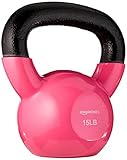
- 15 pound kettlebell weight for exercise and strength training
- Solid cast iron with Pink vinyl coating that protects floors, reduces noise, and prevents corrosion
- Flat base for stay-in-place storage; weight clearly printed on both sides
- Textured, wide, curved handle offers a comfortable, secure grip; hold with one hand or two
- Available in multiple color-coded weight sizes to mix and match for specific workout needs and to expand on over time (additional weights sold separately)
Common mistakes and how to correct them
Starting with a gender-based chart
A chart can provide orientation but cannot account for your movement experience, shoulder strength, grip, balance or injury history. Use the technique test and choose a lighter bell when the charted number is not manageable.
Using the squat weight for every exercise
Lower-body movements often tolerate more load than presses and other stability-heavy exercises. Keep separate exercise records and use different bells when needed.
Adding weight before mastering the path
Load magnifies errors. Return to a lighter bell, slow the movement and practice the positions that break down. For swings, revisit the hinge rather than trying to pull the bell higher with your arms.
Do these 3 things before closing this tab:
1Repair Windows errors before they cause bigger problems2Fix the driver behind crashes, sound loss and screen glitches3Clear out junk files and repair common Windows errorsConfusing fatigue with productive progression
More repetitions are not progress if the range shortens or posture changes. NASM’s progression options include reps, sets, tempo, rest and exercise selection; use the option that preserves technique.
Ignoring the weaker side
Unilateral work is limited by the side with less control. Match the weaker side and avoid extra repetitions that force asymmetry.
When to get professional help
If you are unsure how to hinge, clean, press or park a bell, a qualified trainer can observe the movement and help select a manageable load. The available guidance supports technique-first practice, but it does not establish a universal medical screening checklist or rehabilitation protocol.
Do not rely on a weight chart if you have pain, an injury, symptoms during training or medical restrictions. Cleveland Clinic’s beginner kettlebell guidance warns new trainees not to start with excessive weight (Cleveland Clinic guidance); individualized advice from an appropriate health professional is more suitable when symptoms or restrictions are involved.
A simple decision rule to keep
For each exercise, ask: “Can I perform the next repetition with the same controlled technique?” If yes, keep practicing and progress gradually. If no, reduce the load, rest, simplify the movement or stop. The right kettlebell is the one that lets you train the intended pattern safely and repeatably today—not the heaviest bell a chart says you should lift.
Quick Recap
Product prices and availability are accurate as of the date/time indicated and are subject to change. Any price and availability information displayed on Amazon at the time of purchase will apply.

