
The Tool Desk
Outbyte PC Repair FREEClear out junk files and repair common Windows errorsFree Scan →Outbyte Driver Updater FREEFix the driver behind crashes, sound loss and screen glitchesFind Drivers →iTechGuides is reader-supported. When you buy through links on our site, we may earn an affiliate commission. As an Amazon Associate I earn from qualifying purchases. Learn more
There is no universal MGX power or networking bill of materials. MGX is a platform family implemented in different server models and vendor configurations. Start with the exact machine and its current vendor documentation, then match every power cable, network adapter, transceiver, cable and switch port to that design. NVIDIA’s Grace CPU SuperChip example uses three C13 power cables and separate host and BMC RJ45 connections, while its GH200 example uses a ConnectX-7 card with dual QSFP+ ports. Those are model-specific instructions, not requirements for every MGX server.
Why the exact MGX model matters
An MGX server can combine different CPUs or accelerators, network adapters, chassis designs, power supplies and vendor options. The phrase “MGX server” therefore does not identify a single connector layout, input voltage, PSU rating, redundancy scheme or fabric. A safe component choice must be tied to five pieces of information:
- Server identity: the complete model, chassis and vendor configuration, not merely “MGX.”
- Power design: the installed PSU type, number of inputs, connector style, permitted voltage range and required facility feed.
- Network role: host or tenant access, out-of-band management, cluster east-west traffic, or an internal scale-up fabric.
- Port and mode: RJ45, SFP+, SFP28, QSFP+, QSFP28, QSFP56 or another interface, plus the mode in which the NIC is configured.
- Fabric and speed: Ethernet, RoCE, InfiniBand or NVLink, with a line rate and lane arrangement supported end to end.
Do not infer rack power or cabling from the name of an accelerator, from another MGX deployment, or from a reference architecture intended for a different tray.
Build a component plan before ordering
Use the following sequence for any MGX installation. It prevents a physically compatible part from being electrically, optically or logically incompatible.
#1 Best Overall

- 【Wide Compatibility】This adapter supports all SFP+ optics and cable (except Cisco) reaches, such as 10G-SR, 10G-LR, 10G-ER, 10G-ZR, 10G SFP+ Copper Cable and 10G SFP+ Active Optical Cable. I2C read port information comes from SFP port module, not QSA Module.
- 【Smooth Speed Migration】10Gtek QSA adapter Module offers 10 Gigabit Ethernet connectivity for QSFP-only platforms. It allows smooth and cost-effective migration to 40 Gigabit Ethernet by providing an option to use lower-speed.
- 【Convenient and Flexible Use】With QSA adapter, you can flexibly use any SFP+ module or cable to connect to a lower-speed port on the other end of the network with low insertion loss and crosstalk. Plug and play, without any setup.
- 【QSA vs QSFP Breakout Cable】Not all the 40G cards and switches can be split into 4x 10Gb mode, for example, the Mellanox QSFP cards do not support the QSFP to SFP+ breakout, but they support QSA. And QSA can be used for longer transmission distances than QSFP Breakout Cable.
- 【What You Get】1x cost-effective QSFP+ to SFP+ QSA adapter. 10Gtek is a manufacturer of DAC/Transceiver/AOC/NIC/Media Converter, customized service also is available.
- Record the exact system. Capture the vendor, chassis, board or tray revision, installed NIC model, PSU labels and the document revision supplied for that machine.
- Copy the required interfaces. List every power inlet, host-network port, BMC port and fabric port, including connector type and stated speed.
- Assign each port a role. Mark it as tenant/host access, management, cluster interconnect or an internal scale-up connection. Keep management traffic separate from high-throughput workload traffic unless the vendor design explicitly combines them.
- Choose the fabric. Confirm whether the workload and certified configuration call for Ethernet, RoCE, InfiniBand or an NVIDIA-specific NVLink/NVSwitch connection.
- Match both ends. Verify NIC, transceiver or direct-attach cable, switch port, firmware mode and switch configuration as one link. A connector that fits mechanically can still have the wrong speed, lane count or signaling mode.
- Validate the facility design. Have the vendor specification and the site electrical plan confirm voltage, branch-circuit capacity, receptacles, redundancy and rack distribution before purchasing power equipment.
- Order only after a port-by-port review. Record the exact part number, supported rates, coding or compatibility requirements, cable length and whether a firmware change is needed.
Power components: what is known and what is not
The documented Grace CPU SuperChip example
NVIDIA’s Grace CPU SuperChip: MGX System Quick Start Guide (document DU-11600-001_03) covers a specific Supermicro 2U MGX implementation. For that system, the guide calls for three C13 power cables. It also identifies a dual-port 10GBase-T Ethernet card, host-system RJ45 ports for the communication network and a separate RJ45 port for the Baseboard Management Controller (BMC).
These three C13 cables describe the cited Supermicro configuration only. They do not establish that every MGX server has three inlets, uses C13 connectors, or needs three independent circuits. The guide’s publication date was not established in the inspected material, so obtain the current revision for the machine being installed.
Information that must come from the server vendor
The available MGX setup material does not establish a family-wide value for any of the following:
- PSU wattage or the number of power supplies.
- AC input voltage, frequency or plug type.
- Single-cord versus dual-cord operation.
- N+1, 1+1 or other redundancy requirements.
- Power shelves, busbars, rack PDUs or branch-circuit sizing.
- Maximum draw under a particular CPU, accelerator or NIC load.
Ask the server vendor for the installation specification that applies to the exact serializable configuration. Give that document to the facilities or data-center electrical designer; do not size a rack feed from an accelerator’s advertised thermal design power or from another NVIDIA rack design.
Power-selection checklist
- Confirm the number and type of inlets on the shipped chassis.
- Confirm whether each inlet must be connected for normal operation or only for redundancy.
- Match C13, C14, C19, C20 or another connector only after checking the inlet and PDU receptacle drawings.
- Verify the cord’s current rating, regional plug, length and certification.
- Document which cords feed which PDU or branch circuit, if the vendor requires source diversity.
- Check airflow and cable-clearance requirements so thick power bundles do not obstruct the server or rack doors.
Separate the network roles before choosing adapters
Host or tenant access
This is the interface through which users, applications or north-south services reach the server. In the Grace CPU SuperChip example, the supplied dual-port 10GBase-T card connects through host RJ45 ports to the communication network. Use the speed and connector specified for that card and its intended switch.
Rank #2
- Efficient Design: QSFP to SFP+ Adapter allows smooth and cost-effective migration to 40 Gigabit Ethernet by providing an option to use lower-speed 10G SFP+ modules or cables in empty QSFP ports
- Wide Applications: QSA Module supports all major 10G SFP+ optics and cable reaches, including SFP-10G-SR, SFP-10G-LR, SFP-10G-ER, SFP-10G-ZR, 10G SFP+ Copper Cable and 10G SFP+ Active Optical Cable
- Wide Compatible: Perfect for Mellanox MAM1Q00A-QSA, Dell 407-BBRO, Nokia 474938A, Juniper, Arista, H3C, Extreme and more brand devices with QSFP port; (Don't support Cisco)
- Excellent Performance: All-metal housing for superior EMI performance, Low insertion loss, Low crosstalk. Compliant to SFF-8436, SFF-8432 and RoHS; Support hot-pluggable, plug and play
- Friendly Service: Each QSA adapter is individually tested on switches before delivery. We provide 24/7 Customer Service, 30 Days Free-returned, 3 Year Free Warranty and Lifetime Technology Support
Out-of-band management
The BMC is a separate management path. The Grace guide identifies a distinct RJ45 port for BMC management and describes the BMC as the interface used to manage the Baseboard Management Console. Connect it to the management network required by the site, not automatically to the tenant fabric.
Cluster interconnect
East-west traffic between compute nodes can require substantially different adapters and switches from host access. NVIDIA’s certification guidance describes multi-node workloads using InfiniBand or RoCE, and using NVLink/NVSwitch where applicable, with prescriptive certified configurations. Select the fabric that the workload, software stack and certified server design support; there is no single default for all MGX systems.
Within-rack scale-up
NVLink is NVIDIA’s proprietary standard and serves a different purpose from an Ethernet management or tenant link. A cable or transceiver intended for an external Ethernet switch cannot be substituted for an internal NVLink connection.
NVIDIA’s NCP Software Reference Guide summarizes the distinction this way: “The TAN and SMN are always Ethernet; the CIN can be configured as either Ethernet or InfiniBand, and NVLink is a proprietary NVIDIA standard.” TAN, SMN and CIN are roles in that reference design, not labels that every MGX vendor must use.
GH200 ConnectX-7: when copper RJ45 is possible
Native port arrangement
NVIDIA’s GH200 SuperChip: MGX System Quick Start Guide (DU-11592-001_04) states: “The server comes with a ConnectX-7 networking card that is configured with dual QSFP+ ports.” If the destination switch is QSFP-compatible, connect the general server-network cables directly using the supported QSFP+ media.
Rank #3
- Versatile Compatibility - Widely compatible with SFF 8436 and QSFP MSA compliant equipment from Mellanox, Dell, Juniper, Arista, Extreme, NOKIA, H3C and more brands
- Comprehensive SFP+ Support - This QSA adapter fits all SFP+ optics and cable reaches, including SFP-10G-SR, SFP-10G-LR, SFP-10G-ER, SFP-10G-ZR, 10G SFP+ copper cable, and 10G SFP+ active optical cable (I2C read port information comes from SFP+ port module)
- Cost-effective Conversion from QSFP+ to SFP+ Port - Ipolex 40G to 10G Adapter Module allows smooth and cost-effective migration to 40 Gigabit Ethernet by providing an option to use lower-speed. Plug and play, no configuration required
- Stable Performance - low insertion loss, low crosstalk, and low EMI emission; all metal housing design and secure latching mechanism; Operating case Temp range at -20 to 85℃
- Test Assured - Every QSA Adapter is tested by a skilled technician in ipolex lab for compatibility and stability before delivery
QSFP+ to copper Ethernet path
For a copper Ethernet deployment, the guide describes a two-stage path:
Free tools Windows power users keep installed
One-click scans. No signup required.
- Install a QSFP+-to-SFP+ adapter in the ConnectX-7 port. The guide gives MAM1Q00A-QSA as an example.
- Install an SFP+-to-copper-RJ45 transceiver in that adapter, then connect the RJ45 patch cable to a compatible switch port.
The linked examples in the guide are explicitly not product recommendations. The transceiver, switch port and patch cable must support the same Ethernet rate and operating mode. A generic QSFP-to-SFP adapter is not automatically suitable for every ConnectX-7 firmware, switch or speed combination.
Firmware mode change
The GH200 guide states: “Changing the ConnectX-7 card from QSFP mode to Ethernet Mode requires a change in the firmware at the OS level.” Follow the current GH200 machine procedure before assuming that inserting an adapter is sufficient. In the documented conversion workflow, a USB-to-Ethernet adapter can provide initial connectivity while the firmware and tooling change is completed. That adapter is a setup aid for this workflow, not a standard MGX component.
Match cables, transceivers and switches end to end
Connector shape alone is not a compatibility test. Check the NIC, optic or copper module, cable, switch port and software configuration as a single link. At minimum, compare:
- Line rate: the advertised rate on both endpoints and the inserted module.
- Lane arrangement: whether the link uses one, two, four or another number of lanes and whether breakout is required.
- Connector family: RJ45, SFP+, SFP28, QSFP+, QSFP28 or QSFP56.
- Media: twisted-pair copper, passive or active direct attach, multimode fiber or single-mode fiber.
- Protocol: Ethernet, RoCE or InfiniBand, including any required switch and NIC mode.
- Reach and environment: cable length, temperature rating, bend radius and rack routing.
- Management and coding: vendor-supported transceiver identification, firmware and driver requirements.
NVIDIA’s Ethernet cabling primer gives these examples: 10 GbE over SFP+, 25 GbE over SFP28, 100 GbE over QSFP28 and 200 GbE over QSFP56. It also shows that 50 GbE and 100 GbE can use different lane arrangements. Treat those figures as examples of the available Ethernet combinations, not as a universal MGX port list.
Rank #4
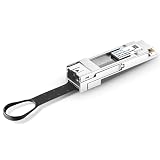
- This coverter supports 25G-SR, 25G-LR, 25G-ER, 25G-ZR, 25G SFP28 Copper Cable and 25G SFP28 Active Optical Cable.
- QSFP adapter module use SFP+ in QSFP+ port of your device. It allow connect to a lower-speed port on the other end of the network with low insertion loss and crosstalk.
- Tested in targeted switches for superior performance, quality, and reliability. A cost-effective offers 10 gigabit ethernet connectivity for only QSFP port equipment.
- This QSFP converter can be used for longer transmission distances than QSFP breakout cable.
- QSFP+ MSA form factor, plug and play. Max. power consumption 1.5W without module
| Example Ethernet link | Typical connector shown in NVIDIA’s primer | What still must be verified |
|---|---|---|
| 10 GbE | SFP+ | NIC support, switch port, optic or copper module and cable type |
| 25 GbE | SFP28 | 25-GbE signaling, lane configuration and switch compatibility |
| 100 GbE | QSFP28 | Four-lane implementation, breakout requirements and supported optics |
| 200 GbE | QSFP56 | Rate, lane arrangement, switch support and transceiver coding |
What the NCP reference design illustrates—and what it does not
NVIDIA’s NCP data-center architecture uses specific GB200 and GB300 tray designs to show how link counts change by node generation. These numbers are examples of a reference architecture, not a purchase list for an unspecified MGX server.
| Reference tray | Tenant-access links | Cluster-network links | Scope |
|---|---|---|---|
| GB200 | Two 400GbE BF3 connections | Four 400Gb CX7 links configurable to InfiniBand or Ethernet | NCP reference design only |
| GB300 | One 400GbE BF3 configured as two 200GbE links | Four 800Gb CX8 links configurable to InfiniBand or Ethernet | NCP reference design only |
The different counts and rates demonstrate why a “standard MGX cable kit” is unsafe. Confirm whether your server is part of such a reference architecture, a vendor-specific derivative or an entirely different MGX implementation.
Independent reader supportYour contribution helps us test, update, and keep practical guides available for everyone.A practical purchasing worksheet
Create one row for every physical connection and complete it from the server and deployment documents:
| Field | Entry to record |
|---|---|
| System | Vendor, complete model, chassis or tray revision |
| Port role | Host/tenant, BMC management, cluster interconnect or internal scale-up |
| Server-side interface | Connector, speed, lane count and configured mode |
| Intermediate component | Direct-attach cable, optic, QSFP-to-SFP adapter or copper transceiver |
| Switch-side interface | Port connector, speed, protocol and breakout mode |
| Physical media | Copper or fiber, length, polarity and environmental rating |
| Software requirements | Firmware mode, driver, transceiver coding or OS-level change |
| Power | Inlet connector, cord, PDU receptacle, source circuit and redundancy role |
| Evidence | Exact vendor document and revision supporting the choice |
Have the network and facilities teams sign off the completed worksheet independently. Network approval does not validate electrical compatibility, and an electrical approval does not validate NIC or switch behavior.
What’s actually slowing this PC down?
Pick the symptom - the matching free tool is one click away.
Common failure modes and recovery steps
The cable fits but the link stays down
- Check that the NIC and switch advertise the same rate and lane arrangement.
- Confirm that the transceiver is supported and recognized by both devices.
- Inspect breakout configuration: a four-lane port split into four links cannot be connected as a single-lane link without the correct cable and switch setting.
- Review firmware and driver state, especially on a ConnectX-7 changed from QSFP mode to Ethernet mode.
RJ45 was ordered for a QSFP+ NIC
Do not force a passive cable or an unverified adapter. For the documented GH200 path, use the specified QSFP+-to-SFP+ adapter and an SFP+-to-RJ45 transceiver, then confirm the OS-level firmware conversion and switch support. Other MGX models may require a different solution or may not support copper on that port.
Best Value

- 40GbE QSFP+ to 4xSFP+ DAC Direct Attach Copper Twinax Breakout Cable, Passive, 1-Meter(3.3ft), 30AWG
- Widely compatible with Cisco QSFP-4SFP10G-CU1M Devices, and other open switch Devices
- 40G QSFP+ to 4xSFP+ Cable can connect 40 Gigabit switch, router, server, NIC, or other fiber optic equipments with QSFP+ ports to 10 Gigabit equipments with SFP+ port for Network Attached Storage, Storage Area Network, and High Performance Computing
- In 10Gtek's Signal Integrity Lab, we 100% passed TDR & VNA tested. And each DAC Cable is individually tested on switches before delivery
The server powers on with one cord removed
That behavior does not prove the installation meets the vendor’s redundancy requirement. Check the exact power diagram for required inlets, PSU population and source diversity, then verify the rack PDU and branch circuits with facilities personnel.
Management traffic was placed on the workload fabric
Return to the role map. Connect the BMC to the designated out-of-band network and reserve tenant or cluster ports for their intended traffic unless the certified design explicitly combines roles.
A reference-design link count was copied into another chassis
Stop procurement and compare the actual server’s port inventory with the reference design. GB200 and GB300 NCP figures are architecture-specific; they do not define the number of ports on every MGX server.
Recommended Free Tools
Final decision rule
Choose power components from the exact vendor electrical specification, and choose network components from a port-by-port mapping of the installed NIC, intended fabric and switch. The Grace CPU SuperChip guide’s three C13 cords and RJ45 host/BMC layout are useful examples for that particular Supermicro 2U system. The GH200 guide’s dual-QSFP+ ConnectX-7, adapter-based copper path and OS-level firmware change apply to that GH200 configuration. Use NVIDIA’s speed and lane examples and NCP architecture tables to understand the options, but do not convert them into family-wide requirements. Until the server model, vendor configuration, region, rack power design and intended fabric are documented, a fully specified MGX bill of materials cannot be given responsibly.
Quick Recap
Product prices and availability are accurate as of the date/time indicated and are subject to change. Any price and availability information displayed on Amazon at the time of purchase will apply.

