
iTechGuides is reader-supported. When you buy through links on our site, we may earn an affiliate commission. As an Amazon Associate I earn from qualifying purchases. Learn more
Choose the accelerator that delivers the required work at your target latency, demand, software stack, and facility limits—not the chip with the highest advertised peak number. Custom silicon can win for a stable, very large workload; GPUs usually reduce programming risk and support broad parallel workloads; FPGAs can excel when a carefully designed pipeline, I/O path, precision, or latency profile matters. The defensible choice comes from benchmarking complete systems on your real application and calculating fully loaded cost.
Start with the workload, not the hardware category
“Custom silicon,” “GPU,” and “FPGA” describe implementation choices, not performance guarantees. A workload that is compute-bound at high concurrency may favor a different platform from the same application when it is memory-bound, latency-sensitive, bursty, or constrained by a small rack power budget. Before requesting quotes, write down the workload and its service objective.

- Application and version: Record the model, algorithm, database query, codec, or other software revision you will actually deploy.
- Input and precision: Define input-size distributions and required numerical formats such as FP32, BF16, FP16, INT8, or fixed point. Accuracy requirements can remove otherwise attractive options.
- Batch, concurrency, and latency: Specify batch size, target requests per second, and p50, p95, and p99 latency limits. A device that wins a large offline batch can fail a small-batch interactive service.
- Demand pattern: Separate low, typical, and peak demand. Fixed accelerator capacity is harder to justify when utilization varies sharply.
- Scale: State whether the job runs on one device, one host, a rack, or multiple sites. Distributed training and serving can be limited by communication rather than arithmetic.
- Deployment boundary: Decide whether you are comparing a cloud instance, an accelerator card in an existing server, or a complete on-premises system with new power and cooling infrastructure.
These definitions become the control conditions for every benchmark. Changing the model, precision, host CPU, software version, or concurrency between tests invalidates a simple ranking.
Free tools Windows power users keep installed
One-click scans. No signup required.
How the three approaches differ
| Option | What is fixed or programmable | Typical reason to choose it | Main risks |
|---|---|---|---|
| Custom silicon (ASIC) | Datapaths, memory structures, and interfaces are designed around an intended workload; behavior is not generally reprogrammable after fabrication. | A stable, high-volume workload can amortize design, verification, software, and deployment investment over many completed tasks. | Large up-front engineering cost, long schedule, difficult late changes, and software or model evolution that makes the design obsolete. |
| GPU | Thousands of programmable parallel execution lanes with a mature software ecosystem, but performance depends on kernels, memory access, and utilization. | Broad parallel workloads, changing models, rapid iteration, and teams that need established frameworks and tools. | Host transfers, memory contention, low utilization, software bottlenecks, and substantial rack power or cooling requirements. |
| FPGA | Reconfigurable logic and custom pipelines, with control over datapaths, precision, and I/O behavior after the card is deployed. | Deterministic latency, streaming or packetized data, unusual precision, tight I/O coupling, or a pipeline that benefits from on-chip memory. | Specialized hardware-design and toolchain work, longer optimization cycles than ordinary software, and variable operator or framework support. |
The table is a starting hypothesis. It is not a universal ranking: the delivered result depends on the complete system, software maturity, and your workload.
#1 Best Overall

- XC7K480T-2FFG1156 Celestica DU-PCB-001-003 FPGA XC7K480T elopment board acceleration card PCIE card KINTEX-7
When custom silicon is justified
Look for a stable, large opportunity
An application-specific integrated circuit (ASIC) hardwires choices around an intended workload. It becomes plausible when the algorithm, data types, interfaces, and demand are stable enough that repeated savings in power, latency, or unit cost can repay non-recurring engineering. Include architecture, verification, physical design, fabrication, firmware, compiler or graph-lowering work, manufacturing risk, spare capacity, and field support in that calculation. A small or frequently changing workload usually cannot spread those costs over enough completed tasks.
Custom silicon also changes the meaning of “flexible.” You can update surrounding software, but changing the core datapath may require a new design and a new production cycle. A business case should therefore include the probability and cost of model changes, new operators, altered precision, and future input shapes.
Use TPU history as context, not a current benchmark
Google’s account of its first Tensor Processing Unit describes a custom ASIC tailored to TensorFlow. In the historical evaluation summarized in that 2017 account, Google reported 15–30 times higher performance and 30–80 times higher performance-per-watt than contemporary CPUs and GPUs for the evaluated neural-network workloads. Those figures describe that generation, software, reference systems, and measurement context; they do not establish a present-day result against modern GPUs or FPGAs. Read the original account at Google’s TPU overview.
Recommended Free Tools
Check the actual service and software contract
A cloud ASIC is still a complete platform, not just a chip specification. Generation-specific framework support, compiler behavior, topology, memory hierarchy, serving modes, and training modes determine whether your application can use it efficiently.
For example, Google’s TPU7x documentation, accessed in 2026, lists 2,307 BF16 TFLOPs per chip, 192 GiB of HBM, and 7,380 GB/s of HBM bandwidth. The same documentation supports JAX and PyTorch and states that TPU7x does not support TensorFlow. Google also warns that HBM can bottleneck memory-bound operations and that movement between memory tiers matters. These are published specifications for that TPU generation, not a cross-category benchmark. Consult the TPU7x documentation for the current topology and software details before committing.
Google’s TPU v5e documentation describes separate training and serving configurations. It lists 197 BF16 TFLOPs per chip, 16 GB of HBM, and 800 GiB/s of HBM bandwidth, and explains that training configurations are optimized for throughput and availability while serving configurations are optimized for latency. The figures are generation-specific specifications, not evidence that v5e is cheaper or faster than another platform for your workload. Verify the current documentation, quotas, region, and framework support when evaluating it.
Model the break-even point
Calculate the number of completed inferences, training tokens, transactions, or other units required to recover the ASIC investment. Use a range for demand and product lifetime rather than one optimistic utilization assumption. Include idle capacity, replacement inventory, validation of a new silicon revision, and the cost of keeping a general-purpose fallback while the custom design is developed. If the break-even point requires an uncertain future workload, a programmable platform may have greater economic value even when its instantaneous performance is lower.
Outdated Drivers Are Slowing You Down
One free scan finds every outdated or missing driver and matches the right update for your exact hardware.Free scan · exact hardware matchPC Slower Than It Used to Be?
A free scan shows the junk files, broken settings and background clutter dragging Windows down - then fixes them in one click.Free scan · Windows 10 & 11When a GPU is the safer starting point
Confirm that parallel work is both substantial and exploitable
A GPU helps when the application exposes enough independent work to occupy many execution lanes and when the cost of moving data to and from device memory is smaller than the saved compute time. NVIDIA’s CUDA Best Practices Guide recommends identifying hotspots, judging their parallelizability, understanding current and future workloads, and profiling realistic data. It specifically calls out bandwidth and inefficient memory access as common constraints.
- Profile the existing implementation and rank functions by wall-clock time, not by source-code size.
- Measure arithmetic intensity, device-memory transactions, cache behavior, host-to-device transfers, and synchronization.
- Port one representative hot path, then compare end-to-end latency and throughput rather than kernel time alone.
- Repeat at the concurrency and batch sizes required by production, including p99 latency and queueing time.
A high theoretical operations-per-second figure is irrelevant if kernels are serialized, memory accesses are scattered, or the host spends most of its time preparing work.
Value the software ecosystem explicitly
GPUs often reduce migration risk because common machine-learning and scientific frameworks, profilers, debuggers, and optimized libraries already target them. That advantage is not free: record the exact framework, compiler, driver, runtime, and library versions, and test operator coverage for your application. A missing operator can force a slow fallback or custom kernel and erase the expected benefit.
Rank #2
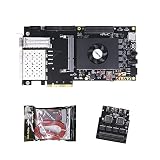
- FL9134 Package: AX7325B+USB downloader+FL9134
- FPGA Chip: XC7K325T-2FFG900I
Track engineering hours for porting, correctness testing, numerical validation, kernel tuning, monitoring, and future upgrades. A GPU that meets the service objective with a small team can have a lower total cost than a theoretically more efficient device that requires scarce specialists.
The Tool Desk
Outbyte Driver Updater FREEScan for outdated or missing drivers - takes under a minuteDriver Scan →Outbyte PC Repair FREERepair Windows errors before they cause bigger problemsFix Now →Plan the whole GPU-ready system
A GPU server needs more than a card slot. Power delivery, cooling, rack layout, host memory and CPU balance, local storage, network fabric, and serviceability affect sustained performance. NVIDIA’s GPU-ready data-center guidance uses older DGX-1 and V100 examples, so use it for the systems-planning principles rather than current product performance or pricing.
AWS advises comparing an appropriate accelerator instance with a general-purpose instance, monitoring accelerator and memory utilization, optimizing code and I/O, and decommissioning instances when they are not needed. Its Well-Architected guidance identifies failure to benchmark a general-purpose instance against a purpose-built instance as an anti-pattern. Apply that advice to every candidate, not only cloud GPUs: measure the delivered workload and shut down or scale down capacity that demand does not use. See AWS accelerator guidance.
When an FPGA is the right middle ground
Match the datapath to the workload
An FPGA can implement a custom streaming pipeline while remaining reconfigurable after deployment. That is valuable when fixed-point arithmetic, deterministic latency, high-rate I/O, protocol handling, or a small working set in on-chip SRAM matters more than general-purpose programmability. It can also combine preprocessing, inference, compression, and filtering in one pipeline, reducing transfers to a host.
AMD lists machine-learning inference, video processing and transcoding, database search and analytics, financial computing, storage compression, and genomics among data-center FPGA workloads in its Alveo product brief. The brief is dated 2023; verify current availability, tools, board support, and framework integration before using those products in a plan.
Quick wins for a faster PC:
Fix the driver behind crashes, sound loss and screen glitchesFind Drivers →Repair Windows errors before they cause bigger problemsFix Now →Scan for outdated or missing drivers - takes under a minuteDriver Scan →Interpret FPGA specifications carefully
The AMD Alveo U200/U250 brief reports 18.6 peak INT8 TOPs, 77 GB/s of DDR bandwidth, and 31 TB/s of internal SRAM bandwidth for its U200 product material. The brief also contains vendor comparisons whose footnotes specify particular tests and reference systems. Treat those comparisons as AMD-reported results for those applications, not as a general claim that FPGAs outperform GPUs or ASICs. The internal-SRAM figure is especially different from external-memory bandwidth; your design must keep data on the appropriate memory tier to benefit from it.
Use case studies as fit evidence, not proof of superiority
An AMD case study says Kuaishou selected an Alveo U50LV for an automatic-speech-recognition service after examining GPU utilization, latency, on-board SRAM capacity, and accuracy, while describing constraints with available ASIC approaches. AMD reports the card as a 75-watt design. Dr. Lingzhi Liu, head of Kuaishou’s Heterogeneous Computing Center, said: “We believed that the ideal solution for ASR acceleration would be a hardware platform that supported high-bandwidth, large SRAM, and fixed-point inference. AMD’s Alveo FPGA U50LV perfectly matched our requirements.” Read the account at AMD’s Kuaishou case study. It is a specific implementation story, not an independently controlled benchmark or a prediction for your service.
Budget for hardware-design work
FPGA development can require RTL or high-level-synthesis expertise, timing closure, resource planning, board bring-up, bitstream release processes, and hardware-aware verification. Framework integration may be less turnkey than a GPU path. Ask how many operators, data types, interfaces, and model revisions your team can support, and price that maintenance over the deployment lifetime. An FPGA is attractive when the resulting pipeline and latency behavior justify this work—not merely because the card has a lower quoted wattage.
Memory and communication can reverse the result
For each candidate, document the complete data path:
- Capacity: Can weights, activations, indexes, and buffers fit without paging or repeated host transfers?
- Bandwidth: What sustained bandwidth does the application achieve, rather than what the memory type’s peak specification suggests?
- Access pattern: Are reads contiguous and reusable, or random and synchronization-heavy?
- Host transfer: How often do data cross the CPU-device boundary, and how much queueing does that create?
- Scale-up fabric: What is the bandwidth and topology between accelerators in one host or rack?
- Scale-out network: Does distributed training or serving spend more time exchanging gradients, parameters, or requests than computing?
Google’s TPU7x documentation explicitly discusses memory hierarchy and data movement constraints. Use the same analysis for GPUs and FPGAs: a device with less arithmetic capacity can deliver more completed work if it keeps the relevant data local and communicates less.
Rank #3

- AX7325B Board: AX7325B+USB downloader
- FPGA Chip: XC7K325T-2FFG900I
Include facility and operations constraints
Compare rack power, peak and sustained draw, cooling method, rack density, floor space, host servers, storage, network ports, and power availability. Add procurement lead time, regional cloud capacity, hardware support, replacement units, firmware management, and failure recovery. A nominally efficient accelerator can be impractical if the required electrical service or cooling plant is unavailable.
Measure utilization over the demand curve, not only during a short performance run. If requests arrive in bursts, compare autoscaling or rental flexibility with the cost of permanently installed capacity. AWS specifically warns against leaving accelerators running when they are not needed. For on-premises deployments, include the energy and space of idle servers and the reserve capacity required for maintenance.
A repeatable evaluation plan
1. Define the acceptance test
Write one test specification covering application version, input distribution, precision, batch, concurrency, target throughput, p50/p95/p99 latency, accuracy, failure behavior, and expected low, typical, and peak demand. Specify whether preprocessing, postprocessing, storage, and network time are inside the measurement boundary.
What’s actually slowing this PC down?
Pick the symptom - the matching free tool is one click away.
2. Establish a baseline and shortlist feasible platforms
Measure the existing CPU or accelerator system first. Then eliminate candidates that lack required framework support, memory capacity, data types, network topology, regional availability, or a support lifecycle you can accept. Do not benchmark a device that cannot run the production software without an unplanned rewrite.
3. Port a representative slice
Use production-shaped data and implement enough of the real pipeline to expose operator gaps, memory movement, preprocessing, and output handling. Record engineering hours, compiler failures, custom-kernel or RTL work, correctness issues, debugging time, and monitoring changes. A toy kernel can make every accelerator look better than it will in service.
4. Measure end to end at target scale
For each candidate, collect:
- Completed work per second and useful work per joule.
- p50, p95, and p99 latency at the required concurrency.
- Accelerator, memory, host CPU, and I/O utilization.
- Device-memory use, host transfers, network traffic, and synchronization time.
- Accuracy or numerical error under the selected precision.
- Warm-up time, queueing, restart behavior, and degradation during failures or maintenance.
Keep model, inputs, software versions, host assumptions, and measurement boundaries identical. Vendor peak figures and case studies are not substitutes for this test.
5. Calculate fully loaded cost
Price the same delivered workload, not a chip in isolation. Include accelerator purchase or rental, host CPU and memory, storage, network, facility power and cooling, software support, engineering, operations, spare capacity, and idle time. The available evidence does not provide comparable current prices across custom silicon, GPUs, and FPGAs, so obtain dated quotes for the deployment region and document whether each price is recurring, reserved, or one-time.
6. Test the demand curve and the exit plan
Repeat the benchmark at low, typical, and peak demand. Test scale-up, scale-out, a failed device, a host replacement, software rollback, and a model update. Decide how you will migrate if the workload changes or the selected platform becomes unavailable. A slightly slower platform with a credible fallback can be safer than a narrowly optimized design with no migration path.
Independent reader supportYour contribution helps us test, update, and keep practical guides available for everyone.Turn measurements into a decision
Create a weighted scorecard whose weights reflect the business objective. A latency-critical service may weight p99 latency and deterministic behavior; batch training may weight sustained throughput and network scaling; a volatile product may weight portability and engineering time. Score only measured or documented values and mark unknowns rather than filling them with estimates.
| Criterion | Evidence to record | Question it answers |
|---|---|---|
| Performance | Throughput and p50/p95/p99 latency at target concurrency | Does the complete service meet its objective? |
| Efficiency | Energy per completed task and sustained power | Does efficiency persist under production utilization? |
| Memory and data movement | Capacity, achieved bandwidth, host transfers, network traffic | Is the bottleneck compute or movement? |
| Software fit | Supported operators, compiler maturity, debugging, portability | Can the team deliver and maintain it? |
| Economics | Fully loaded cost per delivered unit across demand levels | Does it remain affordable when capacity is idle? |
| Operations | Power, cooling, procurement, support, failure recovery | Can the facility run it reliably? |
| Change tolerance | Cost and time to support new models, precision, or interfaces | Will the design survive the product roadmap? |
Do not award a winner when a decisive measurement is missing. Instead, make the next experiment explicit—for example, a memory-capacity test, a p99 latency run at peak concurrency, or a quote that includes facility costs.
Common selection mistakes and their fixes
Choosing from peak TOPS or TFLOPs
Why it fails: Peak arithmetic ignores utilization, memory access, precision, and communication.
Fix: Profile the real pipeline and report completed work, tail latency, utilization, and energy at the service target.
Comparing unlike case studies
Why it fails: Different models, datasets, batch sizes, software versions, and measurement boundaries can produce incompatible results.
Fix: Reproduce one aligned workload on each complete system and label vendor-reported figures with their exact context.
Ignoring software and engineering time
Why it fails: An operator gap, compiler limitation, or timing-closure problem can delay deployment longer than hardware savings justify.
Fix: Track porting, verification, debugging, maintenance, and upgrade effort as cost and schedule items.
Underestimating fixed capacity
Why it fails: A high-performing device that sits idle during normal demand increases cost and power without delivering work.
Fix: Model low, typical, and peak utilization; compare autoscaling, rental, partitioning, and spare-capacity policies.
Forgetting the facility boundary
Why it fails: Power delivery, cooling, rack space, network, and storage can constrain deployment before chip performance does.
Do these 3 things before closing this tab:
1Scan for outdated or missing drivers - takes under a minute2Clear out junk files and repair common Windows errors3Fix the driver behind crashes, sound loss and screen glitchesFix: Have facilities and operations review the design using sustained and peak requirements, not only the accelerator card’s rated power.
The practical decision rule
Choose custom silicon when the workload is stable, the scale is large, and measured lifetime savings can repay the design and deployment investment. Choose a GPU when you need broad framework support, rapid iteration, changing models, or flexible capacity and your profiling shows sufficient parallelism. Choose an FPGA when a custom streaming datapath, precision, I/O path, on-chip memory, or deterministic latency is central enough to justify hardware-oriented development.
When two options remain close, prefer the one with the lower uncertainty: clearer software support, easier capacity management, a tested failure path, and a credible migration route. The winning architecture is the one that delivers your required work reliably at an acceptable fully loaded cost—not the one with the most impressive isolated specification.
Quick Recap
Product prices and availability are accurate as of the date/time indicated and are subject to change. Any price and availability information displayed on Amazon at the time of purchase will apply.

