
What’s actually slowing this PC down?
Pick the symptom - the matching free tool is one click away.
iTechGuides is reader-supported. When you buy through links on our site, we may earn an affiliate commission. As an Amazon Associate I earn from qualifying purchases. Learn more
For a genuinely exposed location, begin with a purpose-built outdoor access point whose stated ingress-protection rating and operating-temperature range match the site. An indoor AP in a weatherproof enclosure can work, but only when the enclosure is explicitly compatible with that AP, suitable for the local conditions, and practical to install and service. Neither arrangement automatically delivers better Wi-Fi range or throughput: those depend on the exact radios, antennas, placement, and environment.
The short decision
Choose a purpose-built outdoor access point when the device will face direct rain, blowing dust, prolonged humidity, seasonal temperature swings, or difficult service conditions. Outdoor models are designed and documented as a complete product, so you can evaluate one set of mounting, cabling, power, and environmental specifications.
Consider an indoor AP in a weatherproof enclosure when you need a particular indoor model, the enclosure manufacturer lists that exact model as compatible, and the combined system fits the site. Treat the AP and enclosure as one engineered installation rather than assuming that a box automatically converts any indoor product into an outdoor-rated device.
The Tool Desk
Outbyte Driver Updater FREEFix the driver behind crashes, sound loss and screen glitchesFind Drivers →Outbyte PC Repair FREERepair Windows errors before they cause bigger problemsFix Now →The decisive evidence is model-specific:
- The AP’s stated ingress-protection rating and installation instructions.
- The AP’s operating-temperature limits.
- The enclosure’s rating, temperature limits, and compatibility list, if you use one.
- The mounting, cable-entry, PoE or power, thermal, and maintenance requirements of the complete installation.
What the two configurations actually are
Purpose-built outdoor access point
An outdoor AP is sold as a unit intended for outdoor deployment. Its housing, mounting method, cable entry, and environmental specifications are documented for that model. TP-Link’s Omada EAP603-Outdoor, for example, is listed with an IP65 rating and an operating range of -30°C to 70°C. Those figures describe that product and hardware version; they are not a promise for every outdoor AP.
#1 Best Overall

- Superior Speeds with MU-MIMO: Equipped with the latest 802.11ac Wave 2 MU-MIMO technology, the EAP225-Outdoor easily delivers dual-band Wi-Fi speeds of up to 1200 Mbps to multiple devices at the same time. Wireless Functions include Reboot Schedule, Enable/Disable Wireless Radio, Multiple SSIDs (Up to 16 SSIDs, 8 for each band). Environment: Operating Temperature: -3070 (-22158 ), Storage Temperature: -4070 (-40158 ), Operating Humidity: 1090% RH non-condensing, Storage Humidity: 590% RH non-condensing
- Indoor/Outdoor Use: The durable, weatherproof enclosure protects the access point against harsh outdoor conditions and provides stable wireless coverage up to 200m+ range at 2.4GHz and 300m+ at 5GHz in outdoor settings. Discreet appearance can also fit with any indoor scenarios
- Integrated into Omada SDN: Omada's Software Defined Networking (SDN) platform integrates network devices including access points, switches and gateways with multiple control options offered - Omada Hardware controller, Omada Software Controller or Omada cloud-based controller. Standalone mode also applies
- Cloud Access: Remote Cloud access and Omada app brings centralized cloud management of the whole network at different sites-all controlled from a single interface anywhere, anytime
- SDN Compatibility: For SDN usage, make sure your devices/controllers are either equipped with or can be upgraded to SDN version. SDN controllers work only with SDN Access Points, Switches and Gateways. Non-SDN controllers work only with non-SDN APs
Another outdoor model can have different limits, even when it looks similar. TP-Link’s EAP225-Outdoor documentation also lists IP65 protection but provides its own model-specific operating-temperature range. Compare the candidate’s current datasheet instead of transferring figures from one product to another.
Indoor AP inside a weatherproof enclosure
This arrangement places a separately sold indoor AP inside an enclosure designed to shield it from the environment. The enclosure must physically accept the AP, preserve the required antenna and cable arrangement, allow appropriate mounting, and keep the combined system within its environmental limits.
Zyxel’s ZZ0102F is an example of why compatibility must be checked by model. Its product information states an IPX5 rating, an enclosure operating range of -20°C to 50°C, and a list of supported Zyxel APs. That list is not a general statement that the enclosure works with other manufacturers’ equipment or with every Zyxel model.
Windows Errors? Fix Them Before They Spread
Repair common Windows errors and clear accumulated junk for a smoother, more stable PC - no reinstall needed.Free scan · no reinstallOutdated Drivers Are Slowing You Down
One free scan finds every outdated or missing driver and matches the right update for your exact hardware.Free scan · exact hardware matchStart with the site, not the product category
Before comparing model names, classify where the AP will sit. A covered patio, a ventilated warehouse, and a pole in an open field do not present the same risk even if all are called “outdoor” installations.
Direct exposure
An AP under an open sky must tolerate rain and wind-driven water. Blowing dust can reach seals and cable entries. Sun can heat the housing beyond the surrounding air temperature, while humidity and condensation can create moisture inside or around the installation. For this case, use a purpose-built outdoor AP or an enclosure-and-AP combination whose documentation explicitly addresses the exposure.
Sheltered but unconditioned locations
A roof overhang reduces direct rain but does not eliminate humidity, dust, temperature changes, or wind-driven water. An indoor AP may be acceptable only if the manufacturer’s documentation permits the proposed enclosure and the expected temperature remains within both devices’ limits.
Indoor spaces with occasional moisture
A plant room, garage, or utility area may not need an outdoor product if it is genuinely protected from precipitation and condensation. Do not select by room name alone; inspect the actual mounting point, airflow, sunlight, and seasonal temperatures.
Recommended Free Tools
How to read the environmental specifications
Use the numbers attached to the exact hardware revision. A rating on a product family page should not be treated as interchangeable with a rating on another model.
Rank #2

- 【Ultra-Fast True Wi-Fi 6 Speeds】Designed with the latest Wi-Fi 6 technology featuring 1024-QAM, HE60 and Long OFDM Symbol, the EAP650-Outdoor boosts dual-band Wi-Fi speeds up to 2976 Mbps.
- 【Indoor/Outdoor Use】The durable, IP67 weatherproof enclosure with dedicated high gain antennas protects the access point against harsh outdoor conditions and provides the best outdoor wireless experiences. Discreet appearance can also fit with any indoor scenarios.
- 【Integrated into Omada SDN】Omada's Software Defined Networking (SDN) platform integrates network devices including access points, switches & gateways with multiple control options offered - Omada Hardware controller, Omada Software Controller or Omada cloud-based controller*(Contact TP-Link for Cloud-Based Controller Plan Details). Standalone mode also applies.
- 【Cloud Access & Omada Compatibility】Remote Cloud access and the Omada app enable centralized management of your entire network across multiple sites. Control everything from a single interface, anywhere and anytime. Please verify device compatibility with SDN firmware in the product documentation or manufacturer's technical specifications.
- 【Advanced Wireless Tech】Supports Mesh WiFi, Seamless Roaming*(Omada Mesh & Seamless Roaming require the use of Omada SDN controllers), Band Steering, Load Balancing, Airtime Fairness and Beamforming technologies.
| Configuration | Weather protection to verify | Temperature information | Important qualification |
|---|---|---|---|
| TP-Link Omada EAP603-Outdoor | IP65, as listed on TP-Link’s product page | -30°C to 70°C operating range | Values are specific to this product page and hardware version. |
| TP-Link EAP225-Outdoor | IP65, as documented for the model | Use the range in the current EAP225-Outdoor documentation | Do not copy the EAP603-Outdoor temperature range to this model. |
| Zyxel ZZ0102F enclosure | IPX5, as listed by Zyxel | -20°C to 50°C enclosure range | Applies to the enclosure; the AP must also remain within its own limits. |
For an indoor AP in an enclosure, the relevant operating envelope is constrained by both components. If the AP has a narrower temperature range than the box, the AP remains the limiting device. If the enclosure heats up in direct sun, the air temperature around the AP may be higher than the weather report or the nominal ambient figure. The cited enclosure specification does not establish suitability for every AP, climate, or mounting orientation.
An ingress-protection code is evidence about the tested product, not a guarantee that an installation is sealed after drilling, replacing glands, routing cables, or opening the cover. Follow the manufacturer’s cable-entry and mounting instructions and inspect every penetration.
Compatibility is a system requirement
An enclosure can fail as a deployment choice even when its headline rating looks adequate. Verify all of the following against the enclosure and AP documents:
- Exact model support: the enclosure should name the AP model, not merely the brand or a visually similar series.
- Physical fit: check dimensions, mounting points, ventilation provisions, antenna clearance, and connector orientation.
- Radio operation: confirm that the enclosure does not obstruct or require a different antenna arrangement from the AP’s documented installation.
- Power and PoE: make sure the AP’s injector, switch, or power supply is suitable for the cable length and outdoor routing.
- Cable entry: use the specified glands, seals, drip loops, and bend radius; an unsealed cable path can defeat a rated housing.
- Service access: allow enough room to reset, replace, or inspect the AP without damaging seals.
- Thermal behavior: check the enclosure’s limits and whether sunlight or restricted airflow can raise internal temperature.
The Zyxel ZZ0102F example demonstrates the principle: its documentation names compatible APs. Compatibility is limited to that published list unless the manufacturer explicitly says otherwise.
Do not assume one option has better Wi-Fi
The sources available for this comparison do not establish a controlled head-to-head test showing that outdoor APs always cover more area, deliver higher throughput, or remain more reliable than indoor APs in enclosures. A fair comparison requires the exact radio hardware, antenna pattern, transmit-power rules, channel plan, mounting height, client devices, and site obstructions.
Compare the radio specifications
For each candidate, record supported bands, spatial streams, channel widths, maximum client capabilities, antenna type and pattern, and any regional transmit-power limits. Then compare those specifications in the configuration you will actually install. An indoor AP’s radio documentation may assume free-space indoor mounting; an enclosure can alter placement and cable routing.
Compare placement before changing hardware
Height, wall materials, foliage, metal structures, and line of sight often matter more than the words “outdoor” or “indoor.” Place the AP where its antenna pattern serves the intended area, while keeping cable runs, grounding, and service access practical. If coverage is uncertain, plan a site survey or a temporary trial at the intended mounting point rather than choosing by enclosure type alone.
Compare the complete installation
The AP price is only one line in the project. Build a bill of materials and labor estimate for both architectures.
Rank #3
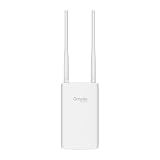
- Blazing-Fast Wi-Fi 6 Speeds: Experience seamless streaming, gaming, and browsing with dual-band speeds up to 1.8 Gbps (574 Mbps on 2.4 GHz + 1201 Mbps on 5 GHz)
- Unlock the power of Omada Cloud Management: Gain advanced features like intelligent network monitoring, remote configuration, AI-driven optimizations, and Zero-Touch Provisioning (ZTP). Manage your entire network with ease, efficiency, and endless possibilities. Also with free Omada Essential version available
- Universal Compatible with the Device Upfront: Seamlessly boost your WiFi coverage with the built-in extender function, designed to work with any device and deliver strong, reliable signal exactly where you need it
- Indoor and Outdoor Use: Built to last, our IP65 weatherproof design, wide operating temperature range (-40F to 158F), and 6kV lightning protection safeguard the access point from heat, cold, dust, rain, and storms, ensuring reliable performance in any outdoor environment
- Long Range WiFi Coverage: Dual-band omnidirectional design delivers strong, seamless signal for whole area coverage
| Installation element | Purpose-built outdoor AP | Indoor AP in enclosure |
|---|---|---|
| Mounting | Use the outdoor model’s specified wall, pole, or other mount. | Include the enclosure mount and confirm that the AP remains secured inside it. |
| Weather sealing | Follow the AP’s cable-entry and sealing instructions. | Seal the enclosure, every cable penetration, and any added hardware. |
| Power and PoE | Check the model’s PoE or power requirements and outdoor cable route. | Check the AP requirement plus the enclosure’s access and thermal constraints. |
| Maintenance | Plan access to the AP, connectors, and mounting hardware. | Plan enclosure opening, resealing, and safe removal of the AP. |
| Temperature | Match the AP’s stated range to expected site conditions. | Meet both the AP and enclosure ranges and account for internal heat. |
| Cost | Include AP, mount, PoE, cabling, labor, and future service. | Include AP, enclosure, mount, glands, cabling, labor, and future service. |
No universal cost winner is established. An indoor AP may already be available, but a compatible enclosure, mounting hardware, glands, installation time, and future resealing can erase that apparent saving. Conversely, a purpose-built outdoor AP may require a different mount or PoE arrangement. Compare complete installed cost rather than retail AP prices.
A step-by-step selection method
- Map the exposure. Note direct rain, wind-driven water, dust, sunlight, humidity, condensation risk, and the highest and lowest expected temperatures at the mounting point.
- Set the environmental threshold. Decide what ingress rating and operating range the site requires, using the manufacturer’s installation guidance for the candidate model.
- List purpose-built outdoor candidates. Record the exact model, hardware revision, rating, temperature range, mounting method, cable entry, power, and management requirements.
- List enclosure candidates only when necessary. For each enclosure, verify that the exact indoor AP model appears on the compatibility list and record the enclosure rating and temperature range.
- Check the combined thermal envelope. The AP and enclosure must both remain within limits. Consider solar heating, restricted airflow, and the enclosure’s orientation.
- Validate installation details. Confirm mounts, glands, drip loops, cable type, PoE delivery, grounding, service access, and any region-specific electrical or building requirements.
- Compare radio performance on paper. Review bands, antennas, spatial streams, channel widths, and regional power limits for the exact installed configuration.
- Estimate total ownership cost. Add hardware, mounting, cabling, power, labor, inspection, cleaning, resealing, and likely replacement access.
- Choose the least complicated compliant system. Prefer the option whose documentation clearly covers the environment and whose installation can be sealed, powered, serviced, and replaced without improvised modifications.
- Verify at the real location. After installation, check association stability, throughput in the target area, temperatures, cable seals, and performance in the conditions that matter to the site.
When an outdoor AP is usually the better fit
Open yard, parking area, or field
Direct exposure and broad temperature swings favor a purpose-built outdoor model with a documented rating and range that cover the site. A separate enclosure adds another set of seals, mounting decisions, and compatibility checks.
Remote or hard-to-service mounting point
Choose the configuration with the clearest long-term maintenance path. If opening an enclosure requires specialized resealing or a lift visit, that service burden belongs in the decision even when the initial AP is inexpensive.
Deployment requiring a manufacturer-supported outdoor workflow
When the vendor’s outdoor model has documented mounting, PoE, management, and environmental instructions, using that complete workflow reduces the number of assumptions an installer must make.
When an indoor AP in an enclosure can make sense
You need a specific indoor platform
An organization may standardize on one indoor AP for management, authentication, or inventory reasons. An enclosure is reasonable only if it explicitly supports that exact model and the combined temperature and installation requirements fit the site.
The location is sheltered but not conditioned
A protected area with limited precipitation may permit an enclosure solution, provided humidity, condensation, dust, sunlight, and temperature are addressed. “Under cover” is not the same as “indoors.”
The enclosure is documented as a complete accessory
Use the enclosure manufacturer’s named compatibility list, rating, temperature range, mounting instructions, and cable-entry method. Do not drill or modify a rated enclosure unless the manufacturer permits the change and you can preserve the required protection.
Quick wins for a faster PC:
Scan for outdated or missing drivers - takes under a minuteDriver Scan →Repair Windows errors before they cause bigger problemsFix Now →Common mistakes and how to correct them
Borrowing a rating from another model
Failure: treating one outdoor AP’s IP65 or temperature range as representative of all outdoor products.
Rank #4

- Up to 300Mbps Wi-Fi with 2x2 MIMO technology ; Rate limit on per SSID to restrict the bandwidth of each client
- Built for outdoor Wi-Fi applications ; WPA/WPA2-enterprise, 802.1X with RADIUS secure authentication and rogue access point detection ensure the security of WLAN
- High transmission power and high gain antennas provide a long-range coverage area
- Passive PoE Power over Ethernet support and simple mounting design allow for flexible deployment and convenient installation
- Free Auranet Controller Software lets administrators easily manage hundreds of EAPs
Correction: record the rating and range from the exact model and hardware revision you will purchase.
Assuming any box makes an indoor AP outdoor-ready
Failure: selecting an enclosure by dimensions or brand without checking the compatibility list.
Correction: require explicit support for the exact AP model and verify the AP’s own environmental limits as well as the enclosure’s.
Ignoring internal heat
Failure: comparing the enclosure’s nominal temperature range with a weather forecast while overlooking direct sun and trapped heat.
Correction: evaluate the mounting orientation, solar exposure, airflow, and the combined system’s thermal limits.
Leaving cable entry until the end
Failure: drilling a hole or routing a cable in a way that bypasses the product’s sealing method.
Correction: design the cable route, glands, drip loop, bend radius, and service slack before mounting the AP or enclosure.
Free tools Windows power users keep installed
One-click scans. No signup required.
Choosing on coverage claims alone
Failure: expecting the word “outdoor” to guarantee greater range or throughput.
Best Value

- Wi-Fi 7 Dual-Band: Faster speeds, less congestion
- IPX6 Weatherproof: Built for harsh outdoor conditions
- 12.5 dBi Directional Antenna: Covers up to 5,000 ft²
- 2.5 GbE PoE+ Port: Power and data over one cable
- 250+ Client Capacity: Ideal for dense deployments
Correction: compare antenna patterns and radio specifications, then validate performance at the intended location with the actual client devices.
Comparing only purchase prices
Failure: omitting mounts, PoE, cable, labor, inspection, and future service.
Correction: price the complete installed system and include the cost of safely reopening and resealing an enclosure.
Do these 3 things before closing this tab:
1Clear out junk files and repair common Windows errors2Scan for outdated or missing drivers - takes under a minute3Repair Windows errors before they cause bigger problemsInstallation and maintenance checklist
- Confirm the exact model and hardware revision before ordering mounts or enclosures.
- Keep the AP and enclosure within their documented operating-temperature ranges.
- Use the specified mounting orientation and hardware.
- Protect cable entries from water paths and provide a drip loop where required by the installation guide.
- Verify PoE or power delivery at the AP, including cable length and connector compatibility.
- Inspect seals, glands, covers, and mounting fasteners after installation and after any service visit.
- Check for condensation, corrosion, blocked vents, dust buildup, and physical damage during scheduled maintenance.
- Record the installed model, revision, rating, temperature limits, cable route, and enclosure compatibility for future technicians.
- After severe weather or enclosure opening, test connectivity and inspect the seal before returning the site to normal operation.
How the documented examples should influence your choice
The TP-Link EAP603-Outdoor specification—IP65 and -30°C to 70°C—shows the level of detail to seek in an outdoor AP datasheet. It does not prove that every outdoor model covers the same range. The EAP225-Outdoor page reinforces that model-by-model checking is necessary even within one product family.
The Zyxel ZZ0102F specification—IPX5 and -20°C to 50°C—shows the two checks required for an enclosure: its own environmental rating and its named AP compatibility. The enclosure’s figures do not replace the indoor AP’s figures, and they do not establish suitability for an unlisted model.
An Aruba deployment note recommends a region-compliant NEMA-rated enclosure for an indoor AP used outdoors and directs installers to the particular AP datasheet for environmental limits. That guidance is older, so verify current product documentation and applicable local requirements before deploying it today.
Final selection rule
For an exposed site, select the purpose-built outdoor AP whose exact rating, temperature range, mounting, power, and cable-entry instructions fit the location. Select an indoor AP in a weatherproof enclosure only when the enclosure explicitly supports that AP, the combined thermal and ingress requirements are met, and the complete installation remains practical to seal and service. Treat wireless coverage, cost, and reliability as characteristics to validate for the specific models and site—not as automatic advantages of either architecture.
Quick Recap
Product prices and availability are accurate as of the date/time indicated and are subject to change. Any price and availability information displayed on Amazon at the time of purchase will apply.

