
Recommended Free Tools
iTechGuides is reader-supported. When you buy through links on our site, we may earn an affiliate commission. As an Amazon Associate I earn from qualifying purchases. Learn more
The right action camera is the one that fits your activity, mounting plan, shooting modes, and editing workflow—not simply the one with the highest resolution. For sports and point-of-view footage, prioritize a secure low-weight mount, dependable stabilization, and the slow-motion modes you actually need. For travel and everyday recording, add framing flexibility, simple controls, battery logistics, storage, microphone support, and phone compatibility to the decision. Then verify the exact model’s waterproof limit, recording restrictions, and accessory fit before buying.
Start with the way you will use the camera
“Best action camera” is not a single specification. A camera on a bicycle helmet faces different problems from one used to record family trips, walking tours, or daily clips. Write down where the camera will sit, how much movement it will experience, whether you need hands-free operation, and where the finished video will be watched.
Sports and point-of-view recording
For cycling, skiing, skating, climbing, motorcycling, water sports, and similar activities, the camera must stay attached while your body and the mount move unpredictably. A low-weight body, a mount that matches your helmet or harness, and effective electronic stabilization usually matter more than a headline resolution. GoPro’s buying guidance specifically describes a sports camera as lightweight, attachable to clothing or gear, and equipped with image stabilization; that is manufacturer guidance rather than an independent comparison.
Crashes, No Sound, or Screen Glitches?
Random freezes, missing sound and display glitches usually trace back to one bad driver. Find and replace yours safely.Free scan · under a minuteWindows Errors? Fix Them Before They Spread
Repair common Windows errors and clear accumulated junk for a smoother, more stable PC - no reinstall needed.Free scan · no reinstallCheck the camera’s supported frame rates before assuming it can produce the slow motion you want. Stabilization can change or disappear in slow-motion modes, and a camera that is excellent at ordinary 4K may not offer the same horizon or electronic stabilization features at every high-speed setting.
#1 Best Overall

- 4K Ultra HD action camera: Professional 4K30Fps & 2.7K30Fps video with 20MP photos at up to 30 frames per second for incredible photos, which is 4 times the resolution of traditional HD cameras.
- Smooth Stabilization: Built-in Electronic Image Stabilization (EIS) delivers steady and smooth videos. It can enable excellent footage even you or the object is in fast-moving.
- 131ft waterproof camera: AKASO EK7000 is designed to withstand extreme environments, together with durable waterproof case. With the accessories, transform it for indoor and outdoor activities.
- Wireless wrist remote control sports camera: With a wrist 2.4G remote, you can capture the world in an all-new way. Controlling the camera, framing shots or recording video is convenient. (THE REMOTE IS NOT WATERPROOF)
- Built-in Wi-Fi, edit & share your action in minutes: Just download App(AKASO GO) on your phone or tablet and connect with this action camera. Wi-Fi signal ranges up to 10 meters. MicroSD card is not included.
Travel and outdoor trips
Travel footage often mixes walking, vehicles, landscapes, people, interiors, water, and quick vertical clips for a phone. Here, the useful questions are broader: Can you change the field of view without physically moving the camera? Is it easy to start recording while wearing gloves? Can you carry enough batteries and storage for a full day? Will your phone or computer handle the camera’s largest files?
A very wide point-of-view image can make a dramatic landscape look expansive, but it can also exaggerate faces near the edge. If you plan to reframe a horizontal clip for a vertical post, confirm that the camera offers an appropriate capture mode and enough resolution for the crop.
Everyday use
For commuting, pets, household projects, children’s activities, and occasional clips, convenience tends to beat extreme specifications. A camera that starts quickly, has understandable controls, and transfers files reliably may be used more often than one that requires a large rig and frequent battery changes. Consider whether you need an external or wireless microphone, how often you will edit on a phone, and whether the camera can be left mounted without becoming intrusive.
Free tools Windows power users keep installed
One-click scans. No signup required.
The specifications that actually change the buying decision
| Decision area | Why it matters | What to verify before purchase |
|---|---|---|
| Mounting, weight, and handling | An awkward or insecure camera produces missed shots and can become a safety problem during movement. | Confirm that the included or optional mount fits your helmet, chest harness, bar, grip, or other attachment point, and check the complete mounted weight. |
| Stabilization and capture modes | Walking, running, vehicle vibration, slow motion, horizon leveling, and time-lapse place different demands on electronic stabilization. | Read the resolution and frame-rate limits for each stabilization mode. Do not choose solely by a feature name such as “Horizon” or “HyperSmooth.” |
| Water exposure | Depth, time underwater, pressure, and the type of liquid all affect whether a bare camera is safe. | Use the exact model’s depth rating and follow its case and liquid restrictions. A rating is not permission to use the camera in every wet environment. |
| Framing and output | Travel and social clips may need landscape, vertical, or later reframing, while sports footage may need a wide locked viewpoint. | Check vertical and custom modes, field-of-view options, lens or lens-cover compatibility, and the resolution retained after cropping. |
| Battery and storage | Long outings fail when the battery runs out or a card fills before the activity ends. | Read the test conditions behind runtime claims, determine whether internal storage is usable, and buy cards in the required speed class. |
| Audio and editing | Wind, speech, music, and mobile editing can determine whether footage is usable even when the image is good. | Check microphone and wireless-audio support, wind-management options, file sizes, and whether your phone can download and edit the highest-resolution modes. |
Match stabilization to the movement you will record
Electronic image stabilization (EIS) uses the camera’s sensor area and software to reduce visible shake. Strong stabilization normally requires some cropping, and the available crop, horizon correction, and frame rate depend on the selected mode. Test the mode you intend to use rather than relying on the camera’s most prominent stabilization label.
DJI’s mode-specific limits
DJI lists RockSteady 3.0, RockSteady 3.0+, HorizonBalancing, and HorizonSteady for Osmo Action 6. Its specifications also state that EIS is unavailable for slow motion and time-lapse. The horizon modes are restricted to particular resolutions and frame rates, so a mode that keeps a horizon level in one setting may not be available in another. This matters if you want both a level horizon and high-speed slow motion: you may have to choose which result is more important for that shot.
Rank #2

- 【4K Action Camera with EIS 2.0 Stabilization】 Capture every adventure in stunning detail with this 4K Action Camera featuring 4K/30FPS video recording and automatic audio recording. Equipped with a 150° ultra-wide-angle lens, this mini action camera delivers a wider field of view and clear footage. Upgraded EIS 2.0 six-axis stabilization reduces shake and keeps videos smooth during fast-moving activities like motorcycle riding, cycling, hiking, and skiing. This compact POV camera is designed for capturing immersive outdoor moments.
- 【WiFi Body Cam with Real-Time Preview & File Transfer】 This portable action camera supports smartphone connection through the app for real-time preview, remote shooting, playback, and wireless file transfer. This mini body camera also supports USB transmission and loop recording, allowing you to easily save and manage videos. Perfect for vlogging, cycling, motorcycle riding, hiking, and daily recording.
- 【33FT Waterproof Mini Action Camera】 Designed for outdoor adventures, this waterproof action camera features IPX8 waterproof protection up to 33FT (10M) without an additional waterproof housing. The wearable camera allows you to record underwater videos while swimming, snorkeling, surfing, and filming in rainy conditions. Capture stable and clear footage wherever your adventure takes you.
- 【Built-In 64GB Storage & Up to 350 Minutes Battery Life】 Record more moments with this 64GB body cam featuring built-in storage for travel videos, daily recordings, and outdoor adventures. The compact sports camera records up to 120 minutes independently, and the wireless charging case extends battery life up to 350 minutes. Enjoy longer recording time without worrying about running out of storage or power.
- 【Magnetic Wearable Sports Camera for Hands-Free Recording】 Featuring a thumb-sized magnetic wearable design, this POV camera can be attached easily with the included magnetic lanyard and 360° rotating clip. Use this mini body camera on hats, clothing, bicycles, and motorcycles for hands-free first-person recording. Ideal for vlogging, cycling, hiking, skiing, and outdoor adventures.
GoPro’s stabilization approach
GoPro advertises HyperSmooth 6.0 for HERO13 Black. Treat that name as an indication of the manufacturer’s stabilization system, not as proof that every resolution, frame rate, lens setting, or accessory combination receives identical results. Check the current mode chart and select a setting that leaves enough field of view for the crop introduced by stabilization.
A practical stabilization test
- Mount the camera exactly where you will use it, rather than holding it by hand.
- Record the same route or movement at the resolution and frame rate you expect to use.
- Review straight lines near the edge of the frame for warping, and inspect the horizon during turns.
- Repeat with the camera’s strongest stabilization and with a less aggressive mode; the wider view may be more useful even if it is slightly less smooth.
Understand waterproof claims before taking a camera near water
Waterproof depth is a boundary, not a guarantee for every duration or liquid. Seals can be affected by impact, wear, incorrect door closure, salt, chemicals, heat, and pressure changes. Rinse and dry equipment according to the manufacturer’s instructions, and inspect doors and seals before a water trip.
Osmo Action 6 limits
DJI states that Osmo Action 6 can operate to 20 m without a case. DJI recommends its waterproof case for long-duration underwater filming or high water pressure, and states that the case supports use to 60 m. DJI cautions against hot springs, extreme underwater environments, and corrosive or unknown liquids. Those cautions apply even when the camera’s nominal depth appears sufficient.
HERO13 Black limit
GoPro lists HERO13 Black as waterproof to 33 ft, approximately 10 m. Confirm whether your planned activity involves repeated impact, diving, or prolonged submersion; a case may still be the sensible choice even when the stated depth is not exceeded.
Choose the protection for the activity
- Rain, splashes, and brief surface use: Use the bare camera only within its documented conditions, with every door fully closed.
- Long underwater sessions or high pressure: Use the model-specific waterproof case recommended by the manufacturer.
- Hot, salty, chemically treated, or unknown liquids: Do not assume the depth rating applies; follow the manufacturer’s exclusions.
- Any case or lens cover: Verify that it does not block microphones, buttons, stabilization options, or the mount you plan to use.
Plan battery life using the test conditions, not a headline number
Published runtime figures are useful for setting expectations, but they are not automatically comparable. Resolution, frame rate, stabilization, wireless radios, displays, voice controls, temperature, and the screen-saver behavior can all change endurance. Carry a charging plan that matches the actual mode you will record.
Rank #3
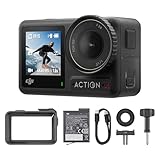
- Superior Low-Light Performance with 1/1.3-inch Sensor - Struggling with grainy footage in low light? Osmo Action 4 action camera 4K uses 2.4μm pixel size for crisp results. Auto white balance adjusts color for true-to-life, flicker-free shots, even underwater.
- Pro-Grade Color Science - Worried your videos lack real-life colors? 10-bit color depth captures subtle shades, while D-Log M preserves more detail and dynamic range for professional editing later. Osmo Action 4 vlogging camera helps you enhance vibrant scenery.
- See More, Feel More - Want to capture more action and scenery? Shoot in 4K at 120fps with a 155° ultra-wide field of view. Minimal cropping means immersive FPV footage. Use it as a motorcycle camera or underwater camera and enjoy stunning sceneries!
- Cold-Resistant, Long-Lasting Battery - Tired of your travel camera dying in the cold? The 1770mAh battery lasts up to 150 minutes [6] and works in temps as low as -20°C (-4°F). Plus, with waterproofing up to 18m [3], DJI Osmo Action 4 is ready for outdoor adventures.
- Effortless Perspective Shifts - Frustrated by slow setup? The magnetic quick-release system lets you mount, switch angles, and go vertical in seconds [2]. The self-locking design keeps your action camera secure, so you can create without limits.
Osmo Action 6’s published figure
DJI reports up to 240 minutes for Osmo Action 6, measured at 25 °C while recording 1080p at 24 fps with RockSteady enabled, Wi-Fi, voice control, and gesture control disabled, and both screens turned off. That controlled result should not be read as four hours of 8K, high-frame-rate, screen-on recording.
What’s actually slowing this PC down?
Pick the symptom - the matching free tool is one click away.
HERO13 Black’s published figure
GoPro states up to 2.5 hours for HERO13 Black under its listed 25 °C setup: the Wide digital lens, wireless and HyperSmooth enabled, screens on with a screen saver, and voice control and GPS disabled. Because the two companies used different settings, these figures are not a controlled head-to-head test.
Build a realistic power plan
- Identify the longest continuous recording you expect, not just the total time you will be outside.
- Use the manufacturer’s runtime conditions as a baseline, then assume less endurance for higher resolution, high frame rate, cold weather, wireless use, or a constantly illuminated screen.
- Decide whether spare batteries, a power bank, or periodic charging is practical for your activity.
- Leave enough time to cool the camera and change batteries safely; do not seal a hot camera in a case while it is recording.
Storage, cards, and file management
High-resolution and high-frame-rate video fills storage quickly. A card that is large enough but too slow can still cause recording interruptions, corrupted clips, or unavailable modes. Use the speed class specified for the exact camera and buy from a reliable source.
Osmo Action 6 storage
DJI lists 64 GB of built-in storage, with 50 GB available to the user, plus expandable microSD storage. DJI recommends U3, A2, V30 cards. Internal storage can be useful when you forget a card or need a short emergency clip, but it should not replace a card-and-backup plan for a long trip.
HERO13 Black card requirement
GoPro specifies microSD cards rated V30 or UHS-3 for HERO13 Black. Check the current compatibility guidance for capacity and model details before recording a major event, and format the card in the camera after copying any clips you need to keep.
Rank #4

- Superior Low-Light Performance with 1/1.3-inch Sensor - Struggling with grainy footage in low light? Osmo Action 4 action camera 4K uses 2.4μm pixel size for crisp results. Auto white balance adjusts color for true-to-life, flicker-free shots, even underwater.
- Pro-Grade Color Science - Worried your videos lack real-life colors? 10-bit color depth captures subtle shades, while D-Log M preserves more detail and dynamic range for professional editing later. Osmo Action 4 vlogging camera helps you enhance vibrant scenery.
- See More, Feel More - Want to capture more action and scenery? Shoot in 4K at 120fps with a 155° ultra-wide field of view. Minimal cropping means immersive FPV footage. Use it as a motorcycle camera or underwater camera and enjoy stunning sceneries!
- Cold-Resistant, Long-Lasting Battery - Tired of your travel camera dying in the cold? The 1770mAh battery lasts up to 150 minutes [6] and works in temps as low as -20°C (-4°F). Plus, with waterproofing up to 18m [3], DJI Osmo Action 4 is ready for outdoor adventures.
- Effortless Perspective Shifts - Frustrated by slow setup? The magnetic quick-release system lets you mount, switch angles, and go vertical in seconds [2]. The self-locking design keeps your action camera secure, so you can create without limits.
Estimate capacity before leaving
- Reserve space for several short takes, not only one uninterrupted clip.
- Carry a second compatible card if changing cards is safer than deleting footage in the field.
- Copy important clips to a phone, laptop, or other storage before formatting or reusing a card.
- Remember that 8K files can be difficult to download, store, and edit on a phone even when the camera can record them.
Choose framing and output for where the video will end up
A camera’s maximum resolution is only useful if your editing device and destination can handle it. Decide whether the final result is a television clip, a horizontal travel film, a vertical phone post, or an unedited record of an activity.
For vertical and reframed travel clips
DJI lists 4K vertical and custom modes for Osmo Action 6. GoPro documents full-frame and vertical workflows, along with optional lens modifications. Features vary by mode and accessory, so verify the exact combination rather than assuming that a vertical crop, a lens accessory, and maximum stabilization can all be used simultaneously.
For sports POV
A wide field of view makes it easier to keep a moving subject in frame and shows context around a helmet or handlebars. The trade-off is edge distortion and a smaller-looking subject. Mounting angle is as important as the lens setting: point the camera slightly lower than eye level when you need to show the trail, board, or hands.
For 8K capture
DJI’s specifications include 8K modes, but DJI says downloading and editing 8K in its app currently supports iPhone 15 Pro series and later; support on other devices depends on future app updates. Confirm current phone compatibility before choosing a camera primarily for 8K. If your device cannot process the files smoothly, a lower mode may deliver a faster and more reliable workflow.
The Tool Desk
Outbyte Driver Updater FREEFix the driver behind crashes, sound loss and screen glitchesFind Drivers →Outbyte PC Repair FREERepair Windows errors before they cause bigger problemsFix Now →Audio can decide whether travel footage is usable
Action cameras are exposed to wind, handling noise, engines, water, and crowds. Built-in microphones can be adequate for ambient sound, but narration and interviews require a deliberate audio plan. Check microphone and wireless-audio support for the exact firmware and accessory combination, and test the connection before an important trip.
Best Value

- 4K30fps Video & 20MP Photo: Capture every detail of life’s most beautiful moments with video resolutions from 4K 30fps to 1080P 60fps and 20MP photos so you can relive them anytime, anywhere. Start recording the wonders of your life.
- 170° Adjustable View Angle and Image Stabilization: With four customizable viewing angles of 170°, 140°, 110°, and 70°, capture the perfect perspective for any situation. Built-in smart gyroscope technology ensures shock-resistant and stable shooting, leading to incredibly smooth, professional-looking footage that stands out from the competition.
- Sport Camera with Wifi and HDMI: This action camera comes equipped with both Wi-Fi and HDMI capabilities, allowing you to quickly and effortlessly share and edit videos with the free app. Simply download the app on your phone or tablet and connect with the camera. With a Wi-Fi signal range of up to 10 meters and an HDMI port for TV connectivity, you can easily share your exciting experiences with friends and family in high quality and on a bigger screen.
- 131FT Waterproof Camera and Dual Screen: Place your action camera into the waterproof case and securely fasten it, then you can dive below 40 meters. This underwater camera is ideal for water sports such as swimming, surfing, diving, etc. Equipped with a 2“ rear screen and 0.96” front screen, you can effortlessly shoot in various scenarios, ensuring you get the perfect shot every time.
- Free Valuable Accessories: This underwater camera comes with a USB Dual Charger and 2 rechargeable 1050mAh batteries, each battery can record up to 90 minutes. We have optimized some accessories for the new version of Brave 4 to make it more suitable for bicycle/motorcycle activities. The kits are available for most kinds of cameras even Gopro. The remote wristband is not waterproof.
For spoken travel pieces, keep the camera close enough for intelligible speech, use wind protection where appropriate, and record a short test in the same environment. If you mainly want scenery with music added later, microphone sophistication may matter less than stabilization and battery capacity.
Two current examples, compared by published specifications
The following table demonstrates how to compare models. It is not a universal ranking: the manufacturers used different test methods, and a specification does not establish which camera will produce better footage in your activity.
| Feature | DJI Osmo Action 6 | GoPro HERO13 Black |
|---|---|---|
| Bare-camera waterproofing | 20 m, according to DJI | 33 ft (about 10 m), according to GoPro |
| Waterproof case rating | 60 m with DJI’s waterproof case; DJI recommends the case for long-duration or high-pressure underwater use | Not stated in the cited product material |
| Stabilization systems named by manufacturer | RockSteady 3.0, RockSteady 3.0+, HorizonBalancing, and HorizonSteady | HyperSmooth 6.0 |
| Mode restrictions | DJI says EIS is unavailable for slow motion and time-lapse; horizon modes have specified resolution and frame-rate limits | Check the mode chart for the selected resolution, frame rate, lens, and accessory |
| Published battery figure | Up to 240 minutes at 25 °C, 1080p/24 fps, RockSteady on, Wi-Fi/voice/gesture controls off, screens off | Up to 2.5 hours at 25 °C with Wide digital lens, wireless and HyperSmooth on, screens on with screen saver, voice control and GPS off |
| Built-in storage | 64 GB, with 50 GB available, plus microSD expansion | Not stated in the cited product material |
| Card guidance | DJI recommends U3 A2 V30 microSD cards | microSD V30 or UHS-3 |
| Battery design | Not stated in the cited material | Removable 1900 mAh Enduro battery |
| Framing and accessories | Specified 4K vertical and custom modes; verify limits by mode | Full-frame and vertical workflows, with optional lens and mounting accessories documented by GoPro |
Use this comparison as a checklist for your own priorities. Check regional availability, current price, firmware, phone support, and accessory compatibility when you are ready to buy; those details can change by market and product generation.
Quick wins for a faster PC:
Fix the driver behind crashes, sound loss and screen glitchesFind Drivers →Repair Windows errors before they cause bigger problemsFix Now →Scan for outdated or missing drivers - takes under a minuteDriver Scan →A step-by-step buying process
- Describe the main activity. Choose one primary use—sports POV, travel, or everyday clips—then list occasional secondary uses.
- Select the mounting position. Identify the helmet, chest, bar, backpack, grip, or tabletop position. Confirm the camera and mount will fit without blocking controls or your line of sight.
- Set the minimum capture mode. Write down the resolution, frame rate, field of view, and vertical or horizontal output you actually need.
- Check stabilization at that mode. Read the restrictions for slow motion, time-lapse, horizon leveling, and any lens accessory.
- Set the water requirement. Decide whether you need rain protection, surface swimming, repeated underwater use, or high-pressure diving, and select the bare camera or case accordingly.
- Calculate the power and storage kit. Use the manufacturer’s conditions as a baseline, then add spare batteries or charging and enough compatible cards for the day.
- Confirm the editing path. Make sure your phone or computer can transfer, decode, and store the largest files you plan to create.
- Verify every accessory. Check model generation, battery, mount, card, case, lens cover, and microphone compatibility before placing the order.
- Run a complete practice session. Record, mount, stabilize, transfer, edit, and recharge the camera exactly as you will on the trip. Fix problems while you still have time.
What to pack beyond the camera
Pack only accessories that solve a known problem in your activity. A compatible microSD card is essential when the camera requires one. Spare batteries or a charging method matter for long outings. A mount should match the surface and movement, not just the camera connector. A waterproof case is justified when the manufacturer recommends it for your depth, duration, or pressure. Lens covers and filters can be useful, but verify that they preserve the stabilization and field of view you intend to use.
Common buying mistakes and how to avoid them
- Comparing runtime numbers as if they were lab head-to-head results: Read the temperature, resolution, frame rate, wireless, screen, and stabilization conditions beside each claim.
- Assuming waterproof means all-purpose: Respect depth, duration, pressure, temperature, and liquid restrictions, and use the recommended case when conditions demand it.
- Buying a card by capacity alone: Match the required V30, UHS-3, U3, or other speed specification and test the card in the camera.
- Choosing the strongest stabilization without checking the crop: Compare the resulting field of view and horizon behavior at the exact resolution and frame rate.
- Buying for 8K without checking the phone: Verify app support, transfer speed, storage, and editing capability before making 8K the deciding feature.
- Ignoring the mount: A camera that cannot be positioned securely and pointed correctly will produce less useful footage than a lower-spec camera mounted well.
- Assuming every accessory fits every generation: Confirm compatibility for the exact model, battery, case, lens, and firmware.
Bottom line
Choose the camera that satisfies your real mounting position, required capture mode, stabilization behavior, water exposure, battery plan, storage speed, and editing device. Sports users should begin with secure mounting and motion control; travelers should add flexible framing and a dependable power-and-card workflow; everyday users should favor quick operation and easy transfer. Manufacturer specifications from DJI and GoPro provide useful boundaries, but their battery figures and feature names are not independent comparative tests. Verify the exact mode and accessory combination before committing.
Quick Recap
Product prices and availability are accurate as of the date/time indicated and are subject to change. Any price and availability information displayed on Amazon at the time of purchase will apply.

