
What’s actually slowing this PC down?
Pick the symptom - the matching free tool is one click away.
iTechGuides is reader-supported. When you buy through links on our site, we may earn an affiliate commission. As an Amazon Associate I earn from qualifying purchases. Learn more
The right down jacket is the one whose insulation amount, construction and weather protection match your conditions. Compare fill power and fill weight together, then check how the down is distributed, whether the fit leaves room for layers, how durable and water-resistant the shell is, and whether you will face rain or heavy exertion. A high fill-power number improves loft, weight efficiency and packability, but it does not by itself prove that one jacket is warmer than another.
For cold, mostly dry trips where low weight matters, down is difficult to beat. For prolonged rain, humid conditions or high-sweat activity, add a waterproof shell or consider synthetic or hybrid insulation. The sections below show exactly what each specification means and how to compare jackets without turning a single number into a misleading temperature rating.
The short answer: compare the whole insulation system
Start with your expected weather and activity, not with the largest number on a hangtag. A jacket’s practical warmth comes from the amount of lofted insulation, where it is placed, how the baffles hold it, the shell and lining, your base and mid-layers, your movement level and your personal comfort. Fill power measures the loft produced by a unit of down. Fill weight measures how much down is actually in the garment. You need both pieces of information to make a meaningful comparison.
Free tools Windows power users keep installed
One-click scans. No signup required.
- Cold and dry, with a premium on low weight: favor efficient down, but verify the total down quantity and construction.
- Everyday wear, where weight is less important: a lower fill-power jacket can be an excellent choice if it contains enough insulation and fits well.
- Rain, wet snow or high output: use a waterproof shell over the jacket or choose synthetic or hybrid insulation.
- Any use case: leave room for layers and inspect the shell, hood, cuffs, hem and pockets as part of the warmth system.
What Is Down Fill Power?
Fill power is a loft-efficiency measurement. In a standardized test, a measured ounce of down is allowed to expand, and the result is expressed as the volume it occupies in cubic inches. Patagonia’s example describes 650-fill-power down as occupying 650 cubic inches per ounce. Higher fill power means more loft from the same mass of down, so a manufacturer can achieve a given volume with less weight, or obtain more volume from the same weight.
#1 Best Overall

- OMNI-HEAT: For versatile lightweight warmth in mild to severe cold. Our patented Heat Reflective garments are the ultimate body heat management system for outdoor performance. Reflects and retains body heat with breathable comfort, and enhanced warmth.
- OMNI-SHIELD: For light precipitation and everyday protection against stains, this garment repels rain, resists stains, and dries quickly.
- THERMARATOR INSULATION: For cold conditions requiring lightweight warmth. Performance synthetic that looks and feels like down with a high warmth-to-weight ratio that’s made from ultra-fine fibers that trap warmth even when wet.
- HANDY FEATURES: Includes zippered hand pockets, stretchy elastic cuffs, soft chin guard, and a drawcord adjustable hem that helps lock out the chill.
- ACTIVE FIT: A modern cut for active men, this insulated jacket is built for ultimate comfort on any adventure.
REI describes 900 fill power as about as good as down gets. That statement describes loft efficiency, not a universal warmth grade. A 900 number does not tell you how many ounces are inside a particular jacket, where those ounces are located or how effectively the garment prevents heat loss.
Why loft matters
Loft creates still air spaces, and those spaces slow heat transfer. The useful question is therefore not “Which jacket has the highest number?” but “How much useful loft does this jacket put over the parts of my body that need it?” A lightweight jacket with very efficient down may pack smaller than a heavier jacket with less efficient down while offering similar insulation volume. Conversely, a high rating paired with a sparse fill can feel colder than a lower rating paired with substantially more down.
Patagonia’s 600/700 and 800 examples
Patagonia describes its own 600- and 700-fill recycled down as generally suited to everyday use and 800-fill down as suited to technical sports. Treat that as the company’s product framing, not as an industry-wide threshold. Other manufacturers may use different constructions, amounts and fit standards at the same fill-power levels.
Recommended Free Tools
What Is Fill Weight?
Fill weight is the actual mass of down placed in the garment. It is the quantity side of the insulation equation, and many jacket specifications omit it. When a brand publishes fill weight, record the number alongside fill power; when it does not, acknowledge that you cannot make a complete warmth comparison from the available specifications.
Why quantity can outweigh the rating
REI gives an illustrative comparison: 30 g of 900-fill-power down versus 100 g of 450-fill-power down. The example is conceptual, not a universal temperature or warmth formula, but it demonstrates the trap in comparing ratings alone. The 900-fill down produces much more loft per gram, while the 450-fill jacket uses far more material. Depending on construction, distribution and other design choices, the lower-rated jacket could provide more total insulation.
Fill weight is not a stand-alone temperature scale either. Two jackets can use the same mass of down but place it differently, use different baffles or cover different body areas. A short, minimalist piece and a longer jacket cannot be compared fairly without considering coverage and fit.
Does Higher Fill Power Mean More Warmth?
No. Higher fill power means more loft per unit of down. Patagonia explicitly says fill power is not an exact measure of warmth, and REI explains that warmth also depends on how much of that down fill is in the garment. Treat fill power as an efficiency and packability specification first.
Do these 3 things before closing this tab:
1Clear out junk files and repair common Windows errors2Scan for outdated or missing drivers - takes under a minute3Repair Windows errors before they cause bigger problemsRank #2

- Material: Puffer jacket is filled with 90% duck down, lightweight and warm, soft and comfortable fabric
- Design: Down jacket hood design, shrink cuffs and hem to prevent the cold wind from entering; inner color clash design, simple and stylish
- 4 Pockets: 2 zipper pockets and 2 inside pockets, easy to carry your belongings
- Easy to Pack: Packable men's insulated bubble jacket, comes with a storage bag, easy to carry on the go
- Occasion: Our jackets is suitable for casual wear, outdoor work, traveling, biking, hiking, fishing, camping. It is a must-have choice for spring, fall and winter
What to compare instead
- Fill power and published fill weight together: these describe both the efficiency and quantity of the down.
- Insulation distribution: look for where the jacket places down and whether important areas have adequate coverage.
- Baffle construction: examine how compartments hold the down in place and whether the design appears likely to create thin or cold areas.
- Garment coverage: torso length, collar, hood, cuffs and hem all influence how much heat the jacket retains.
- Shell and lining: wind-blocking fabric and a well-sealed design can matter as much as a small change in fill-power rating.
- Fit and layers: a jacket that compresses your base layer or leaves gaps at the hem can underperform its insulation specification.
- Conditions and activity: wind, moisture, exertion and your own comfort level change the result.
Because these variables interact, do not convert a fill-power number into a promised temperature rating. The available guidance does not establish a universal warmth scale, and a manufacturer’s temperature claim should be treated as a separate, product-specific statement.
How construction changes real-world warmth
Insulation distribution
Down only insulates where it is present and lofted. Check whether the product description explains the amount of insulation in the body, sleeves, hood and other zones. A jacket may concentrate down in the torso while using less in the arms for mobility, or use a hybrid layout that changes the balance of warmth, weight and moisture management.
Baffles and cold-spot control
Baffles are the compartments that keep down distributed across the garment. Inspect their continuity, spacing and placement rather than assuming every jacket with the same fill power uses the same design. A well-considered layout keeps insulation from migrating away from exposed areas and helps the jacket maintain consistent loft. The construction also affects how compactly the jacket packs and how easily it can be shaken back to full loft.
Shell, lining and wind
The shell protects the down and controls wind exposure. Compare fabric durability, the stated water-resistant treatment and the garment’s ability to block drafts at the cuffs, hem and collar. A highly efficient fill cannot compensate for persistent air leakage or a shell that wets out in the conditions you face.
Outdated Drivers Are Slowing You Down
One free scan finds every outdated or missing driver and matches the right update for your exact hardware.Free scan · exact hardware matchPC Slower Than It Used to Be?
A free scan shows the junk files, broken settings and background clutter dragging Windows down - then fixes them in one click.Free scan · Windows 10 & 11Fit and layering room
Try the jacket over the layers you actually wear. Raise your arms, close the zipper, sit down and check whether the hem rides up or the shoulders pull. Excess space can allow warm air to escape, while an overly tight fit compresses loft and leaves no room for a base or mid-layer. Hood adjustment, cuff closure and hem drawcords are practical details when wind is part of the forecast.
Are Down Jackets Waterproof?
Ordinary down jackets are generally water-resistant rather than waterproof. A durable water-repellent (DWR) finish helps droplets bead on the outer fabric, and hydrophobic-down treatments modify the down so it resists moisture better. Neither treatment turns a normal insulated jacket into a rain shell.
What happens in prolonged wet weather
Rain, wet snow and persistent humidity can overwhelm the shell treatment. Damp down loses loft, and reduced loft means less trapped air. For driving rain, use a genuinely waterproof shell over the insulated layer or choose a product built with a waterproof shell construction. Rab’s fully waterproof down products illustrate that distinction: waterproof performance comes from the complete shell construction, not merely from a DWR finish or hydrophobic down.
Rank #3
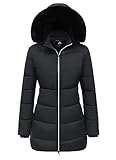
- This winter coat is filled with a lot of insulation and the density of polyester is 65% higher than what is usually found in the market. It ensures that you stay warm in the cold weather.
- With windproof ribbed cuffs and high density fabric, it has good windproof in winter windy weather. Don't let the winter wind make you shiver, it will make you more comfortable in winter.
- The simple, stylish and generous design with golden ratio stitching makes this women's winter coat full of this modern aesthetic and fashion. So even in winter, you still look stunning!
- The simple, stylish and generous design with golden ratio stitching makes this women's winter coat full of this modern aesthetic and fashion. So even in winter, you still look stunning!
- Please note: The warm down jacket will be folded and compacted inside the package upon delivery, so you may find it thin and flat; if so, gently pat the jacket with your hand and let it hang up.
When synthetic or hybrid insulation makes sense
Synthetic insulation is worth considering when you expect repeated wetting, high humidity or heavy exertion. A hybrid jacket can place down where maximum warmth-to-weight efficiency matters and synthetic insulation in moisture-prone zones. These options may be heavier or less compact than an equivalent down design, but avoiding a loss of loft can be more valuable than saving pack space.
Match the jacket to your use case
| Use case | What to prioritize | Weather strategy | Main trade-off |
|---|---|---|---|
| Cold, dry travel or backpacking | High fill power plus published fill weight, low total garment weight and reliable packability | Use the jacket as an insulating layer; carry a shell if conditions can change | Premium efficient down can cost more |
| Everyday commuting and casual wear | Adequate insulation, comfortable fit, durable shell and price that suits your use | DWR helps with incidental moisture; do not rely on it for sustained rain | Lower fill power may be heavier or bulkier |
| Rainy, humid or wet-snow climates | Weather protection, moisture-tolerant insulation and a construction that keeps loft when damp | Use a waterproof shell or synthetic/hybrid insulation | More weight or bulk than a highly efficient dry-weather down jacket |
| High-output activity | Breathability, ventilation, moisture management and a fit that allows movement | Carry a shell for storms; consider synthetic or hybrid zones | Maximum down insulation may feel too warm during exertion |
How to compare two jackets without misleading yourself
Build a specification sheet
Write down the intended activity, typical temperature range, precipitation, wind exposure and the layers you will wear. Then record each jacket’s fill power, fill weight if disclosed, total garment weight, insulation type, baffle description, shell fabric and stated water resistance. Add fit notes, hood and cuff features, care instructions and price. Keeping the same fields for every candidate exposes missing information instead of allowing one prominent number to dominate.
Use total garment weight correctly
Total weight includes shell fabric, zippers, pockets, hood and hardware as well as down. A jacket with a higher fill-power rating may still weigh more because it contains more insulation, has a longer cut or uses a tougher shell. Weight is a decision variable, not a proxy for warmth.
Treat undisclosed fill weight as a real limitation
Many manufacturers do not publish the mass of down. You can still compare fit, construction, shell and intended use, but you cannot claim a complete insulation ranking. Ask the manufacturer for the figure if it is important to your decision, and avoid inferring it from the fill-power number, listed total weight or price.
Current examples of fill-power numbers
These examples show how the number appears in current buying guides; they are not a definitive ranking or a promise that one model is warmer. Product specifications and model details can change, so verify the live listing before buying.
| Example cited by REI’s staff-picks page | Fill power | How to interpret it |
|---|---|---|
| REI Co-op Magma 850 Down Hoodie | 850 | High loft efficiency; warmth still depends on fill weight and construction |
| Patagonia Down Sweater | 800 | High loft efficiency; compare quantity, fit and weather protection with alternatives |
| Cotopaxi Fuego Hooded Down Jacket | 800 | Same rating as the example above does not establish equal warmth or weight |
The examples demonstrate why a rating-only comparison is incomplete. Two 800-fill jackets can differ in down quantity, baffle layout, coverage, shell and fit.
A step-by-step buying process
- Define the exposure. Write down whether you expect dry cold, wind, rain, wet snow, humidity or intense activity. Include the lowest conditions you realistically encounter rather than an extreme scenario you rarely face.
- Decide how much weight and packability matter. Backpackers and climbers may value high fill power because it can deliver more loft for less mass. A commuter may prefer a tougher or roomier jacket even if it packs larger.
- Set a minimum insulation requirement. Use the product’s stated insulation amount and coverage where available. Do not set a “minimum fill power” and assume it equals warmth.
- Find fill weight. Record the manufacturer’s number when published. If it is missing, mark the comparison as incomplete rather than estimating.
- Inspect construction. Check baffle layout, insulation distribution, hood and collar coverage, cuff and hem closure, zipper protection and pocket placement.
- Evaluate the shell. Confirm whether the fabric has DWR, whether the down is treated for water resistance and whether the product is actually described as waterproof. A water-resistant finish is not a substitute for a shell in driving rain.
- Check fit over real layers. Test movement and closure over your base and mid-layers. Avoid compressing the insulation or leaving large openings around the neck, hem and cuffs.
- Compare care requirements. Read the care label before purchase. Down needs appropriate washing and thorough drying to restore loft; use only products and methods the manufacturer permits.
- Make the weather plan. If rain is possible, budget space and weight for a waterproof shell. If sustained wet exposure is normal, compare synthetic and hybrid alternatives before choosing down.
- Recheck the live specification. Model names, fill ratings, materials and prices can change. Confirm the current details from the manufacturer or retailer at the time of purchase.
Care, moisture and recovery
Follow the garment’s care label rather than applying a generic washing schedule. REI notes that a down wash such as Nikwax’s can help maintain the water resistance of water-resistant down. That is a maintenance aid, not a way to restore a failed waterproof barrier. If the shell is leaking through seams or fabric, cleaning alone will not turn the jacket into a rain shell.
Rank #4

- [More Comfortable] Outdoor Ventures women's puffer jacket with hood features high-tech insulation to insulate cold air and retain warmth; The elasticized cuffs and hem of this winter coat can more effectively prevent wind from entering and make you warmer; Impeccable fit built to keep you protected in milder weather; Center-front zipper has zipper garage at chin for next-to-skin comfort.
- [Humanized Design] Outdoor Ventures women's hooded puffer jacket includes 2 outside zipper pockets and 1 zipper chest pocket. It is great for storing money, keys, phone, wallet, passport etc, providing great privacy and convenience for you.
- [Packable Design] This jacket easily folds into its own left side pocket, transforming into a compact zippered bag as shown in the main image. The fold-in-pocket version also comes with a separate drawstring pouch, giving you a second storage option. Whichever method you choose, you'll never stress over losing the bag or needing a replacement.
- [Warm Lightweight Winter Jacket] Outdoor Ventures women's lightweight insulated jacket features water-resistant fabric which will keep you dry in light rainy day; this full zip jacket for women is versatile as a 3-season jacket in fall, spring and winter.
- [Multipurpose] Our outdoor apparel suitable for casual wear, outdoor work, traveling, cycling, hiking, fishing, camping. A must for your wardrobe in spring, autumn and winter.
Store the jacket so its insulation can regain loft, and avoid judging warmth when the down is compressed in a stuff sack. After exposure to moisture, dry it according to the care instructions before long-term storage. A jacket that remains damp can lose loft and develop odors or damage, while aggressive heat or incorrect washing can harm the shell or insulation.
Common buying mistakes and fixes
Mistake: choosing the largest fill-power number
Fix: compare fill weight, coverage and construction. The rating is efficiency, not a complete warmth score.
Mistake: assuming a DWR finish is waterproof
Fix: carry a waterproof shell for sustained rain, or choose a jacket explicitly built with waterproof shell construction.
Mistake: using total jacket weight as a warmth ranking
Fix: separate down mass from shell, hardware and length. A heavier jacket may contain more insulation or a more durable shell.
Mistake: ignoring fit until the jacket arrives
Fix: test the jacket over your real layers and check hem, cuffs, collar and hood movement before removing tags.
Mistake: expecting a universal temperature conversion
Fix: treat temperature claims as product-specific and account for activity, layers, wind, moisture and personal comfort.
Bottom line
Choose the jacket that provides enough total loft in the places you need it, fits over your layers and matches your weather strategy. Fill power tells you how efficiently the down lofts; fill weight tells you how much down you get. Construction, shell protection, fit and conditions determine whether that insulation remains useful. For dry cold and low-weight travel, efficient down is compelling. For prolonged wet weather or hard exertion, pair down with a waterproof shell or move to synthetic or hybrid insulation.
Quick Recap
Product prices and availability are accurate as of the date/time indicated and are subject to change. Any price and availability information displayed on Amazon at the time of purchase will apply.

