
What’s actually slowing this PC down?
Pick the symptom - the matching free tool is one click away.
iTechGuides is reader-supported. When you buy through links on our site, we may earn an affiliate commission. As an Amazon Associate I earn from qualifying purchases. Learn more
Maybe—but the answer depends on the exact laptop, power bank model, USB-C port, power-delivery profile, and cable. A USB-C-shaped connector does not automatically mean a laptop can be charged from it. Confirm that the laptop accepts USB-C Power Delivery, compare its required wattage with the Anker bank’s maximum output from the single port you will use, and use a cable rated for that power.
Follow the checks below before you rely on an Anker power bank as a laptop charger. They also explain why a bank’s large capacity or impressive combined multi-port wattage can be misleading.
The compatibility rule in one sentence
An Anker power bank can charge a laptop only when all parts of the chain agree: the laptop must accept charging through the port, the bank’s individual USB-C port must provide a compatible USB Power Delivery (USB PD) profile at sufficient wattage, and the cable must support the target power and protocol.
Quick wins for a faster PC:
Scan for outdated or missing drivers - takes under a minuteDriver Scan →Clear out junk files and repair common Windows errorsFree Scan →If any one of those conditions fails, the laptop may show no charging, charge very slowly, or lose battery while it is running. There is no universal yes-or-no answer for “an Anker power bank” because Anker sells banks with different port capabilities, and laptops vary widely in whether and how they accept USB-C power.
#1 Best Overall

- Triple 100W USB-C Ports for Multi-Device Charging: Ideal for laptop users, this 25,000mAh power bank features three 100W USB-C ports for simultaneous charging—perfect for remote work, home offices, or powering up multiple devices on the go.
- 25,000mAh for Long-Haul Power: Tackle week-long trips or extended camping with 25,000mAh capacity and ultra-fast recharge speeds for the power bank when used with a 100W or higher charger. (Note: Complies with 100Wh airline restrictions and is airline carry-on friendly.)
- Dual Built-In Cables for Travel: Features two USB-C cables, one extendable up to 2.3 ft with 20,000 retractions, and another at 0.98 ft cable that doubles as a durable carrying strap capable of enduring more than 20,000 bends. Built to handle family travel, outdoor activities, and emergency backup needs.
- Charge 4 Devices at Once: Power up smartphones, tablets, or other USB-enabled devices thanks to dual USB-C cables, a USB-A port, and a USB-C port.
- What You Get: Anker Power Bank (25K, 165W, Built-In and Retractable Cables), protective pouch, user manual, 18-month warranty, and our friendly customer service. (Note: Charger shown in the video is not included.)
What to check before connecting anything
1. The laptop’s charging input
Look up the exact model number in the laptop maker’s specifications or manual. Confirm both of these points:
- The laptop accepts charging through the USB-C port you intend to use.
- The documentation identifies USB Power Delivery (USB PD), or otherwise states the USB-C input voltage and wattage that the port accepts.
Some laptops have USB-C ports used only for data, display output, or accessory power. A connector that fits is not proof that the port is a charging input. If the documentation lists a dedicated charging socket and does not describe USB-C charging, treat USB-C power-bank charging as unconfirmed.
2. The laptop’s power requirement
Read the wattage printed on the original charger or listed in the manufacturer’s specifications. Use the requirement for the laptop input, not the battery’s capacity and not the wattage of a phone charger that happens to fit. If the maker gives a recommended or minimum USB-C input, record that figure and any stated voltage/current combinations.
Recommended Free Tools
For example, a laptop specification that calls for a 65-watt USB PD input gives you a target against which to compare the bank’s single-port output. It does not prove that every 65-watt bank will work: the PD profiles and the cable still have to match.
3. The Anker bank’s single-port output
Find the exact model number on the bank or its packaging, then read the output table for the USB-C port you will use. Compare the laptop requirement with that port’s maximum output and supported PD profiles.
Do not use the headline total for all ports as the comparison. A bank advertised with 250W total output may provide only 140W to one USB-C port. The laptop sees the output negotiated on its own port, not the sum of every port on the bank.
Rank #2
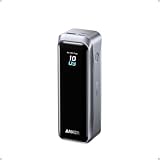
- 220W Total Output Power: Keep your office setup running strong with 220W total output from two USB-C ports and one USB-A port.
- Flight-Ready 20K Power: Carry 20,100mAh (72.36Wh) of portable, TSA-approved power, enough for up to 4.2 days of video streaming on an iPhone 17 Pro Max.
- 140W Max Fast Charging: Delivers up to 140W high-speed output for fast laptop charging when connected to a 5A cable. Charge a 16" MacBook Pro (M4 Pro) to 50% in 28 minutes.
- High-Speed 100W Max Recharging: Recharge Anker Prime Power Bank to 50% in 25 minutes using the 100W max USB-C input.
- What You Get: Anker Prime Power Bank (20K, 220W), 3.3 ft USB-C to USB-C charging cable (240W), travel pouch, welcome guide, 24-month warranty, and our friendly customer service.
4. The cable’s rating
The cable is an active part of the compatibility chain. Use a USB-C-to-USB-C cable rated for the power you are trying to draw and for the relevant USB PD mode. Anker states that reaching 140W from its 737 Power Bank requires both a PD 3.1-capable cable and a device that supports PD 3.1 input.
USB Power Delivery 3.1 can support up to 240W over a suitable full-featured USB Type-C cable and connector, according to the USB Implementers Forum (USB-IF). That is the standard’s ceiling, not a promise that your laptop, bank, or cable supports 240W. A cable’s physical connector shape alone does not establish its power rating.
5. Other devices connected to the bank
Check the output rules for simultaneous use. A bank may reduce the output available to the laptop when another USB-C or USB-A device is drawing power. Judge the setup using the available per-port output under that multi-device condition, not the bank’s single-device maximum.
Step-by-step: verify your particular laptop and power bank
- Write down the full laptop model. Use the model identifier from the underside label, operating-system system information, purchase record, or manufacturer support page. Similar-looking versions can have different charging inputs.
- Read the laptop’s official specifications. Search the exact model’s technical specification for “USB-C charging,” “USB Power Delivery,” “power input,” or “adapter.” Confirm the relevant port and the required or recommended wattage.
- Record the original charger rating. A label showing a voltage and current can be multiplied to understand the charger’s nominal wattage; use the laptop maker’s stated requirement when one is available. Keep the charger’s connector type in mind—USB-C and barrel charging are not interchangeable by appearance.
- Identify the exact Anker model. Product families can contain several revisions. Use the model code printed on the bank, then open that model’s output specification rather than relying on a retailer headline.
- Read the output for the chosen USB-C port. Note its maximum wattage, voltage/current combinations, and PD version or profiles. Use this single-port figure. If the table gives separate values for USB-C1 and USB-C2, choose the value for the port you will actually use.
- Check the cable. Verify its wattage rating and PD 3.1 support when the target output requires it. Replace an unknown or low-rated cable before diagnosing the bank or laptop.
- Test with only the laptop connected. Turn on the bank, connect the cable to the bank’s specified USB-C output and the laptop’s documented charging USB-C input, and watch the laptop’s charging indicator. Then test again with the laptop under a normal workload. Finally, add other devices only if the bank’s multi-port output table shows enough remaining power.
How to interpret the laptop’s requirement
“Wattage” describes the rate at which power can be delivered. The laptop’s requirement is the input it needs to charge as designed; the bank’s output is the maximum rate its port can offer. The bank does not force its maximum into the laptop. USB PD negotiation selects a voltage and current that both devices advertise.
| What you find in the laptop documentation | What it means for the check |
|---|---|
| USB-C charging explicitly supported, with a stated wattage | Compare that wattage and the stated PD profiles with the bank’s single-port output and cable rating. |
| USB-C port listed, but charging is not mentioned | Do not assume it charges. Look for a manual or support entry that identifies USB-C as a power input. |
| Only a barrel or proprietary charging connector is specified | USB-C power-bank compatibility is unconfirmed. Match voltage, current, connector, and adapter requirements from the laptop maker before attempting it. |
| Several charging options or different USB-C ports are listed | Use the port and requirement that correspond to the configuration you will actually use; ports can have different capabilities. |
A bank whose output is below the laptop’s normal charging requirement may still charge some models at a reduced rate, but the result is workload-dependent. Under heavy processor or graphics load, the laptop can consume power faster than the bank supplies it. It may charge slowly, hold its current percentage, or continue to discharge.
Windows Errors? Fix Them Before They Spread
Repair common Windows errors and clear accumulated junk for a smoother, more stable PC - no reinstall needed.Free scan · no reinstallCrashes, No Sound, or Screen Glitches?
Random freezes, missing sound and display glitches usually trace back to one bad driver. Find and replace yours safely.Free scan · under a minuteReading Anker’s published specifications
The following examples show why model-level and port-level figures matter. They are manufacturer specifications from current listings retrieved in 2026, not independent laboratory tests.
Rank #3

- 87W Power to Share: Distribute 87W across three devices, with a single device receiving up to 65W, to rapidly charge iPhones, Samsung phones. Quickly charge a 14" MacBook Pro to 50% in under 40 minutes.
- Speedy Cable Charging: Utilize the built-in cable to elevate your iPhone 15 Pro to 58% or a MacBook Air to 52% in 30 minutes. You can also fully recharge this power bank in 1.5 hours with a 65W charger.
- 20,000mAh for Extended Use: Eliminate concerns about battery depletion with a 20,000mAh power bank that ensures consistent, reliable charging for all your devices, also approved for airline travel.
- Lasts Longer, Charges Faster: The integrated USB-C cable is designed to endure, withstanding over 10,000 bends for dependable charging and convenient storage.
- What You Get: Anker Power Bank (20K, 87W, Built-In USB-C Cable), 6.2 × 2.9 × 1.0 in (15.5 oz), welcome guide, 18-month warranty, and friendly customer service.
| Anker model | Stated capacity | Maximum output stated by Anker | How to use the figure |
|---|---|---|---|
| Anker 737 Power Bank (PowerCore 24K), model A1289 | 24,000mAh | Up to 140W maximum output | Check the output table for the USB-C port. Anker says reaching 140W requires a PD 3.1-capable cable and a device that supports PD 3.1 input. |
| Anker Prime Power Bank (27K, 250W), model A1340 | 27,650mAh | 250W total maximum; up to 140W from one USB-C port | Use the individual 140W USB-C figure for one laptop. The 250W number is a combined multi-port maximum, not the power delivered to a single laptop. |
Anker’s guide reports that, under its stated test conditions, the Prime 27K charged a 16-inch MacBook Pro with an M2 Pro chip to 50% in about 28 minutes using up to 140W. That is a vendor-reported result for that computer, bank, cable, software state, and test setup; it is not a universal charging time for every laptop or a substitute for checking your model.
Anker’s own guidance summarizes the practical rule this way: “For reliable charging, use a USB-C power bank with sufficient single-port output and a cable rated for the required power.” Treat that as a compatibility checklist, not as a guarantee that every USB-C laptop will work with every USB-C bank.
Capacity and output answer different questions
Capacity, usually printed in mAh and sometimes expressed in watt-hours, describes how much energy the bank stores. Output wattage describes how quickly the bank can deliver energy. A large capacity number can extend the time a laptop runs away from an outlet, but it does not prove that the bank can start charging that laptop or sustain its required input rate.
- Capacity affects endurance: a larger bank generally has more stored energy available, subject to conversion losses and the laptop’s consumption.
- Output affects compatibility: the USB-C port must negotiate a voltage/current combination the laptop accepts and provide enough power for the intended use.
- Neither number identifies the PD profile: read the detailed output table and the cable specification.
Do not promise a full charge, a particular number of hours, or a fixed percentage increase from capacity alone. The outcome changes with battery size, laptop workload, display brightness, power-management settings, conversion efficiency, cable losses, and whether the laptop is running during the test.
What happens when the wattage is lower than the laptop’s requirement?
Light use
During light work, a lower-output source may provide enough net power to raise the battery percentage slowly. The laptop can still report “plugged in” while charging at a reduced rate.
Heavy use
Compiling software, rendering video, gaming, or running other demanding workloads can push consumption above the bank’s output. The battery may fall even though the charging icon is visible. This is not necessarily a defective bank; it can be a normal result of insufficient available wattage.
Rank #4

- 200W Total Output for Professionals:This power bank delivers up to 200W total output. Each USB-C port has its own maximum output: USB-C1 up to 140W, USB-C2 up to 100W. When both ports are used simultaneously, the combined output can reach 200W, making it ideal for photographers, videographers, designers, and gamers, ensuring uninterrupted workflow and entertainment.
- 25000 mAh Capacity: During long-distance travel or camping, this ugreen battery pack can be used as an emergency power supply to provide sufficient power for multiple devices, it is enough to charge an iPhone 17 pro 4.3 times
- Charging 3 Devices at Once: Improving the flexibility of use, when you are at a party, usb c power bank can become a shared resource, everyone can charge their own devices simultaneously, avoiding the inconvenience caused by waiting for charging
- TFT Display:Real-time display of battery level, remaining time, output/input power, voltage, current, and other information, showcasing the charm of technology. Compared to an LCD screen, the display content is more delicate and the colors are richer
- Durable & Safe:After 1000 charge-discharge cycles, the capacity still remains above 80%, multiple protections and professional safety certifications, real-time temperature detection and high-speed heat dissipation ensure worry-free use
Negotiation failure
If the bank and laptop share no compatible PD profile, the laptop may refuse to charge altogether. A cable that cannot carry the requested mode can produce the same symptom. Compare the profiles before concluding that the capacity or battery health is the problem.
The Tool Desk
Outbyte Driver Updater FREEScan for outdated or missing drivers - takes under a minuteDriver Scan →Outbyte PC Repair FREEClear out junk files and repair common Windows errorsFree Scan →Using a laptop with a barrel connector
Do not assume that a USB-C-to-barrel adapter makes any power bank compatible. Barrel connectors vary in diameter and polarity, and laptops can require specific voltage, current, and charging behavior. A mismatch can prevent charging or damage equipment.
For a barrel-input laptop, verify all of the following against the laptop maker’s specifications and the adapter documentation:
- Required voltage and acceptable tolerance
- Required current or wattage
- Connector dimensions and polarity
- Whether the adapter is designed to negotiate or regulate the required power
- Whether the power bank can provide that voltage and current continuously
If those details are not established, use the laptop’s approved charger or a power solution explicitly specified for that model instead of experimenting with a generic adapter.
How to confirm that charging is really working
- Start with a known-good configuration. Disconnect every other device from the bank and use the cable whose rating you have verified.
- Check the laptop’s status, not just the bank’s display. Look for the operating system’s charging indicator or the manufacturer’s charging light. A lit bank display only proves that the bank is on.
- Observe the battery percentage for several minutes. A percentage that rises confirms net charging. “Plugged in” with a falling percentage means the source is not keeping up with the current workload.
- Repeat while the laptop is idle or asleep. If it charges while idle but not during demanding work, the likely limitation is available wattage rather than a basic connection failure.
- Test another documented USB-C input or output port if applicable. Only do this when the laptop and bank specifications identify those ports as charging-capable; do not swap ports solely because the connectors fit.
- Reconnect after changing one variable. Try a different rated cable, then a different bank port, changing one item at a time so the failed link can be identified.
Troubleshooting: no charging or unexpected behavior
The laptop shows no charging icon
- Recheck that the laptop’s exact model supports USB-C charging.
- Move the cable to the bank’s specified high-output USB-C port.
- Confirm that the cable is USB-C-to-USB-C and rated for the requested power.
- Remove other devices from the bank and power-cycle the connection.
- Compare the bank’s PD profiles with the laptop’s documented input profiles.
The laptop charges only when asleep
This usually indicates that the source can provide some power but not enough for the active workload. Check the single-port wattage and test with a lighter workload. Do not interpret sleep-only charging as proof that the bank can replace the laptop’s normal charger under load.
Do these 3 things before closing this tab:
1Clear out junk files and repair common Windows errors2Fix the driver behind crashes, sound loss and screen glitches3Repair Windows errors before they cause bigger problemsThe bank works until another device is connected
Read the bank’s simultaneous-output table. The laptop may receive less power when another port is active. Keep the laptop on the highest available port, or disconnect the secondary device when laptop charging is the priority.
Best Value

- Ultra-Fast 145W Charging: With PD3.1 and QC3.0, deliver a total of 145W fast charging. A single USB-C1 port provides up to 140W, powering a 16" MacBook Pro from 0-56% in just 30 minutes
- Massive 25000mAh Capacity: Ugreen's power bank features a huge 25000mAh battery, capable of fully recharging laptops up to 1.3 times and mobile devices up to 5.2 times
- Two-Way Fast Recharge: Recharge the battery pack in just 2 hours using a 65W PD charger (not included). Our bi-directional technology allows for simultaneous fast charging of both the power bank and your devices
- Compact & Convenient: With a sleek, compact design, this portable charger is incredibly portable. The digital display shows remaining battery life at a glance, ensuring you always stay powered and confident on the go
- Wide Compatibility: Compatible with a wide range of devices including MacBook, Dell XPS, HP Spectre, iPad, iPhone 16-12 series, Galaxy S24, Switch, DJI, Steam Deck, and more
The bank stops and starts charging
Inspect the cable and connectors for looseness, then verify that the bank is not entering a low-current or protection mode. Test with only the laptop connected and compare the observed behavior with the manufacturer’s output limits. If the laptop still repeatedly disconnects with a documented, correctly rated setup, contact the relevant manufacturer rather than forcing a different voltage or using an unverified adapter.
The bank becomes empty quickly
A power bank can deliver the correct wattage and still provide limited runtime if the laptop draws substantial power. Capacity is finite, and conversion from the bank’s internal cells to the laptop’s operating voltage is not lossless. Treat the bank as a temporary power source, not as an outlet replacement.
A practical decision checklist
Mark every item before relying on the setup away from mains power:
- Exact laptop model identified
- USB-C charging explicitly confirmed for the port being used
- Laptop input wattage and PD requirements recorded
- Exact Anker model identified
- Single-port USB-C output meets or is intentionally below the laptop requirement
- Compatible PD profiles confirmed on both devices
- Cable rating matches the target power; PD 3.1 support confirmed when required
- Effect of simultaneous use of other bank ports understood
- Charging indicator and battery percentage verified under the workload you expect
If any box is unchecked, the correct conclusion is “compatibility not established,” not an assumption based on the USB-C connector or the bank’s capacity label.
Bottom line
To determine whether an Anker power bank can charge your laptop, verify the laptop’s USB-C charging support, compare its required wattage and PD profiles with the Anker bank’s single-port USB-C output, and use a cable rated for that connection. Capacity tells you how much energy is stored; it does not establish charging compatibility. The Anker 737 and Prime 27K examples show why a 140W single-port specification must be separated from a bank’s combined output, and why even a high-output bank still depends on the laptop and cable supporting the same power-delivery mode.
Quick Recap
Product prices and availability are accurate as of the date/time indicated and are subject to change. Any price and availability information displayed on Amazon at the time of purchase will apply.

