
Quick wins for a faster PC:
Repair Windows errors before they cause bigger problemsFix Now →Scan for outdated or missing drivers - takes under a minuteDriver Scan →Clear out junk files and repair common Windows errorsFree Scan →iTechGuides is reader-supported. When you buy through links on our site, we may earn an affiliate commission. As an Amazon Associate I earn from qualifying purchases. Learn more
You can check some fuses without a multimeter, but the right method depends on the fuse and circuit. For a transparent fuse, a visual inspection can reveal a broken or melted element; for an automotive low-voltage blade fuse, a suitable 12-volt test light can check both sides while it is installed. Those methods do not apply universally: household mains equipment needs different precautions, and a fuse that looks intact may still have failed.
First identify the fuse and its circuit
Before checking anything, determine whether you are dealing with an automotive blade fuse or a household plug fuse. A 12-volt automotive test light is intended for vehicle low-voltage circuits, not household mains. For other fuse types, follow the equipment’s instructions rather than improvising a test.
- Automotive blade fuse: You may inspect a removable fuse or use a suitable automotive test light on its exposed test points.
- UK plug fuse: Unplug the plug from the socket before opening it. Match any replacement to the original rating.
- Opaque cartridge or appliance-internal fuse: There is no universal safe no-meter procedure established here. Use the equipment instructions and an appropriately rated tester, or contact a qualified technician.
Inspect a removable fuse visually
If the equipment instructions allow you to remove the fuse safely, inspect it in good light. On a transparent fuse, a separated, melted, or blackened element is a strong sign the fuse has failed. A filament that appears intact does not prove the fuse is electrically sound, especially if the housing is opaque or the element is hard to see. TotalEnergies describes visual inspection as a first step and notes that a meter can confirm a fuse that looks intact (TotalEnergies’ car-fuse guide).
For a vehicle, check the owner’s manual and fuse-box diagram before removing anything. Some vehicles provide a fuse-removal tool on the inside of the fuse-box cover; others may include a puller or plastic tweezers (Ford support; TotalEnergies’ car-fuse guide). Remove one fuse at a time, and return any fuse you are not replacing to its original position.
#1 Best Overall

- 【PRECISE READOUTS & CLEAR DIGITAL DISPLAY】Bright LED display shows highly clear readings in any lighting condition, 0.1V resolution gives you reliable indication and shows you the voltage number easily & quickly. Bidirectional light emitting diode on the circuit board for easy battery load testing, red light indicates positive polarity, green light indicates negative polarity.
- 【QUICK DETECTION & EXTENSIVE USE】WINAMOO auto circuit tester helps you to quickly test car battery voltage and diagnoses issues in 3V-48V systems, including alternator tester functionality of car/truck/SUV/boat charging systems. Also to inspect circuit tester integrity of headlights, taillights, turn signal circuits, faulty sockets, fuse connections and more.
- 【SHARP PROBE & ANTI-LOST PROTECTIVE SLEEVE】Sharp stainless steel probe for piercing insulation with ease, also for hard to reach tight areas. Integrated anti-lost protective sleeve to secure the probe during storage and safeguarding against damage, making sure no stab and wound and won't be lost wherever you go.
- 【EXTENDED SPRING WIRE & LARGE ALLIGATOR CLIP】High quality 96 inch long enough spring wire increases flexibility to access across broad areas when testing. Attaching with large crocodile clip for easy single-handed operation, which is boosting the efficiency for car battery capacity checks and beyond.
- 【ULTRA-DURABLE & SAFE CONSTRUCTION】This voltage tester pen adopts ergonomic handle for comfort and safe grip. Constructed with premium ABS body with higher transparency, shatter-proof and durable. Ensuring reliable battery meter and circuit analysis for safe operation, making them an essential tool in electrical troubleshooting.
Test an automotive blade fuse with a 12-volt test light
This check applies to a suitable automotive test light and a vehicle’s low-voltage circuit. The fuse can remain installed. It is a voltage check—not a universal continuity test—and the circuit must be powered in the state you are testing.
- Identify the fuse and required circuit state. Use the vehicle’s fuse-box diagram or owner’s manual. Some circuits are powered only with the ignition on or a particular load switched on, as noted in this vehicle fuse-testing guide.
- Check the tester and ground. Verify that the test light works on a known powered source appropriate for that tester, then connect its clip to a verified ground.
- Probe both test points. With the fuse installed, touch the probe to each of the two small exposed test points on top of the blade fuse.
- Interpret the result. If the light illuminates on both sides, power is reaching both fuse contacts, which is consistent with a conducting fuse. If it lights on one side only, the fuse is likely open. If it lights on neither side, the circuit may not be powered in that state, or the tester or ground may be faulty.
Automotive training material likewise describes grounding the test lamp and probing fuse contacts; one-sided illumination indicates a defective fuse, while no illumination on either side can indicate a power-source or ground problem (Automotive training material). Do not treat a dark test light on both sides as proof that the fuse is blown.
Rank #2
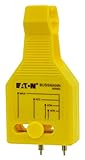
- QUICKLY TEST BLADE-STYLE AUTOMOTIVE FUSES – Bussmann FT-3 Fuse Tester helps diagnose blown or functioning blade fuses in seconds, making it easy to identify electrical issues in cars, trucks, SUVs, RVs, boats, and other 12V automotive applications.
- COMPATIBLE WITH STANDARD BLADE FUSE TYPES – Designed for use with common automotive blade fuses, including ATC, ATO, and other blade-style fuse formats, providing a convenient solution for vehicle electrical troubleshooting and maintenance.
- SIMPLE AND EASY TO USE – No complicated setup required; quickly check fuse continuity to determine whether a fuse is operational or needs replacement, helping reduce diagnostic time and unnecessary parts replacement.
- COMPACT TOOL FOR GLOVE BOX OR TOOL KIT – Lightweight, portable design fits easily in automotive toolboxes, service carts, garages, or vehicle emergency kits, ensuring fuse testing capability is always within reach when electrical problems arise.
- TRUSTED BUSSMANN ELECTRICAL DIAGNOSTIC ACCESSORY – Manufactured by a leading name in circuit protection, the FT-3 Blade-Style Fuse Tester provides a reliable way for DIYers, technicians, and professional mechanics to verify fuse condition and maintain vehicle electrical systems.
What each no-meter method can—and cannot—tell you
| Method | Fuse removal | Power needed | What the result means | Scope and limitation |
|---|---|---|---|---|
| Visual inspection | Usually, if permitted by the equipment instructions | No | A visibly broken, melted, or blackened element strongly suggests failure | Tool-free, but an apparently intact element does not establish that the fuse is sound; most useful with transparent fuses. |
| Automotive test light | No; probe the installed blade fuse | Yes, at the fuse’s circuit contacts | Light on one side only is consistent with an open fuse; light on both sides is consistent with power passing through | For suitable 12-volt vehicle circuits only; depends on circuit state, tester function, and a good ground. |
| Continuity or resistance check | Typically, yes | No; the circuit must be de-energized | Tests electrical continuity directly | Requires a multimeter or dedicated continuity tester, so it is outside this guide’s no-multimeter methods. |
Handle UK plug fuses without probing live equipment
Unplug the plug from the socket before opening it. Electrical Safety First advises: “If you have to replace a fuse, replace it only with another of the same rating.” Check the appliance manufacturer’s instructions if you are unsure which rating is correct. The organization lists 3A and 13A as common UK plug fuse ratings, but those examples do not replace the appliance’s specified rating (Electrical Safety First’s plug and fuse guidance).
Do not use an automotive test light on household mains, or open and probe a consumer unit, service fuse, or appliance enclosure as an improvised test. Electrical Safety First advises taking burn marks, arcing sounds, overheating, or repeated fuse problems seriously: unplug the equipment and contact the retailer, manufacturer, or a qualified repair technician (Electrical Safety First).
Rank #3

- Precision Measurement - The automobile current tester is engineered for high-accuracy electrical current measurements in automotive applications. Can provides real-time readings that help diagnose issues effectively. The high-resolution display ensures that even the smallest fluctuations in current can be detected, allowing for quick identification of potential problems.
- Portable Design - The automotive tester is designed with portability in mind. Its lightweight and compact form factor make it easy to carry around, whether you're moving between different vehicles in a workshop or taking it on the road for mobile diagnostics.
- User-Friendly Interface - Remove the blade fuse attached to the tester from the jack, and then remove thevehicle's fuse from the circuit to be tested and insert the tester's safety in the wiresocket, this ensures the correct level of circuit protection.Then the plug of the tester plug into the vehicle fusesocket. Maximum load is 20A/48V, standard type.
- Durable Construction - Built to withstand the rigors of automotive environments, the fuse tester boasts a robust construction that ensures longevity and reliability. Made from high-quality materials that resist impact and wear, making it suitable for use in busy workshops or outdoor settings. Also it designed to be waterproof, providing an extra layer of protection against spills or moisture.
- Note - This tester can only be used for current measurement of vehicles. Do not exceed the maximum load of the tester: maximum 20A 48V / 10 seconds. Turn off the ignition switch of the vehicle before connecting or disconnecting the tester. Battery include(23A 12V*1).
Replace a failed fuse with the specified type and rating
Use the exact type and rating required by the vehicle or appliance documentation. For a vehicle, follow its fuse chart rather than relying on a generic color chart, which may not cover every vehicle or fuse format. For a UK plug, match the original rating and check the manufacturer’s instructions if uncertain.
If a replacement fuse fails again, stop replacing it repeatedly. A recurring failure points to an underlying electrical fault that needs diagnosis; repeated replacement delays finding the problem (vehicle fuse-testing guide). Never substitute foil, bare wire, or a fuse with a higher rating.
Quick Recap
Best Value
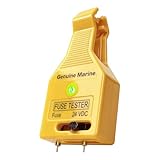
- Nerites Fuse Tester – Ideal for One-Time Fuses The Nerites fuse tester is perfect for checking disposable fuses. It allows quick and easy removal and helps inspect whether a fuse is blown, making it an essential tool for removing and testing fuse arrays.
- Fuse Clip with Built-in LED Indicator This fuse tester clip features an LED indicator that helps identify blown fuses in the fuse box. The light turns on when the fuse is intact, enabling fast troubleshooting of fuse-related issues.
- Non-Slip Adjustable Fuse Puller Designed with a non-slip handle for easy removal of automotive fuses. The adjustable test probes work with mini/standard and maxi-size blade fuses.
- Multi-Functional Fuse Tester Compatibility Besides testing disposable fuses—including mini (ATM), regular (ATC/ATO), and standard blade fuses—this tester also works with auto-reset and manual-reset circuit breakers.
- Compact and Portable Fuse Holder Measuring 70×30×25 mm (2.8×1.2×1 inches), this yellow fuse holder is small and easy to carry. It saves space and can be stored conveniently.
Rank #4

- SAFE & STURDY: This automotive test light features an ergonomic, non-slip handle for a comfortable and secure grip. It offers transparency, durability and resistance to drops, ensuring stable performance with long-term tough use. 39 inch PU wire is both flexible and lightweight, yet more robust than standard cables, significantly enhancing your work efficiency.
- HIGH BRIGHTNESS BULB: Built-in a quality bulb in this electric tester pen that provides bright and reliable illumination, high visibility light indicates circuits' signal. The bulb's brightness varies with different measured voltages, offering intuitive circuit signal indication and making it easy to assess circuit conditions.
- BIDIRECTIONAL CURRENT VOLTAGE TESTING: Simply connect the large size alligator clips to the positive or negative terminal, and use the probe to detect short circuits or faulty fuses on the other side, pinpointing issues accurately and handling various circuit diagnostics effortlessly.
- DURABLE PROBE & INSULATED HANDLE: This automotive circuit tester features a long, sharp stainless steel probe that easily pierce wire insulation and access tight spaces for precise testing, while the insulated handle enhances safety. This automotive electrical tester ensures safe operation in your daily use.
- WIDE APPLICATION: With a voltage testing range of 6-24V DC, this automotive circuit tester/fuse test light is suitable for diagnosing circuits in various vehicles, including turn signal circuits, headlights, taillights, motors, fuse connections, and other 6-24V DC circuits. It is your reliable assistant for automotive repair and maintenance.
Product prices and availability are accurate as of the date/time indicated and are subject to change. Any price and availability information displayed on Amazon at the time of purchase will apply.

