
iTechGuides is reader-supported. When you buy through links on our site, we may earn an affiliate commission. As an Amazon Associate I earn from qualifying purchases. Learn more
A Besu private network is an isolated blockchain with its own chain ID and membership, commonly using proof-of-authority consensus such as QBFT or IBFT 2.0. For a local demonstration, Besu’s Developer Quickstart creates a Docker Compose network; for a real deployment, treat network design, validator governance, key custody, RPC exposure and monitoring as separate operational decisions. The Quickstart is explicitly for education or demonstration, not production.
Choose a network setup that fits the job
There are two documented starting points: generate a local network with the Developer Quickstart, or configure nodes and genesis yourself using the QBFT tutorial. Both can help you learn how Besu works, but neither by itself defines a complete production architecture.
| Choice | What it provides | Best suited to | Important boundary |
|---|---|---|---|
| Developer Quickstart | Docker Compose files, scripts and Besu configuration for four QBFT validators and one non-validator RPC node. | A repeatable local learning or demonstration environment. | Besu describes it as not intended for production. Its sample accounts, keys and exposed services are not production defaults. |
| Manual QBFT tutorial | A guided setup in which you prepare node data directories, generate network configuration and genesis, start a bootnode, then connect additional nodes using its enode URL and distinct ports. | Learning how node configuration, peer discovery and validator setup fit together. | The tutorial warns that an isolated network is not automatically protected or secure; configure appropriate firewall controls. |
Prerequisites for the local Quickstart
The Developer Quickstart lists Docker, Docker Compose v2 or later, Node.js or Yarn, and curl as prerequisites. It says to allow Docker up to 6 GB of memory for this private-network example. That is a requirement stated for the example, not a production sizing recommendation.
The generated environment can optionally enable services including Chainlens and OpenTelemetry. Its local monitoring stack includes Prometheus, Grafana, Loki and Grafana Alloy. Keep those services scoped to the local demonstration unless you have deliberately designed and secured a different deployment.
#1 Best Overall

- Complete M6 rack screws kit: This M6 rack screws hardware kit comes with 45 square rack cage nuts, 45 rack mount screws and 45 black washers. All nuts and bolts are neatly stored in a sturdy compartmentalized plastic storage box, letting you quickly find hardware during server cabinet assembly, upgrade or maintenance. Ideal server rack accessories for your rack installation projects
- Durable carbon steel with black nickel plating: These M6 screws, rack screws and cage nuts are built from heavy-duty carbon steel with premium black nickel plating. The coating offers powerful resistance to rust, corrosion, oxidation and abrasion, prevents fingerprints and discoloration, and delivers dependable performance in high and low temperature environments for extended service life
- Precise sharp threads for secure installation: Our server rack screws and rack mount hardware feature deep, clean-cut sharp threads and smooth burr-free surfaces. These m6 screw threads install smoothly without stripping, creating firm fastening to stop loose connections on rack and cabinet equipment during long-term use
- Universal compatibility for square-hole racks: Our M6 x 16mm cabinet screws fit standard 10mm square-hole server racks and cabinets seamlessly. Great for mounting servers, switches, routers, A/V devices and TV mounts. Perfect bolts and nuts for data centers, server rooms, IT closets and commercial workspaces
- Tight tolerance manufacturing: These M6 rack screws are precision made to strict metric standards with average error below 0.01mm. The tight-tolerance thread design creates a snug fit and even force distribution, resisting slipping and deformation to keep rack-mounted hardware securely fixed. Works great with rack studs for square hole cabinet setups
Configure consensus and validator membership
QBFT is Besu’s recommended enterprise-grade consensus protocol for private networks. Validators take turns proposing blocks, and at least two-thirds must sign a block before it is added. Existing validators propose and vote to add or remove validators.
That quorum has a direct availability consequence: if more than one-third of validators stop participating, block production stalls. In the Quickstart’s four-validator example, three validators are needed for the two-thirds quorum; losing two leaves fewer than that threshold.
Plan validator operations
Validator membership is a governance and operations decision, not just a configuration value. The Besu documentation establishes the voting model and quorum, but does not prescribe an organization’s approval process. Define how your operators select validator accounts, protect signing keys, approve membership changes and maintain validator availability.
Rank #2

- 【Powerful Load-bearing】12U Network Rack Open Frame is constructed from durable cold rolled steel; Rack shelf supports enhance stability, wall-mounted capacity of 130lbs, the ground-mounted up to 260lbs
- 【Considerate Designs】Open-frame layout, including a top panel adding space, anti-slip shelf stops fixing devices and compatible racks for stack and expansion to meet requirements of home server rack
- 【Complete Accessories】A 12U open frame server rack, two ventilated shelves, four shelf stops, four velcro straps and a set of equipment mounting screws
- 【Versatile Application】Ideal for space-efficient multi-device setups in warehouses, retail, classrooms, offices and more; Excellent choices as AV Rack/IT Rack
- 【Effortless Setup】 Network Rack includes hardware, a comprehensive manual, mounting hole drilling template and an online assembly video to simplify setup
Besu’s client does not include key management. Besu documentation identifies Web3Signer as one option for accessing a keystore and signing transactions. Treat the signer and its key custody controls as separate components in your architecture rather than assuming the node process provides a production key-management system.
QBFT or IBFT 2.0?
Besu identifies QBFT and IBFT 2.0 as common proof-of-authority choices for private networks. The material here does not establish a comparative performance benchmark, so throughput alone is not a grounded reason to choose one. Evaluate the protocol against your network’s operating model and the consensus documentation for the version you deploy.
Build the network
For a local demonstration: use the Developer Quickstart
- Install the listed prerequisites and ensure Docker has the memory headroom specified for the example.
- Run the Developer Quickstart as documented. It generates a directory with Docker Compose files, scripts and Besu configuration.
- Start the generated network and verify that its four QBFT validators and separate non-validator RPC node are running.
- Use the generated local HTTP or WebSocket JSON-RPC endpoint for development clients. Do not assume these local endpoints are appropriate for remote or production access.
- Use the bundled monitoring services to inspect metrics and logs. Enable optional services such as OpenTelemetry only if they are useful to the demonstration.
For a manual learning setup: follow the QBFT sequence
- Create a distinct data directory for each node.
- Generate the network configuration and genesis file for the tutorial network.
- Start a bootnode, then start the other nodes with its enode URL and distinct ports.
- Configure the intended validator set; the tutorial demonstrates four validators.
- Query the QBFT JSON-RPC API to check the validator set, then inspect node logs for imported blocks.
The tutorial’s permissive host-allowlist and CORS settings are conveniences for its example, not secure production defaults. Restrict network reachability and RPC access according to your deployment instead of copying tutorial exposure settings without review.
Rank #3

- 【UNIVERSAL 19-INCH RACK COMPATIBILITY】No more ill-fitting hardware! Our M6 x 16mm fasteners fit all standard 19-inch SERVER RACKS, network cabinets and data centers—seamless lock-in, zero size guesswork, no return risks for mismatched parts. Perfect for your rack mount setup
- 【DURABLE BLACK ZINC-PLATED BUILD】Fight mild rust and stripping! Our RACK MOUNT HARDWARE features thick BLACK ZINC PLATING on carbon steel—resists wear, bending and indoor/semi-outdoor corrosion for 2+ years. Sturdier than generic flimsy fasteners
- 【50-PACK ALL-IN-ONE CAGE NUTS KIT】No mid-install part runs! Our complete 50-pack of CAGE NUTS includes matching M6 screws, washers + FREE self-locking cable ties—exact parts for rack/cabinet builds, no extra hardware store trips
- 【TOOL-FREE SNAP-ON EASY INSTALL】Skip complex tools and slow builds! Our RACK MOUNT SCREWS pair with snap-on cage nuts (hand-installed)—twist in with a basic Phillips driver, no stripping. Finish your rack setup in 10-15 mins, even for first-timers
- 【MULTI-USE RACK ACCESSORY HARDWARE】Max out your setup versatility! This hardware works for all NETWORK AND SERVER RACK ACCESSORIES—small business racks, office cabinets, home labs, audio racks. Washers prevent scratches, cable ties tidy wiring
Adding a node to the generated example
The Quickstart’s procedure updates the permissions configuration and static-nodes file with the new node’s enode URL, adds the node as a Prometheus scrape target, and restarts the network. Verify that the node appears and that the peer count increases. Those file changes describe the generated environment; adapt the approach to the topology and configuration of your own network.
Windows Errors? Fix Them Before They Spread
Repair common Windows errors and clear accumulated junk for a smoother, more stable PC - no reinstall needed.Free scan · no reinstallOutdated Drivers Are Slowing You Down
One free scan finds every outdated or missing driver and matches the right update for your exact hardware.Free scan · exact hardware matchSet permissioning boundaries deliberately
Besu provides node permissioning and account permissioning. Node permissioning limits which peers a node accepts; account permissioning can support requirements such as onboarding, suspension or restrictions on account actions.
Local permissioning protects the resources controlled by the node where the rules are configured. It does not make those rules binding for every other participant or encode them into blocks produced by nodes that do not follow them. A node can refuse a connection at its own boundary, but cannot force another operator’s node to enforce the same rule. Effective network-wide policy therefore depends on participant coordination and trust.
Rank #4
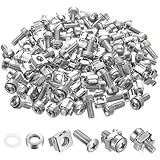
- Exquisite Material: Our rack mount screws are made of high-quality carbon steel, with high strength, strong durability, and high corrosion resistance, are not easy to deform or break, are reliable and stable, and can maintain good performance in any environment.
- Easy to Install: Cage nuts and screws have clear threads, uniform pitch, and better grip, nylon washers ensure better fixation of the screws, providing you with a smooth and satisfying installation process, the dimensions conform to standardized metric systems, making your work easier and more efficient.
- Easy to Store: All server rack screws and cage nuts are placed in storage boxes with labels and partitions, providing you with clear identification and orderly storage, and can also avoid loss, which is convenient and practical.
- Multi-scenario Application: These rack screws are compatible with most square hole racks and cabinets, suitable for installing various server rack hardware, such as rack server cabinets, server racks, equipment enclosures, A/V equipment enclosures, etc.
- M6 Rack Screw Kit: You will receive 55 pieces of rack mount screws with washers(M6x20mm), and 55 pieces of square cage nuts, sufficient quantity can meet your usage and replacement needs on different occasions, bringing you good Use experience.
- Decide which nodes and accounts your own node should accept.
- Coordinate corresponding rules with the other operators if you expect consistent network-wide behavior.
- Control RPC reachability, firewall rules and authentication separately; permissioning is not a substitute for those controls.
- Never use the Quickstart’s publicly visible test accounts or private keys on Mainnet or any production network.
Connect an application and deploy a contract
Besu supports JSON-RPC over HTTP and WebSocket. For a development client that submits a deployment transaction and waits for a response, HTTP is a straightforward choice. Use WebSocket when the application needs subscriptions, such as receiving updates without repeatedly polling. Neither transport removes the need to control who can reach the endpoint.
- Start the network and identify the intended RPC node and its configured endpoint and chain ID.
- Configure a compatible development tool, such as Hardhat, to use that endpoint and the private network’s chain ID.
- Compile the contract in the tool, then submit the deployment transaction using an account authorized and funded for that network.
- Use the transaction receipt and resulting contract address to confirm deployment; query the contract through the same network to verify it responds as expected.
The Quickstart endpoint and test credentials belong only to its local example. Its test private keys are public and must never secure a production deployment. Besu’s command-line and JSON-RPC interfaces also support workflows using tools such as Remix and web3j, but the connection and signing arrangements depend on the tool and the network operator’s design.
Do these 3 things before closing this tab:
1Scan for outdated or missing drivers - takes under a minute2Clear out junk files and repair common Windows errors3Fix the driver behind crashes, sound loss and screen glitchesMonitor health and troubleshoot progress
Besu can be observed through metrics and logs. The Quickstart bundles Prometheus and Grafana for metrics, Loki for logs and Grafana Alloy in the collection path; OpenTelemetry tracing is optional in that example. Besu’s monitoring documentation also discusses CPU and block-time patterns during sync, adjusting log levels and formats for diagnosis, and profiling with Java Flight Recorder or Pyroscope.
Best Value
![M6 Cage Nuts, Screws and Washers [Size: M6 x 16mm 50 Pack] Rack Mount Screws Hardware for use with Network and Server Rack Accessories, Routers, Cabinets and Enclosures.](https://m.media-amazon.com/images/I/51yizSYkrhL._SL160_.jpg)
- Pro Grade – Here is our new Black M6 Rack Screws and Cage Nuts Set [25 x Server Rack Screws, 25 x Cage Rack Nuts, 25 x Washers] used for mounting server racks, enclosures, cabinets, and more.
- Strong & Durable – Our Rack Cage Nuts & Relay Rack Screws for server rack have a high-grade carbon steel construction to prevent stripping. The M6 Cage Nuts and Bolts have also been coated in zinc chromate plating for resistance from corrosion.
- Wide application – Our rack screws & nuts are universally compatible with all square hole racks & cabinets. This makes the rack cage nuts and screws suitable for mounting all server rack hardware, including rack server cabinets, server shelves, A/V device enclosures, and other server mounting procedures.
- Easy to install – Our server rack screws and clip nuts have a Phillip’s truss-head with self-guiding pilot points to allow you to install in no time. The rackmount screws and nuts thread are extra sharp, clean & accurate, offering a smooth & satisfying installation process.
- Essential Bundle – Our Cage nuts & screws m6 set includes all the essential parts for mounting your server equipment. Pack not only includes screws & cage nuts; we have also thrown in additional heavy-duty washers to reduce any marks or scratches when installed. We truly believe our server rack nuts and bolts set is the best in the marketplace and we stand by that. If our cage nut set starts driving you nuts, we’ll FULLY REFUND YOU. So, click “Add to Cart” now and buy with confidence.
- Peers: Check peer count after adding a node and confirm the expected participants are connected.
- Consensus: Query the QBFT validator set and confirm it matches the intended membership.
- Block progress: Inspect logs for imported blocks; if production stalls, check validator participation against the two-thirds quorum.
- Resource and sync behavior: Review CPU and block-time patterns while nodes synchronize, then investigate unusual changes in the context of the workload.
- Diagnosis: Increase or change log detail when investigating a problem, then restore the operational logging configuration you intend to keep.
The cited monitoring guidance does not specify universal alert thresholds or a service-level objective. Set alerting and recovery procedures for your own expected workload, topology and availability requirements rather than treating example dashboards as a complete operating plan.
What must be decided for production
A working demonstration is not a production blueprint. The Besu material covered here does not prescribe production hardware sizing, a cloud provider, backup and disaster-recovery policy, organization-specific validator governance or a complete security architecture. Those decisions depend on the network’s participants, workloads and risk model.
Quick Recap
- Design validator placement, availability and membership-change approval around the QBFT quorum.
- Define key custody and signing separately from Besu, including how validators and applications are authorized to request signatures.
- Set network boundaries, firewall rules, RPC authentication and endpoint exposure deliberately.
- Establish backup, recovery and monitoring procedures for the actual deployment, and test them against its operational requirements.
Product prices and availability are accurate as of the date/time indicated and are subject to change. Any price and availability information displayed on Amazon at the time of purchase will apply.
Recommended Free Tools

