
iTechGuides is reader-supported. When you buy through links on our site, we may earn an affiliate commission. As an Amazon Associate I earn from qualifying purchases. Learn more
You can build a useful Wordle solver by counting how often each letter appears in each position among the remaining answer candidates, scoring guesses against those counts, then filtering candidates against the exact green, yellow and gray feedback. It is a clear, inexpensive baseline—not a guarantee of the fewest guesses. The key correctness detail is repeated letters: simulate feedback with greens first, then yellows, so a guess cannot claim more copies of a letter than the answer contains.
What the solver needs to track
Wordle uses five-letter guesses and returns five colored clues: green means the letter is correct and in the right position; yellow means it occurs elsewhere in the answer; gray means that occurrence is not matched. The cited solver documentation describes the game as allowing six guesses. A program needs to model both the words it may be solving for and the feedback each guess would produce.


Use two word pools when you want the solver to distinguish possible answers from accepted guesses:
answers: the words that may be the hidden target. Feedback filters this list after every turn.allowedGuesses: words the game accepts as guesses. This can include words that are not plausible answers but may help distinguish candidates.
Historical lists are not interchangeable with a current official list. Josh Stephenson’s repository documents 2,315 original answer words and 10,637 guess-only words; wordlesmith documents 2,315 original answers and a 14,855-word valid pool, labeled a mid-2025 snapshot. These are repository snapshots, not a verified current New York Times list or an official list endpoint. Check the game’s current behavior and the list’s provenance before treating a checked-in dictionary as complete.
#1 Best Overall
Why count letters by position?
General English letter frequency can suggest common letters, but it ignores where those letters occur in five-letter answers. Instead, count each letter separately at each index across the candidates still possible. If the remaining candidates commonly start with S, a guess beginning with S earns more positional weight than one using S elsewhere.
In the original-list example documented by Stephenson, S leads at position one, A at positions two and three, and E at positions four and five. Those rankings describe that particular list, not every later or regional answer set. Recalculate from your own remaining candidates rather than hard-coding the example.
Rank #2
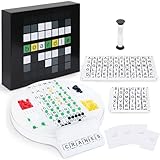
- Wordle Experience in a Board Game – Love Wordle? Boardle brings the same addictive 5-letter word challenge to your table, no screens required. Compete in real life word-guessing duels that capture the fun of the online game in a social, face-to-face format. (This game is unaffiliated with NYT/Hasbro Wordle.)
- Head-to-Head 2-Player Word Duel – Challenge a friend or partner in a battle of wits. Boardle is a 2-player board game where each player takes turns secretly writing a 5-letter word while their partner deciphers the other’s word through strategic guesses. It’s perfect for couples’ game nights or a quick round of competitive fun with a buddy.
- Fun for Family Game Night & Parties – Bring family and friends together with this fast-paced word puzzle game. Play one-on-one or form teams for group play. Boardle spices up parties, classrooms, and family game nights by getting everyone thinking and laughing as they race to crack the code.
- Build Vocabulary & Brainpower – More than just a game, Boardle is an educational word puzzle that helps expand vocabulary and sharpen spelling skills. Great for English learners and word enthusiasts, it’s an engaging tool for teachers or parents to make learning fun. (Screen-free brain teaser!)
- Premium Quality & Complete Set – Boardle comes with a durable game board, letter tiles, color-coded clue pegs, and even a sand timer for timed rounds – everything you need for endless play. High-quality components ensure longevity, and the sleek design makes it a great gift for puzzle lovers. (Ages 14+)
Implement exact Wordle feedback first
Candidate filtering only works when the simulator reproduces the game’s duplicate-letter rules. A reliable method first marks exact-position matches as green and consumes those target letters. It then checks each unmatched guess letter against the still-unconsumed target letters: a match is yellow and consumes one occurrence; no match is gray. This two-pass approach prevents a guess with repeated letters from receiving too many yellow tiles.
The Tool Desk
Outbyte PC Repair FREERepair Windows errors before they cause bigger problemsFix Now →Outbyte Driver Updater FREEFix the driver behind crashes, sound loss and screen glitchesFind Drivers →function scoreGuess(answer, guess) {
const result = Array(5).fill("gray");
const remaining = answer.split("");
// Exact matches consume their answer-letter occurrence first.
for (let i = 0; i < 5; i++) {
if (guess[i] === answer[i]) {
result[i] = "green";
remaining[i] = null;
}
}
// Misplaced matches can use only occurrences not already consumed.
for (let i = 0; i < 5; i++) {
if (result[i] === "green") continue;
const match = remaining.indexOf(guess[i]);
if (match !== -1) {
result[i] = "yellow";
remaining[match] = null;
}
}
return result;
}
function filterCandidates(candidates, guess, observed) {
return candidates.filter(word =>
scoreGuess(word, guess).every((color, i) => color === observed[i])
);
}This representation expects lowercase five-character words and an observed array containing five values: "green", "yellow" or "gray". For example, if the answer is "allee" and the guess is "eerie", the simulator must account for each answer-letter occurrence rather than marking every guessed E as present. Filter by equality of all five colors—not merely by whether the guess contains known letters—so both positional restrictions and gray clues are enforced consistently.
Rank #3

- Guess the Secret Word: Inspired by the most popular online word game that broke the internet, 5-Letter Wordlet is the wordle style party game families and friends can enjoy together.
- Play All Day: With 5-Letter Wordlet, the fun never ends, as players aren't limited to one word puzzle a day like the online version. Unlimited play with dry erase guessing boards and markers means unlimited fun!
- Grab and Go Game: 5-Letter Wordlet's game boards are specifically designed to pick up and hold.
- Party Game Night: Make it a party game night with 5-Letter Wordlet, the wordle based game that is great for evenings with friends and family, game nights, or date nights.
- What's Inside: The 5-Letter Wordlet Word Party Game is loaded with 3 Dry Erase Guessing Boards, 3 Dry Erase Markers, 90 Guessing Chips, 200 Secret Words, and Instructions to get your game night started in five minutes or less
Calculate positional frequencies and score guesses
For five-letter candidates, a positional frequency table can be represented as five maps from letter to count. The score for a word is the sum of the count associated with its letter at each position. This gives a position-aware heuristic without needing a statistical model.
function positionalFrequencies(candidates) {
  const counts = Array.from({ length: 5 }, () => Object.create(null));

  for (const word of candidates) {
    for (let i = 0; i < 5; i++) {
      const letter = word[i];
      counts[i][letter] = (counts[i][letter] || 0) + 1;
    }
  }

  return counts;
}

function frequencyScore(word, counts) {
  return word.split("").reduce((total, letter, i) =>
    total + (counts[i][letter] || 0), 0
  );
}

function rankByFrequency(words, candidates) {
  const counts = positionalFrequencies(candidates);
  return [...words].sort((a, b) =>
    frequencyScore(b, counts) - frequencyScore(a, counts)
  );
}
Here, words can be either the remaining answers or the broader allowed-guess pool. With fixed-length candidates, normalizing each positional count by the number of candidates would divide every word’s score by the same constant, so it would not change the ranking. If two words tie, choose a consistent tie-breaker, such as alphabetical order, to make results reproducible.
Rank #4
Connect scoring to the turn-by-turn loop
- Initialize the candidate set. Load the answer list you have selected into
answers; keep an allowed-guess list separately if your solver may suggest non-answer guesses. - Rank the first guesses. Calculate positional counts over all answer candidates, then sort the permitted guess pool by the sum of its five position-specific counts.
- Collect the actual response. After entering a guess in the game, represent the five tiles in order as green, yellow or gray.
- Filter exactly. Keep only words whose simulated response for that guess equals the observed five-color pattern.
- Recompute. Build positional counts from the reduced candidate set and rank the next guess pool again.
- Stop when solved or out of turns. The solver should report when no candidates remain rather than silently suggesting a word; an empty set usually signals an inconsistent input, a feedback bug or a word-list mismatch.
Frequency ranking treats the candidate list as the basis for what is likely, but it does not automatically account for the information value of a guess that is not itself a candidate answer. If you permit guesses from allowedGuesses, such a word can be worthwhile because it may split the remaining answers into more distinguishable feedback groups.
PC Slower Than It Used to Be?
A free scan shows the junk files, broken settings and background clutter dragging Windows down - then fixes them in one click.Free scan · Windows 10 & 11Outdated Drivers Are Slowing You Down
One free scan finds every outdated or missing driver and matches the right update for your exact hardware.Free scan · exact hardware matchWhat frequency scoring optimizes—and what it does not
Frequency scoring is fast, easy to explain and useful for teaching candidate-based reasoning. It is not the same as maximizing information gain, minimizing expected remaining candidates, or minimizing the worst-case number of turns. When a small candidate set shares many letters, a guess chosen to separate those possibilities can outperform the highest-frequency likely answer. Conversely, an information-seeking guess can cost a turn compared with a lucky direct solution.
Best Value

- PLAY WORDLE IN REAL LIFE WITH FRIENDS: Inspired by the popular digital version, Wordle: The Party Game features the same gameplay fans love, but players compete in real life to solve the Wordle
- THE WORD IS … PARTY: Swap solo play for social with this analog version of the Wordle game. Players take turns writing down a 5-letter Secret Word. The others try to guess it in the fewest tries to win
- UNLIMITED PLAY WITH DRY-ERASE BOARDS: No more waiting for a new Wordle game. Use the Wordle dry-erase boards and markers to play as many rounds as there are players. Replay again and again
- 4 WAYS TO WORDLE: Try the classic play or 3 variations. In fast mode, players race to solve the Wordle first. In timed mode, beat the clock—or receive more points. Or compete in groups with team mode
- FRIENDS & FAMILY GAME NIGHT: Break out this fun game for evenings with friends or family game nights. For ages 14 and up, it’s a great gift for adults, teens, Wordle fans, and word puzzle lovers
wordlesmith reports the following averages on its original 2,315-answer set when guesses are restricted to the remaining answers. These are that repository’s benchmark results and assumptions, not universal Wordle outcomes:
| Strategy | Repository-reported average guesses | What it prioritizes |
|---|---|---|
| Frequency | 3.640 | Position-specific letter counts among remaining answers |
| Entropy | 3.598 | Information gained by dividing answers across feedback patterns |
| Minimax | 3.677 | Reducing the largest remaining feedback group |
These figures do not establish a universal winner: they apply to that project’s chosen answer set and remaining-answer guess pool. The same repository reports different outcomes for its broader 14,855-word valid pool and notes that obscure clusters make the full-pool task harder.
Chao-Lin Liu’s 2022 paper reports a baseline average of 4.078 guesses with 1.77% of games exceeding six guesses, and a best-performing strategy average of 3.674 with 0.65% exceeding six. Those are results from the paper’s stated simulator and 2,315-word set, not a JavaScript speed test or a benchmark on the current New York Times list. Benchmark results are meaningful only alongside the answer set, permitted guess pool, strategy and failure-counting procedure.
What’s actually slowing this PC down?
Pick the symptom - the matching free tool is one click away.
Choose an improvement when your goal changes
- Stay with frequency scoring when readability, low implementation cost and a transparent baseline matter most.
- Try entropy when you want guesses evaluated by how much they divide the remaining answers across possible feedback patterns.
- Try expected remaining-set size when you want to favor guesses that leave fewer candidates on average.
- Try minimax when reducing the largest possible remaining group is more important than the average case.
These methods all depend on accurate feedback simulation and a clearly defined word pool. Improve the solver’s model before interpreting small score differences between strategies.
Keep the word list and claims in scope
Wordle answer lists change, and a historical list may omit a legitimate answer. The repositories cited here document particular snapshots; neither establishes a current official New York Times distribution endpoint or reuse terms. Do not describe a repository dictionary as the current official list, promise that it covers every accepted answer, or assume permission to redistribute it. For a personal experiment, identify the list and its date in your project and make it replaceable so candidate filtering can use an updated source when you have one.
Quick Recap
Product prices and availability are accurate as of the date/time indicated and are subject to change. Any price and availability information displayed on Amazon at the time of purchase will apply.

