
Do these 3 things before closing this tab:
1Repair Windows errors before they cause bigger problems2Fix the driver behind crashes, sound loss and screen glitches3Clear out junk files and repair common Windows errorsiTechGuides is reader-supported. When you buy through links on our site, we may earn an affiliate commission. As an Amazon Associate I earn from qualifying purchases. Learn more
Researchers in the United States are adapting soil steaming for field-grown crops, with current trials focused especially on California strawberries. Steam can suppress some soilborne diseases and weeds when soil receives sufficient heat, but making treatment fast and affordable across farm-sized fields remains a challenge. The method is under study—not yet a proven, universally adopted replacement for chemical fumigation.
How soil steaming is intended to work
Before planting, equipment directs steam into the soil to raise its temperature and suppress targeted soilborne pests, including disease-causing organisms and weed seeds. The aim is to treat the crop’s planting area, not necessarily to sterilize the entire soil profile. Results depend on the organism, soil conditions, treatment depth, and how much heat reaches the target for how long.
A USDA Agricultural Research Service abstract published in 2010 cited 70 °C for 20 minutes as a threshold for effectively killing soilborne pests in the context of its mobile steam applicator research. That is a research-specific reference point, not a universal operating prescription for every soil, organism, depth, or machine.
Recommended Free Tools
Why researchers are testing steam in strawberry fields
California is a consequential test case: the Associated Press reported in October 2026 that nine out of 10 U.S.-grown strawberries come from the state, which has 35,000 acres (14,000 hectares) of strawberry production. Soilborne disease can damage crops severely. Rick Tomlinson, president of the California Strawberry Commission, described the stakes to AP: “Fundamentally, there’s this disease in the soil and if you don’t have some solution, you’re just rolling the dice and one of the years you’re going to end up bankrupt,” he said, “because it can wipe out the entire field.”
#1 Best Overall
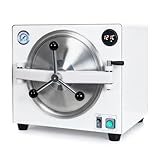
- NO DRYING FUNCTION: This steam autoclave completes high-temperature steam cycles but does not dry items. Residual surface moisture may remain after treatment. Use compatible self-sealing sterilization pouches when a drier finish and protected storage are needed.
- TWO TEMPERATURE CYCLES: Select between 121°C for 25 minutes and 134°C for 5 minutes according to the material and applicable processing requirements of the reusable tools or glassware being treated.
- CLEAR STATUS MONITORING: A combined temperature and pressure gauge, LED digital display, and temperature selector allow users to monitor operating conditions throughout the cycle.
- MULTIPLE SAFETY COMPONENTS: Equipped with a manual pressure relief valve, automatic pressure adjustment, overheat protection, and a safety door switch. Always follow the operating manual before opening or servicing the unit.
- 18L CAPACITY WITH ACCESSORIES: The chamber supports batch processing and includes a tray rack, sterilization trays, drainage tube, and power cord. Allow at least 50 cm of suitable installation space around the unit.
AP reported that four California growers took part in trials the preceding fall. On Rod Koda’s farm, researcher Jenny Broome of the University of California, Santa Cruz, described steam-treated plots as having less Fusarium wilt damage and producing more berries. Koda reported nearly twice the amount of organic strawberries from the particular comparison he described, calling the difference “very noticeable.” These are early observations from particular plots, not evidence that steaming will double yields across farms, seasons, varieties, or soils.
What the current research is measuring
California strawberry trials
A USDA Agricultural Research Service project record describes preplant trials in organic and conventional strawberries in the Watsonville/Salinas and Oxnard regions. Researchers compare steam-treated soil with untreated soil and, on conventional farms, with fumigated soil. The work includes pathogen assays and sequencing-based characterization of soil microbial communities. The record lists the project period as February 1, 2025, through January 31, 2026.
Rank #2

- Electric Steam Sterilization: The electric-heated design combines heating and the pressure vessel in one unit, reducing the need to coordinate a separate heat source and helping streamline steam-processing tasks in an appropriate workspace.
- Practical 4.7 Gallon (18L) Capacity: The vessel provides useful batch room for arranging suitable items during steam processing, helping users consolidate routine loads while retaining a manageable format for a dedicated work area.
- Work-Ready Stainless Steel Exterior: The stainless steel shell gives the unit a professional exterior and creates a straightforward surface for routine wipe-down care, helping the equipment maintain a clean appearance between uses.
- Dedicated Pressure-Vessel Format: The enclosed pressure-canner design is built for steam processing under pressure, giving buyers a focused equipment format for workflows that call for an electric autoclave rather than an open vessel.
- Purpose-Built Use: Intended for steam sterilization tasks, this electric unit is best placed in a dedicated work area and used with items suitable for pressurized steam processing, keeping the workflow centered on the equipment’s stated function.
High-tunnel tomatoes in Ohio
A separate USDA Agricultural Research Service project record covers high-tunnel tomato research comparing steaming with anaerobic soil disinfestation, a method that suppresses pests by creating low-oxygen soil conditions. The project measures microbial community recovery and effects on plant and soil health, and evaluates barriers to adoption. Its listed project period ran from January 1, 2024, through June 30, 2026; the record’s end date does not establish whether related work continued afterward.
Earlier work on field equipment and economics
A completed UC Davis-led project, recorded by the USDA National Institute of Food and Agriculture, examined high-efficiency steam application for soil disinfestation in strawberry nurseries. Its 2020–2024 work included field trials, soil-temperature targets, fuel monitoring, and economic analysis. The project record says traditional steaming methods have been slow and expensive, and frames improving speed and cost effectiveness as goals. Its cumulative award was $499,875.
Rank #3

- BABY BOTTLE AND PACIFIER STERILIZER. Sterilize up to six baby bottles at once, plus bottle parts, pacifiers and more.
- SET IT & FORGET IT. Auto shut-off feature helps prevent overheating.
- EASY TO OPERATE. Features easy-touch electronic controls with cycle indicators: heat cycle, cool down cycle, and ready cycle.
- ELIMINATES HARMFUL BACTERIA. Sterilizing eliminates 99.9% of bacteria, mold, and the yeast that causes thrush.
- QUICK STERILIZING. Large capacity allows you to steam sterilize up to six baby bottles at once.
Can steam replace fumigants?
Not on the evidence currently described. California researchers are comparing steaming with fumigated soil as well as untreated soil, but the existence of those trials does not establish that steam matches fumigation across crops, locations, pathogens, or commercial conditions. AP’s October 2026 report describes faster treatment and cost-effectiveness as unresolved goals.
Steam is also not automatically chemical-free in every system. The UC Davis project record includes study of steam alone and steam used alongside additives such as allyl isothiocyanate and heat-generating compounds. A fair comparison with another treatment should consider:
Rank #4

- 【Lighten up】Grownsy’s baby bottle sterilizer is smaller than the rest but holds enough daily feeding supplies and get the job done much quicker. Don’t let a slow bulky sanitizer add extra anxiety to your parenting journey.
- 【Peace of Mind】With Drying function followed automatically after 99.99% steam sterilization, Grownsy’s bottle sanitizer effectively prevents mold from growing inside baby bottles. Build-in filter prevent secondary pollution by exposure to new contamination in the air. Double protection, Twice as much love.
- 【Stop Waiting】 Tired of endless waiting for air-dry? Go for this Grownsy’s electric sterilizer which features a drying function that’s 31% faster than others! Get more sleep or spend some time on a beauty salon. You will glowing with health and come back with better mood.
- 【Universal Fit】 All brands/sizes baby bottles, pacifiers, pump parts, tiny spoons, teethers and even the occasional wine glass may all find a room in your bottle sterilizer. It’s a nice baby shower gift for modern new parents.
- 【Use 3 Ways and 4 Functions】Features only large lower bin, only smaller upper bin and both bin together for different occasions; Use as a Sterilizer & Dryer, Sterilizer Only, Dryer Only or Storage System.
- Which pathogens and weeds are controlled, and how consistently.
- Crop yield and quality under the relevant field conditions.
- Treatment depth and the soil temperatures achieved where targets are present.
- Application speed and the area treated in a practical work period.
- Effects on microbial communities and how those communities recover.
- Fuel use, operating costs, and fit with the crop and growing system.
Why field-scale adoption is difficult
Heating soil with steam is not new; it has long been used in greenhouses. The engineering problem is adapting it to open-field crop production at a pace and cost farms can manage. Equipment must deliver heat through the relevant soil volume while treating beds efficiently. Fuel use, time, pathogen control, crop response, and soil biology all matter to whether the approach makes sense in a particular operation.
Quick wins for a faster PC:
Repair Windows errors before they cause bigger problemsFix Now →Scan for outdated or missing drivers - takes under a minuteDriver Scan →Clear out junk files and repair common Windows errorsFree Scan →Historical results illustrate both potential and limits. In a specific Salinas demonstration trial reported by USDA ARS in 2010, initial weed density in steam-treated plots was 76% lower than in untreated controls. The same 2010 source reported Sterilter operation costs of $3,848 per acre in November 2009. That is a historical cost figure, not a current price or estimate for today’s machines and farms.
Best Value

- 3-in-1 Wash Bin, Steam Sterilizer & Veggie Steamer: doubles as a wash basin for cleaning baby bottles and accessories, then steam sterilizes—or use it to quickly steam vegetables for added everyday convenience
- Made from 100% Food-Grade Silicone: durable, reusable design safely sanitizes baby bottles, breast pump parts, pacifiers, and toddler accessories
- Holds Up to Five 5–8 oz Baby Bottles: spacious enough for daily feeding essentials while keeping everything contained for washing and sterilizing
- Space-Saving Collapsible Design: folds down from 5.5" to just 1.88" in height for easy storage in diaper bags, cabinets, or travel luggage
- Compatible with Standard U.S. Microwaves: features cool-touch handles for safe removal and easy pouring of hot water after steaming
What is known—and what remains open
- Supported: Researchers are testing preplant steam treatment for soilborne disease and weed suppression, including in California strawberry fields.
- Promising but preliminary: AP reported less Fusarium wilt damage and more berries in steam-treated plots described by a researcher, along with a grower-reported near-doubling of organic strawberries in a particular comparison.
- Still being evaluated: Field application speed, cost-effectiveness, crop outcomes, pathogen control, and effects on soil microbial communities and their recovery.
- Not established by these reports: A universal yield increase, uniform microbiome recovery, commercial competitiveness, or a ready-made replacement for fumigation across U.S. agriculture.
Broome summed up the engineering effort to AP: “We’re going back to the future, where we’re looking back at an older technology but we’re finding more ways to engineer more efficiently and use it.”
Quick Recap
Product prices and availability are accurate as of the date/time indicated and are subject to change. Any price and availability information displayed on Amazon at the time of purchase will apply.

