
iTechGuides is reader-supported. When you buy through links on our site, we may earn an affiliate commission. As an Amazon Associate I earn from qualifying purchases. Learn more
A steam engine converts heat into mechanical motion. A heat source boils water, valves admit the resulting steam to a cylinder, pressure or a condensation-created vacuum moves a piston, and rods, beams or a crank turn that movement into useful work. The exact layout varies: a Newcomen atmospheric engine, a Watt engine, an oscillating-cylinder engine, a uniflow engine and a steam turbine do not use the same mechanism.
What a steam engine actually does
Steam is the working fluid, not the output. The boiler supplies steam, but useful power appears only when the engine controls that steam so it produces a force that can move a component repeatedly. In a reciprocating piston engine, the moving component is a piston sliding inside a cylinder. Steam enters one side of the piston, pushes it through its stroke, and then leaves or condenses. A valve changes the flow path so the process can happen again in the opposite direction or on the other side of a double-acting piston.
The piston’s back-and-forth motion is called reciprocation. A beam can use it to operate a pump, as in a Newcomen engine. A connecting rod and crankshaft can turn it into rotation for machinery. A flywheel stores rotational energy between power strokes and helps the shaft continue moving smoothly.
This explanation describes reciprocating engines in detail. Steam turbines use a different arrangement in which flowing steam drives a rotor, so their parts and cycle should not be substituted for the piston-and-cylinder arrangement below.
#1 Best Overall
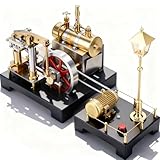
- Lifelike Mini Steam Engine: Witness the magic of steam power with our highly restored and fully functional model. Includes a mini steam generator and lamp scene model.
- Impressived Craftsmanship: Crafted with precision, our Beam Steam Engine Model and Boiler Kit boasts outstanding quality and attention to detail. Each part is made from high-quality materials, ensuring durability and longevity.
- Educational and Engaging: Assemble the kit and explore the principles of engineering and mechanics. Perfect for enthusiasts and nostalgic adults looking for a hands-on experience.
- Industrial Age Ambiance: Immerse yourself in the nostalgic history of the Industrial Age. Admire this beautiful masterpiece that seamlessly blends art and engineering into an impressive work.
- Unforgettable Gift: Our Beam Steam Engine Model and Boiler Kit offers the joy of assembly, the allure of steam power, and the charm of bygone eras, all in a stunning package.
The main parts of a reciprocating steam engine
Boiler or other steam source
The boiler heats water until it becomes steam and supplies the working fluid to the engine. In an early installation, the boiler could be shown as part of the complete engine arrangement rather than as a separate modern-looking unit. The boiler does not by itself create continuous mechanical output: the engine must meter the steam into the working chamber and provide a return path for exhaust or condensate.
Cylinder and piston
The cylinder provides a sealed space in which the piston can move. The piston divides the cylinder and receives force from steam pressure on its face. Its travel is limited by the cylinder ends, and the distance it moves is the stroke. Some engines keep the cylinder fixed. In an oscillating-cylinder design, the cylinder pivots as the connecting rod turns the crankshaft, so the cylinder itself moves relative to the frame.
Valves and valve gear
Valves decide when steam enters and when exhaust leaves. Valve gear links valve movement to the piston’s position, opening the appropriate passage for each part of the cycle. The Smithsonian description of a demonstration valve model shows the basic action: the valve alternately admits and exhausts steam so the piston can keep moving. Real engines may use different valve arrangements and timing methods, so a valve drawing from one design cannot be assumed to represent every steam engine.
Free tools Windows power users keep installed
One-click scans. No signup required.
Piston rod, beam, connecting rod and crankshaft
The piston rod carries force out of the cylinder. In a beam engine, the rod moves a pivoted beam; the opposite end can drive a pump. In a crank engine, the piston rod connects to a connecting rod, which turns a crankshaft. The crank converts the straight-line stroke into rotation. A flywheel attached to the shaft smooths the speed between individual strokes and provides a usable rotating output.
Rank #2

- ✅【Highly Restored Engine】: Witness the magic of steam power as this lifelike model comes to life. Product Dimensions: 18 x 18 x 17cm
- ✅【Impeccable Craftsmanship】: Carefully crafted in precision, the MechPuConToy Beam Steam Engine Model and Boiler Kit boasts outstanding craftsmanship with rich details. Each part in highquality materials, ensuring durability and longevity
- ✅【Educational and Engaging】: Assemble the kit and explore early engineering and mechanical principles, providing a fascinating hands-on experience for young and old enthusiasts alike
- ✅【Industrial Age Ambiance】: Experience the marvels of steam power, immerse yourself in nostalgic history, and admire this beautiful masterpiece that seamlessly blends art and engineering into an impressive work
- ✅【Unforgettable Gift】: The MechPuConToy Beam Steam Engine Model and Boiler Kit offers the joy of assembly, the allure of steam power, and the charm of bygone eras, all in a stunning package
Condenser and air pump
Some engines exhaust steam directly, while others condense it. Watt’s separate-condenser arrangement moved condensation away from the working cylinder. The historical catalog of the Smithsonian’s mechanical collections identifies a separate condenser, condenser air pump and steam-jacketed cylinder among Watt’s improvements. Keeping condensation out of the working cylinder helped preserve the cylinder’s working conditions while the condenser handled the change from steam back to water.
Governor
A governor can regulate power by changing valve timing. In the Corliss patent model, an increase in speed caused the governor to close the inlet valves earlier. Earlier cut-off admitted less steam for each stroke and reduced power. That is a specific Corliss arrangement, not a universal description of every governor or every steam engine.
How one operating cycle produces motion
- Heat water. The heat source raises water to the point where the boiler can supply steam.
- Open the steam path. Valve gear positions the inlet valve so steam reaches the correct side of the piston.
- Move the piston. Steam pressure pushes the piston. In an atmospheric engine, the key force can instead be atmospheric pressure acting after steam has been condensed and a partial vacuum has formed.
- Transfer the force. The piston rod moves a beam and pump or a connecting rod, crankshaft and flywheel.
- Change the valve position. The valve closes the inlet and opens the exhaust or another passage at the required point in the stroke.
- Prepare the next stroke. Exhaust steam leaves or condenses, and the valve admits steam for the next part of the cycle. Repeating this sequence produces continuous reciprocating or rotary work.
Valve timing determines how much of the stroke receives fresh steam and when exhaust begins. A design with the same boiler, cylinder and crank can therefore behave differently when its valve gear is changed.
Pressure-driven and atmospheric engines
Atmospheric action in a Newcomen engine
The Newcomen atmospheric engine used steam to create a vacuum rather than relying solely on high steam pressure to push the piston. Steam entered the cylinder, and condensation reduced the pressure inside. Atmospheric pressure on the other side of the piston then drove it downward. The piston rod moved a beam, and the beam operated a pump. The Smithsonian’s 1939 catalog describes this vacuum-and-beam arrangement as the defining action of Newcomen’s engine.
Rank #3

- 1. Engaging DIY Experience: Dive into a challenging project with our steam engine assembly kit, featuring nearly 40 parts and clear graphical instructions that guide you through the exciting process of building your own functional steam engine.
- 2. Retro Design and Functionality: The vertical structure showcases a transparent cylinder for easy observation of piston movement, while the large flywheel ensures smooth operation and quick startup, enhanced by a realistic simulated jet sound.
- 3. Safety Features: Designed with user safety in mind, this steam engine includes a spherical boiler for even steam pressure release, a mini safety valve, splash-proof exhaust tube, and a brass alcohol lamp, ensuring safe and enjoyable operation.
- 4. High-Quality Manufacturing: Constructed entirely from metal, the boiler boasts a robust design with a short startup time, blending retro aesthetics with advanced processing technology for a premium mechanical model experience.
- 5. Versatile Applications and Great Gift: Perfect as a teaching aid for scientific experiments or as a stunning desktop decoration, this steam engine model makes an ideal gift for birthdays, holidays, or for any technology enthusiast aged 14 and up.
Steam pressure in later piston engines
Later reciprocating arrangements used steam pressure as the direct driving force and developed mechanisms for rotary output. Watt’s separate condenser was one of the changes that helped move steam power toward more efficient operation and rotary work, alongside a steam-jacketed cylinder, rotary-motion mechanisms and double-acting operation identified in the Smithsonian catalog. “Double-acting” means steam can act on alternating sides of the piston so both directions of travel contribute to the cycle.
Why the beam is not the same as a crankshaft
A Newcomen beam engine and a crank engine can both contain a piston rod, but their outputs are different. The Newcomen beam rocks about a pivot and drives a pump. It is not a crankshaft engine. A crankshaft requires a crank and connecting rod to turn reciprocation into continuous rotary motion. Later engines could add such mechanisms, but the beam arrangement should not be retrofitted into every description of steam power.
Designs that show how much steam engines vary
| Design or example | How force is produced | Distinctive motion or steam path | Typical output described by the source |
|---|---|---|---|
| Newcomen atmospheric engine | Condensing steam creates a partial vacuum; atmospheric pressure moves the piston. | Fixed cylinder with a rocking beam. | The beam operates a pump. |
| Watt improvements | Steam works in a cylinder while condensation occurs in a separate condenser. | Separate condenser, condenser air pump, steam-jacketed cylinder and mechanisms for rotary motion. | Supports rotary work and double-acting operation. |
| Van Deren patent model, circa 1860 | Valves alternately admit and exhaust steam to move two pistons. | Oscillating arrangement; a connecting rod drives a crankshaft and flywheel. | Rotary shaft output. |
| Oscillating-cylinder model, circa 1889 | Steam drives a piston while the cylinder pivots. | The cylinder oscillates as the connecting rod turns a crankshaft. | Rotary shaft output. |
| Corliss patent model, circa 1849 | Steam admission is varied by governor-controlled cut-off timing. | Inlet valves close earlier as speed rises. | Power is regulated by changing admission. |
| Uniflow valve arrangement | Steam enters and exhausts through deliberately separated passages. | Cooler exhaust leaves through ports near the cylinder center instead of flowing back past the ends. | The layout is intended to reduce cooling of cylinder walls. |
What a uniflow engine changes
A uniflow engine is not simply a standard engine with a different name. Its exhaust ports are near the center of the cylinder, while admission occurs toward an end. Cooler exhaust steam therefore leaves through the central ports instead of travelling back across the cylinder ends. The Smithsonian’s uniflow valve model presents this flow arrangement as a way to reduce cylinder cooling. The point is control of where steam enters and exits, not a universal rule that all engines exhaust from the center.
How valve timing controls power
Opening the inlet valve admits steam; closing it ends admission. The fraction of the stroke during which fresh steam enters is the cut-off point. In the Corliss example, a governor responds to rising speed by closing inlet valves earlier. Less admitted steam reduces the force available for subsequent expansion and brings power back toward the required level. This illustrates why a governor can regulate an engine without merely turning the boiler heat up or down.
Rank #4
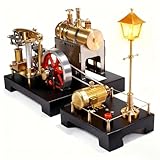
- Highly Restored Engine: Witness the magic of steam power as this lifelike model comes to life. With mini steam generator and lamp scene model
- Impeccable Craftsmanship: Carefully crafted in precision, the Beam Steam Engine Model and Boiler Kit boasts outstanding craftsmanship with rich details. Each part in highquality materials, ensuring durability and longevity
- Educational and Engaging: Assemble the kit and explore early engineering and mechanical principles, providing a fascinating hands-on experience for young and old enthusiasts alike
- Industrial Age Ambiance: Experience the marvels of steam power, immerse yourself in nostalgic history, and admire this beautiful masterpiece that seamlessly blends art and engineering into an impressive work
- Unforgettable Gifts: The Beam Steam Engine Model and Boiler Kit offers the joy of assembly, the allure of steam power, and the charm of bygone eras, all in a stunning package
Exhaust timing matters as well. The cylinder must have a route for used steam to leave or condense before the next admission event. If the valve changes position at the wrong point, steam can enter too early, leave too late or resist the piston’s return. The exact timing sequence depends on the valve gear and engine layout.
Independent reader supportYour contribution helps us test, update, and keep practical guides available for everyone.How steam power developed historically
Savery and the first commercially useful engine
The Smithsonian’s Power Machinery overview identifies Thomas Savery’s 1712 engine as the first commercially useful steam engine. Its place in the history of power lies in applying steam and condensation to useful pumping work, even though later engines used different cylinder, valve and linkage arrangements.
Newcomen’s pumping engine
Newcomen’s atmospheric engine made the vacuum cycle practical for pumping. Condensing steam in the cylinder allowed atmospheric pressure to move the piston, and the beam transferred that motion to a pump. This explains why early steam power should not be pictured as a crankshaft spinning factory machinery from the start.
Quick wins for a faster PC:
Clear out junk files and repair common Windows errorsFree Scan →Fix the driver behind crashes, sound loss and screen glitchesFind Drivers →Repair Windows errors before they cause bigger problemsFix Now →Watt’s separate condenser and rotary direction
Watt’s separate condenser kept the main working cylinder from serving as the place where steam was repeatedly condensed. The Smithsonian catalog also records a steam jacket, condenser air pump, rotary-motion mechanisms and a double-acting cylinder among the changes associated with Watt. Together, these features helped steam engines move beyond a pump-only arrangement toward rotary work.
Best Value

- Wilesco - Construction kit steam engine D 5
Nineteenth-century alternatives
The Van Deren model, the 1889 oscillating-cylinder model, the Corliss model and the uniflow valve model demonstrate that engineers continued to alter cylinder movement, valve timing and exhaust routing. They are useful examples of variation, not pieces that should be assembled into one imaginary universal engine.
Common misconceptions to avoid
- “The boiler makes the power by itself.” The boiler supplies steam; controlled expansion, pressure or condensation produces motion.
- “Steam explodes to drive the piston.” The working action is controlled pressure and, in atmospheric engines, a condensation-created pressure difference.
- “Every steam engine has a condenser.” Some designs exhaust steam without the same condenser arrangement; Watt’s separate condenser is a particular improvement.
- “Every engine has a fixed cylinder.” Oscillating-cylinder designs pivot the cylinder as the crank turns.
- “A beam engine is a crankshaft engine.” Newcomen’s beam drives a pump; a crankshaft requires a connecting-rod-and-crank conversion.
- “A turbine is just a faster piston engine.” A turbine uses a substantially different flow-and-rotor arrangement and should be explained separately.
Using a model to understand the mechanism
A demonstration model can make valve timing, piston travel and linkage relationships visible. Smithsonian collections document models of steam-engine valves, oscillating engines and uniflow arrangements, which makes models useful for education. A commercial kit cannot be judged from those museum records alone. Before operating any kit, check its current contents, assembly difficulty, age or experience guidance, heat source, pressure limits and safety instructions. Never apply heat or pressure to a model unless its manufacturer specifies that it is designed for that use.
The essential mental picture
Imagine four linked actions: heat creates steam, valves control where it goes, pressure or condensation moves a piston, and mechanical linkage turns that stroke into pumping or rotation. Change the valve timing, condenser location, cylinder movement or exhaust ports and you have a different engine design. That is why “how steam engines work” has a common principle but no single universal set of parts.
Recommended Free Tools
Quick Recap
Product prices and availability are accurate as of the date/time indicated and are subject to change. Any price and availability information displayed on Amazon at the time of purchase will apply.

