
Quick wins for a faster PC:
Clear out junk files and repair common Windows errorsFree Scan →Scan for outdated or missing drivers - takes under a minuteDriver Scan →Repair Windows errors before they cause bigger problemsFix Now →iTechGuides is reader-supported. When you buy through links on our site, we may earn an affiliate commission. As an Amazon Associate I earn from qualifying purchases. Learn more
Yes, solar cells can be integrated into fabric, including by embedding miniature photovoltaic cells and wiring in yarn that is then woven into a textile. That is different from coating a prepared fabric with solar-cell layers or hiding cells behind cloth. Research prototypes have demonstrated power generation and some wash or stretch tolerance, but the available evidence does not establish a broad consumer market for garments made from woven solar-cell fabric.
What “solar cells woven into fabric” means
A photovoltaic textile is fabric combined with components that convert light into electricity. The phrase “woven into fabric” is most exact when the solar elements are built into yarns and those yarns are woven into the textile. Other solar textiles may be flexible or fabric-based without using that construction.
Cells embedded in electronic yarn
In a Nottingham Trent University research prototype, miniature crystalline-silicon cells and fine copper wires were embedded in yarn, which was then woven into fabric. The approach was designed to retain flexibility, three-dimensional deformability, and the textile’s ability to transfer moisture and heat. It is the clearest example here of photovoltaic elements woven into the yarn structure itself.
Windows Errors? Fix Them Before They Spread
Repair common Windows errors and clear accumulated junk for a smoother, more stable PC - no reinstall needed.Free scan · no reinstallCrashes, No Sound, or Screen Glitches?
Random freezes, missing sound and display glitches usually trace back to one bad driver. Find and replace yours safely.Free scan · under a minuteSolar-cell layers fabricated on fabric
A 2018 perovskite prototype used polyurethane to coat and smooth woven fabric before solution-processed photovoltaic layers were applied. The textile served as the device substrate, but the cells were not embedded in each yarn. The authors reported 5.72% power-conversion efficiency for that specific prototype.
#1 Best Overall
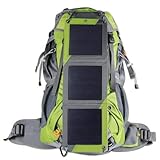
- Large main compartment with multiple pockets, padded laptop sleeve, and external storage options to organize your gear perfectly for hiking, travel, or daily commuting.
- Ultra-Durable & Weather-Resistant – Made from rugged, tear-resistant materials with reinforced stitching to handle tough outdoor conditions. Protects your valuables in light rain and rough terrain.
Cells placed behind fabric
Aalto researchers described concealing solar cells behind textile, with attention to machine washing and recyclability. This design may make the photovoltaic elements less visible, but it is not evidence that the cells themselves are woven into yarn.
Other flexible and woven designs
RIKEN reported an ultrathin organic solar cell protected by elastomer films. Its reported tests included 20 simulated washing cycles and stretching to half the cell’s original length; those results concern the cell, not a complete garment. RIKEN presented clothing as a possible future application.
Rank #2
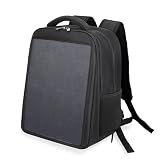
- 【20W HIGH-POWER SOLAR SYSTEM】 Features upgraded HPBC solar cells with a 24.8% conversion rate. This 20W high-output panel effectively solves the slow-charging pain point of common 7W/14W competitors, providing a more reliable energy supplement for your phone or power bank in the wild. Note: As with all portable solar products, charging efficiency depends on direct sunlight intensity and is intended for supplemental power.
- 【DUAL SMART PORTS & COMPATIBILITY】 Equipped with a dedicated junction box featuring Type-C and USB ports. The dual-port design allows you to charge your phone and a small gadget simultaneously, while protective sheaths ensure the interfaces stay clean and functional in outdoor environments.
- 【ALL-IN-ONE MULTI-FUNCTIONAL DESIGN】 Engineered to transition seamlessly between diverse scenes. It provides the ruggedness required for hiking and camping, while the organized 16 inch laptop compartment and professional aesthetic make it perfect for daily work commutes, campus, and air travel.
- 【DURABLE OXFORD CRAFTSMANSHIP】 Crafted from premium 1680D Oxford cloth, which is significantly more wear-resistant than standard nylon. Combined with a water-resistant solar panel and reinforced stitching, it protects your tech essentials from light rain and the rigors of frequent outdoor use.
- 【ERGONOMIC COMFORT & LARGE CAPACITY STORAGE】 Breathable honeycomb back panel and padded S-shaped shoulder straps help relieve pressure for all-day wear. The luggage strap on the back slides over your suitcase handle, making travel from trail to terminal easy. This 17.7-inch backpack has plenty of room and multiple compartments to keep your gear, electronics, and personal items organized , great for long outdoor trips or daily commutes.
A separate dye-sensitized solar-cell study used textile elements in a woven structure. Its authors reported 2.63% energy-conversion efficiency under 1 sun, 1.5 A.M. That figure belongs to that device and illumination condition.
What the prototypes have demonstrated
These results show that textile-integrated photovoltaics can generate power and that some designs have been tested for deformation or washing. They are not interchangeable performance ratings: the studies used different cell chemistries, layouts, sample areas, illumination conditions, and test methods.
Rank #3

- SOLAR POWER FOR OUTDOOR USE: Built-in solar panel captures sunlight to support charging on extended outdoor trips for hiking, trekking, camping, and travel situations
- CONVENIENT USB ACCESS PORT: External USB port allows easy connection to an internal power bank, so you can access charging without opening the backpack during travel
- ENHANCED VISIBILITY WITH LED DESIGN: Integrated LED/luminous feature improves visibility in low light outdoor environments such as night trekking, cycling, or camping
- DURABLE & WEATHER-RESISTANT MATERIAL: Constructed with rugged, water resistant fabric to protect gear from light rain, dust, and harsh outdoor conditions
- SPACIOUS STORAGE FOR TRAVEL GEAR: Multiple compartments including a padded laptop section and accessory pockets for organized storage during travel and outdoor use
| Prototype or study | Reported result | What the result applies to |
|---|---|---|
| Nottingham Trent University, 2019 | About 90% of original power output retained after 15 domestic machine-wash cycles | The researchers’ woven, cell-embedded electronic yarns; not a universal washing rating for solar garments. |
| Nottingham Trent University, 2019 | About 2.15 mW/cm² under one-sun illumination | A fabric sample containing 200 solar cells, with a 44.5 mm × 45.5 mm active area. The authors said it could power a basic mobile phone; that does not establish everyday clothing-based charging performance. |
| Journal of Power Sources study, 2018 | 5.72% power-conversion efficiency | A solution-processed perovskite prototype on polyurethane-coated textile. |
| RIKEN-reported research, 2017 | 20 simulated washing cycles; stretched to half the cell’s original length | An ultrathin organic cell protected by elastomer films, not a garment-wide durability test. |
| Dye-sensitized textile-cell study, 2015 | 2.63% energy-conversion efficiency under 1 sun, 1.5 A.M. | The particular dye-sensitized device and its stated illumination conditions. |
Efficiency figures across these studies should not be ranked as if they came from a common test. A meaningful comparison would also need to account for output under matched lighting, fabric comfort and feel, flexibility, washing and weather resistance, visibility, repair options, and recyclability.
Can solar clothing charge a phone?
A textile photovoltaic system can produce electricity, and the Nottingham Trent University team reported that its tested fabric could power a basic mobile phone. That is a research demonstration tied to a particular sample and one-sun illumination—not a guarantee that clothing will charge a phone reliably during ordinary wear.
Rank #4
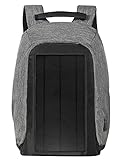
- SPECIAL ANTI-THEFT DESIGN - The zipper of the main pocket is fully hidden in the back of the backpack; no theft will easily open your backpack. Equipped with a secret pocket behind the bag which can keep your valuable items from thieves. As another security aspect, there are no compartments or zippers on the outside of the backpack
- BUILT-IN SOLAR PANEL - The built-in 10W solar panel is made of various high-quality solar cells
- EASY ACCESS USB PORT - With a built-in USB outlet on the outside and a built-in charging cable inside the backpack, this Jauch backpack offers a more convenient way to charge your smartphones, tablets, cameras and more on the go
Real-world usefulness depends on the illuminated area, how much light reaches it, the electrical output, and how the system connects to a device. The cited results do not establish charging time, performance in changing outdoor light, or phone-charging reliability for a finished garment. Treat “can power a phone” as a prototype result, not a general promise about solar clothes.
Free tools Windows power users keep installed
One-click scans. No signup required.
Are solar fabrics washable and comfortable?
Some prototypes have undergone wash or stretch testing, but their results cannot be generalized to every textile photovoltaic design. The Nottingham Trent University electronic-yarn prototype retained about 90% of its original power output after 15 domestic machine-wash cycles. RIKEN’s reported 20 simulated washing cycles and stretching test concerned a protected ultrathin organic cell, not a complete item of clothing.
Best Value

- INCLUDES A BATTERY PACK (V50 POWER BANK) to charge your device quickly and safely. Store energy and power to charge your devices even when it is cloudy and the sun is not out
- INCLUDES A 2-YEAR WARRANTY. Our solar panels are designed to last. Built using rugged fabric and strong solar cells that can withstand the rigors of everyday use (2 year on solar panel, 1 year on battery pack)
- HIGH PERFORMANCE SOLAR PANELS made from industry-leading monocrystalline solar cells charges most smartphones completely in 3.5 hours in direct sunlight
- BACKPACK DESIGN | Padded laptop/tablet sleeve (up to 15" laptop and 10” tablet), large main storage compartment, plenty of convenient storage for cables, adapters and tablets, expandable water bottle / tripod pocket, easy access padded sunglasses pocket
- COMPATIBILITY | Designed to power thousands of devices that charge from USB, including various handheld devices and smartphones, and DSLR camera batteries (with USB charging cradle). Includin iPhone, iPad, Android, Samsung Galaxy, Blackberry, iPads and Samsung Tablets, iPods, Sony, Nikon, Canon, and GoPro digital cameras
Comfort is also a design question, not something settled by flexibility alone. A useful garment must integrate conductive connections and photovoltaic elements while preserving the fabric properties its wearer needs, such as drape, movement, moisture transfer, and heat transfer. The Nottingham Trent approach explicitly aimed to maintain flexibility, three-dimensional deformability, and moisture and heat transfer; the available figures do not establish how every solar fabric feels or performs in wear.
Independent reader supportYour contribution helps us test, update, and keep practical guides available for everyone.Where solar textiles may be used
Research and institutional sources discuss wearable and mobile devices, health monitors, work and outdoor clothing, and curtains. These are applications under exploration, not proof that each category has a widely available, independently tested product.
Sphelar Power presents examples including a solar tent, a solar-textile backpack for phone charging, and shoes with LEDs. Those company-described examples should not be confused with Nottingham Trent University’s embedded electronic-yarn construction, and the cited material does not establish independent performance testing for each product. A backpack that uses solar textile is an adjacent use case, not necessarily a garment made from yarn woven with solar cells.
What’s actually slowing this PC down?
Pick the symptom - the matching free tool is one click away.
Can you buy a garment made from woven solar-cell fabric?
The cited material documents research prototypes, company-described applications, and commercial plans; it does not establish broad retail availability of clothing made from cells woven into yarn. SolarWeave describes plans to sell fabric and license its technology to commercial partners, but that is a stated plan, not confirmation of current availability. Check a seller’s current product information before treating a concept or announced plan as a purchasable garment.
If the immediate need is portable solar charging, a conventional flexible solar panel is a different product category and should not be presented as fabric woven with solar cells. A solar-textile backpack is closer to wearable or portable integration, but its construction and performance need to be assessed on their own terms.
Quick Recap
How to assess a solar-textile claim
- Identify the construction: Is the photovoltaic element inside yarn, deposited on a prepared textile, or concealed behind fabric?
- Check the test conditions: Look for the sample area, lighting condition, wash protocol, and whether a result applies to a cell, a fabric swatch, or a finished garment.
- Separate power from practicality: A stated output under controlled illumination does not by itself show how quickly or consistently clothing can charge a device outdoors.
- Look beyond efficiency: Flexibility, comfort, durability, visibility, repairability, and recyclability affect whether a textile system is useful to wear.
- Verify availability: Distinguish a research result or a company’s future plan from a product currently offered for sale.
Product prices and availability are accurate as of the date/time indicated and are subject to change. Any price and availability information displayed on Amazon at the time of purchase will apply.

