
iTechGuides is reader-supported. When you buy through links on our site, we may earn an affiliate commission. As an Amazon Associate I earn from qualifying purchases. Learn more
Robot vacuums map a home by combining distance, vision and motion sensors to estimate their position, detect obstacles and plan where to clean. Depending on the model, the robot may use LiDAR/LDS laser scanning, a camera-based visual system, an inertial measurement unit (IMU), or a combination. The resulting map is an operational navigation model—not necessarily a complete architectural floor plan—and it can contain room labels, cleaning zones, restricted areas, virtual walls, coverage history and, on some products, detected objects.
What happens to that information is model-specific. Some manufacturers describe local processing and on-device storage; others send maps to an app or cloud service. Camera images may stay on the robot, be processed locally or be covered by optional sharing controls. Check the exact model, region, firmware and privacy settings before assuming what your vacuum can see or where its data goes.
What “home mapping” means in a robot vacuum
A robot vacuum does not usually create a construction-grade blueprint. It builds a spatial representation that helps it answer practical navigation questions: Where am I? Which areas have I already covered? Where are walls, furniture and drop-offs? Which rooms or zones should I clean next? The map also powers app features such as room selection, no-go areas and virtual walls.
The map is assembled while the robot moves. Sensor readings are combined with wheel movement and, on some models, inertial measurements to estimate position and update a representation of nearby boundaries. The result can be highly useful for systematic cleaning while still omitting hidden spaces, misrepresenting temporary furniture and changing when the environment changes.
#1 Best Overall
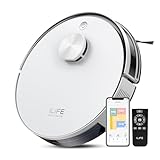
- Up to 10,000Pa Strong Suction: Experience deep cleaning with up to 10,000Pa ultra-strong suction in Spot Mode. The A30s robot vacuum effortlessly lifts dirt, debris, and pet hair from carpets and hard floors. Customize the suction power directly from the ILIFE Clean app for a personalized clean
- Smart Mapping & LiDAR Navigation: With advanced LDS LiDAR technology and the SLAM algorithm, the A30s robotic vacuum cleaner quickly maps your home and plans the most efficient cleaning path, ensuring comprehensive floor coverage and reducing missed spots
- Suitable for Pet Households: Design with dual anti-tangle brush, the A30s robotic vacuum effectively collects pet hair while minimizing tangles, suitable for dogs, cats, and busy pet households. Please note: This model supports vacuum only and does not have mopping function
- 2.4G WiFi & ILIFE Clean App Control: Take command of your cleaning via the ILIFE Clean App. Set no-go zones, virtual walls, and cleaning schedules, select specific rooms or areas to clean, activate auto carpet boost feature, and adjust suction power —all from your phone. Note: Compatible with 2.4GHz WiFi only
- Smart Voice & Remote Control: Achieve hands-free control via voice commands with Amazon Alexa or Google Assistant. You can also easily start the vacuum robot with the included remote, which is easy to use for all family members
Manufacturers use different names for similar technologies. “LiDAR” and “LDS” generally refer to laser distance scanning. “Visual navigation” uses a camera to recognize visual features. An IMU measures motion and orientation. Exact performance, map detail and privacy behavior depend on the product’s implementation.
Which sensors create the map?
LiDAR or LDS laser scanning
A laser scanner measures distances to surrounding surfaces and uses those measurements to build a two-dimensional representation. Because the scanner can gather geometric information without relying on visible light in the same way a camera does, laser-based navigation is often described as a distinct alternative to visual navigation.
Vorwerk’s description of the Kobold VR7 provides a concrete example: it combines a 2D laser scanner (LDS or LiDAR) with an inertial measurement unit to generate a map. That statement applies to that product, not automatically to every laser-equipped vacuum.
Do these 3 things before closing this tab:
1Clear out junk files and repair common Windows errors2Scan for outdated or missing drivers - takes under a minute3Repair Windows errors before they cause bigger problemsCamera-based visual navigation
Visual-navigation systems use a camera to recognize features and estimate movement relative to them. Xiaomi’s privacy documentation describes models that add a vision sensor alongside a laser sensor. It says ceiling features used by specified visual-navigation models are processed locally and are not uploaded. This is a model- and feature-specific description, so it should not be generalized to all camera-equipped robots.
A camera can support obstacle recognition as well as localization. Whether images are retained, transmitted or discarded depends on the manufacturer’s design and settings. A camera sensor also does not mean a person is watching a live feed; the relevant question is how image data is processed and handled.
Combined systems
Some robots combine several sensor types. The IMU can contribute orientation and movement information while laser or visual readings provide environmental references. iRobot says its Roomba Plus 504 combines ClearView Pro LiDAR and PrecisionVision AI to create up to five maps and automatically name rooms in its app. That is a current claim for that specific model, not a category-wide capability.
Other navigation and safety sensors
Robots also use sensors for immediate movement decisions, such as detecting obstacles or edges. A map may incorporate the robot’s interpretation of those readings, but the map should not be treated as a complete record of every object the sensors encountered. The presence of a sensor does not by itself establish that its raw data leaves the device.
Free tools Windows power users keep installed
One-click scans. No signup required.
How a robot turns sensor readings into a cleaning map
- Initial sensing: The robot measures nearby distances, visual features or both while moving from its starting point.
- Position estimation: Wheel movement and, where fitted, IMU readings help estimate direction and distance travelled.
- Boundary and obstacle interpretation: Repeated measurements are used to infer walls, open passages and objects that affect travel.
- Map construction: The robot joins these estimates into a navigable representation of the areas it has observed.
- Cleaning planning: The system uses the representation to choose routes and track coverage rather than moving randomly.
- App features: Depending on the model, the app may turn the representation into room labels, selectable zones, restricted areas, virtual walls or multiple saved maps.
Mapping quality depends on sensor placement, lighting for visual systems, reflective or transparent surfaces, moving furniture and the software’s assumptions. A map can be operationally accurate enough for room-directed cleaning without describing every architectural detail.
What information can a map contain?
The simplest map is a geometric outline used for navigation. More capable systems attach labels and events to that outline. Xiaomi’s privacy white paper says its floor-map information may include the generated floor layout, zone coverage, zone names, restricted areas and virtual walls. These fields can reveal how the home is divided and which areas a user has chosen to exclude.
Rank #2

- INCREDIBLE SUCTION: Powerful Shark suction picks up dirt and debris on all floor types—tackling even the toughest of messes in your home.
- NO SPOTS MISSED: With Matrix Clean Navigation, the vacuum cleans in a precise matrix grid taking multiple passes over dirt and debris for whole home, deep cleaning coverage.
- IT EMPTIES ITSELF: The bagless, self-emptying base holds up to 30 days of dirt and debris while its true HEPA filtration captures and traps 99.97%* of dust and allergens (*down to .3 microns).
- PRECISION HOME MAPPING: 360° LiDAR vision quickly and accurately maps your home so your robot can methodically clean detecting and avoiding objects in its path, day or night, adapting to everyday changes in the home.
- PERFECT FOR HOMES WITH PETS: With powerful vacuum suction, Shark’s self-cleaning brushroll, and HEPA filtration system the robot captures pet hair, dust, dander and allergens with ease.
Some products support more than one saved map. iRobot says the Roomba Plus 504 can create up to five maps and automatically name rooms. Multiple maps may be useful in a multi-floor home, but the number and behavior are product-specific.
Map-related data can also include cleaning history or coverage: where the robot travelled, which zones were selected and which areas were skipped. That information can disclose routines even when the map contains no camera images.
What sensors may reveal beyond room outlines
Objects, people and pets
iRobot’s privacy policy lists possible environmental information including object types detected by a camera, the presence of pets and people, and data used by human-detection features. These are categories described for iRobot products and features; they do not prove that every robot detects or stores all of them, or that collection is always enabled.
Wi-Fi location and heat-map information
The same iRobot policy describes the location and confidence factor of Wi-Fi devices and Wi-Fi heat maps as possible environmental information. Such data can indicate where connectivity is strongest or where devices are located relative to the robot. Again, this is an iRobot-described category, not a universal robot-vacuum capability.
Camera images
A camera-based robot may capture image data while navigating or recognizing obstacles. Shark’s connected-device notice says mapping data is sent to the SharkClean app so users can see where the robot cleaned, while camera images remain on the machine and are not accessed by SharkNinja. iRobot’s policy also describes optional image sharing for certain connected camera-based robots produced before 2025. These statements illustrate why the exact model and opt-in settings matter.
Where maps and sensor data may go
Storage and transmission practices differ by manufacturer, model and feature. The following examples are documented product or policy descriptions, not rules for the entire category.
| Manufacturer or product example | Documented handling | Important scope |
|---|---|---|
| Xiaomi systems described in its privacy white paper | The device may upload a fuzzy contour layout to a server and app for map-related functions. The document says navigation and obstacle-avoidance algorithms run locally, transient environmental information is discarded in real time, and a local mode keeps maps and cleaning records on-device. It also describes encryption measures. | The white paper was available years before this article’s publication; verify current behavior and settings for the exact model. |
| Shark connected robot notice | Mapping data is sent to the SharkClean app so users can view where the robot cleaned. The notice says camera images stay on the machine and are not accessed by SharkNinja. | Applies to the connected-device category described in the notice. |
| iRobot Smart Maps | iRobot support guidance says Smart Maps are stored in the cloud. An in-app Mapping Features control can stop spatial-data transmission to cloud servers. | Turning the control off also disables map-dependent functions. |
| Roborock Qrevo-series EU declaration | The declaration describes LiDAR mapping and says maps are encrypted and stored on the device. | This is a Qrevo-series EU transparency declaration, not a statement about every Roborock model or region. |
| Kärcher Home Robots System | Its privacy statement describes camera-based AI object recognition that extracts characteristics quickly and says the system stores data locally without transmitting it to Kärcher. | Applies to the Home Robots System described in that statement. |
“Stored locally” and “stored in the cloud” are not the only questions. A device may process navigation locally while uploading a map for app features, or retain images locally while transmitting route data. Encryption claims, retention periods, deletion controls and account access should be checked separately.
Privacy controls and the feature trade-off
Privacy settings can change what the vacuum can do. iRobot’s support guidance says disabling Mapping Features stops spatial-data transmission to cloud servers, but it also turns off map-dependent functions such as directed room cleaning and keep-out zones. A privacy choice therefore has a functional cost: less cloud mapping can mean less precise control from the app.
Look for controls that are specific to mapping, camera use, image sharing, experience-improvement programs and account data. Xiaomi’s white paper says some collection is conditional on joining its User Experience Improvement Program. Optional programs should not be confused with the basic operation of every device.
Rank #3

- POWERFUL CLEANING YOU CAN SEE—AND FEEL. The Roomba 105X devours dirt with 70X more power‑lifting suction* to pull embedded dust, crumbs, and pet hair from carpets and hard floors. .*Compared to Roomba 600 series robots.
- 3‑STAGE CLEANING SYSTEM. Combines intense suction, a Multi‑Surface brush, and an Edge‑Sweeping brush to leave floors truly barefoot‑clean—not just surface tidy.
- SMART LIDAR MAPPING = NO MISSED ROOMS. ClearView LiDAR maps your home quickly and cleans in neat, efficient rows, delivering consistent coverage instead of random paths.
- CONFIDENT CLEANING, DAY OR NIGHT. Avoids furniture, cords, and everyday obstacles—even in low light—so cleaning continues smoothly without getting stuck.
- CUSTOM ROOM‑BY‑ROOM CLEANING. Schedule cleans, target high‑traffic areas, adjust suction, and add extra passes where messes build up.
Can a robot-vacuum camera see inside your home?
It can collect visual information within the camera’s field of view, but the practical privacy answer depends on processing and storage. A camera may be used to recognize features or objects, process data on the robot and discard transient information. Another product may send selected data to an app or cloud service. The presence of a camera alone does not establish remote viewing, human access or permanent image retention.
The Tool Desk
Outbyte Driver Updater FREEFix the driver behind crashes, sound loss and screen glitchesFind Drivers →Outbyte PC Repair FREEClear out junk files and repair common Windows errorsFree Scan →Check four separate points in the model’s documentation:
- What the camera is used for: navigation, obstacle recognition, human detection or another feature.
- Whether images are processed locally or transmitted.
- Whether images are retained, deleted immediately or shared only after opt-in.
- Whether disabling the camera or related mapping features removes other cleaning functions.
How to evaluate a robot before buying or connecting it
- Identify the exact model and region. Product families can contain different sensors and privacy behavior. Confirm the model number, market and current app documentation.
- List the navigation sensors. Look for LiDAR/LDS, visual navigation, IMU support or a combination. Do not infer camera use from the word “smart” alone.
- Read the map-feature list. Check for room labels, multiple maps, cleaning zones, no-go areas, virtual walls, object recognition and coverage history.
- Ask what leaves the robot. Separate map uploads, route or coverage data, camera images, diagnostic data and optional improvement-program data.
- Check storage and deletion. Determine whether data is on-device, in the cloud or both; look for encryption statements, retention periods and account-deletion procedures.
- Test privacy controls before setup is complete. Find the mapping, camera and image-sharing switches in the app and note which features disappear when they are disabled.
- Review policy scope. Privacy notices can vary by model, feature, region and date. A statement about one series should not be applied to another.
Common assumptions that lead to privacy mistakes
“Every robot creates the same kind of map.”
False. Laser-only, camera-based and combined systems can produce different data and support different app functions.
“A map is just an outline of rooms.”
Not always. Depending on the product, it can include labels, zones, restrictions, virtual walls, coverage and detected-object information.
“Local navigation means nothing is uploaded.”
Local algorithms and cloud features can coexist. Xiaomi’s documentation, for example, describes local navigation while also describing possible map uploads for app functions.
PC Slower Than It Used to Be?
A free scan shows the junk files, broken settings and background clutter dragging Windows down - then fixes them in one click.Free scan · Windows 10 & 11Outdated Drivers Are Slowing You Down
One free scan finds every outdated or missing driver and matches the right update for your exact hardware.Free scan · exact hardware match“A camera means someone can watch the house.”
That conclusion requires evidence about transmission and access. Shark’s notice says its described camera images remain on the machine, while other policies describe optional sharing for particular models.
“Turning off mapping has no downside.”
On iRobot systems, disabling Mapping Features also removes directed room cleaning and keep-out zones. Check the feature consequences for your model before changing the setting.
What a map can—and cannot—tell you
A map can show the robot’s inferred layout, selected zones, restrictions and sometimes cleaning coverage or object categories. It may reveal patterns about room arrangement, routines, pets, people or Wi-Fi placement when the product collects those categories.
It cannot automatically be treated as a complete architectural floor plan, a definitive inventory of possessions or proof that every visual observation was retained. Sensor coverage, software interpretation, settings and manufacturer policy all limit what the representation means.
What’s actually slowing this PC down?
Pick the symptom - the matching free tool is one click away.
Quick Recap
Product prices and availability are accurate as of the date/time indicated and are subject to change. Any price and availability information displayed on Amazon at the time of purchase will apply.

