
iTechGuides is reader-supported. When you buy through links on our site, we may earn an affiliate commission. As an Amazon Associate I earn from qualifying purchases. Learn more
Piezoelectric haptic feedback can add touch-based alerts to a steering wheel or other vehicle controls, giving drivers another way to receive information without relying only on a visual display or sound. It is a promising interface option, not a proven crash-prevention technology: the available evidence supports automotive applications and general haptic design principles, but does not establish that piezo haptic alerts reduce real-world crashes.
How can piezo haptic feedback enhance driver safety?
A haptic alert communicates through touch. In a vehicle, it might be a brief vibration or a change in steering-wheel torque that a driver can feel while holding the wheel. Haptics can also be placed in a seat or seatbelt. The potential safety benefit is an additional channel: a driver may notice a tactile cue without first looking at a display or hearing a tone.
Piezoelectric actuators are one way to generate those sensations. When driven by an electrical signal, piezo materials deform; carefully controlled deformation can produce quick, patterned tactile feedback. That makes piezo components candidates for compact automotive interfaces, including steering wheels, dashboards, buttons and displays. A tactile sensation alone, however, does not tell a driver what to do. The signal needs a clear, consistent meaning and must be evaluated in the driving task where it will be used.
The distinction between a useful warning and a safety outcome matters. A cue that attracts attention or speeds a response in a simulator is not, by itself, evidence that the system prevents collisions on public roads. The sources described here do not establish a reduction in crash rates attributable to piezo haptic driver alerts.
#1 Best Overall

- AI Car Blind Spot Detection System: Comprehensive system includes car blind spot camera paired with display system, driving recorder, BSD blind spot warning assistance, blind spot monitoring BSM, and camera monitoring system CMS for enhanced vehicle awareness
- 6.25-Inch High-Definition IPS Touch Screen: Full view display touch screen simultaneously shows rear left and rear right images, allows switching between single view angles, provides clear images of blind spot areas on left and right sides of the car, covers wide range of blind spots, and includes magnetic bracket for convenient installation location selection
- 1080P High-Definition Image Quality with Alerts: Model A65S supports sound and light warning function for better safety protection during driving, includes driving recorder function for monitoring blind spots on the vehicle body
- Non-Drilled Hidden Installation Design: Rotating camera adjusts horizontal viewing angle to adapt to various vehicle models, features simple design and lightweight construction, installs with double-sided tape on side of car door without affecting original vehicle appearance
- Adjustable Camera and Auto-Brightness Display: Features 120-degree angle adjustable rear view cameras that add safety to your vehicle and driving, with display screen that automatically adjusts brightness based on daytime and nighttime conditions, and customizable screen positioning with up, down, left, and right adjustments
What can a tactile warning communicate?
The best fit for haptics depends on the message. A simple alert or timing cue may be easier to communicate through touch than a detailed instruction. Directional guidance or negotiation with an automated system is more demanding: drivers must learn what each pattern means, distinguish it from other sensations, and respond correctly without becoming distracted.
NHTSA’s Human Factors Design Guidance describes steering-wheel torque and vibration, vibrotactile seats and seatbelt vibration as possible driver-vehicle displays. It notes that hands are sensitive to vibration and that steering-wheel cues may support motor priming. It also cautions that complex messages can be difficult to convey through touch. A seatbelt vibration may work mainly as a general or temporal alert rather than as an inherently directional instruction.
| Location | Potential role | Design consideration |
|---|---|---|
| Steering wheel | Alert, timing cue or—in more complex designs—directional guidance or interaction with automation. | The driver needs to be in contact with the wheel, and the pattern must be distinguishable from normal steering sensations. NHTSA identifies steering-wheel vibration and torque as possible displays. |
| Seat | Vibrotactile notice delivered through the seat. | Placement and pattern need to make the cue detectable and understandable in the intended driving position. NHTSA lists vibrotactile seats as a possible display. |
| Seatbelt | A general or time-sensitive alert. | NHTSA notes that a seatbelt cue may communicate timing or a general warning rather than direction. |
These locations are not interchangeable. A steering-wheel cue may be closely associated with a steering response, while a seat or belt cue can reach the driver through a different contact point. Whatever the location, designers should avoid assuming that a tactile signal will be understood just because it can be felt.
Rank #2
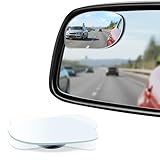
- 【360 Degree Adjustable】 The LivTee 2-Pack Blind Spot Mirrors feature an upgraded 360-degree adjustable rotation and sway design. These side mirror blind spot accessories offer a wide-angle convex view that effectively eliminates blind spots and enhances your rear view mirror visibility for safer lane changes.
- 【HD Glass】 Crafted with premium HD glass, these blind spot mirrors for car feature a frameless design that delivers ultra-thin, clear, and distortion-free reflections. With IP65 waterproof technology, they remain durable in rain, snow, and extreme temperatures, ensuring reliable performance in any weather. Perfect for automotive exterior accessories and car mirror accessories.
- 【Secure & Durable Adhesive】 Our blind spot mirrors come with outdoor-rated adhesive, ensuring they stay securely attached to your side mirror even during car washes, extreme cold, or exposure to saltwater. No need to worry about them falling off in harsh conditions, making them ideal car rear view mirror accessories.
- 【Universal Compatibility】 LivTee blind spot mirror for car is suitable for most vehicles, including cars, SUVs, and trucks. The 2.9-inch x 1.8-inch size and wide-angle convex mirror design allow them to fit seamlessly on various side mirrors, enhancing visibility and safety. These car mirror accessories are a must-have for anyone looking to improve their car exterior accessories.
- 【Service Guarantee】Any issues or questions please feel free to contact us, we are always here to satisfy all of you.
How strong is the evidence for safer driving?
The evidence spans different levels, from component and application claims to simulator studies and design guidance. Those types of evidence answer different questions: a component can show that a sensation is technically possible, while a simulator study can examine how people respond under its test conditions. Neither establishes a real-world crash reduction without appropriate field evidence.
| Evidence | What it reports | What it does not establish |
|---|---|---|
| University of Glasgow repository record for Shakeri et al. (2016) | A steering-wheel surface using solenoids produced 81.3% overall pattern recognition and 92.2% recognition for a single active solenoid in a driving simulator. | These results are not piezo-actuator measurements, and recognition is not a safety or crash outcome. |
| 2015 haptic-steering-gesture versus HUD simulator study | Haptic gestures produced faster lateral reactions in the tested scenarios; visual warnings had a greater measured safety benefit when assessed by minimum distance to the hazard. Most participants preferred visual warnings. | The comparison does not establish that one modality is best in every vehicle, alert type or road situation. |
| University of Michigan Engineering report, October 1, 2026 | A simulator study of a wheel that indicated automation intent and let drivers signal agreement or disagreement reported smoother, more accurate paths, less braking, lower reported workload and quicker trust recovery after system errors. | The findings are simulator results, not proof of an on-road safety improvement. The report also flags possible overtrust. |
| Manufacturer product and application material | TDK describes piezo actuators for automotive interface examples; Texas Instruments lists a piezo haptic driver IC; Boréas announced a dated automotive HMI demonstration. | Product capabilities and demonstrations do not show that a complete alert system is deployed or reduces crashes. |
The Glasgow figures illustrate why hardware and outcome must be kept separate. The study used solenoids, not piezo actuators, and reported recognition rates in a simulator. They cannot be presented as piezo-specific performance or as evidence that drivers avoided hazards.
The 2015 comparison also resists a simplistic conclusion that haptics are always safer because they can prompt a quick reaction. In those scenarios, haptic steering gestures improved lateral reaction speed, while visual warnings had the stronger measured safety benefit by minimum distance to the hazard. Response time, hazard clearance, comprehension and user preference are different measures; an evaluation needs to consider the measures relevant to its intended use.
Rank #3

- Hide menu: You can click on the bottom left corner of the screen to turn off and turn on the status of the sound, or go to the warning settings in the system settings to turn on and turn off the sound. You can click on the bottom right corner of the screen to go to Device Settings, Image Shift, Clock Backlight, Warning Area Settings..
- The high-definition touch screen is equipped with BSD flagship CPU, which adds effective driving warnings and pedestrian warnings. Significantly improving driving safety in complex traffic environments.
- The all aluminum alloy body design is lightweight and fashionable, enhancing the high-end functionality and appearance of the product, and the heat dissipation function has also been significantly improved; The configuration of the magnetic suction fixed bracket is simple and convenient.
- Full screen touch: convenient to use, high-end and atmospheric; 6.25 "single screen dual channel display; 5.0" single screen single channel display; And it can freely click on the screen to switch display;.
- Vehicle mounted high-definition blind spot camera monitoring system, high-performance CPU+full screen touch+perfect integration of driving records and parking monitoring; Beautiful, practical, integrated with monitoring and recording.
What does piezo hardware contribute?
TDK describes its multilayer piezo-ceramic PowerHap actuators for automotive examples such as steering wheels, displays, dashboards and buttons. Its application material says piezo actuators can be thin enough for compact placements and can create varied vibration patterns. These are manufacturer descriptions of component capabilities and use cases, not independent evidence that a particular warning improves driver safety.
Do these 3 things before closing this tab:
1Fix the driver behind crashes, sound loss and screen glitches2Clear out junk files and repair common Windows errors3Scan for outdated or missing drivers - takes under a minuteA vehicle interface needs substantially more than an actuator. A complete system would include the logic that detects or receives relevant information, a controller that decides when and what to signal, an actuator driver, mechanical integration, and a mapping between messages and tactile patterns. It also needs evaluation with drivers to verify that cues are noticeable, interpretable and appropriate under the conditions in which they will be used.
- Actuator: produces the tactile sensation at the selected contact point.
- Driver electronics: supply and control the electrical signal for the actuator.
- Message logic: determines which event calls for a cue and what that cue should mean.
- Mechanical integration: places and couples the actuator to a steering wheel, control, seat or other surface.
- Pattern mapping and evaluation: connect each intended message to a distinguishable signal, then assess whether drivers detect and interpret it as intended.
For engineering prototypes, TDK describes a PowerHap development kit that includes a PowerHap 1204H018V060 actuator and a Boréas BOS1901-Kit driver board. Texas Instruments identifies the DRV2665 as an active piezo haptic driver IC with an integrated boost converter and digital front end. These are development components, not a ready-to-install consumer safety device.
Rank #4
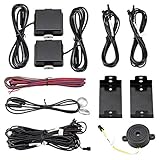
- This blind spot detection system is a vehicle assistance device that helps you safely changing the lane during driving & improve driving safety. The LED indicator will alert you when there is a moving object into the vehicle blind area, so that the you can be caution when lane changing to avoid the possibility of traffic accident & improve driving safety.
- The blind spot monitoring system can monitor the closing objects in the neighbor lane within a range of 6-12 meters with speed gap over 0.5m/second. When the moving object enters the blind area, the LED light will be flash to alert the driver.
- If the steering is turned on, the system works in lane change assistant mode & the LED light will flash rapidly and the buzzer beeps three times to alert the driver being careful to change a lane.
- With 2pcs 24GHz microwave sensor, probe the rear side of the vehicle for moving objects into the blind area of the detection zone.
- IMPORTANT: Can install on cars with a plastic bumper only, not work with vehicles with a metal bumper as metal bumper will interference with the radar sensor. This item fits for most DC12v sedan, compact, SUV, MPVs, pickup etc and professional audio installer installation is required.
In January 2020, Boréas announced a CES demonstration combining its BOS1211 with TDK PowerHap actuators for automotive human-machine interfaces, including safety alerts in touch-sensitive steering wheels. That is a dated vendor demonstration announcement; it should not be taken as proof of commercial deployment or validated safety efficacy.
Independent reader supportYour contribution helps us test, update, and keep practical guides available for everyone.How should designers evaluate a haptic alert?
Design should start with the message and the action expected from the driver, not with a choice of actuator. NHTSA’s guidance and the differences between the simulator findings point to a practical principle: the alert channel and pattern must fit the information being communicated, and performance has to be measured across more than one convenient metric.
Recommended Free Tools
- Define the message. Decide whether the cue is a simple notice, a timing prompt, directional guidance or part of an exchange with vehicle automation. Do not expect a single tactile pattern to carry a complex instruction unless drivers can reliably interpret it.
- Choose the contact location. Consider whether the intended user will be touching the steering wheel or whether a seat or seatbelt is more suitable. Account for whether that location naturally supports the response the message calls for.
- Map patterns to meanings. Make alerts distinguishable from one another and from ordinary vehicle sensations. More complex spatial messages may require multiple actuators, a clear mapping and user familiarization.
- Measure interpretation and response. Evaluate detection, response time and whether drivers select the correct response; a fast reaction is not enough if a cue is misunderstood.
- Assess workload and acceptance. Measure workload and annoyance, and examine effects of false or unnecessary alerts. A signal that is ignored or resented may not serve its intended purpose.
- Test the intended use, then match claims to evidence. Simulator findings can guide design, but should not be described as on-road crash prevention. Claims should reflect the setting and outcome actually evaluated.
SAE International’s catalog description for J3280_202306, issued June 20, 2023, says the standard’s intent is “to help system designers determine when to use haptic interfaces and how to ensure their effectiveness.” The description is a useful statement of the design problem; it is not itself evidence that a specific implementation improves crash outcomes.
Best Value

- Universal Fit for Most 12V Vehicles-Designed for sedans, SUVs, and pickup trucks with DC 12V power systems. Professional installation is recommended. Includes an installation manual and radar angle alignment tool for accurate setup and optimal detection performance
- 24GHz Millimeter Wave Radar Detection-Built-in dual 24GHz millimeter wave radar sensors provide stable blind spot monitoring with a detection range of 1–32.8 ft (0.3–10 m). When a moving vehicle approaches from the side or rear blind zone, the LED warning indicator activates automatically
- Multi-Mode Blind Spot Warning Alerts-The system provides real-time alerts based on driving conditions for safer lane changes: 1.Turn signal OFF – the corresponding LED warning light stays illuminated when a vehicle enters the blind spot zone 2.Turn signal ON – the corresponding LED flashes and the buzzer sounds 3 warning beeps during lane changes 3. Hazard lights ON – the LED flashes continuously and the buzzer sounds 3 times for increased driver awareness
- Professional Installation Required-Radar sensors cannot penetrate metal surfaces. Please read the installation manual carefully before installation. Proper sensor mounting position, angle, height, and wiring are essential for accurate blind spot monitoring performance
- Enhanced Driving Safety in All Conditions-Improves driving awareness by monitoring vehicles approaching from rear and side blind spots. Effective during lane changes and in low-visibility conditions such as nighttime driving, rain, snow, or fog
Where does two-way haptic communication with automation fit?
A warning normally sends information from a vehicle system to the driver. A newer design direction treats the steering wheel as a two-way interface: automation indicates its intent, and the driver signals agreement or disagreement through tactile controls. This shifts haptics from simply attracting attention toward helping the driver and system resolve a conflict before an action.
In the University of Michigan Engineering report published October 1, 2026, robotics Ph.D. student and first author Hannah Báez described drivers squeezing haptic zones to agree or disagree with an automated system before an action. The reported simulator results included smoother, more accurate driving paths, less braking, lower reported workload and quicker recovery of trust after system errors. Senior author Brent Gillespie said, “We found that drivers drove better when negotiating with the automated system through haptic feedback.” That statement describes the reported simulator work, not a general guarantee of safer automated driving.
The same report identifies a risk: successful interaction can foster overtrust in automation. If the driver comes to rely too heavily on a system, a clear and comfortable exchange is not automatically a safe one. Designers need to consider whether users retain appropriate oversight and how they respond when the automation is wrong, not just whether negotiation feels smooth when it works.
PC Slower Than It Used to Be?
A free scan shows the junk files, broken settings and background clutter dragging Windows down - then fixes them in one click.Free scan · Windows 10 & 11Outdated Drivers Are Slowing You Down
One free scan finds every outdated or missing driver and matches the right update for your exact hardware.Free scan · exact hardware matchWhat should drivers expect today?
The documented products and kits are relevant to engineers and product developers building or evaluating interfaces. They do not amount to an established aftermarket upgrade that motorists can install to make a vehicle safer. A component’s ability to produce a tactile sensation, or a vendor’s demonstration of a steering-wheel alert, is not the same as a complete, validated driver-warning system.
For consumers, the sensible expectation is that haptic feedback may complement visual or audible alerts where a vehicle manufacturer has integrated and evaluated it. It should not be treated as a replacement for paying attention, nor should a steering-wheel vibration be assumed to have the same meaning across different vehicles. The effectiveness of any cue depends on the system’s design and the driver’s understanding of it.
Quick Recap
Product prices and availability are accurate as of the date/time indicated and are subject to change. Any price and availability information displayed on Amazon at the time of purchase will apply.

