
iTechGuides is reader-supported. When you buy through links on our site, we may earn an affiliate commission. As an Amazon Associate I earn from qualifying purchases. Learn more
PCIe 6.0 specifies eight times the per-lane transfer rate of PCIe 3.0: 64.0 GT/s versus 8.0 GT/s. It reaches that rate with PAM4 signaling and adds fixed-size Flit-mode transfers, forward error correction (FEC), and CRC. Those are interface specifications, not a promise that an application or device will run eight times faster.
How do PCIe 3.0 and PCIe 6.0 compare?
The figures below describe the standards, not measured application performance. Per-lane rates are in GT/s; x16 bandwidth is shown in the units and form PCI-SIG reports. PCI-SIG’s 2024 presentation lists the generation rates, encoding, and encoding-adjusted x16 bandwidth for generations 3.0 through 6.0. Its separate overview describes PCIe 6.0 x16 bandwidth as bidirectional.
| Generation | Release year listed by PCI-SIG | Rate per lane | Encoding or signaling | x16 bandwidth |
|---|---|---|---|---|
| PCIe 3.0 | 2010 | 8.0 GT/s | 128b/130b encoding | 126 Gb/s after encoding overhead |
| PCIe 4.0 | 2017 | 16.0 GT/s | 128b/130b encoding | 252 Gb/s after encoding overhead |
| PCIe 5.0 | 2019 | 32.0 GT/s | 128b/130b encoding | 504 Gb/s after encoding overhead |
| PCIe 6.0 | 2022 | 64.0 GT/s | PAM4 signaling with Flit mode, FEC, and CRC | 1,024 Gb/s after encoding overhead; up to 256 GB/s bidirectional |
Generation-table values are from PCI-SIG’s 2024 presentation; the PCIe 6.0 bidirectional x16 figure is from its specification overview. Gb/s means gigabits per second, while GB/s means gigabytes per second. PCI-SIG describes 256 GB/s as total bidirectional bandwidth for x16, not 256 GB/s in each direction. These x16 figures assume a sixteen-lane link; a narrower link carries less bandwidth.
Windows Errors? Fix Them Before They Spread
Repair common Windows errors and clear accumulated junk for a smoother, more stable PC - no reinstall needed.Free scan · no reinstallOutdated Drivers Are Slowing You Down
One free scan finds every outdated or missing driver and matches the right update for your exact hardware.Free scan · exact hardware matchWhat changes technically in PCIe 6.0?
PAM4 raises the transfer rate
PCIe 3.0 uses 128b/130b encoding at 8.0 GT/s per lane. PCIe 6.0 uses four-level pulse-amplitude modulation (PAM4), which encodes two bits per signaling interval. PCI-SIG says it retains a 16 GHz Nyquist frequency while reaching 64.0 GT/s. This is why the headline rate increases without simply raising the signaling frequency by the same factor.
#1 Best Overall
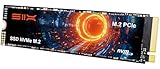
- Unleash Upgraded power - Employing PCIe Gen4x4 High Speed Interface, SIX X7400 nvme m.2 ssd confer it UP to 5000MB/s read speeds. With faster transfer speeds and high-performance bandwidth and throughput.
- Work and Play - Whether you pursue science or culture, X7400 m.2 ssd 512GB accentuates ferocious performance for heavy computing and immersive gameplay. Get up to 30% fast performance for heavy-duty applications in data analytics, content creation, gaming and more.
- Match ur Next-level M.2 SSD - Compatibility ready for laptop, desktop or PS5 storage expansion, X7400 internal 512GB ssd is easy to install to extend lifecycle and storage. Speed up your bootups, file transfers, and game loads for tech-savvy users or hardcore gamer.
- Purpose Built - SIX X7400 m.2 nvme ssd ps5 is built for achieving immersive gameplay, experiencing uninterrupted gameplay and incredibly short load times. Breathe in. Focus. Breathe out, X7400 lightning-fast loading are ready for your final boss.
- 5 Years Limited Warranty & What u Get - Your X7400 nvme m.2 ssd is safeguarded for 5 years by SIX Limited Warranty Service. To improve your installation experience, X7400 provide all you need for installation(such as screw, screwdrivers, heatsink and so on).
FEC and CRC address signaling errors
PAM4 has a higher bit error rate than the signaling approach used by earlier generations. PCIe 6.0 uses lightweight forward error correction (FEC) and cyclic redundancy check (CRC) to mitigate that increased error risk. These mechanisms are part of the link’s reliability approach; they do not turn the transfer rate into guaranteed application throughput.
Flit mode changes how data is packaged
PCIe 6.0 introduces Flit mode, which exchanges fixed-size 256-byte Flits containing variable-sized transaction-layer packets (TLPs) and data-link-layer payloads (DLLPs). PCI-SIG’s FAQ says fixed-size Flits are needed alongside PAM4 and FEC. Flit mode is supported at all link speeds, not only at 64 GT/s; translation takes place at boundaries between Flit and non-Flit links. See the PCI-SIG PCIe 6.0 FAQ.
Rank #2
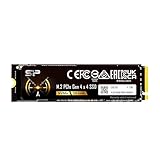
- PCIe Gen 4x4 interface with read speeds up to 7,000MB/s and write speeds up to 6,000MB/s
- NVMe 1.4 support allows for higher performance, lower latency, and lower power consumption
- Available in massive storage capacity options ranging from 1TB to 4TB
- TBW: 300
- Backed by a 5-year limited warranty or up to 300 TBW, whichever comes first. Please note that the warranty covers standard consumer/business use and is voided if the drive’s total written data exceeds its rated TBW limit.
Will PCIe 6.0 work with PCIe 3.0?
PCI-SIG states: “Yes, PCIe 6.0 products will interoperate and maintain backwards compatibility with all previous generations of PCI Express technology.” This is a standards-level interoperability statement, not a guarantee that a particular component will work in every system or operate at PCIe 6.0’s maximum rate.
Do these 3 things before closing this tab:
1Clear out junk files and repair common Windows errors2Scan for outdated or missing drivers - takes under a minute3Repair Windows errors before they cause bigger problemsA connected link is limited by the capabilities of its endpoints and host platform, as well as its lane width and negotiated link speed. An older platform does not gain PCIe 6.0 performance merely by connecting a newer-generation device. PCI-SIG does not provide a motherboard-by-motherboard or device-by-device compatibility matrix in the cited material, so check the specifications for the exact host and device before planning an upgrade.
Rank #3

- SPEED UP PROJECTS. Launch creator applications fast with uncompromising PCIe 4.0 read speeds up to 7,100MB/s,[2] (1TB and 2TB[1] models) and write speeds up to 6,700MB/s[2] (1TB[1]-4TB[1] models).
- CREATE AND STORE MORE. Make more room for your 4K videos and high-resolution images with capacities from 500GB[1] up to 4TB[1] on M.2 2280 built with our trusted 8th generation SANDISK BiCS QLC 3D CBA NAND.
- IT GOES WHERE YOU GO. With an all-new power efficient design, your drive delivers high performance with low power, giving you more time to be productive while on the go.
- UNCOMPROMISED RELIABILITY. With up to 1,200 TBW[3] (4TB[1] model) endurance rating, your drive is designed for creators.
- KEEP YOUR DRIVE UPDATED. Monitor your SSD’s performance and check for updates with the downloadable SANDISK Dashboard application.[5]
What does the difference mean for performance?
At the specification level, PCIe 6.0’s 64.0 GT/s per lane is eight times PCIe 3.0’s 8.0 GT/s, with each intervening generation doubling the rate. Actual application performance is a separate question: it depends on the device, host, negotiated generation and lane width, and the workload. The interface rate alone cannot establish a universal speedup, and the cited specifications do not provide application benchmark results.
PCI-SIG’s presentation lists PCIe 3.0 as released in 2010, PCIe 4.0 in 2017, PCIe 5.0 in 2019, and PCIe 6.0 in 2022. Those dates describe the presentation’s generation table, not the availability of a specific product or its support in an individual computer.
Quick Recap
Rank #4

- Unleash Upgraded power - Employing PCIe Gen4x4 High Speed Interface, SIX X7400 nvme m.2 ssd confer it UP to 7350MB/s read speeds. With faster transfer speeds and high-performance bandwidth and throughput.
- Work and Play - Whether you pursue science or culture, X7400 m.2 ssd 1TB accentuates ferocious performance for heavy computing and immersive gameplay. Get up to 40% fast performance for heavy-duty applications in data analytics, content creation, gaming and more.
- Match ur Next-level M.2 SSD - Compatibility ready for laptop, desktop or PS5 storage expansion, X7400 internal 1TB ssd is easy to install to extend lifecycle and storage. Speed up your bootups, file transfers, and game loads for tech-savvy users or hardcore gamer.
- Purpose Built - SIX X7400 m.2 nvme ssd ps5 is built for achieving immersive gameplay, experiencing uninterrupted gameplay and incredibly short load times. Breathe in. Focus. Breathe out, X7400 lightning-fast loading are ready for your final boss.
- 5 Years Limited Warranty & What u Get - Your X7400 nvme m.2 ssd is safeguarded for 5 years by SIX Limited Warranty Service. To improve your installation experience, X7400 provide all you need for installation(such as screw, screwdrivers, heatsink and so on).
Product prices and availability are accurate as of the date/time indicated and are subject to change. Any price and availability information displayed on Amazon at the time of purchase will apply.
Quick wins for a faster PC:
Scan for outdated or missing drivers - takes under a minuteDriver Scan →Repair Windows errors before they cause bigger problemsFix Now →
