
Quick wins for a faster PC:
Clear out junk files and repair common Windows errorsFree Scan →Fix the driver behind crashes, sound loss and screen glitchesFind Drivers →Repair Windows errors before they cause bigger problemsFix Now →iTechGuides is reader-supported. When you buy through links on our site, we may earn an affiliate commission. As an Amazon Associate I earn from qualifying purchases. Learn more
L‑Acoustics Source Intelligence is a licensed, real-time vocal-isolation system that uses machine learning to identify a singer’s voice and reduce crowd noise, instrument bleed, PA spill and room reflections before the front-of-house engineer mixes the channel. L‑Acoustics’ public materials associate Céline Dion with an earlier project reference, but they do not establish that she used Source Intelligence, which launched in 2026.
What Source Intelligence does in a live mix
Source Intelligence continuously analyzes a microphone signal for the patterns of a human voice. When it detects non-voice material, it suppresses that material so the engineer receives a cleaner vocal feed. The intended targets include audience noise, sound from nearby instruments, loudspeaker spill and reflections from the venue.
Processing happens before the fader
Traditional live-vocal tools such as equalizers, gates and threshold-based processors react to the signal after unwanted sound has entered the channel. They can shape tone or reduce noise during pauses, but they cannot reliably distinguish every changing source of stage crosstalk. Source Intelligence is designed to perform that separation before the vocal is balanced at front of house, giving the engineer a cleaner starting point rather than another corrective stage after the microphone signal is already contaminated.
Recommended Free Tools
It is neither auto-tune nor generative AI
L‑Acoustics Co‑CEO Laurent Vaissié says the company’s machine-learning system “recognizes the pattern of the voice and is able to eliminate the noise from the signal and give the engineer the purest form of the vocal signal as possible.”
#1 Best Overall
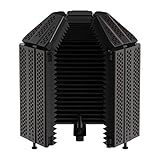 XTUGA MIS02 Recording Microphone Isolation Shield, 5 Panels Soundproof Foam
- REDUCES NOISE INTERFERENCE– The XTUGA Microphone isolation Shield has three layers that work in tandem to reduce noise while recording. It particularly relies on ⅗ reflectors with a triangular high density thickened sponge insulator material which reduces the propagation of interference sound waves and creates perfect recording conditions that result in sublime recordings
- Flexibility And Convenience– There is lots of flexibility working with the mic isolation shield with a stand as you can choose to use the 3-panel design with 2 foldable end panels, 5-panel design with 4 foldable end panels. It is easy to adjust the arch design, enables angle adjustments for optimal sound insulation and meets the recording needs of the environment hence ensures only the highest quality recordings
- SUPERIOR NOISE REDUCTION DESIGN–This portable vocal booth is designed to maximize on blockage of all sound interpretations with its compact design.It is a full package design, with a foldable top to efficiently cancel out noise interference from the environment for a noiseless,multi-layer noise cancellation structure. It reduces noise on the back and side to ensure cleaner and clearer recordings.The reflection area and the absorption area reduce noise generated by the external environments
- EASY TO USE–The microphone isolation cover is designed for easy usage as it can be disassembled separately and installed according to the recording environment.You can fox it on a desktop or microphone stand. It is suitable for use with multiple stands making it suitable for your current needs.You can adjust the height of the recording shield to fit the preferences of the personal preferences. This one are suitable for professional or vocal recordings and podcast recording studios
- QUALITY MATERIALS – The state-of-the-art recording shields are constructed from high-quality material for sturdiness and long-lasting performance. They can be used with multiple stands or microphones, you can use them on a flat surface and can be fitted on countertops and desktops
The company explicitly describes the feature as not generative AI and not auto-tune. It does not synthesize a new performance or retune the singer; its stated job is to remove stage crosstalk from the captured signal.
Published performance figures
The following numbers are claims published by L‑Acoustics in 2026, not independent laboratory benchmarks.
Rank #2

- ♪【The package contains】♪: Microphone Isolation Shield x 1, Metal Thread Adapter x 2 (Adapt most microphones), Adjustable Stand x 1 and instruction manual. (The height of the isolation shield can be adjusted freely) *NOTE: Microphone is NOT included.
- ♪【Designed for recording】♪: The inside of the microphone cover is made of absorbent cotton material, which maintains the clarity of the human voice and the instrument during recording, eliminating the interference of the audio waves and the external environment.
- ♪【Rugged & Durable】♪: Made of high-quality steel, the Microphone Isolation Shield is more rugged and scratch-resistant.
- ♪【Easy to install】♪: The Microphone Isolation Shield has steel clips on the back. Insert the steel clip into the stand and tighten the screws.The height of the stand is 182CM, and you can install the isolation shield to any height you want.
- ♪【Special recording】♪: This acoustic shield features an acoustic foam front and a vented metal back plate. If you need to record in the studio, this Microphone Isolation Shield will give you unexpected results.
| Measure | Published figure | Qualification |
|---|---|---|
| Reduction of non-voice material | Up to 40 dB | Maximum cited by L‑Acoustics; actual reduction depends on the source, microphone and production. |
| End-to-end latency | Under 8.5 milliseconds over MADI | Vendor figure for the MADI path; other system paths may have different totals. |
| Independent processing instances | Four per L‑ISA Processor II | Described as four separate instances in the processor. |
| Voice-quality comparison | Ranked highest in L‑Acoustics’ blind listening tests against competitors | The reviewed product pages do not disclose participant count, protocol or an independent dataset. |
Hardware, connections and licensing
Source Intelligence runs as a licensed application on the L‑ISA Processor II/Core platform and is intended for L‑Acoustics systems rather than general-purpose consumer audio gear. Official product information lists MADI, Milan‑AVB and AES input and output options.
Do these 3 things before closing this tab:
1Clear out junk files and repair common Windows errors2Fix the driver behind crashes, sound loss and screen glitches3Repair Windows errors before they cause bigger problemsNetwork requirement
A deployment needs at least three L‑Acoustics amplified controllers on the network. That requirement makes the feature part of a complete installed or touring system design, not a plug-in that can simply be inserted on an arbitrary digital console.
Rank #3

- 【BASIC INFO】: Inside size after setup: 8'' (L) X 10'' (W) X 12'' (H), large space for various studio equipment of any sizes; Exterior size: 12'' (L) X 12'' (W) X 16'' (H); Folded size: 12'' (L) X 12'' (W) X 6'' (H); Weight: 2 lbs; Equipped with holes for audio cables and mic stands【PORTABLE & FOLDABLE & SPACE-SAVING】: This studio booth is portable and foldable. It's light weight and ready-to-go. Just put in your suitcase and record wherever you are
- 【NOTABLE SOUND ABSORPTION & RECORDING CLARITY IMPROVEMENT】All inside surfaces of this voiceover box cube are treated with TroyStudio 2" thick dense egg-crate foam for optimal acoustical treatment. It effectively eliminates echoes and reflections while reducing ambient noise. As a result, recordings are well protected from room reverb by 92.7%, producing a dry, clear sound that greatly enhances recording clarity. If you don't have a professional recording studio, it is an excellent alternative
- 【REDESIGNED STRENGTHENED STRUCTURE】This new-version portable studio includes 5 pieces of high-density, 2-inch thick sound dampening foam that will not sag over time; A specially designed backing panel adds significant support to prevent the entire system from becoming flimsy; Additionally, if you want it to be more compact, you can use the elastic bands included in the felt shield case to further secure the foam in place
- 【BROAD COMPATIBILITY】: Both stand mount & table use available. Compatible with all the microphones, such as vocal microphone, condenser microphone, usb mic, phone, recorder pen, condenser hanging mic. Work with various mic stands, like desktop mic stand, boom arm stand, ceiling holder stand and floor stand. Please note that this mini recording booth can only be mounted on stands with a diameter smaller than 0.86 inches
- 【ENDLESS APPLICATION】: Ideal for versatile recording needs including podcasting, audiobooks, vocal/ musical, voice over work, instruments, percussion... Perfect for home studio, music studio, office, apartment, podcast studio, basement room, closet booth, bedroom and more. 【QUICK INSTALLATION】: Setup can be effortlessly completed within 1 minute, and disassembly takes only 20 seconds. NOTE: Please read the instruction before installation, since wrong setup steps may lead to unstable issues
Capacity planning
One L‑ISA Processor II can provide four independent Source Intelligence processing instances. A production with more isolated vocal channels must account for additional processing capacity during system design.
Why engineers use it on stage
More gain before feedback
L‑Acoustics positions the reduction of non-voice sound as a way to increase vocal clarity and gain before feedback. Removing changing stage spill from the vocal path can give an engineer more usable level, although the achievable margin still depends on microphone choice, loudspeaker placement, room acoustics and system tuning. Source Intelligence is not a guarantee against feedback.
Rank #4

- Sound Absorption & Isolation: This vocal booth features a box design combining five high-density foam and sound absorbing panel boards. This setup effectively eliminates echoes and reflections while reducing ambient noise. It prevents 96% of indoor reverb, producing a dry, clear sound to significantly improve your recording clarity
- Strong Stability: The box is reinforced by hardened plastic frames at the front and back, providing powerful support and greatly enhancing the system’s stability. It includes a heavy-duty tripod made from premium thick steel, removing any concern about an unstable center of gravity or the risk of it tipping over from a light touch
- Height Adjustable: The Vocal Booth isolation shield has a user-friendly design that can be easily installed in just five minutes! The height is adjustable from 51.2’’–74.8’’ (1.35 m–1.9 m) via the knob on the telescopic pole, making it convenient for either standing or seated recording
- Large Box Space: After installation, the recording box has a spacious interior of 12’’ × 13.6’’ × 16.7’’ (30.5 cm × 34.5 cm × 42.5 cm) to accommodate microphones of various sizes; the external dimensions are 15’’ x 15’’ x 19.7’’ (38 cm * 38 cm * 50 cm). The microphone fixing pole can also be used as a tray to support a tablet or phone for easy lyric viewing
- Wide Compatibility: A 3/8’’ to 5/8’’ adapter is provided for compatibility with most microphones on the market, supporting a maximum microphone weight of 4.4 lbs (2 kg). It is suitable for a variety of recording needs, including podcasts, audiobooks, voice-overs, and instruments, making it ideal for recording studios, home studios, and music studios
Greater performer freedom
Because the processing is intended to reduce PA spill and other non-voice components at the source, L‑Acoustics says singers can move more freely, including in front of the PA. The benefit is most relevant to productions where performers leave a fixed microphone position or where loud stages make conventional gating and equalization difficult.
Launch context and reported deployments
L‑Acoustics introduced Source Intelligence at its 2026 Keynote alongside the L1 large-format line-array system and CS1 subwoofer. The company’s launch material says the technology had already been used in the field since spring 2025 on major touring productions, Broadway shows and prominent houses of worship.
Best Value

- PLUG AND PLAY STUDIO MICROPHONE: This music mic does not require additional drivers, plug and play, and it’s suitable for smartphones, PC and laptop. The recording mic adpots a cardioid pickup pattern, which can capture the front of the microphone clearly, smooth sound with great sound performance.
- PORTABLE AND FOLDABLE MICROPHONE SHIELD: This 5-panel mic isolation shield is composed of a reflective layer, filter layer, absorbing layer, and high-quality screws, which are durable. The inner layer is composed of high-density absorbent foam, which can absorb environmental noise and reduce sound reflection when recording sound, providing excellent recording effects. The compact and foldable panel design can be adjusted to suit the angle you want, making it easy to carry.
- DOUBLE-LAYER MIC POP FILTER: The adjustable pop filter can adjust the distance and angle from the condenser microphone to achieve multi-layer noise reduction and record clearer sound. The height-adjustable metal tripod can place the mic at a suitable height in front of you, allowing you to record in a comfortable posture.
- COMPATIBILITY AND VERSATILITY: The mic shield can be used on a desk using the metal tripod included with the kit, or it can be mounted on a microphone stand (not included) for use. Recording microphone for singing, vocal recording, live streaming, and podcast.
- STUDIO EQUIPMENT PACKAGE LIST: This studio recording equipment includes 5-panel microphone shield*1, vocal recording microphone*1, USB microphone cable*1, Type-C adapter*1, metal tripod stand*1, mic clip*1, microphone filter*1, instruction manual*1. If you encounter any problems before purchasing or during use, you can contact us at any time, we will serve you wholeheartedly.
Listed applications include touring, festivals, special events, houses of worship, theater and performing arts, musicals and concert venues. In a release about a Bruno Mars tour, L‑Acoustics described the system separating the lead vocal from crowd noise, instrument bleed, PA spill and room reflections on that production.
Independent reader supportYour contribution helps us test, update, and keep practical guides available for everyone.What the Céline Dion reference confirms—and what it does not
L‑Acoustics’ February 2024 catalog includes “CÉLINE DION” among its project references. That is evidence of an L‑Acoustics project association, but it does not identify which products or processing methods were used.
Source Intelligence was launched in 2026, so the catalog entry cannot by itself verify that Dion used this machine-learning vocal-isolation feature. A responsible description is that L‑Acoustics has documented a Céline Dion project reference while providing no public confirmation in the reviewed material of her use of Source Intelligence.
Crashes, No Sound, or Screen Glitches?
Random freezes, missing sound and display glitches usually trace back to one bad driver. Find and replace yours safely.Free scan · under a minutePC Slower Than It Used to Be?
A free scan shows the junk files, broken settings and background clutter dragging Windows down - then fixes them in one click.Free scan · Windows 10 & 11Source Intelligence versus conventional live-vocal processing
| Decision point | Source Intelligence | Conventional processing |
|---|---|---|
| What is removed | Machine-learning separation aimed at non-voice sound such as bleed, crowd noise, PA spill and reflections. | Equalization, gates, compressors and thresholds shape or reduce a signal but do not provide a single universal source-separation figure. |
| When it acts | Before the front-of-house mix receives the vocal signal. | Usually after the microphone signal reaches the console or processor. |
| Latency | Under 8.5 ms over MADI, according to L‑Acoustics. | Not stated as a universal value; it varies by console, plug-ins and routing. |
| Hardware model | Licensed professional software on L‑ISA Processor II/Core with an L‑Acoustics controller network. | Can be built from console processing and outboard or software tools, depending on the system. |
| Feedback and movement | Designed to increase usable gain and support movement near the PA; results depend on system design. | May improve stability through placement, EQ and gating, but changing spill remains a recurring problem. |
| Maximum non-voice reduction | Up to 40 dB, vendor-reported. | No single figure is stated; performance depends on the processing chain and conditions. |
Do not confuse it with L‑Acoustics DJ
L‑Acoustics DJ is a related but different product. It applies machine-learning source separation inside the L‑ISA spatial-audio engine to turn a stereo DJ feed into an immersive live mix. It works with the LA‑DJC controller and L‑Acoustics DJ App and can distribute the result across as many as 128 outputs. That workflow separates elements of a DJ program; it is not the vocal-isolation function described here.
How a production should evaluate a deployment
- Confirm system compatibility. Verify that the venue or tour uses the required L‑ISA Processor II/Core platform, at least three networked L‑Acoustics amplified controllers and a supported MADI, Milan‑AVB or AES signal path.
- Map the vocal channels. Decide which microphones need isolation and reserve one of the processor’s four instances for each channel, adding processors if the channel count exceeds that capacity.
- Test with the real stage. A demo should use the intended microphones, backline, monitor levels, PA positions and audience or room conditions. Listen for residual bleed, artifacts and the actual feedback margin rather than relying only on a specification.
- Use a qualified system designer. L‑Acoustics directs professional buyers toward its company or a Certified Partner for consultation, demonstration, design, calibration and commissioning. Public product material does not provide a standard retail price.
Why the distinction matters
Source Intelligence is best understood as an infrastructure-level tool for cleaning live vocal channels before they reach the mix, not as a singer-correction effect. Its published latency, reduction and processing-capacity figures describe a professional L‑Acoustics workflow, while the Céline Dion catalog reference should remain a project association rather than proof of a specific Source Intelligence deployment.
Quick Recap
Product prices and availability are accurate as of the date/time indicated and are subject to change. Any price and availability information displayed on Amazon at the time of purchase will apply.

