
What’s actually slowing this PC down?
Pick the symptom - the matching free tool is one click away.
iTechGuides is reader-supported. When you buy through links on our site, we may earn an affiliate commission. As an Amazon Associate I earn from qualifying purchases. Learn more
Archaeologists estimate how many people lived in a past settlement by combining evidence such as the area and layout of its buildings, written records, burials, and signs of disease. None of these usually provides a complete headcount. Researchers interpret each source according to what it actually records, then use demographic models to convert those observations into a reasoned estimate—often a range, not an exact total.
What a past-population estimate actually measures
A population figure can refer to very different things: people living inside one settlement, residents of a region, the population of a political territory, or the inhabitants of a much larger area at a particular time. It may describe a short interval or a period spanning generations. Those boundaries matter: an estimate for an ancient city cannot be compared directly with a regional total, and a count of deaths during an epidemic is not a count of everyone who lived through it.
Population size is also distinct from settlement density, carrying capacity, and effective population size. Density describes people relative to an area. Carrying capacity is an estimate of how many people an environment could support under specified conditions. Effective population size is a separate demographic concept and should not be substituted for the number of residents. A good estimate identifies which quantity it is trying to describe, its geography, and its date or time span.
The Tool Desk
Outbyte Driver Updater FREEScan for outdated or missing drivers - takes under a minuteDriver Scan →Outbyte PC Repair FREERepair Windows errors before they cause bigger problemsFix Now →For most ancient societies, researchers cannot check a model against a complete census. Instead, they combine imperfect sources that illuminate different parts of the problem. The result is an inference built on evidence and assumptions—not a recovered headcount.
#1 Best Overall

- 1.Value Package: Come with a 33.8 oz rock pick hammer,4 PCS of metal rock chisels & 1pcs wood chisel,Multi-function shovel & Gloves, musette bag and safety glasses,3-in-1 whistle (whistle & thermometer & compass), jewelers loupe, flashlight, 3pcs cleaning brushes and 1pcs small detail brush,1pc Utility knife, 1pc Dust Blower,1pc Tweezers,1pc marker and a plastic storage case with compartments and 100pc clear plastic storage bags. Come with all the equipment that will you need.
- 2.Different Size of Rock Chisels,7.8-inch flat chisel, 9.8-inch flat chisel and point tip chisel& 11.8-inch flat chisel,used for chipping brickwork, concrete, metal, and stone, build from high strength forged steel,this set also including a small wood chisel,to dig clay
- 3.Stainless Steel Rock Pick Hammer: 33.8oz drop forged one-piece all steel head-handle construction with fully polished finish and additional rust-preventative clear coating for maximum strength and durability
- 4.Large Musette Bag:Made of heavy duty nylon,very durable and tear proof. Carry all your tools as well as the rocks, minerals, gems, gold & fossils that you find.There is mark and clear bag to storage your rock hunting gain,you can label them with mark pen,storage them in Plastic Organizer Box (24 Compartments )
- 5.Great for the experienced rock collector, gem hunter, hobbyist,from digging, exploring, cleaning, sorting, collecting,INCLY offer necessary tool for our customers.If you are not satisfied with INCLY Geological Tools , we’re very happy to either provide a no-questions-asked Refund or Replacement. Order today risk free!
How archaeologists estimate settlement populations
Start with the occupied area and its layout
Researchers may map the area that appears to have been inhabited and examine the buildings, streets, and other structures within it. They can then estimate how many households or people the settlement might have held using habitation-density coefficients: assumptions about the number of occupants associated with a given area or pattern of housing.
This is not simply “site area multiplied by a standard number of people.” A mapped site can include open space, public buildings, workshops, roads, or areas that were not occupied at the same time. Homes can differ in size and function, and settlement density varies across periods and places. The estimate therefore depends on the boundaries used, the interpretation of the architecture, and the coefficient chosen.
Jeffrey R. Zorn’s 1994 study evaluates habitation-density methods alongside approaches based on natural resources. It argues that different methods can be combined at a site when the settlement’s architectural pattern is reasonably clear. In his site-specific estimate, Tell en-Nasbeh probably had 800–1,000 people during Iron Age II and perhaps 400–500 in the subsequent Babylonian period. These figures apply to that settlement and those periods; they are not a general rule for converting area into people.
Use facilities and settlement form where they fit
Some settlements have evidence that supports a more tailored approach. For Ptolemaic Fayum settlements, Katja Mueller and William Lee proposed recording the presence or absence of known facilities in matrices and using linear regression to estimate settlement size. This method depends on the relationship between those facilities and settlement size in that particular context. It should not be treated as a universal formula for ancient cities: a model fitted to one group of settlements may not describe a different period, region, or urban form.
Rank #2

- Value Practical Package: Unwrap the ultimate value package that includes a robust 22oz stainless steel rock pick hammer, flat chisel, a reliable shovel set, and durable gloves. This kit comes complete with a convenient musette bag, safety glasses, a whistle, jewelers loupe, and a slotted box for organizing your precious finds. Everything you need is right here in one place.
- Rock-Solid Hammer: Crafted with a drop-forged, all-steel head-handle construction, our 22oz stainless steel rock pick hammer boasts exceptional strength and durability. The fully polished finish and rust-preventative clear coating ensure it stands up to the toughest conditions. It's a geology enthusiast's dream come true.
- Spacious Musette Bag: Carry your tools, treasures like rocks, minerals, gems, gold, and fossils, and even pack a lunch, a change of clothes, and gold prospecting gear. Our medium-sized musette bag offers ample room for your exploration essentials, making it an ideal companion for any field adventure.
- Archeology Kit: Designed for young people, our kit features essential safety gear, including a whistle, gloves, and goggles. These practical additions provide peace of mind during gold prospecting outings by ensuring a secure and protected experience in the field.
- Geologist Tools: Whether you're an experienced rock collector, a passionate gem hunter, or a hobbyist with a keen interest, our rock hunting tool kit caters to all levels. It's the perfect stocking stuffer for adventurous explorers. Beyond its excitement, this kit introduces the world of geology to young people, nurturing their diverse interests and hobbies from an early age. Unleash your inner geologist with this remarkable kit!
Compare settlements with resources cautiously
Regional population estimates may compare the size and distribution of settlements with food production and the resources available to support people. This can help researchers ask whether a proposed population is plausible given the environment and agricultural system. But resource-based carrying capacity describes what could potentially be supported under stated assumptions; it does not establish how many people actually lived there.
The Cologne Protocol review discusses differences in how closely demographic proxies relate to population size and considers comparing settlement evidence with nutritional carrying-capacity hypotheses for agrarian regions. The distinction is essential: a resource model is a check on plausibility, not an independent census. If its assumptions about food supply, land use, or access to resources change, the estimate can change too.
What written records can—and cannot—count
Documents are useful because they may name people, households, or events, but the reason a record was made determines what its numbers mean. Historical-demography source overviews identify censuses and vital statistics for more recent periods, and parish registers, hearth or poll taxes, enumerations, genealogies, and institutional records for earlier ones.
Quick wins for a faster PC:
Scan for outdated or missing drivers - takes under a minuteDriver Scan →Repair Windows errors before they cause bigger problemsFix Now →A tax list might record liable taxpayers or household heads rather than every resident. A parish register might record a baptism, marriage, or burial rather than the full population. An enumeration might cover one jurisdiction but exclude people outside its administrative reach. The record can also be incomplete because some pages, districts, or years did not survive. Before turning a document’s total into a population estimate, researchers need to establish who could be recorded, who was omitted, what area and date it covers, and whether the surviving record is representative.
Rank #3

- Each kit includes essential excavation tools such as margin and pointing trowels for controlled digging and artifact exposure.
- Comes with multiple detail brushes in varying sizes to carefully remove soil and debris from delicate finds.
- Includes precision measuring tools—Lufkin metric rule, line level, neon line, and square—for accurate site mapping.
- Durable 15" canvas zipper bag provides convenient storage and transport for all tools in the field.
- Designed for both professionals and students of archaeology, paleontology, and historical preservation.
That means a number in a source is not necessarily a population count. A count of taxable units, registered births, or recorded deaths measures the category the institution tracked. Converting it into residents requires additional assumptions, such as how many people belonged to a household or how completely a register captured events. Those assumptions should be visible rather than hidden behind a precise-looking total.
What bones, burials, and disease evidence add
Skeletons can reveal mortality patterns, not a complete census
Paleodemography combines archaeological evidence with methods from historical demography and statistics. The French National Institute for Demographic Studies (INED) describes the field as drawing on evidence such as dwellings and food remains for settlement histories and bones and teeth for demographic and health questions.
Researchers can estimate age at death from skeletal remains and study the age and sex distribution of a burial sample. These observations may help reconstruct mortality patterns, especially when written records are absent. But age estimates involve error, and the people whose remains are recovered may not represent the population that was alive. Burial practices, preservation, excavation choices, and the circumstances of death can all affect which individuals appear in the sample. A cemetery’s profile therefore cannot be read automatically as the age profile of an entire living community.
Free tools Windows power users keep installed
One-click scans. No signup required.
Disease evidence can illuminate a crisis
Evidence relevant to disease may include the context of burials, diagnostic lesions on bones, and molecular data. Which kinds of evidence are available depends on the disease and archaeological setting; not every infection leaves identifiable marks in skeletal remains, and a burial’s context does not always establish a cause of death.
Rank #4

- NORTH ARROW SET — Shows orientation and metric scale in archaeological photographs.
- 4 ARROWS — One 25 cm, one 3 cm, and two 10 mm north arrows; made in the USA.
- CONVERSIONS — 25 cm arrow has hypotenuse and metric/standard conversions on the back.
Disease models are most useful here for investigating health patterns or a specific mortality event, not for independently counting a whole population. They can contribute evidence about who died, when, and under what circumstances, but translating that evidence into a total population requires other information and assumptions. There is no universal conversion from disease evidence to population size.
A study of the eighteenth-century plague in Provence illustrates the value of combining sources: its authors compare historical archives with biological archives and analyze the age and sex distribution of epidemic casualties. Reading written and skeletal evidence together can show more than either source alone. Researchers still need to assess how representative the surviving documents and burial sample are before generalizing from them.
Independent reader supportYour contribution helps us test, update, and keep practical guides available for everyone.How estimates are built from different sources
The central task is to make unlike evidence answer a clearly defined question without pretending that the sources measure the same thing. Settlement remains may indicate occupied space; documents may count administrative categories or recorded events; burials may provide a sample of people who died. Models connect those observations to a population estimate, but the connection depends on choices about scale, coverage, and conversion.
- Define the population and time. Specify whether the question concerns a settlement, region, or larger territory, and identify the date or interval the estimate represents.
- Describe what each source records directly. Separate occupied area, buildings, tax units, registered events, deaths, and skeletal age or sex profiles. Do not treat one as a direct substitute for another.
- State the conversion assumptions. Explain how structures or area become estimated occupants, how households become people, how resources become potential carrying capacity, or how a burial sample informs mortality.
- Assess coverage and preservation. Consider missing or undercounted records, unexcavated or disturbed sites, non-residential space, and whether a burial sample reflects the wider population.
- Compare independent evidence and alternatives. Ask whether different methods point to broadly compatible results and whether the estimate changes when plausible assumptions change.
- Report uncertainty in proportion to the evidence. Give a range when warranted, preserve terms such as “probably” or “perhaps,” and avoid presenting a fragile inference as an exact count.
This approach helps explain why two careful estimates may differ without either being a simple arithmetic mistake. They may cover different dates or boundaries, use different evidence, or apply different assumptions to the same evidence. The systematic-method literature on Greek and Roman settlements exists in a context where city and total-population estimates have been debated; settlement and regional models also depend on their selected inputs.
Best Value
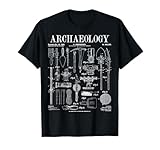
- Unique retro blueprint patent application diagram of vintage archaeologist tools, trowel, pick, spade, brushes, dustpan, flashlight, camera, compass, flag tape, pegs, string, levelling transit, root cutter and screen image design.
- When you dig archaeology. Funny future archaeologist and archaeological theory students, professor and teacher gifts and gift ideas for archaeologist, teacher and student.
- Lightweight, Classic fit, Double-needle sleeve and bottom hem
Examples of estimates and how to quote them
Specific figures are useful when their scope and attribution travel with them. Zorn’s 1994 estimates for Tell en-Nasbeh are site- and period-specific: probably 800–1,000 inhabitants in Iron Age II, and perhaps 400–500 in the following Babylonian period. The qualifications are part of the claim, not optional decoration.
A 2017 article extract by J. W. Hanson and S. G. Ortman reports Walter Scheidel’s estimate that roughly 1.5 million people lived in the five largest Greco-Roman cities by the second century CE, and gives approximate figures for Rome, Alexandria, and Antioch. That is an attributed scholarly estimate reported in an article extract, not a census result. It should not be generalized to all cities or treated as a directly observed total.
No single accuracy percentage applies to estimates of past populations across places, periods, and methods. A claimed precision must be evaluated for the particular model and evidence behind it. If an author does not establish an overall error rate, adding one would create certainty the evidence does not support.
How to judge a population estimate
When reading a published figure, look for the reasoning behind it, not just the final number. A useful estimate makes its boundaries clear and lets the reader see how the evidence was converted into a result.
- Scale and date: Is this a settlement, region, empire, or wider population, and what time does it represent?
- Direct observation: Does the evidence count buildings, people, households, events, deaths, or something else?
- Model choices: Are density coefficients, household assumptions, resource calculations, or burial interpretations explained?
- Coverage: What may be missing, undercounted, destroyed, unexcavated, or unrepresentative?
- Uncertainty: Does the author preserve appropriate qualifications, give a range, or test alternative assumptions?
- Cross-checks: Do independent sources support a broadly similar interpretation, or do they measure different things?
A precise-looking number can still rest on uncertain assumptions. Conversely, a range can be informative when it identifies what the evidence supports and where its limits lie. The strongest estimates let readers distinguish observed evidence from the model used to interpret it.
Quick Recap
Product prices and availability are accurate as of the date/time indicated and are subject to change. Any price and availability information displayed on Amazon at the time of purchase will apply.

