
What’s actually slowing this PC down?
Pick the symptom - the matching free tool is one click away.
iTechGuides is reader-supported. When you buy through links on our site, we may earn an affiliate commission. As an Amazon Associate I earn from qualifying purchases. Learn more
High-altitude weather balloons carry a small instrument called a radiosonde through the atmosphere. Its sensors measure temperature, pressure and relative humidity as it rises; GPS tracks its position, allowing a ground station to calculate wind speed and direction from its movement. The station receives the readings by radio and processes them into a vertical atmospheric profile, called a sounding, for forecasting, weather models and research.
What the balloon measures—and what it does not
The balloon is the lift system; the radiosonde is the measuring and transmitting instrument. A radiosonde typically contains sensors for atmospheric temperature, pressure and relative humidity, plus a GPS receiver for position. It sends its readings to a ground receiver during the flight. The resulting profile describes how conditions change with height rather than reporting only what is happening at the surface. NOAA’s National Weather Service fact sheet describes the instrument and its measurements, while NOAA’s National Centers for Environmental Information overview lists upper-air profiles that include temperature, humidity, wind speed and direction, pressure and geopotential height.
Wind is an important distinction: the radiosonde does not need to measure wind with a separate anemometer. The instrument’s changing GPS positions show how it is being carried through the air. A basic radiosonde observation contains the direct sensor measurements; when the instrument is tracked to obtain wind information, NOAA’s terminology calls the observation a rawinsonde. In everyday usage, “radiosonde” is also often used more broadly for the instrument and its observation. NOAA explains this distinction in its JetStream radiosonde overview.
How a sounding is collected, from launch to ground station
1. The radiosonde is prepared below the balloon
A radiosonde is a small, expendable instrument package. The NWS fact sheet gives a typical package weight of 60–80 grams. It is suspended 25–35 meters below the balloon, rather than attached directly to it, to reduce contamination of the temperature measurement by heat from the balloon. The separation also gives the package a clearer sample of ambient air instead of air disturbed immediately around the balloon envelope. The exact equipment and procedures can vary among systems and locations.
#1 Best Overall

- Huge balloon,100g,about 6ft/72 inch after inflation,Lift off altitude about 26000m
- natural color close to white , can be painted the color you want, easy to track or entertainment
- Ideal for fairs aerial photos,meteorologists, science projects and grand openings.
- 72‘’ balloon Approximately 100 grams of items can be lifted (not accurate calculation, only approximate value, you need to measure it after you buy the balloon)
- These balloons must be filled with helium if they want to float up. You need to buy helium locally or fill it with hydrogen in a laboratory to ensure safety (dangerous, not recommended for ordinary people).
Before launch, operators connect the instrument to its power supply and ground receiving system, verify that the sensors and transmitter are responding, and attach the suspension train. The balloon itself is filled with hydrogen or helium. These preparation details explain why a sounding is an observing operation, not simply a balloon released with a consumer thermometer tied to it.
2. The balloon carries the instrument upward
The balloon is filled with hydrogen or helium. As it rises into air at lower ambient pressure, the gas inside expands and the balloon grows. Eventually it reaches its elastic limit and bursts. The ascent rate stated as typical by the NWS is about 300 meters per minute (about 1,000 feet per minute). A typical NWS flight may exceed 35 km (about 115,000 feet) and last more than two hours, although actual altitude, trajectory and duration vary with the flight and system.
The balloon does not follow a perfectly vertical line. Winds carry the suspended radiosonde sideways while it climbs, so the track can curve and the instrument can travel far from the launch point. That horizontal movement is not a defect: it is the position history needed to calculate winds at successive levels. It does mean the sounding describes the air along a particular path, not every location in a broad region.
Crashes, No Sound, or Screen Glitches?
Random freezes, missing sound and display glitches usually trace back to one bad driver. Find and replace yours safely.Free scan · under a minuteWindows Errors? Fix Them Before They Spread
Repair common Windows errors and clear accumulated junk for a smoother, more stable PC - no reinstall needed.Free scan · no reinstall3. Sensors sample the surrounding air
As the radiosonde ascends, its sensors record pressure, temperature and relative humidity, while GPS supplies position data. The NWS fact sheet says these data are transmitted every second. Measurements at successive levels let forecasters see vertical changes—for example, where the air becomes warmer or colder, how moisture varies, and how pressure changes with height. These are observations along the instrument’s route, not a continuous measurement at every point in the surrounding atmosphere.
Pressure normally decreases as the package gains altitude, and the pressure record helps place each observation in the vertical structure of the atmosphere. Temperature and humidity readings show layers, dry zones and moist zones that a surface station cannot reveal. NOAA NCEI describes resulting upper-air products as including geopotential height as well as temperature, humidity, pressure and winds; some of those fields are measured directly and others are calculated from the observations and position.
4. A radio link sends the readings to the station
A battery-powered transmitter on the radiosonde sends the measurements to a ground receiver. The NWS fact sheet gives a typical frequency range of 400–405.9 MHz. That range describes what the fact sheet states; it should not be treated as a universal radio specification for every radiosonde or observing network. The receiving station must capture and decode the transmission to turn the radio signal into usable meteorological readings.
Rank #2
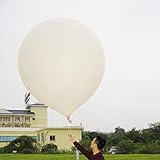
- 2 PCS Hwoyee professional huge balloon,For meteorological purposes, the Suggested Inflation Volume of a 50g balloon is 0.11-0.15m ³, Net Lifting Force=150g, Total Lifting Force=450g, Bursting Altitude=12000 m/49000 feet.
- Natural color close to white ,Neck Length≥6cm,Neck Diameter≤3.9cm,Body Length=45-55cm.
- Ideal for fairs aerial photos,meteorologists, science projects and grand openings.
- If you are using it for other purposes, you can charge more helium or hydrogen gas to achieve greater lift near the ground.
- If need to fly,these balloons must be filled with helium if they want to float up. You need to buy helium locally or fill it with hydrogen in a laboratory to ensure safety (dangerous, not recommended for ordinary people).
The link operates while the instrument is in flight, so a station needs a clear enough signal and a way to keep the antenna pointed or configured for a moving target. The transmitted stream includes the sensor values and GPS position at the stated cadence. Losing a transmission can create gaps that operators and processing software must identify rather than silently treating as real atmospheric changes.
5. GPS movement provides wind information
The ground system compares the radiosonde’s GPS positions over time. Its displacement between successive observations indicates how the surrounding air is moving the instrument; calculated at successive levels, this yields wind speed and direction aloft. This is why tracking matters as much as the instrument’s onboard sensors: without the position history, the three sensor measurements alone would not provide the same wind profile.
In practical terms, the system determines how far the package moved horizontally and vertically during a time interval, then resolves that motion into a direction and speed. The result is a wind profile paired with the pressure, temperature and humidity profile. NOAA’s use of “rawinsonde” emphasizes that wind information comes from tracking the radiosonde; it is not necessarily a separate wind sensor hanging below the balloon.
6. The station processes the data into a profile
The station converts received signals into meteorological values, checks and processes the observations, and produces a sounding: a vertical profile of atmospheric conditions. The NWS describes quality control at both the station and national-center levels. Checks can flag implausible jumps, missing records or position and sensor combinations that do not fit the flight, allowing questionable points to be reviewed or excluded.
NOAA’s NCEI provides information about archived weather-balloon products. The resulting profile combines the instrument’s measured variables with derived wind information; it is not simply a record of the balloon’s maximum altitude. Forecasters can inspect the sounding as a graph or table, while data centers preserve observations for model initialization, verification and later atmospheric studies.
The Tool Desk
Outbyte Driver Updater FREEScan for outdated or missing drivers - takes under a minuteDriver Scan →Outbyte PC Repair FREERepair Windows errors before they cause bigger problemsFix Now →Typical flight figures at a glance
The following figures are those stated as typical or given in the NOAA National Weather Service’s Radiosonde Observation fact sheet, which is undated and was accessed in 2026. Actual configurations and flights can differ.
Rank #3
- Hwoyee professional huge balloon,For meteorological purposes, the Suggested Inflation Volume of a 300g balloon is1.5-1.8m ³, Net Lifting Force=810g, Total Lifting Force=1360g, Bursting Altitude=18000m.
- Natural color close to white ,Neck Length≥10cm,Neck Diameter≤6.4cm,Body Length=135-160cm.
- If you are using it for other purposes, you can charge more helium or hydrogen gas to achieve greater lift near the ground.
- If need to fly,these balloons must be filled with helium if they want to float up. You need to buy helium locally or fill it with hydrogen in a laboratory to ensure safety (dangerous, not recommended for ordinary people).
- Ideal for fairs aerial photos,meteorologists, science projects and grand openings.
| Flight or instrument detail | Figure stated by the NWS | What it describes |
|---|---|---|
| Radiosonde package weight | 60–80 grams | Typical weight of the instrument package |
| Separation below balloon | 25–35 meters (about 80–115 feet) | Suspension distance intended to reduce balloon heat’s effect on temperature measurement |
| Ascent rate | About 300 meters per minute (about 1,000 feet per minute) | Typical upward speed |
| Altitude reached | More than 35 km (about 115,000 feet) | A typical sounding can exceed this height |
| Flight duration | More than two hours | A typical sounding can last longer than this |
| Data cadence | Every second | Stated transmission cadence for pressure, temperature, relative humidity and GPS position |
| Radio frequency | 400–405.9 MHz | Range stated in the fact sheet; not a universal specification |
NOAA’s Atlantic Oceanographic and Meteorological Laboratory also says flights can exceed two hours and rise above 115,000 feet in its explainer, “Upper Air Observations: How Weather Balloons Improve Forecasts”, published September 1, 2017, with a page update indicated June 7, 2024. The NWS figures are useful for understanding the scale of a typical flight, but they should not be read as fixed performance specifications for every observing system.
Why the vertical profile matters to forecasts
Weather at the surface does not reveal the full state of the atmosphere above it. A sounding supplies observations at multiple heights, including temperature, pressure, moisture and wind information. Forecast models and forecasters can use those observations to understand the atmosphere’s vertical structure, while researchers use upper-air profiles to study atmospheric conditions. NOAA NCEI describes the archived upper-air products, and the NWS Charleston upper-air page describes local operational observations and their processing: Weather Balloon / Upper Air Observations.
These observations help identify boundaries between air masses, layers of unusually dry or moist air and changes in wind with height. Such vertical detail can improve the starting information supplied to numerical weather prediction models and help forecasters interpret developing storms. The profile is one observation in a larger network, so it is combined with surface stations, aircraft reports, satellites, radar and other sources rather than used in isolation.
Do these 3 things before closing this tab:
1Fix the driver behind crashes, sound loss and screen glitches2Repair Windows errors before they cause bigger problems3Scan for outdated or missing drivers - takes under a minuteA key value of a balloon observation is that it directly samples the air along its ascent. Satellites, by contrast, estimate atmospheric variables from remote observations using radiative-transfer equations. The two approaches provide different kinds of information: one follows a particular path through the atmosphere, while the other infers conditions from signals observed remotely. NOAA AOML discusses this distinction in its upper-air observations explainer. A sounding therefore complements other observing systems rather than replacing them.
How balloon observations differ between systems
The basic collection chain—lift, measure, transmit, track and process—does not mean every station uses an identical sensor arrangement or derives every reported field in the same way. For example, the NWS Charleston operational page describes its local system as using temperature and humidity components, with software deriving pressure and wind. That implementation illustrates why it is safer to describe what radiosonde systems do generally, while checking a particular station’s documentation for its current equipment.
Likewise, the NWS frequency, cadence, flight altitude and duration figures above belong to the fact sheet’s stated typical setup. They are not specifications that can be assumed for all countries, networks, radiosonde models or launches. NOAA’s sources establish the broad method and provide operational examples, but a local system may differ in hardware and procedures.
Rank #4
- Hwoyee professional huge balloon,For meteorological purposes, the Suggested Inflation Volume of a 200g balloon is 1.0-1.2m ³, Net Lifting Force=760g, Total Lifting Force=1210g, Bursting Altitude=17000 m.
- Natural color close to white ,Neck Length≥10cm,Neck Diameter≤6.4cm,Body Length=90-104cm.
- If you are using it for other purposes, you can charge more helium or hydrogen gas to achieve greater lift near the ground.
- If need to fly,these balloons must be filled with helium if they want to float up. You need to buy helium locally or fill it with hydrogen in a laboratory to ensure safety (dangerous, not recommended for ordinary people).
- Ideal for fairs aerial photos,meteorologists, science projects and grand openings.
What happens when the balloon bursts?
As external pressure falls, the balloon expands until its material reaches its elastic limit and it bursts. That event ends the balloon’s ascent; the radiosonde’s data collection is tied to the flight and transmission path described above. The cited NWS fact sheet does not establish a single recovery outcome for every flight, so the fate of the balloon or instrument should not be generalized from the burst mechanism alone.
The instrument is described as expendable, which means operational soundings are designed around sending a package up rather than routinely bringing it back for another flight. A particular launch may have local procedures for handling or recovering equipment, but those procedures are not universal in the official material cited here. The burst itself should therefore be understood as the normal end of the ascent, not as evidence that every radiosonde lands in the same place or is reused.
Can a weather-balloon kit make the same measurements?
A classroom or hobby balloon can illustrate the general idea of a balloon carrying an instrument package, but the official sources here do not verify a particular retail kit, safe operating procedure or consumer system that reproduces NWS observations. Professional work requires compatible sensors, a transmitter, GPS tracking, a receiving station, data processing and appropriate launch procedures. A simple thermometer attached to a balloon would not automatically provide a calibrated, quality-controlled sounding or the wind profile obtained from tracked position data.
Common questions
Readers often ask whether the balloon or the instrument does the measuring, how wind is found without an anemometer, and what happens after the burst. The answers follow directly from the collection chain: the radiosonde carries the sensors and transmitter; GPS movement supplies wind information; and the balloon expands and bursts at high altitude, ending the ascent. The processed observations become a sounding that can be archived and used alongside other weather observations.
Frequently Asked Questions
How do high-altitude weather balloons collect data?
A radiosonde suspended below the balloon measures temperature, pressure and relative humidity as it rises. It transmits those readings and GPS positions by radio to a ground station, which processes them into a vertical sounding.
Recommended Free Tools
What does a radiosonde measure directly?
The standard measurements described by NOAA are atmospheric temperature, pressure and relative humidity. GPS supplies the instrument’s position; wind speed and direction are calculated from how that position changes over time.
Best Value

- Teach kids Bernoullis Principle and Pascals Principle using this solar balloon
- Large balloon impresses kids
- Balloon measures 50 feet long x 29 inches diameter
How does a weather balloon measure wind?
The ground system tracks successive GPS positions of the radiosonde. The displacement between positions, resolved by height and time, gives wind speed and direction aloft. An onboard anemometer is not required for this method.
How high and how long can a sounding go?
The NWS fact sheet gives typical figures of more than 35 kilometers (about 115,000 feet) and more than two hours, with an ascent rate of about 300 meters per minute. Actual altitude, duration and path vary by system and flight.
Why is the radiosonde suspended below the balloon?
The NWS states a typical separation of 25–35 meters. Keeping the package away from the balloon helps reduce the effect of heat from the balloon on the temperature measurement.
Quick wins for a faster PC:
Scan for outdated or missing drivers - takes under a minuteDriver Scan →Repair Windows errors before they cause bigger problemsFix Now →Fix the driver behind crashes, sound loss and screen glitchesFind Drivers →What happens after the balloon bursts?
The balloon bursts after expanding to its elastic limit as outside pressure falls, ending the ascent. The radiosonde is an expendable package, and the cited NWS material does not define one universal recovery or reuse outcome for every launch.
How do balloon soundings help weather forecasts?
They provide direct, multi-level observations of temperature, pressure, moisture and wind along the balloon’s path. Forecasters and numerical models use this vertical information with satellite, radar, surface and other observations.
The Bottom Line
The balloon supplies lift, but the radiosonde does the observing. Its sensors sample temperature, pressure and humidity while GPS tracking reveals winds from the instrument’s motion; a radio link carries the data to a ground station, where quality-controlled readings become a sounding for forecasts, models and atmospheric studies.
Quick Recap
Product prices and availability are accurate as of the date/time indicated and are subject to change. Any price and availability information displayed on Amazon at the time of purchase will apply.
Free tools Windows power users keep installed
One-click scans. No signup required.

