
Windows Errors? Fix Them Before They Spread
Repair common Windows errors and clear accumulated junk for a smoother, more stable PC - no reinstall needed.Free scan · no reinstallOutdated Drivers Are Slowing You Down
One free scan finds every outdated or missing driver and matches the right update for your exact hardware.Free scan · exact hardware matchiTechGuides is reader-supported. When you buy through links on our site, we may earn an affiliate commission. As an Amazon Associate I earn from qualifying purchases. Learn more
Modern conventional military helicopters generally publish maximum or upper-end speeds of about 150 to 170 knots (roughly 279 to 315 km/h), but there is no single speed for every aircraft. The figure changes with the model, variant, payload, altitude, weather and—most importantly—the performance label being used. Boeing lists the AH-64E Apache at 150+ knots (279+ km/h) maximum level-flight speed, while its CH-47F Block II Chinook is listed at 170 KTAS maximum speed and 157 KTAS cruise speed. The U.S. Army gives the UH-60L/M Black Hawk a 120–145-knot cruise airspeed and a 156-knot maximum continuous airspeed. The Army’s 280-knot figure for the MV-22B Osprey is a separate case because it is a tiltrotor, not a conventional helicopter.
Published speeds at a glance
The table below keeps each number attached to the exact term used by its publisher. That distinction matters: a cruise speed is not a maximum speed, and a combat-mission figure is not automatically a test or structural limit.
| Aircraft | Published figure | Source label | Source |
|---|---|---|---|
| Boeing AH-64E Apache | 150+ knots (279+ km/h) | Maximum level-flight speed | Boeing AH-64 Apache |
| Boeing CH-47F Block II Chinook | 170 KTAS (302 km/h) | Maximum speed | Boeing H-47 Chinook |
| Boeing CH-47F Block II Chinook | 157 KTAS (291 km/h) | Cruise speed | Boeing H-47 Chinook |
| UH-60L/M Black Hawk | 120–145 knots | Cruise airspeed | U.S. Army FM 3-04 (2020) |
| UH-60L/M Black Hawk | 156 knots | Maximum continuous airspeed | U.S. Army FM 3-04 (2020) |
| MV-22B Osprey | Up to 280 knots | Speed reported by the Army | U.S. Army, 82nd Airborne Division (2020) |
The Boeing figures were taken from the manufacturer’s current aircraft pages as accessed for this article on October 13, 2026. The Black Hawk figures come from the Army’s April 2020 flight manual. The Apache comparison article from 2014 uses another label, so its numbers should not be blended with Boeing’s specification.
Recommended Free Tools
What “speed” means for a military helicopter
Maximum speed
“Maximum speed” is an upper performance figure, but it does not describe a normal patrol or transport setting. The conditions behind the number can include a particular weight, altitude, temperature and configuration. Boeing’s 170 KTAS figure for the CH-47F Block II is therefore best read as the published ceiling for that variant, not as the speed crews use for every mission.
#1 Best Overall
![ACA12127 1:35 Academy USMC AH-1Z Cobra 'Shark Mouth' [Model Building KIT]](https://m.media-amazon.com/images/I/51n+69EWuVL._SL160_.jpg)
- This is a plastic model kit. Assembly and painting is required.
- Paint and glue is NOT included.
- Contains parts to build one of each model.
Maximum level-flight speed
Boeing labels the AH-64E’s 150+ knots specifically as maximum level-flight speed. “Level flight” tells you that the aircraft is not trading altitude for speed in a descent. The plus sign also means the page does not state a precise upper endpoint; it establishes a floor of at least 150 knots under the manufacturer’s stated conditions.
Cruise speed
Cruise is an operating target chosen for an efficient, sustainable mission rather than a short-duration dash. The CH-47F Block II is listed at 157 KTAS in cruise, below its 170-KTAS maximum. The Army’s UH-60L/M table gives a cruise range of 120 to 145 knots instead of one fixed value, reflecting the fact that a Black Hawk’s practical cruise depends on how it is configured and employed.
Maximum continuous airspeed
The Black Hawk’s 156 knots is identified as maximum continuous airspeed. That is a different category from both the 120–145-knot cruise range and a one-time maximum. It is the Army’s published continuous operating figure for the UH-60L/M entry and should not be presented as the aircraft’s universal top speed.
Combat mission speed
The Army’s Apache material uses the phrase combat mission speed. In that source, the AH-64D is listed at 145 knots and the AH-64E at 164 knots. Those values describe the Army’s comparison for a combat mission; they are not interchangeable with Boeing’s 150+ knots maximum-level-flight figure. Different variants and labels can produce apparently conflicting numbers without either source being wrong.
Rank #2
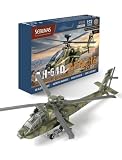
- [Newly designed assembly model]]The AH-64 helicopter model kit assembly model is based on the real AH-64 helicopter, and the classic features of the AH-64 helicopter are carefully restored from the appearance, such as the unique helicopter shape, exquisite spraying details, movable wheels and propellers, etc. The model perfectly demonstrates the modern technology of the military helicopter. And the texture is very good, making the AH-64 helicopter model look more refined.
- [Easy-to-use assembly experience]The AH-64 helicopter model kit parts are carefully designed and made with good compatibility and fit, and can be assembled without special tools. It comes with an assembly step-by-step diagram, so even beginners can easily get started. At the same time, the assembled model is also movable, the propeller can rotate 360 degrees freely, and the helicopter wheels can also move, giving you a more vivid display effect.
- [Product size and painting]The AH-64 military helicopter kit is restored according to the prototype ratio of 1:72, with a specific size of 23*23*7.5 and a weight of 0.146 pounds. The helicopter model assembly model is made of high-quality plastic material, which is not only sturdy and durable, but also not easy to oxidize and fade. The material is exquisite and lightweight, it has no sharp edges, and can effectively prevent the model from being damaged during assembly and play, which is safer.
- [Unique decoration and gift]The assembled AH-64 military helicopter model kit is not only a beautiful handicraft, but also can be used as a decoration and collection. It is very suitable for military enthusiasts to collect or give as a gift. For teenagers and children, the assembly process of this 1/72 AH-64 helicopter model can exercise hands-on ability. Whether you collect it yourself or share it with like-minded people, this AH-64 helicopter model can bring you endless fun and satisfaction.
- [Worry-free Purchase]The product contains tiny parts, be careful not to let children swallow them by mistake. The AH-64 helicopter model kit uses a hard carton as the outer packaging to better protect the helicopter from damage during transportation. We insist on strict production requirements to control the quality of this AH-64 military helicopter model to ensure that every customer is satisfied with the high-quality product. If you encounter any problems, please feel free to contact us!
How fast the major conventional examples are
AH-64E Apache
Boeing publishes the AH-64E Apache at 150+ knots (279+ km/h) maximum level-flight speed. This is the most directly relevant current manufacturer figure for the question when discussing the E variant. The Army’s 2014 AH-64E Apache Attack Helicopter article gives 164 knots for the E model under its combat-mission category and 145 knots for the AH-64D. Comparing 164 and 150+ as though they were two tests of one identical “top speed” would hide the difference in both source date and definition.
The Apache is an attack helicopter, so speed is only one part of its performance envelope. A mission may prioritize weapons employment, sensor operation, terrain masking, fuel endurance or formation safety. A published maximum is useful for comparing specifications, but it does not tell you how fast an Apache normally approaches a target or flies a patrol.
CH-47F Block II Chinook
Boeing lists the CH-47F Block II at 170 KTAS maximum speed and 157 KTAS cruise speed. In the supplied comparison, that is the highest published maximum among the conventional helicopters with directly comparable figures. The source expresses both numbers as knots true airspeed (KTAS); retain that qualifier when quoting them.
Free tools Windows power users keep installed
One-click scans. No signup required.
At 170 KTAS, Boeing gives a metric equivalent of 302 km/h. At the 157-KTAS cruise figure, the equivalent is 291 km/h. The 13-knot difference is meaningful: it shows why a reader should not substitute the maximum for the speed used during a sustained transport sortie. The Chinook’s tandem-rotor layout and heavy-lift mission also mean that payload and environmental conditions can affect the speed available on a particular flight, even though those condition-specific limits are not itemized on the cited page.
Rank #3

- Create this cornerstone of American military with this 139-piece model kit
- Kit features choice of outboard mini guns or rockets, two flight crew figures, separate doors, extensive detail, and two sets of decals
- Model scale 1:32
- Recommended for ages 12 years and older
- Paint and glue are sold separately
UH-60L/M Black Hawk
The U.S. Army’s FM 3-04 Army Aviation manual, dated April 2020, lists 120–145 knots as cruise airspeed for the UH-60L/M and 156 knots as maximum continuous airspeed. The manual’s range is more useful for planning than a single headline number: a lightly loaded aircraft in favorable conditions may cruise near the upper end, while a heavily loaded aircraft or one operating in demanding conditions may use a lower setting.
Because the Army calls the 156-knot value maximum continuous airspeed, it should not be described simply as “the Black Hawk’s top speed.” The source does not provide a directly comparable maximum-level-flight number in the table cited here. That is why a careful answer gives both the cruise range and the continuous limit rather than forcing one number into every context.
Why the MV-22B Osprey is a separate comparison
The Army reports the MV-22B Osprey at up to 280 knots in its account of an 82nd Airborne Division air assault. That figure is far above the conventional-helicopter examples, but the Osprey is a tiltrotor. It takes off and hovers with its rotors positioned vertically, then rotates the engine-and-rotor assemblies forward for turboprop-style airplane flight.
Quick wins for a faster PC:
Clear out junk files and repair common Windows errorsFree Scan →Fix the driver behind crashes, sound loss and screen glitchesFind Drivers →Repair Windows errors before they cause bigger problemsFix Now →Including 280 knots in a list of helicopter top speeds without a category note creates a misleading ranking. The Osprey can perform vertical takeoffs and landings, yet its high-speed cruise is achieved in a different flight mode from that of an Apache, Chinook or Black Hawk. For a like-for-like conventional-rotorcraft comparison, leave the MV-22B in a separate section.
Rank #4

- The AH-1W helicopter is a two rotor, twin engine, medium-sized general-purpose armed helicopter designed and produced by a US company for the US Navy. This is a multifunctional dual hair attack helicopter with a domineering and exquisite appearance, emitting a strong combat style. It has high historical commemorative significance.
- Based on the AH-1W helicopter, it faithfully restored the fuselage, cockpit outline, and tail structure, and assembled a 1:35 standard ratio tactical helicopter using 958 particles. The overall visual effect is very influential, with a finished size of 48.6 x 12.8 x 14.7 centimeters. The completed model is not only a beautiful artwork, but also a tribute to history. Can be used for display and collection.
- The main propeller and tail blades can rotate freely, the cockpit door can be opened, and the interior details fully demonstrate the seating arrangement of the prototype helicopter. The gun barrel can rotate, the sled style landing gear and exquisite printed components are equipped with dual engine exhaust ports. It can freely choose from three interchangeable missile mounting options and features a quick disassembly design, providing a more realistic assembly and display experience.
- If you are looking for an immersive, fun, and unprecedented building block challenge, this MISINI AH-1W building block kit offers greater challenges, complexity, and details. Looking forward to becoming one of your choices. Design friendly and easy to assemble, both beginners and experienced model players can easily enjoy the fun of architecture.
- High quality - Made of ABS environmentally friendly materials and high-precision mold injection molding, all components of the building blocks are smooth and polished, providing a comfortable and smooth feeling. Detailed instructions with color images, perfect for gifts and personal use. If you encounter any problems during the assembly process, please feel free to contact us at any time.
Which conventional military helicopter is fastest?
Among the conventional examples in the table, the CH-47F Block II has the highest cited maximum: 170 KTAS. It is therefore reasonable to call it the fastest of these examples on the basis of Boeing’s published figure. It is not safe to claim that this proves the Chinook is the fastest military helicopter in the world. The available figures cover selected variants, use different labels and come from sources published at different times; many military aircraft do not have a complete public specification set.
The Apache comparison illustrates the problem. The Army gives the AH-64E 164 knots for combat mission speed, while Boeing gives 150+ knots for maximum level flight. Those figures cannot be averaged, ordered as a universal ranking or treated as contradictory test results without knowing the exact conditions and definitions behind each one.
Independent reader supportYour contribution helps us test, update, and keep practical guides available for everyone.How to compare a speed claim correctly
- Identify the exact variant. “Apache,” “Chinook” and “Black Hawk” each cover families with different engines, equipment and weight limits. The cited figures are for the AH-64E, CH-47F Block II and UH-60L/M entries, not every model ever built.
- Copy the source label. Keep “maximum level-flight,” “maximum,” “cruise,” “maximum continuous” or “combat mission” next to the number.
- Keep the airspeed reference. The Chinook figures are KTAS. Airspeed is not automatically the same as speed over the ground.
- Check the date and publisher. Boeing’s current pages, the Army’s 2020 manual and the Army’s 2014 Apache article may describe different configurations or editorial conventions.
- Separate aircraft categories. A tiltrotor such as the MV-22B should not be ranked directly against a conventional helicopter without explaining the change in flight mode.
Airspeed is not the same as travel speed over the ground
Published aircraft specifications normally state airspeed. Ground speed changes with wind: a helicopter flying into a headwind covers less distance over the ground in a given time than one flying with the same wind behind it. Altitude, temperature, aircraft weight and configuration also affect the speed available in a real sortie. Consequently, a 157-KTAS cruise specification does not promise a fixed arrival time, and a 150-knot maximum does not mean the aircraft will maintain that number from takeoff to landing.
This distinction is especially important when converting a specification into a travel estimate. Use the source’s airspeed as a performance reference, then account for route, wind, climb, descent, formation procedures, refueling and mission tasks. The published number alone is not a timetable.
Best Value

- Detailed model kit.
- Glue and Paints not included.
- Easy to follow instructions.
- Kit suitable for ages 14 to adult.
What the numbers mean for missions
Attack and escort
An AH-64E’s speed can shorten repositioning time, but attack missions also require the crew to use sensors, coordinate with other aircraft and manage weapons and fuel. The combat-mission label used by the Army is therefore more informative for an operational comparison than a bare top-speed claim.
Heavy transport
The Chinook’s separate maximum and cruise figures show the trade-off between a brief high-speed capability and a sustainable transport pace. A heavy-lift aircraft may carry troops, vehicles or cargo, so the speed available on a particular sortie depends on the load and conditions even when the brochure number remains unchanged.
Utility transport
The Black Hawk’s 120–145-knot cruise range reflects a broad utility mission set. Search and rescue, air assault, medical evacuation and cargo work can require different speeds and profiles. The 156-knot maximum-continuous value defines a limit in the Army table; it does not replace mission planning.
Do these 3 things before closing this tab:
1Clear out junk files and repair common Windows errors2Scan for outdated or missing drivers - takes under a minute3Repair Windows errors before they cause bigger problemsBottom line
For conventional modern military helicopters, a well-supported headline range is about 150–170 knots at the upper end. Boeing’s CH-47F Block II figure of 170 KTAS is the highest maximum in this comparison, the AH-64E Apache is listed at 150+ knots maximum level flight, and the UH-60L/M Black Hawk is listed at 120–145 knots cruise and 156 knots maximum continuous airspeed. The MV-22B’s reported 280 knots belongs in a separate tiltrotor category. Always quote the aircraft variant and the source’s exact performance label before calling one helicopter “fastest.”
Quick Recap
Product prices and availability are accurate as of the date/time indicated and are subject to change. Any price and availability information displayed on Amazon at the time of purchase will apply.

