
iTechGuides is reader-supported. When you buy through links on our site, we may earn an affiliate commission. As an Amazon Associate I earn from qualifying purchases. Learn more
A stereo signal carries two audio channels—left and right. Differences between those channels let listeners perceive sounds across a left-to-right space. Mono carries one channel; sending that same mono content to two speakers does not create a stereo image.
What does “stereo” mean in audio?
Stereo describes a two-channel audio arrangement, conventionally labeled left and right. Mono uses one channel. The World Wide Web Consortium’s Web Audio API 1.0 Recommendation defines mono as one channel and stereo as two, ordered front-left followed by front-right in that specification.
A channel is a stream of audio content. It is not the same thing as a physical speaker, headphone earcup, or track in a digital audio workstation (DAW). A stereo file has two channels even if a device later combines them for mono playback.
Recommended Free Tools
How do left and right channels create a stereo image?
When a sound is present at different levels or with different timing or phase in the left and right channels, playback can make it seem positioned somewhere across the listening space. A sound shared equally between both channels can appear centered between a properly positioned pair of stereo speakers; this is often called a phantom center. Headphones deliver the left and right channels to separate ears, making their differences easy to hear.
#1 Best Overall

- Bookshelf speakers (pair), compact bookshelf design for small spaces
- 3-way, 3 driver bookshelf speaker system
- 5.12 in. woofer boosts low-end frequencies
- High precision tweeter for faithful sound
- Wide dispersion super tweeter create an expansive sound stage
The placement effect depends on channel content, playback equipment, and listening position. A stereo speaker setup is most convincing from a central position, while headphones keep each channel at its respective ear. Stereo can add width and left-to-right placement to music, films, or games, but it is not automatically the best choice for every recording or room.
How is stereo different from mono?
| Feature | Mono | Stereo |
|---|---|---|
| Audio channels | One | Two: left and right |
| Channel content | One shared audio signal | Left and right may carry distinct content |
| Spatial placement | No left-right image encoded by separate channels | Channel differences can create a left-right image |
| Typical capture | One microphone or another one-channel source | A stereo microphone, a microphone pair, or an encoded stereo technique |
| Common use | Voice-focused recordings, public-address systems, or listening areas where people move around | Music, films, games, and other content that benefits from left-right placement |
Two output devices do not prove that a source is stereo. A mono signal sent identically to two speakers is sometimes called dual mono: both speakers play, but there is no distinct left-right image in the signal. Conversely, a stereo source remains a two-channel source if a downstream system folds it into mono.
Rank #2

- 【Compact Design, Bold Performance】Despite their compact size of 4.3" in length and 6.6" in height, RIOWOIS passive bookshelf speakers can deliver a peak power of up to 30W. With a 6-ohm impedance, these bookshelf speakers are compatible with a wide range of amplifiers and can handle dynamic peaks without distortion.
- 【2.75-inch Woofer and 2-inch Tweeter】Experience clear and balanced sound with our passive bookshelf speaker, which features a 2.75-inch woofer and a 2-inch tweeter. The independent tweeter and woofer work together to deliver more accurate and complete sound than a single full-range driver.
- 【3D Wood Grain Appearance】The natural beauty of wood grain adds a touch of elegance and warmth to the bookshelf speakers, making them visually appealing and blending well with various room decor styles. This particular wood grain is not only beautiful but also gives the user wonderful tactile feedback. Gliding across the delicately textured surface provides a tactile sensation that is pleasing and inviting.
- 【Wide Range of Applications】The package contains all the accessories needed for wall mounting. With the hooks and shockproof tab on the back of the bookshelf speakers, you can easily hang the speakers in every corner of your room and suited as a satellite speaker for your home surround sound system.
- 【Worry-free Purchase】Get peace of mind with our package that includes passive bookshelf speakers, wall-mounted accessories. Our dedicated after-sales team is available 24/7 to provide exceptional service and support for your products. Order now and enjoy worry-free listening!
How do you record a microphone or guitar in stereo?
For one voice microphone or mono guitar input
Start with a mono track when recording a single microphone or a one-channel instrument output. Audacity’s recording documentation explains that one microphone produces one channel and recommends mono for voice. A mono recording can later be panned left, right, or between them in the mix. Applying stereo effects afterward can create a wider output, but it does not mean the original source was captured with a stereo image.
For an instrument or source with separate left and right outputs
Use a stereo track when the source actually provides two channels, and preserve the left/right routing. Some keyboards and synthesizers have separate left and right outputs; others are mono. Check the source’s outputs and the interface routing rather than assuming that an instrument is stereo.
Rank #3
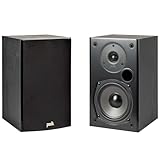
- EXPERIENCE AMAZING HOME THEATER SOUND WITH RICH, IMMERSIVE AUDIO – Featuring a 0.75" tweeter and a 5.25" Dynamic Balance driver, these passive bookshelf speakers deliver clear, balanced sound with deep bass, even at low volumes
- Use these wall-mountable bookshelf speakers as front, left-right, or rear for a surround sound system in your home theater setup and enjoy clear vocals and immersive sound—perfect for anyone starting their home audio journey
- Start your home theater journey with these Polk audio speakers then expand to a full 5.1 setup by adding T50 towers, T30 center channel, and subwoofer when ready
- QUICK & EASY SETUP – Just connect the speaker wire to your AV receiver, and you're ready to enjoy rich, high-quality sound—no complicated setup needed
- Over the past 50 years Polk has become one of the most trusted names in home audio speakers and entertainment. Our unwavering commitment to innovation allows you to sit back, relax, and enjoy music
For stereo microphone capture
Capturing an acoustic stereo image requires a stereo microphone or an intentional multi-microphone technique. A spaced pair can record left-right differences, but microphone placement and phase relationships can affect the sound when the recording is summed to mono. Coincident and near-coincident microphone arrangements are other ways to capture stereo; the appropriate method depends on the source and recording goals.
Mid-Side recording
Mid-Side (M-S) is a stereo technique that uses a Mid microphone aimed toward the source and a bidirectional Side microphone positioned at right angles to it. The channels are decoded as:
Rank #4

- 2 x AUX INPUT - Convenient connection to any device that has a 3.5mm headphone output or dual RCA output. Connect to two devices via AUX at the same time, no plugging and switching needed.
- STUDIO SOUND QUALITY - Natural sound reproduction from 13mm silk dome tweeter and 4 inch full range unit
- REMOTE CONTROL - Adjust volume at your figure tips. Bass and treble control located on the side of main speaker.
- CLASSIC WOOD FINISH - High quality MDF wood build finished with wood effect vinyl serves as a great compliment to any home decor.
- SIDE PANEL CONTROLS - Use the side panel knobs to adjust the EQ to your liking. The controls are located on the active/powered speaker.
- Left: Mid plus Side.
- Right: Mid minus Side, made by reversing the Side signal’s polarity before combining.
Adjusting the Side level changes the stereo spread. When the decoded channels are summed to mono, the Side contribution cancels and the Mid signal remains, which makes the technique mono-compatible in this respect. Sound Devices explains the M-S arrangement and decoding in its Mid-Side recording guide.
Do these 3 things before closing this tab:
1Scan for outdated or missing drivers - takes under a minute2Clear out junk files and repair common Windows errors3Fix the driver behind crashes, sound loss and screen glitchesWhy does a mic or guitar play through only one headphone side?
A mono input can be recorded or routed in a way that sends it to only the left or right channel. A DAW’s stereo track is a track arrangement; it does not make a one-channel input stereo by itself. Focusrite’s explanation of one-sided microphone monitoring describes how a mono source on a stereo track may be hard-panned to one side, depending on routing.
Best Value

- 【SMALL HIFI BOOKSHELF SPEAKERS】With its modern aesthetic and compact design, this stylish black speaker complements contemporary home or office décor. The space-saving design fits seamlessly into any environment, maximizing desktop space. Ideal for desktop setups or small room audio systems like home offices or gaming stations.
- 【Experience powerful sound】Unleash powerful 30Wx2 distortion-free sound. Featuring a 0.75-inch carbon fiber silk dome tweeter and a 3-inch carbon fiber full-range driver, this speaker delivers crystal-clear highs and rich mid-bass. The rear bass port amplifies low-end depth, while the integrated independent sound card ensures smooth, detailed audio playback for the ultimate listening experience.
- 【Durable Performance】Built with a premium MDF wooden enclosure, this computer speakers with subwoofer effectively reduces box resonance for clearer, stream studio-quality,more precise sound. The easy-to-reach volume control knob on the front panel allows for quick adjustments during gaming or music sessions. Crafted from high-quality materials, it’s designed for long-lasting durability, providing consistent, stable performance even during intense gaming use.
- 【Multiple Input Options】These speakers are designed to offer versatile connectivity, featuring Bluetooth 5.3 along with RCA, AUX, and USB inputs. This variety ensures compatibility with a wide range of devices, giving you the flexibility to connect seamlessly to your preferred audio source.
- 【Versatile Use】The computer speakers for desktop pc Ideal for gaming, music streaming, and enhancing your computer audio experience, these speakers are compatible with smartphones, turntables, desktop or laptop computers, TVs, audio mixers, streaming devices , gaming pc, media players , subwoofers, audio receivers, and more. No matter your setup, these speakers meet all your audio needs with ease.
- Check whether the input is mono or a true stereo pair.
- For one microphone or one guitar output, select a mono input and mono track.
- Pan the mono track as desired, or route it through stereo effects if you want a stereo mix output.
- For a genuine stereo source, use a stereo track and confirm that left and right inputs reach the corresponding outputs.
What happens when stereo is played back in mono?
A mono playback system combines the left and right channels into one. Important elements can become quieter, masked, or absent if the channel signals partially cancel or interact in an unfavorable way. Check important mixes in both stereo and mono rather than assuming that every mono system or format folds stereo down identically.
The W3C Web Audio API 1.0 Recommendation specifies one stereo-to-mono downmix rule for that API: output = 0.5 × (left + right). That rule applies to the Web Audio API specification; it should not be assumed to describe every codec, device, or playback system.
Which should you use: mono or stereo?
Choose according to the source and listening situation, not the number of speakers. Mono is often a practical fit for a single voice microphone, public-address audio, or settings where listeners are spread around and cannot occupy a central stereo position. Stereo is useful when left-right placement or width contributes to the experience, such as in music, films, and games. A mono source can still be panned within a stereo mix, and a stereo recording should be checked for mono compatibility when it may be played on a mono system.
You do not need stereo recording equipment just to listen to stereo audio. Headphones can reproduce the two channels at separate ears; a stereo speaker pair can reproduce them through separate left and right speakers. To capture stereo, however, the source and recording method must provide two-channel information.
Quick Recap
Product prices and availability are accurate as of the date/time indicated and are subject to change. Any price and availability information displayed on Amazon at the time of purchase will apply.

