
The Tool Desk
Outbyte Driver Updater FREEFix the driver behind crashes, sound loss and screen glitchesFind Drivers →Outbyte PC Repair FREERepair Windows errors before they cause bigger problemsFix Now →iTechGuides is reader-supported. When you buy through links on our site, we may earn an affiliate commission. As an Amazon Associate I earn from qualifying purchases. Learn more
Digital twins turn infrastructure data into an operational picture. A sensor measures a physical condition such as vibration, temperature, traffic or air quality; connected software gives that reading time and context, relates it to a digital representation of an asset or network, and helps people inspect conditions, test interventions or coordinate operations. The twin is not simply a 3D drawing, and a sensor network alone is not a twin.
The value comes from the connection to the real asset, the decision the twin supports, and the quality and security of the data flowing through it. Synchronization can be continuous, periodic or event-driven, depending on the use case; not every twin operates in real time.
What is a digital twin?
A digital twin is a digital representation of a real-world entity, system or process that is connected to its physical counterpart for a defined purpose. The representation may include asset records, geometry, live observations, historical measurements, engineering models, simulations and operating rules. Its useful output might be a condition dashboard, a maintenance decision, a design comparison or an operational control.
The UK Department for Transport’s 2025 infrastructure report gives a concise definition: “A digital twin is a virtual model of an object, system or process connected to its real-world counterpart by a 2-way flow of real-time data.” That wording describes a strong form of twin, but implementations vary. NIST’s 2025 report quotes the Digital Twin Consortium definition as “A digital twin is a virtual representation of real-world entities and processes synchronized at a specified frequency and fidelity.” The phrase “specified frequency and fidelity” matters: a bridge-inspection twin may update after a survey, while a traffic-management twin may ingest readings every few seconds.
#1 Best Overall

- Complete Project-Based Learning Path – Build 13 progressive projects (LED blink → button control → PIR motion sensor → music playback → motorized doors/windows → SK6812 RGB lighting → fan control → LCD display → gas alarm → temperature/humidity monitor → RFID door unlock → Morse code access → WiFi control → mobile APP remote control). Each project builds on the previous one, ensuring you understand both the electronics and the programming logic behind every smart home feature.
- Master Two Industry-Standard Languages – Learn to code in both Arduino C++ and MicroPython with 13 detailed tutorials for each language. Compare how the same hardware behaves under different programming approaches – a valuable skill for any aspiring engineer. Perfect for classrooms teaching multiple coding languages or self-learners who want flexibility.
- Build a Real WiFi-Controlled Smart Home – Assemble the wooden house structure and integrate sensors to create a functioning smart home system. Control lights, fans, door servos, and RGB lighting directly from your mobile APP (iOS/Android) . Experience how IoT works in real life – from manual control to automated responses based on temperature, humidity, motion, and gas detection.
- Comprehensive Online Wiki with No Guesswork – Our detailed online tutorials (also accessible via the packaging) include wiring diagrams, full code explanations, and step-by-step assembly guides for every project. Whether you're a complete beginner or a teacher preparing lessons, the structured content eliminates confusion and helps you succeed from project 1.
- Everything You Need to Get Started – (TIPS: Batteries are NOT Included)This kit includes the ESP32 development board, expansion board, wooden house parts, all sensors and modules (DHT11, PIR motion, gas sensor, RFID, SK6812 RGB, servo motors, fan, LCD1602, etc.), and connection cables. NOTE: 6x AA batteries are required (NOT Included). The kit is unassembled – you'll build it yourself following our online tutorials, making the learning experience truly hands-on.
A static building information model, a spreadsheet of assets or a one-off simulation can be valuable without being a digital twin. They become components of a twin when they are connected to an identified physical asset or process and used for an operational or lifecycle purpose. Conversely, a highly detailed 3D scene has little twin value if its geometry is disconnected from current condition, ownership, work history or decisions.
What a twin contains
- Identity and context: stable identifiers, location, ownership, design version, dependencies and operating limits.
- Observations: measurements from sensors, inspections, control systems, weather services or human reports, each with time, units and quality information.
- Models: engineering calculations, statistical models, simulations or rules that turn observations into condition estimates or scenarios.
- Actions and feedback: work orders, traffic plans, set-point changes or other interventions, with a record of what happened afterward.
The twin’s boundary should be explicit. It may represent one pump, a building, a road corridor, a railway route, a drainage catchment or a multimodal transport network. A larger boundary creates more coordination possibilities but also increases integration, governance and cybersecurity demands.
How do smart sensors work in infrastructure?
A smart sensor does more than produce an electrical signal. It typically combines a sensing element with local processing, a communications interface, a power arrangement and metadata such as units, calibration status and timestamp. Some devices filter noise, detect events or compress data before transmission; others send raw samples to an edge gateway or cloud platform.
Do these 3 things before closing this tab:
1Scan for outdated or missing drivers - takes under a minute2Clear out junk files and repair common Windows errors3Fix the driver behind crashes, sound loss and screen glitches- Measure a physical property. Accelerometers can observe vibration; temperature probes, strain gauges, pressure transducers, flow meters, cameras, air-quality instruments and radar can observe other conditions. The measurement must match a decision: vibration frequency may matter for rotating equipment, while axle counts and speed matter for a road junction.
- Attach context and quality. A reading needs an accurate clock, asset identifier, location, units, calibration history and an indication of missing or suspect data. Without context, a numerically precise value can still be unusable.
- Move the data. Wired networks, cellular links, low-power wide-area radio, mesh networks or local gateways carry readings. Buffering is important when a tunnel, remote site or basement temporarily loses connectivity.
- Validate and normalize. Software checks range, rate of change, duplicate messages, time drift and sensor health, then maps the result to a common data model. This is where incompatible naming, units and asset identifiers are resolved.
- Relate the reading to the twin. The platform associates the observation with an asset or network segment and combines it with design limits, maintenance history, weather, traffic or other relevant data.
- Support a decision. Operators view a condition, receive an alert, compare scenarios, schedule an inspection or authorize a control action. The outcome is fed back so the model and work history remain useful.
An industrial vibration sensor is a defensible example of the hardware category, but no single device is suitable for every public asset. Selection depends on the variable being measured, accuracy, sampling frequency, temperature and moisture exposure, physical mounting, battery or mains power, communications coverage, cybersecurity features and integration method. Consumer equipment may lack the environmental rating, calibration evidence or lifecycle support required for infrastructure.
How are digital twins used in roads and buildings?
Roads, bridges and transport corridors
Condition data can combine inspection findings, structural sensors, weather, traffic loading and maintenance records. An owner can use the resulting view to prioritize inspections, decide whether to repair or renew an asset, and understand how a restriction on one link affects the wider network. The UK Department for Transport’s 2025 report identifies ageing, climate change and emerging cybersecurity threats as risks that infrastructure twins can help owners consider when planning intervention and future design.
At network scale, a twin can connect signals, roadworks, public transport, weather and incident systems. A 2024 Department for Transport analysis examined an integrated network-management twin linking management systems across transport modes. Its appraisal estimated approximately £850 million in present-value benefits, using discounted 2010 prices over a ten-year period. That figure belongs to that study’s scope, assumptions and appraisal method; it is not a current-price quote or a universal saving forecast for every transport authority.
Rank #2

- Ultimate Sensor Kit for Arduino Beginners: The kit features the original Arduino Uno R4 Minima board, 30+ high-quality sensors and modules, and free video lessons co-created with educator Professor Joselito. With over 50 engaging projects (30 basic, 17 IoT, and 10 advanced fun projects), beginners aged 8+ can dive into the world of electronics and programming with ease. Certified RoHS compliant, it guarantees safety and quality for all learners, making it the perfect choice for both education and innovation
- Powered by the Arduino Uno R4 Minima: R4 Minima is a major upgrade from the Uno R3. With a 32-bit ARM Cortex-M4 processor, 256 KB Flash memory, and 48 MHz clock speed, it offers faster performance and greater memory. It also features higher-precision ADC (14-bit), a built-in DAC, CAN bus support, and a wider power input range (6-24V), making it more powerful and versatile for all users
- 30+ Sensors for Infinite Creativity: With 30+ high-quality sensors and modules, plus a battery for portable applications, this kit is ideal for IoT, environmental monitoring, and smart automation projects. It includes step-by-step tutorials, sample codes, and progressive online lessons, making learning seamless for beginners and advanced users alike. Fully compatible with other Arduino boards like Uno R3 and Nano, it offers endless customization and innovation opportunities
- Engaging Projects for Every Skill Level: Featuring 50+ projects (30 basic, 17 IoT, 10 advanced fun), this kit supports IoT platforms like Blynk and IFTTT, enabling smart automation and real-world applications. With Arduino C++ programming, step-by-step guidance, and hands-on coding exercises, it’s perfect for students, teachers, and engineers to learn, build, and innovate at any level
- Dedicated Support for Beginners: Alongside online resources and video tutorials, SunFounder provides technical support and troubleshooting forums to help beginners solve programming challenges with ease
A 2023 Department for Transport urban-transport project described shared sensor-data infrastructure for several uses: measuring and visualizing black carbon, modelling low-traffic neighbourhoods with sensor-informed data, and using artificial intelligence for forecasting and real-time simulation. These are examples of intended applications, not guarantees that every deployment will improve air quality or traffic flow.
Buildings and energy systems
Building information is often fragmented among drawings, facilities-management systems, meters, access controls, work orders and equipment vendors. NIST’s building-digitization work describes the goal of interoperable semantic models synchronized with physical buildings. With consistent meanings for spaces, equipment and measurements, analytics can identify abnormal energy use, automation can coordinate heating and ventilation, and building systems can interact with an electrical grid.
A building twin might associate a chiller’s temperature and power readings with its manufacturer limits, service history, occupancy and outdoor conditions. It can then compare a control change with a baseline rather than displaying an isolated graph. For a portfolio owner, the same identifiers and data rules can make performance comparable across sites, provided differences in design and operation are preserved rather than hidden.
Resilience and emergency planning
Government digital-twin programmes describe demonstrations for asset management, resilience, event planning and response. A flood scenario, heatwave, bridge closure or power interruption can be represented against current assets and dependencies so teams can examine consequences before an event. Such demonstrations show what a programme is trying to enable; they do not prove a universal reduction in damage, response time or cost.
Can a digital twin predict when infrastructure needs maintenance?
It can support a maintenance forecast, but it cannot provide certainty by merely being called a twin. Prediction requires a defined failure mode, observations that are sensitive to that mode, enough history to establish a baseline, and a model validated for the asset and environment. A vibration trend may indicate developing bearing wear; it does not by itself establish the remaining life of a bridge joint or a transformer.
A practical maintenance workflow is:
- Define the intervention decision and the consequence of being early or late.
- Specify the physical indicators, sampling rate, accuracy and acceptable data gaps.
- Establish a healthy baseline for each asset class and account for seasonal and operating changes.
- Combine sensor trends with inspections, work orders, loading, weather and known design limits.
- Test alerts against historical cases or controlled trials, recording false positives and missed events.
- Route an alert to an inspection or engineering decision, not directly to an irreversible action unless the control system has been separately validated.
Where data are sparse, a rules-based condition indicator may be more defensible than a machine-learning forecast. The twin should show confidence, data age and missing inputs so an operator can distinguish a measured change from a communications failure or a sensor that has drifted.
Rank #3
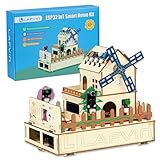
- 【Multiple functions】It can detect temperature, humidity, light and human movement, support card unlocking, voice control, automatic device control and colorful RGB light effects.
- 【Dual APP & Voice Control】Connect with mobile phone via WiFi to remotely view data and control devices. Built-in voice recognition function allows hands-free control of lights, fans and light strips, bringing vivid intelligent operation experience.
- 【Easy Assembly】Standard unified interfaces with anti-reverse design prevent wiring errors. Simple plug-and-play connection lets you finish assembly quickly and focus more on learning and creation.
- 【Beginner-Friendly】Works well with Arduino IDE. The well-organized and annotated open source codes are easy to understand and modify. You can freely expand functions and create your own IoT projects.
- 【Ideal STEM Educational Gift】Comes with complete learning guides and operation tutorials. Help cultivate hands-on ability, logical thinking and programming skills. A great choice for students, hobbyists and electronics lovers.
What makes a twin trustworthy across systems?
Interoperability is the ability to interpret and use data across tools, suppliers and lifecycle stages. It is more than exporting a file. Systems need shared identifiers, units, time conventions, relationships and meanings. A road segment called “A12-NB-04” in a traffic system must be unambiguously related to the asset record, work-order system and map used by another team.
Plan interoperability at the start:
- Create an asset and location register with ownership, version and lifecycle status.
- Publish a data dictionary and semantic model for measurements, events and relationships.
- Record provenance, calibration, transformations and uncertainty alongside values.
- Use documented interfaces and versioning so a vendor replacement does not erase history.
- Define who may read, change, approve and retain each data class.
Lifecycle integration is especially important. Design assumptions, construction changes, commissioning results, operations data and decommissioning records should use compatible identifiers. Otherwise the twin becomes a succession of disconnected project models rather than a durable operational record.
Choosing the right twin scope and synchronization rate
Start with the decision, not with a visualization project. The following comparison helps set proportionate requirements.
Quick wins for a faster PC:
Scan for outdated or missing drivers - takes under a minuteDriver Scan →Clear out junk files and repair common Windows errorsFree Scan →| Purpose | Typical data need | Synchronization expectation | Main trade-off |
|---|---|---|---|
| Asset register and visualization | Identity, geometry, documents and status | On change, inspection or project milestone | Lower operating cost, but limited live awareness |
| Condition monitoring | Selected sensor streams, thresholds and maintenance history | Periodic or event-driven; seconds to days depending on failure mode | More useful alerts require better sensor quality and context |
| Maintenance planning | Condition trends, inspections, work orders, risk and intervention options | Aligned with inspection and planning cycles, with faster updates for critical signals | Integration and model validation become substantial |
| Simulation and network coordination | Multiple systems, dependencies, scenarios and external conditions | Fast enough for the operational decision; not necessarily continuous | Broader benefits increase governance and cybersecurity complexity |
| Operational control | Trusted live state, control commands, safeguards and feedback | Defined latency and availability targets | Highest safety, security and assurance burden |
More detail and faster updates are not automatically better. If a decision is made weekly, collecting millisecond-level data may add storage and attack surface without improving it. Conversely, an emergency traffic response may require low-latency data and a tested fallback when communications fail.
Independent reader supportYour contribution helps us test, update, and keep practical guides available for everyone.Security, privacy and operational trust
A twin concentrates information about critical assets and may connect to operational functions. NIST’s 2025 report on digital-twin cybersecurity addresses both established and novel challenges. Threats include forged sensor readings, stolen credentials, malicious changes to models, denial of service, unsafe control commands and leakage of sensitive building or infrastructure information.
- Separate monitoring networks from control networks where practical, and enforce least-privilege access.
- Authenticate devices and services; manage certificates and keys throughout the hardware lifecycle.
- Protect data in transit and at rest, and preserve tamper-evident logs of changes and commands.
- Validate firmware, models and configuration before deployment; maintain a rollback path.
- Monitor time synchronization, data gaps and anomalous behavior as security signals as well as data-quality issues.
- Exercise manual and local-control procedures for outages, corrupted data and compromised accounts.
Privacy also matters in urban sensing and buildings. Define retention, aggregation and access rules before collecting video, occupancy or travel data. A technically accurate twin that people cannot trust or safely operate will not deliver its intended value.
Rank #4

- 【microbit IoT:bit】ELECFREAKS Smart Science IoT Kit is developed based on loT:Bit, a new breakout board compatible with science sensors such as the ultrasonic sensor, dust sensor, light sensor and water level sensor, including RTC Timing and WIFI module.
- 【Microbit + Internet】Support Thingspeak/ IFTTT Oline Education to Learn Infinite. You can gather data via the sensors and send data to the cloud with more stable and accuratedata analysis.
- 【IoT:bit Characteristic】(1) Intergrated ESP12F WiFi, RTC, earphone jack and passive buzzer (2)Adaptive for Building Blocks (4 standard spacing fixed holes) (3)Separately lead IIC interface, directly plug in OLED, BME280 and IIC,etc
- 【Fun Smart Science Case】You can build scene like Air quality monitoring, Environmental noise detection, An environmental quality monitoring station, An automatic irrigation detection, A self defense monitoring station and more.
- 【Graphical Programming Languages】 Rich makecode graphical programming blocks allow kids to learn programming from the simplest to more complex.【TIPS 】(1)WITHOUT micro: bit!!! Suitable for ages over 12 years old. (2)Wiki Tutorial Get: Pls enter "wiki.elecfreaks.com/en/" to learn. (3)Strong Technical Support—Pls click “elecfreaks” and click “Ask a question” to email us! Looking for your consultation!
Cost, skills and implementation realities
Building a twin can be bespoke and expensive. The UK technology assessment warns that substantial computing, infrastructure and multidisciplinary skills may be required. Costs include sensors and installation, communications, calibration, data engineering, semantic modelling, platform operation, cybersecurity, model validation, staff training and long-term replacement of field hardware.
Free tools Windows power users keep installed
One-click scans. No signup required.
A staged implementation limits risk:
- Choose one decision with a measurable consequence. For example, prioritize inspections on a defined bridge group or coordinate a specific corridor during incidents.
- Map existing data first. Identify authoritative records, gaps, ownership, update rates and conflicting identifiers before purchasing sensors.
- Instrument only the uncertainty that affects the decision. Use a pilot to test mounting, power, communications, calibration and environmental durability.
- Build the minimum semantic and integration layer. Preserve provenance and make the data usable by the teams who must act on it.
- Validate with operators and historical cases. Measure alert usefulness, false alarms, response time and data availability, not just dashboard uptime.
- Set a lifecycle plan. Budget for sensor replacement, software updates, security monitoring, model retraining and eventual decommissioning.
The right business case is case-specific. Benefits may include avoided disruption, better-timed renewal, faster incident coordination or improved design decisions; they depend on the value of the decision, adoption by operating teams and the quality of integration. The £850 million estimate from the Department for Transport’s 2024 analysis should not be generalized beyond that appraisal.
Common failure modes and fixes
“We have a 3D model, so we have a twin.”
Problem: geometry is disconnected from live condition, ownership or decisions. Fix: define the physical counterpart, identifiers, update trigger and operational question the model must answer.
“More sensors will solve the data problem.”
Problem: readings arrive without calibration, timestamps, context or a workflow for acting on them. Fix: specify data quality, metadata, maintenance responsibility and decision thresholds before expanding the network.
“The prediction says failure is imminent.”
Problem: a model is treated as certainty outside its validated conditions. Fix: show confidence and data age, test against known cases, and require an engineering review for consequential interventions.
What’s actually slowing this PC down?
Pick the symptom - the matching free tool is one click away.
“Every system uses the same asset name.”
Problem: identifiers, units or meanings differ between design, facilities, transport and work-order systems. Fix: govern a shared semantic model, mappings and versioned interfaces.
“The twin is available, so operations are safe.”
Problem: connectivity or data integrity can fail, and a twin may expose new attack paths. Fix: design authentication, segmentation, monitoring, fallback modes and recovery exercises as part of the architecture.
Bottom line
Digital twins and smart sensors are most useful when they form a disciplined feedback loop: measure the physical world, preserve context and quality, relate observations to a maintained digital representation, and connect the result to a decision. Infrastructure owners should begin with a specific maintenance, resilience, design or coordination problem, then scale only when interoperability, security, skills and lifecycle funding can support it. The technology can improve visibility and scenario testing, but reliable outcomes depend on the data, models and operating practices built around it.
Quick Recap
Product prices and availability are accurate as of the date/time indicated and are subject to change. Any price and availability information displayed on Amazon at the time of purchase will apply.

