
The Tool Desk
Outbyte PC Repair FREERepair Windows errors before they cause bigger problemsFix Now →Outbyte Driver Updater FREEScan for outdated or missing drivers - takes under a minuteDriver Scan →iTechGuides is reader-supported. When you buy through links on our site, we may earn an affiliate commission. As an Amazon Associate I earn from qualifying purchases. Learn more
When you open a photo, the computer loads the app and the photo’s data, has its processor carry out instructions, and sends the result to the display. The operating system coordinates that work; memory and storage hold different kinds of information; and hardware turns input and output into forms people and programs can use. The path below uses a conventional stored-program computer as a guide. Real devices overlap many operations, and their designs differ.
What happens when you open a photo?
- You provide input. A click, tap, or key press reaches the computer through an input device. The device and its interface represent that action as data the system can process.
- The operating system starts the app. The photo application is stored as a program on persistent storage. The operating system loads the program and the data it needs into RAM, then manages the running instance, known as a process.
- The processor executes instructions. The CPU fetches instructions from memory, decodes them, and performs their operations. It uses registers for immediate values and may use cache to keep frequently needed information close to the processor. Arithmetic and logic operations are handled by processor circuitry that includes an arithmetic logic unit.
- The app processes the photo. The program’s instructions and the photo’s data move through memory and hardware interfaces as needed. The CPU may perform some work while specialized components handle other tasks; the simple sequence here is a teaching model, not a claim that every operation happens alone or in strict order.
- The display presents the result. The system sends image data to the display, which converts it into visible pixels. Other output devices can turn computed data into sound or another useful result.
OpenStax describes the central sequence as a program being stored as an executable, loaded from storage into memory by the operating system, and then processed as the CPU fetches, decodes, and executes instructions. Results can go into a register or back into memory, and the processor repeats the cycle while the program runs. Components communicate over interconnects such as buses. OpenStax: Computer Systems Organization
How can bits represent both programs and photos?
A bit is a binary digit. At the computer-architecture level, data and instructions are represented as patterns of bits; eight bits make a byte. Hardware implements distinguishable states and operations, but it is too simplistic to say that every computer component literally stores everything as a low or high voltage.
Do these 3 things before closing this tab:
1Scan for outdated or missing drivers - takes under a minute2Clear out junk files and repair common Windows errors3Fix the driver behind crashes, sound loss and screen glitchesIn the stored-program model, main memory holds both instructions and data in binary form. MIT OpenCourseWare’s Computation Structures material puts it this way: “Both instructions and data are, of course, just binary data stored in main memory.” A bit pattern does not identify itself as an instruction or a photo value. Its role depends on how the processor or program uses and interprets it. MIT OpenCourseWare: Computation Structures, annotated slides
#1 Best Overall

- [INTEL POWERED CONTENT] - Built with a 8th Generation Hexa-Core Intel i5 and 32GB of DDR4 RAM; Modern, Windows 11 ready, with 4K support, Executive multitasking, media streaming and smooth, multi-tab web browsing; Perfect as an all-purpose multimedia computer; built for content creators; Plenty of RAM and Mass storage for photo and video editing powered by Intel HD 630
- [LATEST WIRELESS TECH] - This Dell Desktop Computer easily connects to the internet through the Built In WiFi / Bluetooth
- [SOLID STATE STORAGE] - This Dell Computer setup comes with an ultra-fast 1TB Solid State Drive (SSD); Setup as the primary boot device; Boot and load programs with lightning speed ; Additional expansion available
- [BUY & OWN WITH CONFIDENCE] - From the world's largest Microsoft Authorized Refurbisher; Quality Guarantee and Free Tech Support; Award-winning Customer Service; | Support Sustainable Business
- [MODERN HI-SPEED PORTS] - USB 3.0 (x4) | USB 2.0 (x4) | DisplayPort (x1) | HDMI Port (x1) | Audio Combo Jack (x1) | Audio Out (x1) | RJ-45 Ethernet (x1) | Internal SATA (x3)
This is why a program can be stored like other information but still direct a computer’s behavior: the processor interprets particular patterns as operations when it fetches them as instructions.
How are storage, RAM, cache, and registers different?
They all hold information, but they serve different roles. “Memory” and “storage” are not interchangeable terms.
Rank #2

- Model: Dell OptiPlex 7050 Small Form Factor (SFF)
- Processor: Intel Core i7-7700 3.60 GHz
- Memory: 32GB DDR4 Ram
- Storage: 1TB Solid State Drive (SSD) Fast Boot + Storage
- Operating System: Windows 11 Pro (64-bit)
| Component | What it is for | What happens when power is off? |
|---|---|---|
| Persistent storage, such as an HDD or SSD | Keeps programs and files for later use. The operating system loads a program from storage when it is launched. | Information is retained; this is nonvolatile storage. |
| RAM, or main memory | Holds active programs and the data they need so the processor can work with them. | RAM is volatile; its active contents are not retained as normal working memory without power. |
| Cache | Fast storage close to or inside the CPU that keeps information the processor may need soon. | It is working storage, not a substitute for persistent files. |
| CPU registers | Very small locations within the processor for values used in immediate operations, such as an instruction or result. | They serve immediate processing rather than long-term file storage. |
The broad pattern is that information moves from persistent storage into RAM for active work, while cache and registers support processing closer to the CPU. This hierarchy is a useful guide, not a guarantee that every workload or design has the same performance characteristics. OpenStax explains program loading, RAM, cache, registers, and nonvolatile secondary storage in its coverage of computer organization and operating systems. OpenStax: Computer Systems Organization OpenStax: Fundamental OS Concepts
What does the operating system do?
The operating system connects programs with the computer’s hardware and organizes resources needed to run them. A program is the passive instructions saved on storage; a process is an instance of that program being executed. When you open an app, the operating system loads it, manages its process, and allocates and tracks memory.
Rank #3

- IMMERSIVE 24 INCH DISPLAY: Experience stunning clarity on a Full HD IPS screen with ultra-thin bezels, offering a 90% screen-to-body ratio that makes everything from spreadsheets to streaming come alive with vibrant colors and crisp details.
- POWERFUL INTEL PROCESSING: Tackle demanding tasks with ease thanks to the Intel processor and 16GB of high-speed memory, delivering smooth performance whether you're multitasking between applications or running productivity software.
- GENEROUS STORAGE: Store all your important files, photos, and programs with blazing-fast solid state drive technology that ensures quick boot times, rapid file access, and plenty of space for your digital life.
- ENHANCED PRIVACY AND COLLABORATION: Work confidently with the pop-up privacy camera that tucks away when not in use, plus dual microphones with noise reduction for crystal-clear video calls that keep you connected professionally.
- ECO-CONSCIOUS DESIGN: Feel good about your purchase with an EPEAT Gold registered and ENERGY STAR certified computer that combines premium performance with responsible environmental manufacturing practices.
The operating system also gives a program a managed view of memory. Virtual memory is an address-space abstraction: a program can use addresses that the system maps to physical memory. Some pages may be moved between RAM and storage-backed swap or a page file. Virtual memory is therefore not simply “extra RAM”; when active data must be fetched from storage, access can be much slower than using physical memory. OpenStax: Fundamental OS Concepts
How do input, output, and computer components communicate?
Input devices translate actions or signals into data. A keyboard reports key presses; a microphone provides sound input. Output devices translate computed data into something usable, such as a picture on a screen or sound from speakers. Interfaces let devices exchange data with the rest of the system, while interconnects move information among components.
Rank #4
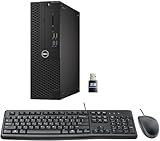
- This Certified Refurbished product is tested and certified to look and work like new. The refurbishing process includes functionality testing, basic cleaning, inspection, and repackaging. The product ships with all relevant accessories, a minimum 90-day warranty, and may arrive in a generic box. Only select sellers who maintain a high-performance bar may offer Certified Refurbished products on Amazon.com.
- Dell Optiplex 3050 SFF Desktop computer PC, Intel Quad Core i5-6500 up to 3.6GHz, 16GB DDR4, 256GB SSD
- Includes: USB Keyboard & Mouse, USB WiFi adapter, Microsoft office 30 days free trail.
- Port: Front: USB 3.0(2), USB 2.0(2); Rear: DP, HDMI, USB 3.0(2), USB 2.0(2), RJ-45.
- Support 4K (3840x2160) Dual display, makes it easy to connect two monitors at the same time, and you can expand working Windows, mirror content, or expand a single window across multiple monitors.
“Input, storage, processing, output” is a helpful beginner framework for the flow of information, though it is not a complete map of every modern system. Intel presents these categories in its educational introduction to computers. Intel: Introduction to Computers
Windows Errors? Fix Them Before They Spread
Repair common Windows errors and clear accumulated junk for a smoother, more stable PC - no reinstall needed.Free scan · no reinstallCrashes, No Sound, or Screen Glitches?
Random freezes, missing sound and display glitches usually trace back to one bad driver. Find and replace yours safely.Free scan · under a minuteDo phones and appliances work the same way?
Many devices beyond desktop and laptop computers contain computers. Phones, cameras, cars, and washing machines can all use processors, memory, data representation, and peripherals. The same broad ideas help explain them, but their components and software vary. An embedded device may be designed for a narrow task and may not run a general-purpose operating system or include the same components as a personal computer. The Open University: An introduction to computers and computer systems
Best Value

- Connectivity: Includes WiFi, Bluetooth, and LAN for wireless and wired connections
- Memory: Features 16GB DDR4 RAM for smooth multitasking and performance
- Storage: Combines 500GB SSD and 1TB HDD for ample storage space
- Graphics: Integrated Intel UHD Graphics 630 for crisp visuals and video playback
- Design: Sleek desktop tower with black color and slim profile for modern look
If you want a hands-on next step, No Starch Press describes Matthew Justice’s How Computers Really Work as a print book covering topics from circuits and memory through machine code, operating systems, and the internet. The publisher lists optional electronics projects that require a breadboard, power supply, and circuit components, as well as software projects using a Raspberry Pi; it does not establish that a particular kit is included. No Starch Press: How Computers Really Work
Quick Recap
Product prices and availability are accurate as of the date/time indicated and are subject to change. Any price and availability information displayed on Amazon at the time of purchase will apply.

