
Do these 3 things before closing this tab:
1Scan for outdated or missing drivers - takes under a minute2Clear out junk files and repair common Windows errors3Fix the driver behind crashes, sound loss and screen glitchesiTechGuides is reader-supported. When you buy through links on our site, we may earn an affiliate commission. As an Amazon Associate I earn from qualifying purchases. Learn more
Protect a database from SQL injection by keeping user-supplied values out of SQL text: use prepared statements or your language’s parameterized-query API, and bind every value. Then handle query structure with fixed allow-lists, review stored procedures for unsafe dynamic SQL, and restrict the database account to the permissions the application actually needs. No single one of these controls replaces the others.
How SQL injection happens
SQL injection commonly occurs when an application builds a query by concatenating untrusted input into SQL text. The input can then change the query’s structure or meaning instead of being treated only as data. OWASP classifies injection as A05:2025 in the OWASP Top 10:2025.


Use parameterized queries for data values
Define the SQL statement separately from the values supplied by a user. A prepared statement or parameterized-query API sends each value as a parameter rather than inserting it into the SQL text. OWASP’s SQL Injection Prevention Cheat Sheet describes this as a primary defense and provides examples for Java and .NET, with pointers to examples in other languages.
What’s actually slowing this PC down?
Pick the symptom - the matching free tool is one click away.
For example, a query should have a placeholder for a customer name, with the name bound separately through the database library. Do not build the SQL by joining a name, search term, or other untrusted value into a string. Bind every data value that can come from a user or another untrusted source.
#1 Best Overall
OWASP explains: “Prepared statements are simple to write and easier to understand than dynamic queries, and parameterized queries force the developer to define all SQL code first and pass in each parameter to the query later.” See its Query Parameterization Cheat Sheet for related guidance.
Handle table names, columns, and sort direction separately
Parameters generally bind values, not SQL identifiers or syntax. A placeholder cannot usually stand in for a table name, column name, or keyword such as ASC or DESC. If a user choice changes the query structure, do not concatenate that choice directly into SQL.
Rank #2
- Prefer a fixed query or redesign the feature so the choice is represented as a bound value.
- When the structure must vary, map each permitted user choice to a code-defined identifier or SQL fragment. For example, map a requested sort option to one of two fixed directions, or a report-field choice to a known column.
- Reject choices outside the allow-list. Validation helps ensure the application accepts only expected values, but it does not make arbitrary concatenated SQL safe.
Validate values for the feature’s expected type, format, range, or enumerated choices. Do not rely on banning punctuation such as apostrophes to secure a query: free-form text may legitimately contain punctuation and Unicode. OWASP’s Input Validation Cheat Sheet treats validation as a separate control, not a replacement for safe query construction.
Use stored procedures safely
Stored procedures can prevent SQL injection when implemented safely, just as parameterized statements can. The important question is whether user values remain parameterized throughout query execution. A procedure that assembles and executes dynamic SQL from untrusted input can recreate the same vulnerability. Review procedure bodies for dynamic SQL construction and execution; parameterizing the application’s call to a procedure does not fix unsafe SQL assembled inside it. OWASP covers these caveats in its SQL Injection Prevention Cheat Sheet and Injection Prevention Cheat Sheet.
Choose between prepared statements and stored procedures based on the application’s language, database, and data-access design. In either approach, check for internal dynamic SQL and ensure the application’s database permissions fit its functions.
Limit what the application’s database account can do
Give each application database identity only the access its functions require. A feature that only reads data should not need write or administrator privileges. Where it fits the design, grant access through specific views or procedures, or limit access to the necessary tables. OWASP’s Database Security Cheat Sheet and Secure Database Access guidance discuss restricting database access.
Least privilege limits what an attacker may be able to do if an application is compromised; it does not stop injection. Keep parameterized queries as the core prevention control, and use distinct database accounts where appropriate to separate application functions.
Quick wins for a faster PC:
Fix the driver behind crashes, sound loss and screen glitchesFind Drivers →Clear out junk files and repair common Windows errorsFree Scan →Scan for outdated or missing drivers - takes under a minuteDriver Scan →Why escaping is not the main defense
Escaping input is database- and context-specific, so it is easy to apply incorrectly and difficult to guarantee across every query. OWASP strongly discourages escaping all user-supplied input as the primary SQL injection defense. Prefer parameterized values and fixed, allow-listed query structure instead.
Quick Recap
Best Value
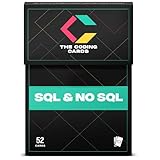
- Comprehensive Coverage: SQL Flashcards and NoSQL Flashcards designed for beginners and interview prep, covering core database concepts, queries, indexing, normalization, and real-world use cases. From relational structures, JOINs, and indexing to NoSQL document models, key-value stores, and distributed systems, these flashcards give you a solid foundation and advanced knowledge to handle any database challenge confidently.
- Interactive Learning: Enhance your understanding with an interactive, hands-on approach. Each card includes practical query examples, schema illustrations, and exercises that let you immediately apply what you learn. This active learning style helps you strengthen your querying skills and build intuition for solving real data problems. Beginner-friendly explanations that help you learn SQL and NoSQL faster without overwhelming theory or dense textbooks
- Portable Convenience: Study databases anytime, anywhere. Whether you’re at home, commuting, or taking a break, these portable flashcards make it easy to learn on the go. Perfect for busy students, developers, or professionals fitting learning into a tight schedule.
- Versatile Audience: Designed for all learners from students preparing for exams to data analysts, backend engineers, and tech enthusiasts. Whether you're building your first query or optimizing production databases, these flashcards guide you at every stage of your learning journey. Perfect for SQL interview preparation for software engineers, data analysts, backend developers, and computer science students
- Skill Enhancement: Boost your confidence and stay current with evolving database technologies. Ideal for self-study, bootcamps, university courses, and last-minute interview revision with concise, memorable flashcard format
Review SQL access during code review
- Search for SQL built with string concatenation, interpolation, or other dynamic assembly.
- Trace user-controlled values to query execution and confirm they are passed as bound parameters rather than inserted into SQL text.
- Check any variable table, column, or sort choice against a fixed allow-list.
- Inspect stored procedures and other database-side code for unsafe dynamic SQL.
- Verify that each database account has only the permissions its application functions need.
- Check that database errors do not disclose sensitive implementation details. OWASP’s Secure Code Review Cheat Sheet offers broader review guidance.
Product prices and availability are accurate as of the date/time indicated and are subject to change. Any price and availability information displayed on Amazon at the time of purchase will apply.

